
Yellow Plum Cherry Tomato Seeds
Regular price
3,90 €
Regular price
Sale price
3,90 €
Unit price
/
per
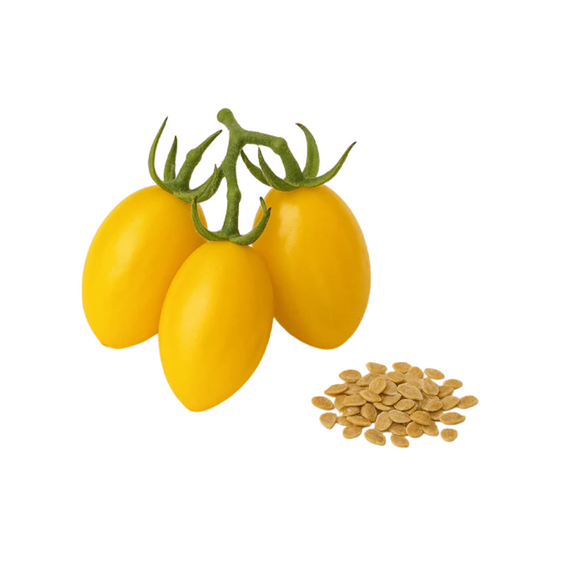
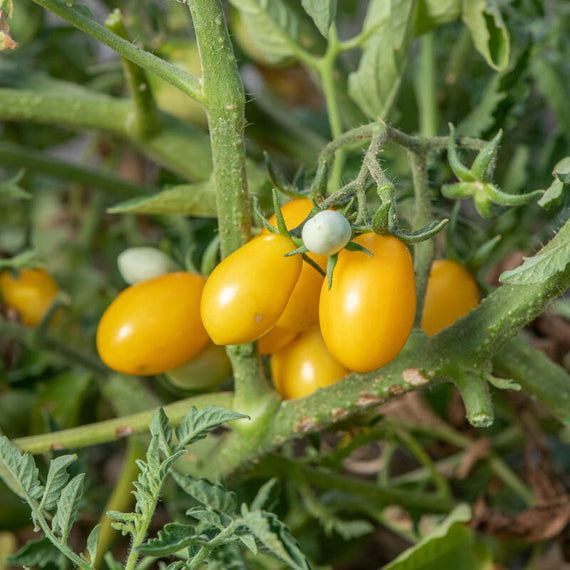
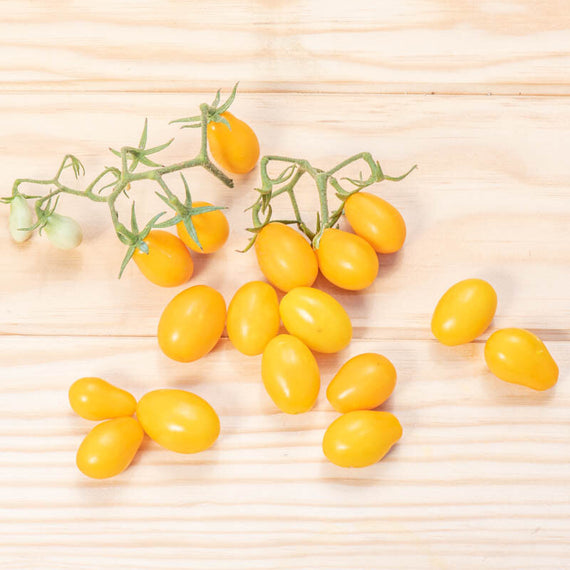
A very old cherry tomato, Prune Jaune bears, until the frosts, trusses of 7 to 10 fruits, lemon yellow and plum-shaped, weighing 20 to 30 g, with a sweet flavour and no acidity.
The packet contains 35 seeds, organic and open-pollinated. This mid-season variety is sown from February to April and planted at least 50 cm from its neighbour.
 Customer support 7 days a week by email
 Delivery within 2 to 15 business days
100 % secure payment
The summary
- What you receive: a packet of 35 organic, open-pollinated seeds of Prune Jaune cherry tomato.
- The fruit: plum-shaped, lemon yellow, 20 to 30 g, sweet and without acidity.
- Sowing: from February to April under cover, at 16 to 20 °C, 5 weeks before planting out.
- Harvest: in trusses of 7 to 10 fruits, from summer until the first frosts.
- In aquaponics: monitor potassium, calcium and iron, on a system that is 2 to 3 months old.
- How to choose: this one for the yellow cherry, the Corbarino for the red.
Lemon yellow heirloom cherry tomato, in clusters, 35 farmers' seeds
Prune Jaune cherry tomato seeds, from the Kokopelli Association, are a heritage variety, lemon yellow and plum-shaped, and the packet contains 35 organic, open-pollinated seeds. Until the first frosts it produces clusters of 7 to 10 fruits of 20 to 30 g, with a sweet, low-acid flavour. It is sown from February to April, under cover, at 16 to 20 °C.
Prune Jaune is a very old cherry tomato that bears, right up to the first frosts, an abundance of trusses of 7 to 10 lemon-yellow, plum-shaped fruits. Each fruit measures 2 to 4 cm and weighs 20 to 30 g; its fleshy, juicy flesh has a mild, sweet flavour with no acidity, and is eaten whole, without a knife.
📜 A variety from 1877
This tomato comes from the United States, where it appears as early as 1877 in the catalogue of the seedsman Gregory, in Massachusetts. It is a mid-season variety with indeterminate growth: the stem keeps lengthening until the first cold weather and forms new trusses for as long as the season allows, which means you need a stake or training string as soon as it is planted out. It can be grown in open ground or in a greenhouse, in full sun, in a well-drained, rich, warm soil, with moderate water needs.
🌱 From seedling pot to cluster
Sow seeds in small pots from February to April, at 16 to 20 °C under a bright shelter, and germination takes 6 to 10 days. About 5 weeks later, plant out the whole root ball after the last frosts, burying the stem up to the first leaves, since the buried part produces roots and anchors the plant better. Allow at least 50 cm between plants, because the plant fills out all summer, and lay a mulch to keep the soil evenly moist.
Sow
Sow in pots from February to April, at 16 to 20 °C, in a bright, sheltered spot.
Planting
Plant the root ball after the frosts, at least 50 cm apart, with the stake put in the same day.
Pick
Pick the fruits once they have turned lemon yellow, until the first frosts.
Measure the potassium before the clusters flower
In an aquaponic system, fish feed supplies little potassium, yet it is the element that determines the size and flavour of the fruits. The potassium drop test gives you the potassium content of the water in mg/L before you decide on an addition. You then know whether the summer trusses have what they need, rather than adding a fertiliser with nothing to go by.
Regular watering to prevent blossom end rot
A dry, brown patch at the tip of the fruit, opposite the stalk, is the sign of blossom end rot. It is a physiological disorder rather than a disease: it appears after erratic watering, water or heat stress, too much nitrogen or a pH that is too low. So water at regular intervals rather than heavily all at once, and keep the mulch in place all summer.
💧 The Yellow Plum in aquaponics
A cherry tomato grows well in an aquaponic system, provided the system has been running for 2 to 3 months and the pH of the water stays between 6.4 and 7.5. Your fish water is often short of three elements that a fruiting plant needs, potassium, calcium and iron, and a variety that carries so many trusses uses them up all summer. At flowering, the inputs shift from nitrogen towards potassium and phosphorus, as explained in the guide to growing tomatoes in aquaponics, and the guide to plant deficiencies in aquaponics helps you read the leaves.
Technical specifications
The sachet
- Capacity
- 35 seedsEnough to plant around ten specimens, including germination losses.
- Seed origin
- Kokopelli associationOrganic seeds, royalty-free.
- Seed type
- Open-pollinated, non-hybridReproducible: seed from your own harvest will give the same variety.
- Seed storage
- About 4 yearsStore in a dry, cool, dark place.
The variety
- Botanical name
- Solanum lycopersicum
- Variety origin
- United StatesListed in a seed catalogue as early as 1877.
- Fruit
- Cherry to plum size, 2 to 4 cmIn clusters of 7 to 10 fruits.
- Fruit weight
- 20 to 30 g
- Colour at maturity
- Lemon yellowMild, sweet flavour, with no acidity.
- Earliness
- Mid-seasonIndeterminate growth, cropping until the first frosts.
Seedling and harvest
- Seedlings under cover
- February to AprilIn a small pot, under a well-lit shelter.
- Germination temperature
- 16 to 20 °C
- Germination time
- 6 to 10 days
- Time in the nursery
- 5 weeks
- Installation
- After the last frostsWhole root ball, stem buried up to the first leaves, at least 50 cm between plants.
- Harvest period
- July to October
To budget for separately
- Stake or string
- Trellising put in place from the start
- Growing medium
- Clay pebbles or coir
10 further specifications are available in the detailed view.
In the box
- 1 packet of 35 Prune Jaune cherry tomato seeds, from organic farming
Pack size, fruit, origin, earliness and sowing: data sheet from the seed supplier Kokopelli (ref. P6620), taken on 11/10/2026. Germination time, harvest period and storage are guidelines for mainland France.
Manufacturer and product safety
- Manufacturer
- Association Kokopelli (SIREN 433481124, TVA FR80433481124)
- Postal address
- 7 route de Sabarat, Forêt de Castagnès, 09290 Le Mas-d'Azil, France
- Contact
- Formulaire de contact : https://kokopelli-semences.fr/fr/faq/ (aucune adresse e-mail publique) ; téléphone 05 61 67 69 87
- Website
- kokopelli-semences.fr
Information provided under Regulation (EU) 2023/988 on general product safety.
Compare the four varieties
Four farmhouse tomatoes, in the same packet format. What changes is the size of the fruit, its colour and what you will do with it in the kitchen.
Two red, two yellow, two sizes
The four tomatoes differ by fruit colour and size. Two answers are enough to identify yours.
| Red Tomato Seeds "Jupiter"Your choice | Yellow Belgium Tomato SeedsYour choice | Grappoli Corbarino Cherry Tomato SeedsYour choice | Recommended Yellow Plum Cherry Tomato SeedsYour choice | |
|---|---|---|---|---|
| The fruit | ||||
| Size | Medium to large, 80 to 230 g | Large, 150 to 300 g | Cherry type, in clusters of 7 to 10 | Cherry, 20 to 30 g |
| Colour at maturity | Red | Orange-yellow | Dark red | Lemon yellow |
| Shape | Round, slightly flattened | Round | As a plum | As a plum |
| Best use | Sauces and preserves | Slices and carpaccios | Drying and jarring | Nibbles and salads |
| The growing | ||||
| Earliness | Mid-season | Mid-season | Early | Mid-season |
| Growth | Indeterminate | Indeterminate | Indeterminate | Indeterminate |
| Variety origin | France | United States | Italy | United States |
| The sachet | ||||
| Seeds per packet | 35 | 35 | 35 | 35 |
| Open-pollinated seeds | Yes | Yes | Yes | Yes |
Red Tomato Seeds "Jupiter"
The fruit
SizeMedium to large, 80 to 230 g
Colour at maturityRed
ShapeRound, slightly flattened
Best useSauces and preserves
The growing
EarlinessMid-season
GrowthIndeterminate
Variety originFrance
The sachet
Seeds per packet35
Open-pollinated seedsYes
Yellow Belgium Tomato Seeds
The fruit
SizeLarge, 150 to 300 g
Colour at maturityOrange-yellow
ShapeRound
Best useSlices and carpaccios
The growing
EarlinessMid-season
GrowthIndeterminate
Variety originUnited States
The sachet
Seeds per packet35
Open-pollinated seedsYes
Grappoli Corbarino Cherry Tomato Seeds
The fruit
SizeCherry type, in clusters of 7 to 10
Colour at maturityDark red
ShapeAs a plum
Best useDrying and jarring
The growing
EarlinessEarly
GrowthIndeterminate
Variety originItaly
The sachet
Seeds per packet35
Open-pollinated seedsYes
Yellow Plum Cherry Tomato SeedsRecommended
The fruit
SizeCherry, 20 to 30 g
Colour at maturityLemon yellow
ShapeAs a plum
Best useNibbles and salads
The growing
EarlinessMid-season
GrowthIndeterminate
Variety originUnited States
The sachet
Seeds per packet35
Open-pollinated seedsYes
Size, colour, shape, earliness and seed count: data sheets from the seed company Kokopelli, recorded on 11/10/2026.
Help choosing
Which colour and size for your vegetable garden?
Estimate your
delivery time
Your estimate
Delivery
Estimated time
It covers preparing your order and then the transit time quoted by the carrier, counted in working days.
It is not a guaranteed delivery date: public holidays, peak periods, customs or a carrier delay can extend it. The exact amount, in your currency, is worked out in the cart once your address is entered.
A packet of seeds ships as a small parcel. It can be grouped at no extra cost with the rest of your order, and the exact amount is calculated at checkout.
Frequently asked questions
6 questions
6 key questions
Growing calendar
Reference points for mainland France, to be shifted by approximately two weeks depending on your region.
| Stage | ||||||||||||
|---|---|---|---|---|---|---|---|---|---|---|---|---|
| Seedlings under cover3 months | Seedlings under cover: no | Seedlings under cover in February | Seedlings under cover in March | Seedlings under cover in April | Seedlings under cover: no | Seedlings under cover: no | Seedlings under cover: no | Seedlings under cover: no | Seedlings under cover: no | Seedlings under cover: no | Seedlings under cover: no | Seedlings under cover: no |
| Transplanting2 months | Transplanting: no | Transplanting: no | Transplanting: no | Transplanting: no | Transplanting in May | Transplanting in June | Transplanting: no | Transplanting: no | Transplanting: no | Transplanting: no | Transplanting: no | Transplanting: no |
| Pinching out side shoots3 months | Pinching out side shoots: no | Pinching out side shoots: no | Pinching out side shoots: no | Pinching out side shoots: no | Pinching out side shoots: no | Pinching out side shoots in June | Pinching out side shoots in July | Pinching out side shoots in August | Pinching out side shoots: no | Pinching out side shoots: no | Pinching out side shoots: no | Pinching out side shoots: no |
| Harvest4 months | Harvest: no | Harvest: no | Harvest: no | Harvest: no | Harvest: no | Harvest: no | Harvest in July | Harvest in August | Harvest in September | Harvest in October | Harvest: no | Harvest: no |
KeySeedlings under coverTransplantingPinching out side shootsHarvest
This month
October
Growing guidance
- Seedling depth
- 0.5 to 1 cmCover lightly, then firm down
- Germination temperature
- 16 to 20 °C
- Germination time
- 6 to 10 days
- Nursery time
- 5 weeks
- Spacing
- At least 50 cmBetween two plants, along the row
- Fruit weight
- 20 to 30 gIn clusters of 7 to 10
- Fruit shape
- Plum-shaped, lemon yellow
- Earliness
- Mid-seasonCrops until the first frosts
- pH in aquaponics
- 6.4 to 7A compromise between fish, bacteria and plants
- Seed storage
- About 4 yearsDry and away from light
What you need to know
- Bury the stem up to the first leaves when planting out. The buried part produces roots and anchors the plant for the whole season.
- Mulch the soil as soon as you plant. Even moisture limits swings in watering, which are among the causes of blossom end rot.
- In a greenhouse, ventilate from late morning. Above 70% humidity, the pollen sticks and fruit set fails.
- Pinch out the side shoots every week and train the plant on two stems. A highly productive variety left to its own devices turns into a bush in which the fruits ripen in the shade.
- In aquaponics, wait until the system has been running for 2 to 3 months before installing a tomato, even a small-fruited one, and monitor potassium from flowering onwards.
- Pick preferably in the morning and come back often. Regular harvesting limits split fruits after rain.
You may also like



Related articles

Crops
Growing tomatoes in aquaponics
System maturity, pH, potassium and pollination: what a tomato fed by fish water needs.
Read the article

Understanding
Plant deficiencies in aquaponics
Recognising an iron, potassium or calcium deficiency on the leaves, and correcting it without harming the fish.
Read the article

Guide
Getting started with an aquaponic system
The six weeks between a tank filled with water and a system capable of feeding a plant.
Read the article

Guide
Successful spring seedlings in aquaponics
When to start seedlings, at what temperature, and how to move from cell to grow bed without losing plants.
Read the article

Understanding
The nitrogen cycle in aquaponics
Why a hungry plant yields nothing on a new system, and how to tell when the cycle is properly established.
Read the article

Maintenance
Maintaining your aquaponic system in summer
Heat, evaporation, dropping oxygen: the seasonal adjustments that save a crop in July.
Read the article

Schedule
What to grow in hydroponics, season by season
What to sow in January, April and September to keep a grow bed in constant production.
Read the article

Selection
The 15 plants to grow in aquaponics
A ranking of crops by nitrogen appetite, and which ones thrive on a young system.
Read the article
Let us talk about your project
A question about this product or your setup? Our team will answer and advise you.

Interest-free instalment payments
Offered depending on the cart amount, at checkout.

Delivery in 2 to 15 working days
Depending on the products and shipping sites. Estimate by destination in the estimator on this page.

After-sales service 7 days a week by email or chat
Our team answers all your questions.

Shop responsibly
Become part of the change.
