

Crimean Black Tomato Seeds
Regular price
3,90 €
Regular price
Sale price
3,90 €
Unit price
/
per
Note du produit : 4.4
(20 avis)
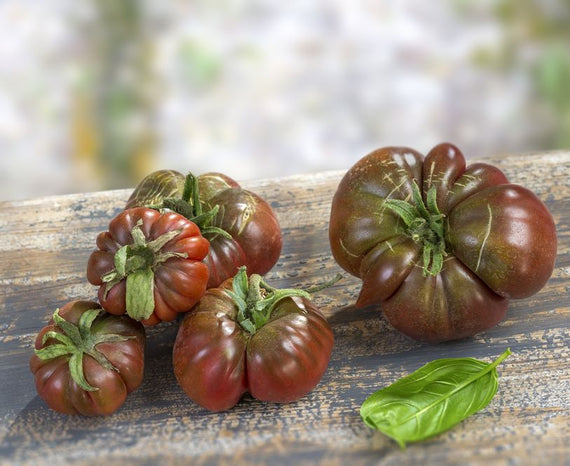
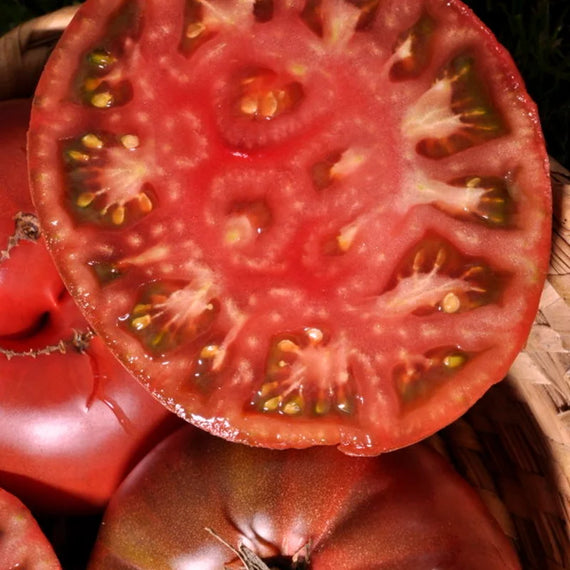
A purple heirloom tomato with green shoulders, the Noire de Crimée produces fruits weighing 150 to 500 g, with dense, almost acid-free flesh that is best eaten raw in thick slices.
Packet of 35 organic, open-pollinated seeds, Kokopelli heritage seeds. Sow from February to April, harvest from mid-July to October.

7/7 customer service by e-mail

Payment in instalments, free of charge
The summary
- What you receive: 35 organic, open-pollinated seeds of Noire de Crimée, a heritage variety distributed by Kokopelli.
- Sowing: February to April under cover, at a depth of 5 to 7 mm, between 16 and 25 °C. Germination in 8 to 15 days.
- Harvest: approximately 70 to 80 days after transplanting, from mid-July to October depending on sowing date.
- The fruit: round and ribbed, 150 to 500 g, green shoulders, dense flesh, mild and low in acidity.
- How to choose: this one for eating raw, Jupiter for cooking, Corbarino for nibbles.
- How much effort: sturdy staking, a weekly session for tying in, and really consistent watering.
Purple heritage tomato, 35 open-pollinated seeds, greenhouse or aquaponics
Noire de Crimée is a heritage tomato that originated on the shores of the Black Sea, on the Crimean peninsula, and is widely known in the English-speaking world as Black Krim. Its skin turns deep purplish-brown as it ripens, the shoulders stay green, and the dense flesh delivers a flavour that is almost free of acidity, with a slight sweetness and a hint of smokiness. It is a tomato for eating fresh, cut into thick slices.
The seeds in this packet are open-pollinated heritage seeds distributed by the Kokopelli association, which has been sharing traditional, royalty-free varieties since 1999. In practice, the plant you grow will produce seeds identical to those you sowed: you can harvest, dry and resow them year after year, just like the rest of our seeds and sprouting seeds.
Three tomato varieties are grown and eaten in different ways. The Black Krim is grown for eating raw, the Jupiter red tomato is ideal for cooking and preserving, and the Grappoli Corbarino cherry tomato produces large clusters of small fruits. The comparison of the three varieties sets them side by side, covering fruit weight, earliness and intended use.
Sowing, transplanting, growing
Tomatoes are always started in the warmth before being moved to their final position. Allow for two clearly separate stages: a nursery period of seven to eight weeks, then transplanting once all risk of frost has passed. Black Krim is an indeterminate variety: the main stem never stops growing and produces fruit right up to the first cold spells. It therefore needs a sturdy support and regular pruning; left unchecked, it will sprawl, exhaust itself, and produce small fruit. If you are starting in February, read first about setting up an indoor seedling corner: at that time of year, it is light that is lacking before heat.
In the nursery
Sow at 5 mm depth, in a module or seed tray, in a warm spot between 20 and 25 °C. Germination takes 8 to 15 days.
At transplanting
One plant every 60 cm, buried up to the first leaves so that the stem puts out additional roots.
In season
One visit per week to tie in the stem, remove side shoots and check that the soil or grow medium stays moist.
In aquaponics and soilless growing
The tomato is a hungry fruiting plant: it consumes far more nitrogen, potassium and calcium than a lettuce, and will only reach its potential in an already-cycled system where the fish population produces enough nutrients. In a bed that has just been set up, plants will struggle, and the variety is not to blame, but rather the nitrogen cycle, which is not yet established. Young foliage yellowing between the veins most often indicates an iron deficiency, which is common above pH 7. Aim for a pH between 6.5 and 7.5 and water that does not drop below 15 °C for any prolonged period.
Plan ahead before ordering
An adult Noire de Crimée grows to 1.80 m and needs 60 cm of floor space. Check three things before sowing: the available height in your greenhouse or shelter, a fixing point for a stake or training string, and a warm spot at 20 °C in February for germination. As for growing media, a bed of clay pebbles or coco fibre works well; deep water culture does not, it cannot support the weight of the plant or the root volume.
Harvest runs from mid-July through to October. A fruit is ready when the skin has darkened and the flesh gives slightly under the thumb, there is no need to wait for an even colour: the green shoulders are characteristic of the variety and do not mean the tomato is unripe. On a well-trained plant, whether grown in open ground or in a greenhouse, yields of 3 to 6 kg per plant over the whole season are commonplace.
Saving your own seeds
To save your seeds, scoop the pulp from a fully ripe, healthy fruit and leave it to ferment for two to three days in a small amount of water, then rinse and dry the seeds flat in the shade. Stored dry, cool, and away from light in an airtight container or paper envelope, they will remain viable for 4 to 6 years. Write the year on the packet: it is the only way to know, three winters later, whether you need to sow more densely.
Common mistakes to avoid
Irregular watering is the main pitfall with this variety: several strains of Black Krim are prone to stem-end cracking, and a heavy watering after a dry spell will literally split the skin. Water little but often, at the base and never over the foliage. The second mistake is sowing too early without sufficient light: a seedling started in January on a windowsill will etiolate, become spindly, and never recover, as our guide on germination failures explains in detail. The third mistake is putting plants outside before the last frosts, around mid-May in mainland France.
Technical specifications
The variety
- Botanical name
- Solanum lycopersicumKnown as Black Krim in the English-speaking world
- Variety type
- Heritage, traditional, non-hybridReproducible and royalty-free
- Postage
- UndeterminedThe stem keeps growing until the first frosts
- Adult height
- 1.20 to 1.80 mA cane or training twine is essential
- Fruit weight
- 150 to 500 gRound, ribbed fruit — one or two slices is enough
- Colour at maturity
- Purple-brown, green shouldersGreen shoulders are not a sign of under-ripeness
- Observed yield
- 3 to 6 kg per plantApproximate figure over the season, well-managed plant, not guaranteed
- Cycle
- 69 to 80 daysFrom transplanting to first harvest. Growing guide, unpublished by Kokopelli
The sachet
- Number of seeds
- 35Number stated by Kokopelli for reference P7311 — enough to plant around ten specimens.
- Seed origin
- Association KokopelliOrganic, royalty-free seeds
- Treatment
- NoneNo GMOs, no coating, no chemical treatment
- Storage
- 4 to 6 yearsCommon benchmark for tomatoes, stored in a cool, dry place away from light. Kokopelli does not publish a shelf life.
Seedling and cultivation
- Seedling period
- February to April, under coverA February seedling brings the harvest forward by a month
- Seedling depth
- 5 to 7 mmCover lightly then firm down
- Germination temperature
- 16 to 25 °CKokopelli states 16 to 20 °C; between 20 and 25 °C germination is faster and more even.
- Germination time
- 8 to 15 days
- Transplanting
- From mid-MayOnce the last frosts have passed
- Spacing
- 50 to 60 cmKokopelli states 50 cm; allow 60 cm if you want to walk between the plants
- Aspect
- Full sunA minimum of six hours of direct sunlight per day in season
- Harvest period
- From mid-July to OctoberKokopelli indicates a harvest period from June to October, across all regions
In aquaponics and soilless growing
- Water pH
- 6.5 to 7.5Balancing fish, bacteria, and plants
- Minimum temperature
- 15 °CBelow this, growth and fruit set stall
- Growing medium
- Grow medium bed or large potThe deep water culture raft holds neither the weight nor the roots
- System maturity
- Minimum 6 weeksWhile the nitrogen cycle establishes itself
- Nutritional needs
- Nitrogen, potassium, calciumMarkedly higher than those of a lettuce
- Pollination
- Manual under closed coverVibrate the flower stem once a day during flowering
18 further specifications are available in the detailed view.
In the box
- 1 resealable paper packet of 35 Black Crimea tomato seeds, harvested from organic farming
- 1 variety label: botanical name, seedling period and seed harvest year
Kokopelli states 35 seeds for the Noire de Crimée, reference P7311, and publishes a seedling temperature of 16 to 20 °C, sowing depth of 5 to 7 mm and 50 cm between plants. The broader ranges given here are our own growing guidelines. Weight, height, yield, cycle length and shelf life are indicative figures only, not guaranteed, and are based on conditions in metropolitan France.
Compare the three varieties
Our three most popular Kokopelli tomatoes, in the same packet format and the same price range. What differs is the fruit, the maturity time, and the culinary use.
Can't decide between these three varieties?
Answer three quick questions and we'll highlight the variety best suited to your situation in the table.
| Maximum fruit weight (g) | Colour at maturity | Best use | Earliness | Spacing between plants (cm) | Variety origin | Seeds per packet (seeds) | Open-pollinated seeds | |
|---|---|---|---|---|---|---|---|---|
| Recommended Noire de CriméeYour choice | 500 g | Purple-brown, green shoulders | Raw, in slices | Mid-season to late | 60 cm | Crimée | 35 seeds | yes |
| Rouge JupiterYour choice | 200 g | Bright red | Cooking, sauces and preserves | Mid-season | 60 cm | France | 40 seeds | yes |
| Cerise Grappoli CorbarinoYour choice | 25 g | Red, in clusters | Aperitif, salads and drying | Semi-early | 50 cm | Italie | 40 seeds | yes |
Noire de CriméeRecommended
The fruit
Maximum fruit weight (g)500 g
Colour at maturityPurple-brown, green shoulders
Best useRaw, in slices
Cultivation
EarlinessMid-season to late
Spacing between plants (cm)60 cm
Variety originCrimée
The sachet
Seeds per packet (seeds)35 seeds
Open-pollinated seedsyes
Rouge Jupiter
The fruit
Maximum fruit weight (g)200 g
Colour at maturityBright red
Best useCooking, sauces and preserves
Cultivation
EarlinessMid-season
Spacing between plants (cm)60 cm
Variety originFrance
The sachet
Seeds per packet (seeds)40 seeds
Open-pollinated seedsyes
Cerise Grappoli Corbarino
The fruit
Maximum fruit weight (g)25 g
Colour at maturityRed, in clusters
Best useAperitif, salads and drying
Cultivation
EarlinessSemi-early
Spacing between plants (cm)50 cm
Variety originItalie
The sachet
Seeds per packet (seeds)40 seeds
Open-pollinated seedsyes
The seed count is the number stated by the supplier for each packet and may vary from one batch to another. All three varieties have their own page in the shop, with their growing calendar. Weights and maturity times are typical values recorded in cultivation, not guaranteed figures.
Help choosing
Which tomato for your season?
Product videos
The Black Crimea tomato, a variety overview
Everything you need to know about the Black Crimea tomato
Successfully sowing tomatoes, then transplanting
Potting on tomato seedlings: when and how
Estimate your
delivery time
Your estimate
Delivery
Estimated time
It covers preparing your order and then the transit time quoted by the carrier, counted in working days.
It is not a guaranteed delivery date: public holidays, peak periods, customs or a carrier delay can extend it. The exact amount, in your currency, is worked out in the cart once your address is entered.
A packet of seeds ships as a small parcel, so it can be combined with the rest of your order at no extra cost. The exact amount is calculated at checkout.
Frequently asked questions
15 questions
6 key questions, 15 in the detailed view
No questions in this category.
Growing calendar
Guidelines for mainland France, to be shifted by approximately two weeks depending on your region. Kokopelli recommends seedling at 16 to 20 °C, 5 to 7 mm deep, with 50 cm between plants.
| Stage | ||||||||||||
|---|---|---|---|---|---|---|---|---|---|---|---|---|
| Seedling under cover3 months | Seedling under cover: no | Seedling under cover in February | Seedling under cover in March | Seedling under cover in April | Seedling under cover: no | Seedling under cover: no | Seedling under cover: no | Seedling under cover: no | Seedling under cover: no | Seedling under cover: no | Seedling under cover: no | Seedling under cover: no |
| Transplanting2 months | Transplanting: no | Transplanting: no | Transplanting: no | Transplanting: no | Transplanting in May | Transplanting in June | Transplanting: no | Transplanting: no | Transplanting: no | Transplanting: no | Transplanting: no | Transplanting: no |
| Training and pruning4 months | Training and pruning: no | Training and pruning: no | Training and pruning: no | Training and pruning: no | Training and pruning: no | Training and pruning in June | Training and pruning in July | Training and pruning in August | Training and pruning in September | Training and pruning: no | Training and pruning: no | Training and pruning: no |
| Harvest4 months | Harvest: no | Harvest: no | Harvest: no | Harvest: no | Harvest: no | Harvest: no | Harvest in July | Harvest in August | Harvest in September | Harvest in October | Harvest: no | Harvest: no |
KeySeedling under coverTransplantingTraining and pruningHarvest
This month
September
Growing guidance
- Seedling depth
- 5 to 7 mmCover lightly then firm down, without burying any deeper
- Germination temperature
- 16 à 25 °CKokopelli states 16 to 20 °C; 20 to 25 °C gives the fastest germination
- Germination time
- 8 to 15 days
- From transplanting to harvest
- 69 à 80 joursMid-season to late variety. Growing guide, not published by Kokopelli
- Spacing
- 50 à 60 cmBetween plants, whether in rows or in troughs
- Adult height
- 1,20 à 1,80 mIndeterminate habit: the stem won't stop on its own
- Fruit weight
- 150 à 500 g
- Yield per plant
- 3 to 6 kgApproximate figure over the entire season, well-managed plant
- Aspect
- Full sunA minimum of six hours of direct sunlight per day in season
- Growing temperature
- Above 15 °CBelow this, growth and fruit set come to a halt
- pH in aquaponics
- 6,5 à 7,5The usual balance between fish, bacteria and plants
- Seed storage
- 4 à 6 ansCommon guideline for tomatoes: store dry, cool, and away from light
What you need to know
- Fruit splitting is the most common problem with this variety, and it is almost always caused by irregular watering. A heavy watering after several dry days causes the flesh to swell faster than the skin can stretch, and the fruit cracks. Water little, but often.
- Bury the plant up to its first leaves at transplanting. The buried stem produces new roots along its entire length, giving a noticeably more anchored plant that is far more drought-resistant for the rest of the season.
- Place the stake on the day of transplanting, not three weeks later. Pushed in late, it cuts through the root system already in place and causes a visible check in growth.
- In a greenhouse or indoors, flowers won't set fruit on their own: there's no wind or bumblebee to release the pollen. A daily vibration of the flower stem with your fingertip is enough to turn the blossom into fruit.
- In aquaponics, do not add tomatoes to a system that is less than six weeks old. A fruiting plant consumes far more than a lettuce, and until the nitrogen cycle is established, it will yellow and stall regardless of the variety.
- The green shoulders are not a sign of under-ripeness — they are the variety's trademark. Waiting for them to turn red means harvesting fruit that is overripe and will deteriorate within two days.
- Pinch out the main stem at the end of August, just above the last set fruit truss. The plant then stops investing in new shoots that won't have time to crop, and concentrates everything on the fruit already in place.
- A layer of mulch around the base solves two problems at once: it evens out soil moisture — thereby reducing splitting — and it stops soil splashing onto the lower foliage, which is the main entry point for fungal disease.
Vous aimerez aussi


Related articles

Guide
Successfully sowing seeds in spring aquaponics
When to start seedlings, at what temperature, and how to move from propagator to grow bed without losing plants.
Read the article

Troubleshooting
Germination failure: causes and solutions
Seeds that won't germinate, uneven germination, seedlings that etiolate: the six real causes and how to correct them.
Read the article

Equipment
Creating your indoor seed-starting setup
Heat mat, lighting, humidity: setting up a reliable seedling corner at home to start tomatoes in February.
Read the article

Understanding
The nitrogen cycle in aquaponics
Why a fruiting plant produces nothing in a new system, and how to tell when the cycle is finally established.
Read the article

Selection
15 plants to grow in aquaponics
Where tomatoes sit among nutrient-hungry crops, and which plants to combine them with in the same system.
Read the article

Calendar
A practical calendar for success in aquaponics
Month by month, the tasks to carry out on the system and the crops, from the spring restart through to winterising.
Read the article

Equipment
Which substrate should you choose for aquaponics ?
Clay pebbles, coco coir, vermiculite: what supports a 1.80 m tomato plant and what doesn't.
Read the article
Let us talk about your project
Une question sur ce produit ou votre installation ? Notre équipe vous répond et vous conseille.

Paiement plusieurs fois sans frais
Proposé selon le montant du panier, au moment du paiement.

Livraison sous 5 à 15 jours ouvrés
Selon les produits et sites d'expédition. Estimation par destination dans l'estimateur de cette page.

SAV 7/7 par mail ou chat
Notre équipe répond à toutes vos questions.

Faire un achat engagé
Devenez acteurs du changement.
