

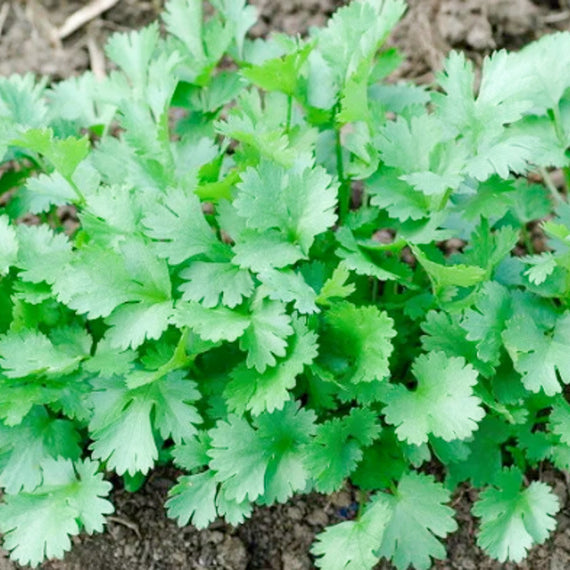
Cultivated coriander seeds
Regular price
3,90 €
Regular price
Sale price
3,90 €
Unit price
/
per
A dual-harvest annual herb, cultivated coriander first gives highly fragrant leaves, then seeds with lemony notes once flowering is over.
The packet contains 200 seeds, organic and open-pollinated. Sow under cover in March and April, then plant out from April to September, and the leaves can be cut from June to October.
 Customer support 7 days a week by email
 Delivery within 2 to 15 business days
100 % secure payment
The summary
- What you receive: 200 organic, open-pollinated coriander seeds.
- Sowing: under cover in March and April, in place from April to September, at a depth of 1 cm.
- Germination: 10 to 20 days at 15 to 20 °C, quicker after soaking for 24 hours.
- Two harvests: the leaves from June to October, then the seeds at the end of flowering.
- Space needed: rows 15 cm apart, one plant every 15 cm after thinning.
- The rhythm: a fresh sowing every 3 to 4 weeks, because the plant bolts quickly.
Annual herb with a double harvest, 200 farmers' seeds, leaves then seeds
The cultivated coriander seeds from the Kokopelli association are an annual herb with a double harvest, which first gives fragrant leaves from June to October, then seeds with lemony notes. The packet contains 200 organic, open-pollinated seeds. As the plant bolts quickly, a new sowing every 3 to 4 weeks extends the picking season.
Cultivated coriander is an annual herb of the apiaceae family, which gives two different harvests from the same plant. Its green, rounded, serrated leaves flavour Asian and Mexican dishes and tagines; its seeds, once dry, take on a citrusy note and are used as a spice in breads, curries and marinades. Its small white or pale pink flowers are edible too, in a salad or on a hot dish.
🌿 A quick-flowering plant
As soon as the days lengthen and the warmth sets in, coriander forms a flower stalk, and leaf production almost immediately stops: this is bolting. Each sowing therefore gives only a harvest window of a few weeks. To have leaves from June to October, sow a small batch every 3 to 4 weeks rather than a single row in spring, and cut the leaves young, as you need them. In midsummer, a spot in partial shade delays flowering, whereas in full sun the flower stalk appears much sooner.
Dose each batch with a hand seeder
Because the batches follow one another every 3 to 4 weeks, each one needs only a pinch of seed, and the packet of 200 seeds then covers a whole season. A hand seeder lets you drop the seeds one by one into the drill, instead of tipping the packet out all at once. You sow thinly from the outset, and thinning to 15 cm comes down to removing a few seedlings.
🪴 In a pot or in place
Two ways of sowing work well. Under bright cover, in March and April, sow in pots filled with a light seedling compost, then transplant at 15 cm spacing in every direction when the plants have 4 to 5 leaves. Sown in place, from April to September, sow thinly, in rows 15 cm apart and 1 cm deep, then thin to 15 cm at the same stage. Germination takes 10 to 20 days at 15 to 20 °C, and soaking for 24 hours in lukewarm water shortens it. Each round "seed" is actually a fruit containing two seeds, which explains why two seedlings sometimes emerge from the same spot.
Transplant young, with the whole root ball
Coriander forms a taproot, long and sparsely branched, which does not tolerate being broken. So transplant the seedlings from their pots at the 4 to 5 leaf stage, without waiting any longer, and transplant the whole root ball without breaking it up. A plant transplanted late or bare-rooted often reacts by flowering straight away, which ends the leaf harvest before it has even begun.
In aquaponics, coriander is one of the easy herbs, since its nutrient needs are modest, its growth is fast and it has no structure to support. Its taproot nevertheless prefers a grow bed filled with clay pebbles to a shallow raft basket. As it bolts quickly, set aside a spot that you will resow several times during the season, next to the longer-term crops presented in the 15 plants to grow in aquaponics.
🌼 From flower to spice
A plant that has finished producing leaves simply moves on to its second harvest. Let it flower in umbels, then wait until the small green balls turn pale beige, which takes several weeks after flowering. Then cut the whole stem over a cloth or a paper bag, because the dry seeds fall at the slightest knock, and finish drying them flat, away from damp. Kept in an airtight jar, they serve as a spice for several years, and you can resow part of the harvest the following year, since the variety breeds true.
Technical specifications
The sachet
- Number of seeds
- 200Enough to sow one batch a month throughout the season.
- Seed origin
- Kokopelli associationOrganic seeds, royalty-free.
- Seed type
- Open-pollinated, non-hybridReproducible: seed from your own harvest will give the same variety.
- Seed storage
- Around 6 yearsStore in a dry, cool, dark place.
The plant
- Botanical name
- Coriandrum sativumApiaceae family, like parsley and carrot.
- Cycle
- AnnualIt flowers and sets seed in the same year.
- Adult height
- 30 to 70 cmLow foliage, taller once in flower.
- Aspect
- Sun, partial shade in summerPartial shade delays bolting.
Seedling and harvest
- Seedlings under cover
- March to April, in a potTransplanting at 4 to 5 leaves, with the whole root ball.
- Direct seedling
- April to SeptemberA small batch every 3 to 4 weeks.
- Seedling depth
- 1 cmCover then firm down lightly.
- Germination time
- 10 to 20 daysBetween 15 and 20 °C, shorter after a 24 h soak.
- Spacing
- 15 cm in every directionRows 15 cm apart, thinned to the same spacing.
- Harvesting the leaves
- June to OctoberLeaves cut young, as you need them.
To budget for separately
- Seed drill
- 1 hand seeder for sowing thinly
- Seedling medium
- Light potting compost for small pots
8 further specifications are available in the detailed view.
In the box
- 1 paper packet of 200 cultivated coriander seeds, harvested from organic farming
- 1 variety label: botanical name, sowing period, and year of seed harvest
Contents, sowing calendar and spacings checked on 11/10/2026 on the seed supplier's sheet. Depths, temperatures and germination times checked on 20/09/2026 on two growing calendars. Heights and storage periods are approximate figures for mainland France.
Manufacturer and product safety
- Manufacturer
- Association Kokopelli (SIREN 433481124, TVA FR80433481124)
- Postal address
- 7 route de Sabarat, Forêt de Castagnès, 09290 Le Mas-d'Azil, France
- Contact
- Formulaire de contact : https://kokopelli-semences.fr/fr/faq/ (aucune adresse e-mail publique) ; téléphone 05 61 67 69 87
- Website
- kokopelli-semences.fr
Information provided under Regulation (EU) 2023/988 on general product safety.
Estimate your
delivery time
Your estimate
Delivery
Estimated time
It covers preparing your order and then the transit time quoted by the carrier, counted in working days.
It is not a guaranteed delivery date: public holidays, peak periods, customs or a carrier delay can extend it. The exact amount, in your currency, is worked out in the cart once your address is entered.
A packet of seeds ships as a small parcel. It can be grouped at no extra cost with the rest of your order, and the exact amount is calculated at checkout.
Frequently asked questions
6 questions
6 key questions
Growing calendar
Guidelines for mainland France, to be shifted by about 2 weeks depending on your region.
| Stage | ||||||||||||
|---|---|---|---|---|---|---|---|---|---|---|---|---|
| Seedlings under cover2 months | Seedlings under cover: no | Seedlings under cover: no | Seedlings under cover in March | Seedlings under cover in April | Seedlings under cover: no | Seedlings under cover: no | Seedlings under cover: no | Seedlings under cover: no | Seedlings under cover: no | Seedlings under cover: no | Seedlings under cover: no | Seedlings under cover: no |
| Direct seedling6 months | Direct seedling: no | Direct seedling: no | Direct seedling: no | Direct seedling in April | Direct seedling in May | Direct seedling in June | Direct seedling in July | Direct seedling in August | Direct seedling in September | Direct seedling: no | Direct seedling: no | Direct seedling: no |
| Harvesting the leaves5 months | Harvesting the leaves: no | Harvesting the leaves: no | Harvesting the leaves: no | Harvesting the leaves: no | Harvesting the leaves: no | Harvesting the leaves in June | Harvesting the leaves in July | Harvesting the leaves in August | Harvesting the leaves in September | Harvesting the leaves in October | Harvesting the leaves: no | Harvesting the leaves: no |
| Seed harvesting3 months | Seed harvesting: no | Seed harvesting: no | Seed harvesting: no | Seed harvesting: no | Seed harvesting: no | Seed harvesting: no | Seed harvesting: no | Seed harvesting in August | Seed harvesting in September | Seed harvesting in October | Seed harvesting: no | Seed harvesting: no |
KeySeedlings under coverDirect seedlingHarvesting the leavesSeed harvesting
This month
October
Growing guidance
- Seedling depth
- 1 cmCover then press down gently
- Germination temperature
- 15 à 20 °C
- Germination time
- 10 to 20 daysSoaking for 24 h before sowing speeds it up
- Harvesting the leaves
- June to OctoberLeaves cut while young
- Sowing schedule
- Every 3 to 4 weeksEach series is harvested within a short window
- Spacing
- 15 cm in every directionRows spaced 15 cm apart
- Adult height
- 30 to 70 cmTaller once in flower
- Transplanting
- Young, with the whole root ballAt the 4 to 5 leaf stage
- pH in aquaponics
- 6.5 to 7.5The usual balance between fish, bacteria and plants
- Seed storage
- Around 6 yearsDry and away from light
What you need to know
- Sow in succession rather than all at once. A pinch every 3 to 4 weeks gives leaves from June to October, because the window for each batch is short.
- Soak the seeds for 24 hours in lukewarm water before sowing. The seed coat softens and germination, which otherwise takes 10 to 20 days, is brought forward by several days.
- Transplant the plants from their pots while young, at 4 to 5 leaves, without breaking up the root ball. Its taproot does not tolerate being broken, and a plant transplanted late flowers almost immediately.
- Sow in partial shade in midsummer. The leaf-harvesting window lasts longer there than in full sun, where bolting comes very quickly.
- A plant in flower begins its second harvest. The dry seeds keep for several years as a spice, and some will self-sow the following year.
- Cut the umbels over a cloth or a paper bag. A dry seed falls at the slightest knock, and a harvest made without care loses a good part of it on the ground.
You may also like


Related articles

Schedule
A practical schedule for success with aquaponics
Month by month, the tasks to carry out on the system and on the crops, from the spring restart to overwintering.
Read the article

Selection
The 15 plants to grow in aquaponics
A ranking of crops by nitrogen appetite, and which ones thrive on a young system.
Read the article

Guide
Getting started with indoor hydroponics
Growing indoors, without a garden: light, space, watering, and what it really demands each week.
Read the article

Schedule
What to grow in hydroponics, season by season
What to sow in January, April and September to keep a grow bed in constant production.
Read the article

Guide
Successful spring seedlings in aquaponics
When to start seedlings, at what temperature, and how to move from cell to grow bed without losing plants.
Read the article

Cooking
Summer recipes from the kitchen garden
What to do with a harvest that all arrives at once, without throwing anything away and without freezing half of it.
Read the article
Let us talk about your project
A question about this product or your setup? Our team will answer and advise you.

Interest-free instalment payments
Offered depending on the cart amount, at checkout.

Delivery in 2 to 15 working days
Depending on the products and shipping sites. Estimate by destination in the estimator on this page.

After-sales service 7 days a week by email or chat
Our team answers all your questions.

Shop responsibly
Become part of the change.
