

Organic lettuce and chard seed collection
Regular price
21,90 €
Regular price
Sale price
21,90 €
Unit price
/
per
7,30 € × 3 with no fees
Klarna.
Spring lettuces, summer batavias, lamb's lettuce and spinach for winter: these collections of 6 to 20 organic varieties of salad leaves or chard, one per packet, are sown in successive batches from February through to September.
 Customer support 7 days a week by email
 Delivery within 2 to 15 business days
100 % secure payment
The summary
- What you receive: a gift box of organic salad and leafy vegetable seed packets, one variety per packet.
- The varieties: romaine, oak leaf, batavia, rocket and lamb's lettuce on the salad side; chards Rhubarb and Bright Yellow on the chard side.
- When to sow: February to September, in succession.
- Sowing depth and germination: no more than 0.5 cm, then 3 to 7 days between 10 and 20 °C.
- What comes next: sowing in a seedling tray then transplanting, or direct sowing followed by thinning.
- Salad or chard: lettuce is cut all at once; chard is harvested leaf by leaf over 4 to 6 months.
Boxes of seasonal salad leaves and colourful chard, seedlings staggered from February to September
Lettuces and chard are among the fastest-growing crops in the kitchen garden and among the most suited to successional sowing. The box of 10 lettuces includes romaine, oak leaf, iceberg, batavia, cut-and-come-again lettuce, rocket, lamb's lettuce, and spinach; the chard selection brings together Rhubarb with its vivid red stems, bright golden Bright Yellow, a multicoloured mix, and a chard-spinach variety, all belonging to the species Beta vulgaris.
🥬 One lettuce per season
Each type of lettuce has its own sowing season. Spring lettuces, tender and fast-growing, bolt at the first sign of heat. Summer batavias and oak-leaf varieties handle drought better and delay bolting by several weeks. Lamb's lettuce and spinach, meanwhile, tolerate cold and take over from autumn through to spring, in open ground or under fleece. No single variety covers the whole year, whereas a mixed selection lets you choose whichever suits the month you are sowing.
🌈 Chard can be harvested continuously
Chard is managed quite differently from lettuce. A single plant can be harvested leaf by leaf for 4 to 6 months, by removing the outer stems and leaving the heart to keep producing: you therefore never cut the whole plant at once. Coloured-stem varieties, such as red Rhubarb or yellow Bright Yellow, are grown in exactly the same way as the white types and require no special care; the colour is in the stem and fades during cooking. This species is also far more tolerant of summer heat than lettuce, making it the go-to leafy vegetable for the height of summer.
Above 25 °C, lettuce germinates poorly
Heat is the main obstacle for seedlings sown in July and August, regardless of seed quality. Above 25 °C, many lettuce varieties enter dormancy and fail to germinate, a phenomenon known as thermo-inhibition. Sow in shade during the height of summer, water with cool water, or place the seed tray in the refrigerator for 2 days before bringing it out.
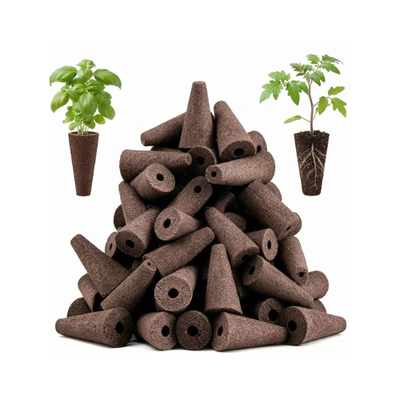
Germination sponges for soilless growing
These species are among the easiest to grow hydroponically, thanks to their short cycle and shallow root system. Germination sponges hold the seed and then slot straight into a basket without disturbing the roots. Our guide on what to grow in hydroponics covers cultivation season by season.
Rhubarb
Chard with carmine red stems and dark green foliage, as ornamental as it is productive as a border plant.
Bright Yellow
Golden-yellow stems, very tender, cook them separately from the leaves, which need less time.
Chard mix
A packet blending several chard stem colours, handy for a single mixed row.
Surface sowing
Lettuce seed germinates in light: it should be barely covered, no more than 5 mm deep.
🔄 Sowing in successions
With these species, the most reliable method is successional sowing. Rather than sowing an entire row in April, sow a quarter of a row every 2 or 3 weeks from March to September, switching variety according to the season. This gives you a continuous harvest instead of everything coming at once in the same week, and within a single year you will discover which variety tolerates the heat and which holds up in the cold in your area. Allow 3 to 7 days for germination depending on temperature, then transplant at the 4 true-leaf stage for lettuces grown as hearting types.
🪣 Watering and bitterness
A lettuce that is short of water turns bitter and bolts more quickly, and once the flower stem has gone up, bolting is irreversible. Watering should therefore be regular rather than copious, ideally in the morning and at the base, as wet foliage in the evening encourages downy mildew. A fine mulch between the rows limits evaporation and saves you every other watering session in summer. Chard, on the other hand, tolerates irregular watering far better, making it the natural fallback when holidays fall at an awkward time.
🔁 Save and re-sow
Stored dry, cool, and away from light, lettuce seeds retain their germination capacity for around 5 years and chard seeds for around 6 years, meaning a box of 20 varieties can be sown without waste over several seasons. Lettuce is also well suited to saving your own seed, as its flowers are self-pollinating: a few metres between two varieties is sufficient in a temperate climate. Chard, by contrast, is biennial and cross-pollinates with beetroot, so only one of the two should be allowed to flower at a time. Our product page for Laitue Gloire du Dauphiné features a variety sold individually.
Technical specifications
The essentials
- What you sow
- Organic seeds for salads and leafy vegetablesOne variety per paper herb sachet, labelled with its name.
- The varieties in the kit
- Romaine, oak leaf, iceberg, batavia, rocket, lamb's lettuce; Rhubarb and Bright Yellow chardLettuces in the 10- and 20-piece sets, chard in the 6-piece set.
- Sowing period
- February to September, in successionsWindow for mainland France, to be adjusted depending on the region.
- Seedling depth
- 0.5 cmEach sachet states the exact value of its variety.
- Germination temperature
- 15 à 20 °CGrow medium temperature, not room temperature.
- Germination time
- 3 to 4 daysApproximately 7 days in soil at 10 °C.
To budget for separately
- A fine seedling compost
- Germination cubes or plugsLettuce seed germinates in light and should be barely covered.
- A mulch layer between the rows
- A few centimetresIt reduces evaporation and saves you every other watering in summer.
In the box
- 1 box of organic salad and leaf vegetable seeds, one variety per seed paper sachet
- 1 label with common name and Latin name on each sachet
Variety names and packaging: ZenGreens sets, official photographs retrieved on 07/10/2026. Germination times by temperature: OSU Extension table (Oregon). Storage and crossing: DIYseeds lettuce and beetroot data sheets.
Estimate your
delivery time
Your estimate
Delivery
Estimated time
It covers preparing your order and then the transit time quoted by the carrier, counted in working days.
It is not a guaranteed delivery date: public holidays, peak periods, customs or a carrier delay can extend it. The exact amount, in your currency, is worked out in the cart once your address is entered.
The kit, being light, is dispatched on its own or with the rest of your order. Exact shipping costs and final delivery times are displayed at checkout once your address has been entered. Outside the European Union, import duties and taxes remain the responsibility of the recipient.
Frequently asked questions
8 questions
6 key questions, 8 in the detailed view
You may also like


Related articles

Germination
Germination failure: causes and solutions
Soaking, temperature, light: the three steps that determine germination.
Read the article

Indoor
Creating your indoor seedling space
Where to place a seedling tray, and what the room needs to provide.
Read the article

Season
A practical calendar for success in aquaponics
What to sow and when, between indoor growing and the growing system.
Read the article

Crops
What to grow in hydroponics, season by season
The species that take over when the season gets under way.
Read the article

Plants
The 15 plants to grow in aquaponics
From kitchen sprouts to leafy vegetables grown through to harvest.
Read the article

Understand
What is aquaponics?
The principle, for anyone discovering the shop through the seeds section.
Read the article
Let us talk about your project
A question about this product or your setup? Our team will answer and advise you.

Interest-free instalment payments
Offered depending on the cart amount, at checkout.

Delivery in 2 to 15 working days
Depending on the products and shipping sites. Estimate by destination in the estimator on this page.

After-sales service 7 days a week by email or chat
Our team answers all your questions.

Shop responsibly
Become part of the change.
