Lettuce bolting

Written by Joan Canals · May 17, 2026
Salades cultivées en aquaponie en période chaude

Your aquaponic lettuces suddenly start bolting upwards, their leaves turn bitter, and a flower stalk appears : this is bolting, an almost systematic phenomenon in July and August. Good news, understanding its three causes and applying five simple solutions guarantees you a tender and flavorful harvest all summer long.

Understanding bolting

Bolting is a biological survival reflex in lettuce. When the plant perceives severe stress, it switches to reproduction mode : it shoots up, flowers, and produces seeds before dying. In aquaponics, three factors converge in mid-summer to trigger this alarm signal : air temperature, day length, and the water temperature of the pond.

This guide first explains the mechanism and the three causes in aquaponics, then details five concrete solutions : choosing the right varieties, shading the system, cooling the water, staggering sowings, and switching to alternative leafy greens during heatwaves. You will also find early signs that indicate bolting so you can react in time.

Bolting, a survival reflex

Bolting, a survival reflex

Lettuce is a biennial plant whose full cycle lasts two years : leaves in the first year, bolting in the second. In cultivation, it is harvested before it flowers, but strong heat stress compresses this cycle.

The plant then receives a hormonal signal that shifts its resources from the leaves to the flower stalk and seeds. This is called bolting. Once initiated, it is almost impossible to stop, hence the importance of acting upstream.

Biologically, auxin and gibberellin orchestrate this program change. Understanding this mechanism helps to grasp why heat, day length, and water stress are the real culprits.

Heat above 22 °C

Heat above 22 °C

Above 22 to 25 °C continuously, most lettuce varieties begin to receive stress signals. Above 30 °C for several days in a row, bolting becomes almost inevitable for sensitive varieties.

This threshold concerns the ambient air but also how the plant perceives it at the leaf level. A closed greenhouse in mid-July can easily reach 35 °C in the afternoon, explosive conditions for your lettuces.

Therefore, summer system maintenance must include careful temperature monitoring, ideally with a maximum-minimum thermometer to detect nocturnal peaks.

Long days and warm water

Long days and warm water

Lettuce is sensitive to photoperiod. Beyond 14 hours of light per day, many varieties interpret this signal as an end of season and switch to flowering. This is exactly the case from mid-June to mid-August in Europe.

Combined with heat, the effect is devastating. In aquaponics, a third often-ignored factor is added: the water temperature of the tank. Beyond 26 °C, the roots undergo stress that amplifies the bolting signal.

This triad of heat + light + warm water explains why lettuces that grew perfectly in May suddenly bolt in July.

Recognising the early signs

Before the flowering stem becomes visible, several signs indicate that bolting is under way. The heart of the lettuce elongates vertically, the central leaves appear more taut and upright, and cutting the plant releases a more abundant white latex than usual. The leaves also begin to lose their tenderness and a bitter taste appears.

If you spot these signs, there are two options: harvest immediately even if the head is not fully formed, or attempt to slow the process with quick shading and a reduction in water temperature. The first option is almost always the most practical, as once bolting is triggered it resumes as soon as stressful conditions return.

Choosing tolerant varieties Reine de Mai lettuce seeds

Choose tolerant varieties

The first and most effective lever is genetic. Batavian lettuces like Carmen, Canasta, or Kamikaze, romaine lettuces like Romea or Jericho, oak leaf lettuces, and Lollo Rossa are much more heat-resistant than classic butterhead lettuces.

In our catalog, Reine de Mai is an old variety that resists early heat very well. The Gloire du Dauphiné is better suited for spring and autumn sowing.

Avoid winter lettuces like Lamb's Lettuce or Winter Butterhead for summer sowing : they bolt in two weeks as soon as the heat hits.

Shade to gain 5 °C

Shade to gain 5 °C

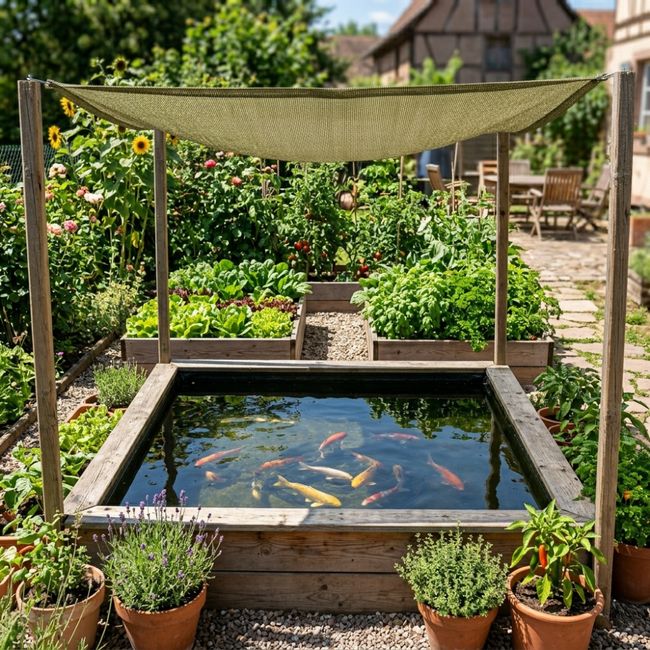
A shade net at 50–80% density stretched above the system reduces air temperature by an average of 5 to 8°C, and surface water temperature by 2 to 3°C. The effect on heat-stressed lettuces is immediate.

Fix the net over four wooden stakes or directly onto the structure of your greenhouse. Choose breathable nets that still let some light through — block too much and you will also hold back growth.

A natural and attractive alternative: train hops, runner beans, or passionflower up a trellis positioned along the south-facing edge. The shade becomes living, productive, and can be taken down out of season.

Cooling pond water Floating pond thermometer

Cool the pond water

The pond water heats up slowly but stays warm for a long time : it's what keeps the roots warm even at night. A thermal cover placed over two-thirds of the surface reduces direct solar radiation by 70%.

For occasional heatwaves, add a few frozen water bottles floating in the pond, never in direct contact with the fish. The water temperature will drop by 2 to 3 °C in a few hours.

Proper summer maintenance prevents most bolting. Stable water around 22-24°C is ideal for lettuce as well as for the majority of aquaponics fish.

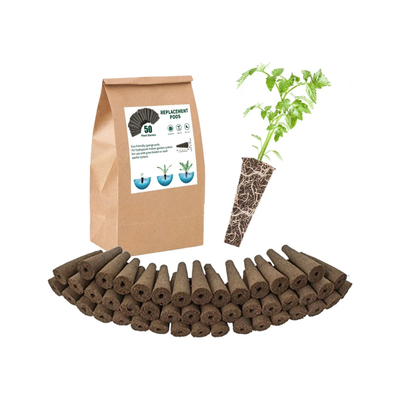
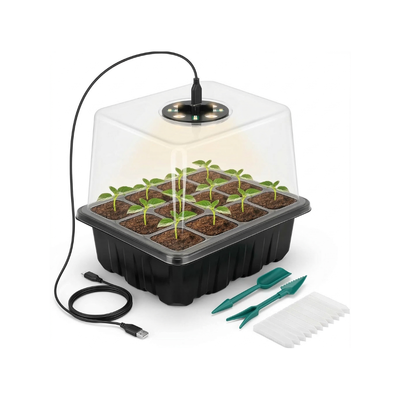
Stagger your seedlings Small germination kits : Packs of 6 or 12 units

Stagger plantings

Rather than a single massive sowing in spring, make 4 to 5 waves of small sowings, spaced two weeks apart, from April to the end of August. You will harvest continuously and limit the risk of an entire wave going to seed while you are on vacation.

In aquaponics, growth is significantly faster than in open ground : count 4 to 5 weeks from germination to harvest, compared to 6 to 8 weeks in soil. Take advantage of this shortening to multiply the cycles.

Get inspiration from our guide on spring sowing to calibrate your successive waves smoothly.

Alternatives for the height of summer Chinese Cabbage Seeds - Dwarf Pak Choy

Full-sun alternatives

When July and August are really too hot, temporarily abandon lettuce and switch to truly heat-tolerant leafy greens. New Zealand spinach, purslane, amaranth, chard, and Malabar spinach all handle the heat beautifully.

Basil is also a valuable addition : it loves the heat and remains productive all summer. In terms of taste, these alternatives offer true culinary diversity and a refreshing change for the palate.

Resume your classic lettuces from mid-August, when nights become cool again. Our guide to 15 plants details the best species season by season.

A matter of timing and choice

Bolting is not inevitable. By carefully selecting resistant varieties, providing shade from late June, cooling the pond water, staggering sowings every fortnight, and switching to alternative leafy greens during heatwaves, you can ensure a tender and flavorful harvest nine months out of twelve.

Regularity and anticipation are more important than a variety's raw resistance. After two seasons of practice, you'll know exactly when to sow what to never again see your lettuces bolt uncontrollably.

Sources

NC State Extension, Lettuce Production in North Carolina, Optimum for vegetative growth, optimum for germination, and comparative tolerance across lettuce types.

University of Minnesota Extension, Growing lettuce, endive and radicchio in home gardens, Favourable day and night cycle, and the threshold of several warm days that triggers flowering.

Central Baltic TransFarm, Plant Selection and Requirements Report, Water temperature range in aquaponics and the bitterness threshold of lettuce.

Oregon State University Extension, Soil Temperature Conditions for Vegetable Seed Germination, Lettuce germination times by temperature, useful for staggering seedlings.

Virginia Cooperative Extension, Daily Light Integral for Greenhouse Crops (SPES-720), Daily light requirement for lettuces, set against summer shading.

Tsoumalakou et al. 2022, Agriculture, lettuce in aquaponics, Behaviour and productivity of lettuce in aquaponics when parameters are kept in range.

Frequently asked questions

Yes, but it turns bitter and tough fairly quickly. Harvest without delay, keep the lowest and most tender leaves, and remove the flowering stem.

Two ranges must be distinguished that do not overlap, and that is the crux of the summer problem in aquaponics. For the plant, horticultural publications place the optimal vegetative growth temperature for lettuce at around 15–18°C, with an ideal regime of cool nights close to 10°C and daytime temperatures not exceeding 20°C. Several consecutive days above 24°C are enough to trigger bolting in many varieties, and aquaponics literature notes that lettuce turns bitter above 26°C.

For the system, the usual working range sits between 18 and 26°C water temperature, with a pH around 6.8 to 7.2. In other words, water that is perfectly acceptable for your fish and your bacteria may already be at the upper limit of what lettuce can tolerate. There is no setting that suits everyone in July.

The practical consequence is straightforward to remember. You are not trying to cool the system down to the optimum for lettuce — that would be detrimental to the fish and energy-intensive. Instead, you act on the air and on solar radiation, through shading and ventilation, and you accept that it is time to change crops when the window closes.
The ranking is fairly consistent across publications, and it is based on type before variety.

  • Loose-leaf and butterhead lettuces are among the most heat-tolerant.
  • Romaines handle heat better than headed lettuces.
  • Crisp-head types are the most sensitive — and they are precisely the most widely grown type.

Choosing a tolerant type will gain you more than optimising a variety within a sensitive type. It is the least costly lever of all those described in this article.

It is possible, but the difficulty shifts from bolting to germination. The optimal germination temperature for lettuce is around 21 to 24 °C, and a grow medium that is too warm can actually inhibit germination. A tray left in full summer sun will therefore often germinate less well than one kept in the shade.

Sow in the shade or in a cool room, transplant in the evening, and favour varieties intended for late-summer harvests. This is the logic of the staggered sowing approach described above, applied to the most delicate period of the year.

No. Once the flower stem has been triggered, there is no going back — the plant has already redirected its resources. Cooling can slow the progression by a few days and give you time to harvest, nothing more. Cooling is a preventive measure for the next plants, not a treatment for those that have already bolted.

Both, depending on how the system is designed. The water volume buffers fluctuations, so the roots experience less severe thermal swings than they would in surface soil exposed to direct sun. On the other hand, that same volume retains heat overnight, which deprives the plant of the nocturnal rest period that plays an important role in triggering flowering.

There is also a growth-rate effect. Research on lettuce in aquaponics shows that the crop is productive and fast-growing when parameters are kept in check, and rapid growth mechanically shortens the window during which the plant can bolt. A well-managed system does not eliminate the risk — it simply gives you a better chance of harvesting before it occurs.

Read next

Auxiliaires contre les nuisibles

Auxiliaires contre les nuisibles

En aquaponie, les poissons et les plantes partagent la même eau, ce qui rend la plupart des insecticides inutilisables. Les auxiliaires, ces insectes et acariens prédateurs ou parasitoïdes, deviennent alors la seule stratégie vraiment

Read the article
Aquaponics and Summer Holidays

Aquaponics and Summer Holidays

You're going away for two weeks in July and your aquaponics system will be running without you : this thought rightly makes you anxious, because heatwaves, evaporation, and fish feeding raise practical questions. Good

Read the article
All about Ollas (Guide 2026)

All about Ollas (Guide 2026)

Olla irrigation (or Oyas) is a passive hydraulic engineering that redefines autonomy in modern vegetable gardens. Faced with recurring heatwaves and increasingly severe water restrictions in Europe, understanding the physics of microporosity and soil-plant

Read the article
Recognizing deficiencies in aquaponics

Recognizing deficiencies in aquaponics

In aquaponics, plants can show signs of weakness even when the system appears balanced. Pale leaves, slowed growth, or deformities are often linked to subtle yet critical micro-deficiencies. These deficiencies involve essential elements such

Read the article
A practical calendar for success in aquaponics

A practical calendar for success in aquaponics

In aquaponics, the success of a season depends mainly on good upstream calendar management : periods of sowing, planting, ramp-up… and times when it is better not to intervene. Unlike a traditional vegetable garden,

Read the article
Controlling pests in aquaponics

Controlling pests in aquaponics

Aquaponics has a reputation for being a clean, ecological, and naturally protective method of cultivation. However, like any living system, it can be affected by pests : aphids, gnats, mites, invasive algae, or unwanted

Read the article