

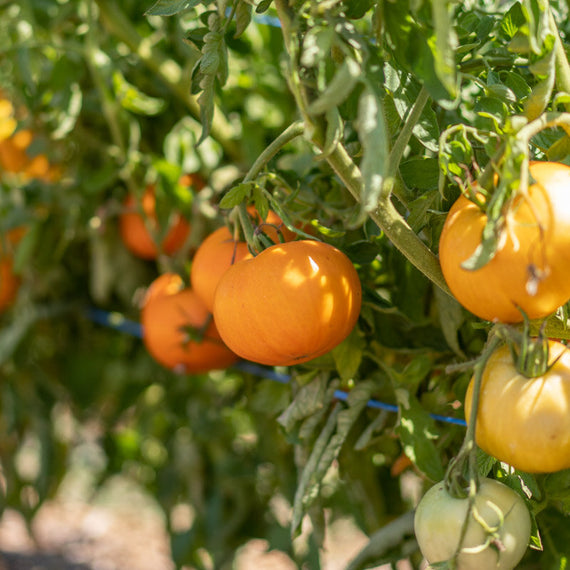
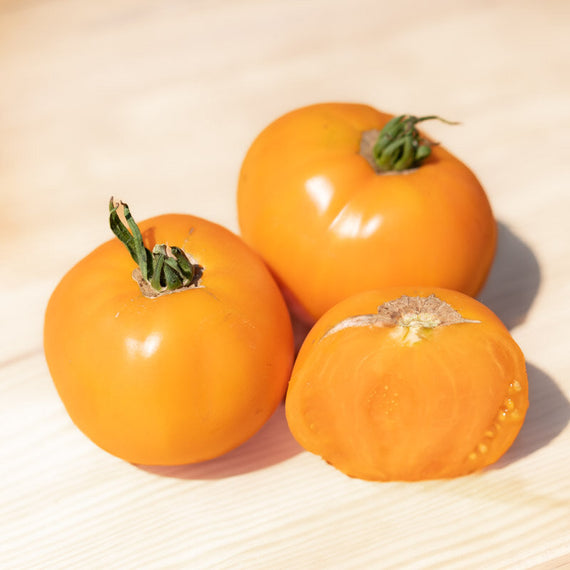
Yellow Belgium Tomato Seeds
Regular price
3,90 €
Regular price
Sale price
3,90 €
Unit price
/
per
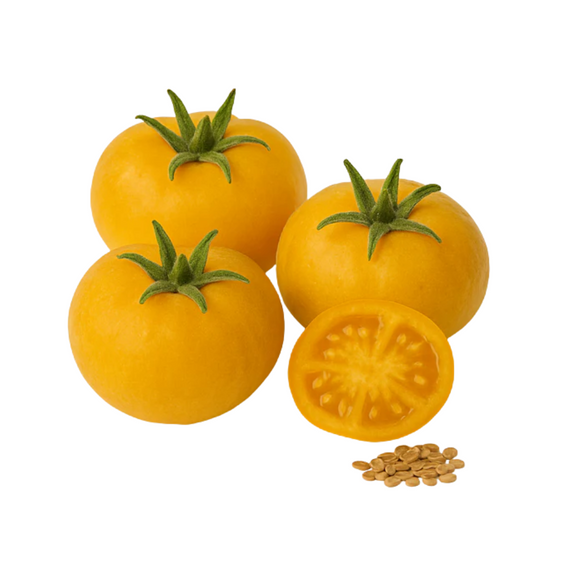
A very old variety with large, round, orange-yellow fruits, Yellow Belgium produces tomatoes of 150 to 300 g with dense, juicy, sweet flesh, best eaten raw in thick slices.
The packet contains 35 organic, open-pollinated seeds. Its indeterminate growth habit calls for sturdy staking from the moment it is planted out.
 Customer support 7 days a week by email
 Delivery within 2 to 15 business days
100 % secure payment
The summary
- What you receive: a packet of 35 organic, open-pollinated Yellow Belgium tomato seeds.
- The fruit: round, orange-yellow, 150 to 300 g, with dense, juicy, sweet flesh.
- Sowing: from February to April under cover, at 16 to 20 °C, 5 weeks before planting out.
- Harvest: from July to October, when the flesh gives under your thumb.
- How much effort: sturdy staking, for an indeterminate variety.
- How to choose: this one for the large yellow fruit, Jupiter for the red.
Heirloom tomato with large round yellow-orange fruits, 35 farmers' seeds
The "Yellow Belgium" yellow tomato seeds from the Kokopelli association come in a packet of 35 organic, open-pollinated seeds. This heirloom variety produces round, yellow-orange fruits of 150 to 300 g, with dense, juicy, sweet flesh, mainly intended to be eaten raw. Its indeterminate growth habit calls for solid staking from the moment it is planted out.
Yellow Belgium is a very old large-fruited tomato with round, orange-yellow fruits weighing 150 to 300 g. The fruits contain few seeds, and their dense, juicy flesh has a mild, slightly sweet flavour. Sliced, its orange-yellow flesh stands out from the red of the other tomatoes in your basket.
The variety comes from the United States, where it is said to descend from Giant Belgium, a pink-fruited tomato selected in Ohio. It crops mid-season, from July to October depending on the sowing date, and its growth is indeterminate: the stem keeps lengthening until the first frosts, so you need a stake or a string from the moment it is planted out. It can be grown in open ground or under glass, in full sun, in free-draining, rich, warmed soil.
⚖️ The weight of the fruit
A 300 g fruit exerts leverage on the truss that carries it, so that a string that is too thin cuts through the stem and a stake that has not been driven in firmly tips over under the load. So plan for solid support from the moment of transplanting, train the plant on one or two stems, and support the fruits of your first trusses individually. This training is decided before planting, because a stake added in June passes through roots that are already established.
🍽️ Raw, in thick slices
Its sweetness and dense flesh make it best suited to raw cooking, which shows off its colour on your plate. It is sliced thickly, served with olive oil and salt, and pairs with a red tomato such as Jupiter for a two-tone plate. Cooked, it gives golden sauces, but its juicy flesh needs longer reduction than a preserving tomato.
In salads
Serve it in thick slices, with olive oil and salt. Its sweetness speaks for itself.
As carpaccio
Alternate its slices with a red tomato, for a contrast of colour.
As a sauce
It gives a golden sauce, which needs reducing for longer than a tinned tomato.
Tie up large fruits in a single movement
A Yellow Belgium plant is tied to its stake every week, as the stem lengthens and the trusses fill out. The plant tying machine wraps a tape around the stem and the stake, staples it and cuts it with a single squeeze of the hand. You keep your other hand free to hold a stem weighed down with 300 g fruits, and each tie goes on in a few seconds along the whole row.
💧 In a greenhouse and in aquaponics
Under a closed shelter, neither wind nor insects release the pollen, and the flowers drop without setting fruit. Vibrate the flower stem with your fingertip every day, or press the back of an electric toothbrush against the stem for a few seconds around midday, as described in the guide on how to pollinate your plants indoors. In your aquaponic system, a large-sized plant needs a system that has been running for at least 2 to 3 months, a pH of 6.4 to 7.5 and a media bed deep enough for its roots. In a younger system, the foliage turns yellow and the plant stalls, and the guide to plant deficiencies in aquaponics helps you identify the missing element.
Technical specifications
The sachet
- Capacity
- 35 seedsEnough to plant around ten specimens, including germination losses.
- Seed origin
- Kokopelli associationOrganic seeds, royalty-free.
- Seed type
- Open-pollinated, non-hybridReproducible: seed from your own harvest will give the same variety.
- Seed storage
- About 4 yearsStore in a dry, cool, dark place.
The variety
- Botanical name
- Solanum lycopersicum
- Fruit shape
- Round, few seeds
- Fruit weight
- 150 to 300 g
- Colour at maturity
- Orange-yellowPick when the flesh gives slightly under your thumb.
- Growth
- IndeterminateStake or training twine from the moment of planting out.
- Earliness
- Mid-season
Seedling and harvest
- Seedlings under cover
- February to AprilIn small pots, under a well-lit shelter.
- Germination temperature
- 16 to 20 °C
- Germination time
- 6 to 10 days
- Time in the nursery
- 5 weeks
- Installation
- After the last frostsWhole root ball, stem buried up to the first leaves, at least 50 cm between plants.
- Harvest period
- July to October
To budget for separately
- Reinforced training
- Doubled string or a sturdy stake
- Growing medium
- Clay pebbles or coir
10 further specifications are available in the detailed view.
In the box
- 1 packet of 35 organic Yellow Belgium tomato seeds
Quantity, fruit, origin and sowing: sheet from the seed company Kokopelli (ref. P6623), recorded on 11/10/2026. Germination time, harvest period and storage are guidelines for mainland France.
Manufacturer and product safety
- Manufacturer
- Association Kokopelli (SIREN 433481124, TVA FR80433481124)
- Postal address
- 7 route de Sabarat, Forêt de Castagnès, 09290 Le Mas-d'Azil, France
- Contact
- Formulaire de contact : https://kokopelli-semences.fr/fr/faq/ (aucune adresse e-mail publique) ; téléphone 05 61 67 69 87
- Website
- kokopelli-semences.fr
Information provided under Regulation (EU) 2023/988 on general product safety.
Compare the four varieties
Four farmhouse tomatoes, in the same packet format. What changes is the size of the fruit, its colour and what you will do with it in the kitchen.
Four heirloom tomatoes, from large beefsteak to cherry
A large fruit for slicing isn't grown like a cluster of cherry tomatoes. Start from what you want on your plate.
| Red Tomato Seeds "Jupiter"Your choice | Recommended Yellow Belgium Tomato SeedsYour choice | Grappoli Corbarino Cherry Tomato SeedsYour choice | Yellow Plum Cherry Tomato SeedsYour choice | |
|---|---|---|---|---|
| The fruit | ||||
| Size | Medium to large, 80 to 230 g | Large, 150 to 300 g | Cherry type, in clusters of 7 to 10 | Cherry, 20 to 30 g |
| Colour at maturity | Red | Orange-yellow | Dark red | Lemon yellow |
| Shape | Round, slightly flattened | Round | As a plum | As a plum |
| Best use | Sauces and preserves | Slices and carpaccios | Drying and jarring | Nibbles and salads |
| The growing | ||||
| Earliness | Mid-season | Mid-season | Early | Mid-season |
| Growth | Indeterminate | Indeterminate | Indeterminate | Indeterminate |
| Variety origin | France | United States | Italy | United States |
| The sachet | ||||
| Seeds per packet | 35 | 35 | 35 | 35 |
| Open-pollinated seeds | Yes | Yes | Yes | Yes |
Red Tomato Seeds "Jupiter"
The fruit
SizeMedium to large, 80 to 230 g
Colour at maturityRed
ShapeRound, slightly flattened
Best useSauces and preserves
The growing
EarlinessMid-season
GrowthIndeterminate
Variety originFrance
The sachet
Seeds per packet35
Open-pollinated seedsYes
Yellow Belgium Tomato SeedsRecommended
The fruit
SizeLarge, 150 to 300 g
Colour at maturityOrange-yellow
ShapeRound
Best useSlices and carpaccios
The growing
EarlinessMid-season
GrowthIndeterminate
Variety originUnited States
The sachet
Seeds per packet35
Open-pollinated seedsYes
Grappoli Corbarino Cherry Tomato Seeds
The fruit
SizeCherry type, in clusters of 7 to 10
Colour at maturityDark red
ShapeAs a plum
Best useDrying and jarring
The growing
EarlinessEarly
GrowthIndeterminate
Variety originItaly
The sachet
Seeds per packet35
Open-pollinated seedsYes
Yellow Plum Cherry Tomato Seeds
The fruit
SizeCherry, 20 to 30 g
Colour at maturityLemon yellow
ShapeAs a plum
Best useNibbles and salads
The growing
EarlinessMid-season
GrowthIndeterminate
Variety originUnited States
The sachet
Seeds per packet35
Open-pollinated seedsYes
Size, colour, shape, earliness and seed count: data sheets from the seed company Kokopelli, recorded on 11/10/2026.
Help choosing
Which tomato for your season
Estimate your
delivery time
Your estimate
Delivery
Estimated time
It covers preparing your order and then the transit time quoted by the carrier, counted in working days.
It is not a guaranteed delivery date: public holidays, peak periods, customs or a carrier delay can extend it. The exact amount, in your currency, is worked out in the cart once your address is entered.
A packet of seeds ships as a small parcel. It can be grouped at no extra cost with the rest of your order, and the exact amount is calculated at checkout.
Frequently asked questions
6 questions
6 key questions
Growing calendar
Reference points for mainland France, to be shifted by approximately two weeks depending on your region.
| Stage | ||||||||||||
|---|---|---|---|---|---|---|---|---|---|---|---|---|
| Seedlings under cover3 months | Seedlings under cover: no | Seedlings under cover in February | Seedlings under cover in March | Seedlings under cover in April | Seedlings under cover: no | Seedlings under cover: no | Seedlings under cover: no | Seedlings under cover: no | Seedlings under cover: no | Seedlings under cover: no | Seedlings under cover: no | Seedlings under cover: no |
| Transplanting2 months | Transplanting: no | Transplanting: no | Transplanting: no | Transplanting: no | Transplanting in May | Transplanting in June | Transplanting: no | Transplanting: no | Transplanting: no | Transplanting: no | Transplanting: no | Transplanting: no |
| Hand pollination2 months | Hand pollination: no | Hand pollination: no | Hand pollination: no | Hand pollination: no | Hand pollination: no | Hand pollination in June | Hand pollination in July | Hand pollination: no | Hand pollination: no | Hand pollination: no | Hand pollination: no | Hand pollination: no |
| Harvest4 months | Harvest: no | Harvest: no | Harvest: no | Harvest: no | Harvest: no | Harvest: no | Harvest in July | Harvest in August | Harvest in September | Harvest in October | Harvest: no | Harvest: no |
KeySeedlings under coverTransplantingHand pollinationHarvest
This month
October
Growing guidance
- Germination temperature
- 16 to 20 °C
- Germination time
- 6 to 10 days
- Time in the nursery
- 5 weeks
- Spacing
- At least 50 cmBetween two plants, in the row as well as in the grow bed
- Fruit weight
- 150 to 300 g
- Fruit shape
- Round, orange-yellow
- Growth
- IndeterminateStaked from planting out
- Harvest period
- July to October
- pH in aquaponics
- 6.4 to 7A compromise between fish, bacteria and plants
- Seed storage
- About 4 yearsDry and away from light
What you need to know
- Double up the training twine as soon as you transplant. A 300 g fruit acts as a lever on the truss that carries it, and a thin tie cuts into the stem before the end of summer.
- Train the plant on one or two stems and pinch out the side shoots every week. A large-fruited variety that keeps all its shoots spreads its vigour over too many fruits.
- Support the fruits of the first two trusses individually, with a net or a strip of cloth. These are the heaviest on a still-young plant.
- Under a closed shelter, the flower does not set fruit on its own. A daily vibration of the flower stem with your fingertip replaces the missing wind and insects.
- Do not rely on colour alone when picking. On a yellow-orange variety, the eye is easily fooled: rely on flesh that gives slightly under your thumb.
- In aquaponics, a large-fruited variety is one of the most demanding crops in nitrogen, potassium and calcium. Wait until the system has been running for 2 to 3 months before installing it.
You may also like



Related articles

Crops

Technique
Pollinating your plants indoors
What light cannot do: carry pollen from one flower to another.
Read the article

Understanding
The nitrogen cycle in aquaponics
Why a hungry plant yields nothing on a new system, and how to tell when the cycle is properly established.
Read the article

Troubleshooting
Plant deficiencies in aquaponics
Yellow leaves, green veins, scorched edges: reading a symptom and tracing it back to the missing mineral.
Read the article

Guide
Successful spring seedlings in aquaponics
When to start seedlings, at what temperature, and how to move from cell to grow bed without losing plants.
Read the article

Equipment
Which grow medium to choose for aquaponics?
Clay pebbles, coco fibre, rockwool: what each grow medium actually holds in terms of root volume.
Read the article

Cooking
Summer recipes from the kitchen garden
What to do with a glut harvest — without throwing anything away or freezing half of it.
Read the article
Let us talk about your project
A question about this product or your setup? Our team will answer and advise you.

Interest-free instalment payments
Offered depending on the cart amount, at checkout.

Delivery in 2 to 15 working days
Depending on the products and shipping sites. Estimate by destination in the estimator on this page.

After-sales service 7 days a week by email or chat
Our team answers all your questions.

Shop responsibly
Become part of the change.
