





EHEIM aquaAlert+e WiFi conductivity controller for aquariums
Regular price
259,90 €
Regular price
Sale price
259,90 €
Unit price
/
per
86,63 € × 3 with no fees
Klarna.
The EHEIM aquaAlert+e continuously measures the water's conductivity, a reflection of the dissolved salts that build up, as well as its temperature. It alerts you by e-mail when a threshold is crossed and estimates the date of the next water change.
It is set up over WiFi from a browser, and both the probe and the calibration solutions are supplied.
 Customer support 7 days a week by email
 Delivery within 2 to 15 business days
100 % secure payment
The summary
- What it measures: conductivity from 0 to 3,000 µS/cm, and temperature.
- Its alerts: three levels, sudden rise and temperature, sent by email.
- Its setup: over 2.4 GHz WiFi, from a browser.
- In the box: controller, probe and two calibration solutions.
The right time to change the water, measured continuously
In an aquarium, the water gradually fills with dissolved salts: fish waste converted into nitrates, decomposed food remains, and minerals brought in by tap water and concentrated by evaporation. This build-up is invisible, and it is often the reason why clear water ends up stressing the fish or the plants. Electrical conductivity, measured in microsiemens per centimetre (µS/cm), sums it up in a single figure: the more dissolved salts the water contains, the better it conducts current. The EHEIM aquaAlert+e measures this value continuously in your aquarium, along with the temperature, and alerts you when it is time to change the water.
📈 What the device monitors
The probe, connected to the controller by a cable of about 2 m, sits in the tank and measures conductivity from 0 to 3,000 µS/cm, with a response time of under a minute. A built-in sensor also tracks the temperature. The controller compares these readings with the thresholds you have set, between 250 and 3,000 µS/cm, and sorts the state of the water into three levels, green, yellow and red, each with a recommended action. An alarm also sounds in the event of a sudden rise, when conductivity increases by half within an hour: this is a sign of an abnormal input, such as an overdose of fertiliser or treatment, a dead fish or a decoration releasing minerals.
Water change
The controller estimates the right moment from the history of readings.
Sudden rise
An alarm goes off if the conductivity rises by 50% within an hour.
Temperature
You set the alert threshold yourself.
Probe out of the water
A warning signals an electrode running dry.
Everything is set up over WiFi at 2.4 GHz, from the browser of a smartphone, tablet or computer, with no app to install. The controller keeps a history of the readings and uses it to estimate the date of the next water change. Alerts arrive by email, as does the reminder to clean the electrode. It works on its own or as part of the EHEIM digital network, alongside a pH controller or a connected lighting unit from the brand, if your tank is already fitted with one.
Identifying the cause of an alert with the tests
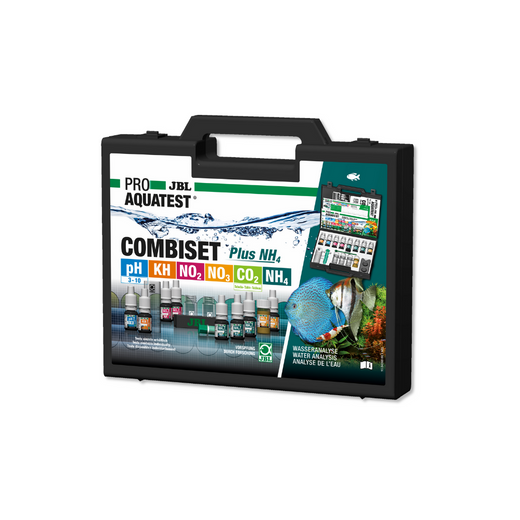
Conductivity indicates how many salts the water contains, but not which ones. The pack of 5 water tests NH4, NO2, NO3, pH and KH tells you whether a rise comes from nitrates, which are expected in a well-stocked tank, or from ammonium and nitrite, which are toxic to fish even at low levels. After a yellow alert, a nitrite test lets you decide whether the water change can wait a few days or must be done the same day.
🔧 Installing and calibrating
The controller, measuring 98 × 116 × 28 mm, is fixed by the bracket on its back to the cabinet or against a wall, away from splashes and never under the lid. The probe sits below the surface, in a well-circulated area, with its suction cup on the glass or with its bracket on the intake tube of an external filter. Avoid placing it next to an air or CO2 diffuser, as the bubbles will distort the reading. The unit comes with two calibration solutions, at 1,413 and 84 µS/cm: you calibrate the probe when you first set it up, then at regular intervals, following the controller's wizard.
Take a 240-litre freshwater aquarium filled with tap water at 400 µS/cm. Over the weeks, the conductivity rises as nitrates build up and the water evaporates. With a yellow threshold at 550 µS/cm and a red threshold at 650 µS/cm, the alert comes when the water contains markedly more salts than at the start. A water change of a quarter of the volume, i.e. 60 litres of water treated with Easy-Life AquaMaker conditioner, then lowers the conductivity by about 60 µS/cm, and a second change brings it back below the yellow threshold. Topping up for evaporation with tap water, on the other hand, removes no salts, since the water added brings in new ones: only a genuine water change lowers conductivity lastingly.
🌱 In aquaponics
In aquaponics, conductivity plays a dual role. It measures the salts that build up around the fish, but also the nutrients available to the plants: nitrates, potassium, calcium. An aquaponic system most often sits between 500 and 1,500 µS/cm, depending on the fish and the crops. A conductivity that falls indicates plants consuming faster than the fish produce; a conductivity that keeps rising indicates an overloaded system or insufficient water replacement. The nitrates that weigh on this value come from the nitrogen cycle in aquaponics, which turns fish waste into nutrients for your plants.
The aquaAlert+e is designed for freshwater. It needs a mains socket for its 5 V power supply and a 2.4 GHz WiFi network: a router set to 5 GHz only will not allow it to connect. When the controller reminds you to clean the electrode, wipe the body of the probe with a soft, damp cloth, then rinse its tip under cold tap water, without using any hard object or harsh product, as a deposit of limescale or biofilm skews the reading. Then recalibrate if the discrepancy persists.
Technical specifications
Measurement
- Parameters measured
- Conductivity and temperature
- Measurement range
- 0 to 3,000 µS/cm at 25 °C
- Alert range
- 250 to 3,000 µS/cm
- Response time
- Less than a minute
Controller
- Connection
- 2.4 GHz WiFi, set up through a browser
- Feed
- Mains adapter 100 to 240 V, 5 V output
- Dimensions
- 98 × 116 × 28 mm
- Probe cable
- Around 2 m
In the box
- 1 controller with its power supply unit
- 1 conductivity probe with suction cup and bracket
- 2 calibration solutions, at 1,413 and 84 µS/cm
Features, measuring ranges and contents taken on 09/10/2026 from the manufacturer's manual and description. Freshwater only.
Documents & manuals
Instructions for use
Manufacturer's manual: probe installation, calibration, WiFi connection and technical specifications.
Document not showing? Some publishers block display inside a frame, so open it in a tab.
Estimate your
delivery time
Your estimate
Delivery
Estimated time
It covers preparing your order and then the transit time quoted by the carrier, counted in working days.
It is not a guaranteed delivery date: public holidays, peak periods, customs or a carrier delay can extend it. The exact amount, in your currency, is worked out in the cart once your address is entered.
Delivered to your home by Colissimo or Chronopost, as you prefer at checkout. The exact cost is shown in the basket, according to the total weight of your order.
Frequently asked questions
10 questions
6 key questions, 10 in the detailed view
You may also like


Related articles

Understanding
The nitrogen cycle in aquaponics
Where the nitrates measured by conductivity come from.
Read the article

Technique

Start-up

Water
Understanding and correcting cloudy water in aquaponics
Keeping the water healthy and clear.
Read the article

Guide
Let us talk about your project
A question about this product or your setup? Our team will answer and advise you.

Interest-free instalment payments
Offered depending on the cart amount, at checkout.

Delivery in 2 to 15 working days
Depending on the products and shipping sites. Estimate by destination in the estimator on this page.

After-sales service 7 days a week by email or chat
Our team answers all your questions.

Shop responsibly
Become part of the change.
