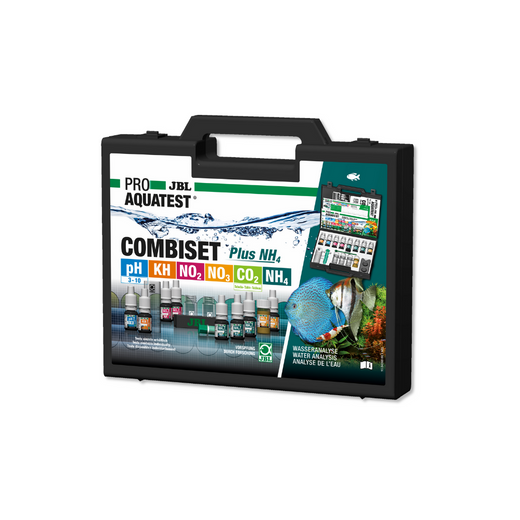


13-in-1 water testing kit for aquariums
Regular price
119,90 €
Regular price
Sale price
119,90 €
Unit price
/
per
Product rating: 4.6
(912 reviews)
39,96 € × 3 with no fees
Klarna.
The JBL PROAQUATEST LAB brings together 13 drop tests in a single case and covers 12 freshwater parameters, from pH and nitrite to iron and CO2.
Aquarium, pond or aquaponic system, the laboratory comparator block makes the reading reliable even on tinted water. The instructions are multilingual, French included, and the reagents are available as separate refills.
 Customer support 7 days a week by email
 Delivery within 2 to 15 business days
100 % secure payment
The summary
- What you receive: the JBL PROAQUATEST LAB case, 13 drop tests, 23 reagent bottles, 12 glass test tubes, a comparator block and a thermometer.
- What you measure: 12 freshwater parameters, pH across three ranges, from ammonium to nitrates, from iron to phosphates, from silicates to dissolved oxygen.
- How long it takes: 5 minutes for a single test, around 30 minutes for a full check of all 13 tests.
- How to choose: the 6-parameter version is enough if you have no demanding plants, while this one is the right choice as soon as you need to monitor iron and phosphates.
- What runs out: only the 23 bottles, sold as refills test by test. The glassware, the comparator block and the thermometer stay.
- What ships to you: a parcel of around 1.9 kg, with the reagents in their original case, by Colissimo or Chronopost to your door.
JBL case of 13 drop tests, 12 parameters, for aquariums, ponds and aquaponics
This kit brings together 13 drop tests to read 12 freshwater parameters, from ammonium to copper, in half an hour of simple steps. It is aimed at those who want to see an imbalance coming rather than simply note it, because by the time the fish breathe fast at the surface or the plants yellow from the top, it has been developing for several days. You can use it equally well on an aquarium, a pond or an aquaponic system.
🔬 Drops and comparator block
Each test relies on a volume of water measured with a syringe, which reacts with a reagent dosed drop by drop into a glass test tube. The reading is then taken in a comparator block that cancels out the water's own tint, which matters with water stained amber by peat or by a root, where a direct reading gives a value that is too high, as explained in the article on cloudy water in aquaponics.
🧪 The 12 parameters measured
The nitrogen cycle trio
Ammonium, nitrite and nitrate tell you the true state of the biological filtration. These are the three values to monitor during start-up and after every incident.
The foundation: pH, KH and GH
KH stabilises pH, pH determines the proportion of toxic ammonia, and GH governs shrimp moulting. These three values should be read together.
What plants live on
Phosphates, iron and carbon dioxide make up the diet of aquatic plants. An iron deficiency shows on the young leaves first.
Unwanted visitors
Copper, silicates and a lack of oxygen are behind shrimp losses or brown diatoms whose cause would otherwise remain untraceable.
Rinsing, bottle storage, light
Rinsing the test tubes in tap water rather than in tank water will skew the phosphate and silicate readings for good. Laying a dropper bottle on its side lets air in and gives uneven drops, hence inaccurate KH and GH titrations, whereas the instructions say to hold the nozzle vertically, pointing down. Reading a colour under artificial evening light shifts the nitrite reading. Finally, a test taken the day after a medicinal treatment may be skewed by substances still present in the water.
Correcting a low iron reading taken with the test kit
The iron test in the kit tells you when an addition becomes necessary, and the form of the chelate then determines whether that iron will stay available to plants. DTPA 11% chelated iron keeps iron in solution up to pH 7.5 without colouring the water, which covers most planted aquariums and aquaponic systems. Measure the iron just before dosing and again 1 to 2 days afterwards: the difference between the two readings gives the actual uptake of your crops and the interval to leave between doses.
Each colour chart carries three reading bands, marked by a pictogram: the fish for freshwater, the koi carp for the garden pond, the starfish for seawater. The same colour therefore does not give the same verdict depending on the environment, first because salt dampens the intensity of the reaction, and second because a pond undergoes temperature and light variations that a living-room tank never experiences. Each band runs from green to yellow and then red, which gives you both the measured value and what to do about it.
🕐 One complete testing session
A complete session takes three stages. Draw the water from the middle of the tank, never from the surface or against the sand, because the surface film and the zone near the substrate give values that do not represent the whole volume. Then run the instant-reading tests while those with a waiting time wait for their timer, which brings the full session down to about thirty minutes. Finally, note the values on the supplied record sheet, together with the date, the temperature read on the kit's thermometer and the last action taken on the tank. That column of dates is what helps you most, because a single value is hard to interpret whereas a 6-week series shows a trend.
🌿 The targets in aquaponics
In aquaponics, the values to aim for are not those of an aquarium. Nitrates become a resource here, since they are what feeds your lettuces, whereas an aquarist tries to bring them down. The pH sits between two opposing needs: nitrification is faster in slightly alkaline water, while the roots absorb iron and phosphorus better in slightly acidic water. Two parameters then determine the health of your crops, iron and phosphate, and this kit measures both. Yellowing of the young leaves between veins that have stayed green signals an iron deficiency: without measurement, you are correcting blind.
🧫 The parameters people overlook
Three of the measurements in this kit are only used occasionally, when a problem has no obvious cause. Copper often explains invertebrate losses without any mortality among the fish, whether it comes from an antiparasitic treatment or an old pipe. Silicates feed the brown diatoms that coat the glass of a new tank, and their source is almost always the top-up water itself. Oxygen, finally, is rarely measured, even though its level drops sharply on summer nights in a pond, at the very moment your fish need it most. These three values are therefore not monitored routinely, but when one of these symptoms appears.
♻️ The equipment and the refills
The water-resistant plastic case, the 12 glass test tubes, the syringes, the measuring spoons, the comparator block, the thermometer and the colour charts stay with you from one year to the next. Only the 23 reagent bottles run out, and they are bought separately, test by test. The water analysis range brings together the most common refills, from pH to nitrates, including iron and copper. Check the level in each bottle before a series of analyses, since a single empty reagent is enough to block the corresponding parameter.
Technical specifications
The essentials
- Parameters measured
- 12, with 13 drop testsThe pH is read on three ranges, and the CO2 on a chart cross-referencing the pH and KH you have already measured
- Method
- Liquid reagents, colorimetric readingThe supplied comparator block cancels out the water's own colour when you take the reading
- Environments covered
- Freshwater, pond, aquaponicsOne reading strip per medium on each colour chart, seawater included
- Reagent bottles
- 23, child-resistant capsFrom 1 bottle for KH or iron to 3 bottles for ammonium, silicates and oxygen
- Manufacturer's reference
- JBL 2408400, PROAQUATEST range
- Dimensions of the box
- 38.2 x 31.8 x 8.5 cmThe kit stores flat on a shelf, with a handle on top and clip fastenings.
The 13 tests and CO2
- pH, wide range
- 3.0 to 10.0To place an unknown water on the scale before refining with one of the two narrow ranges
- pH, acidic range
- 6.0 to 7.65 ml of water, 4 drops, read after 3 minutes
- pH, alkaline range
- 7.4 to 9.0Hard water, cichlids, koi ponds. 5 ml of water, 4 drops, read after 3 minutes
- KH, carbonate hardness
- Titration, 1 drop = 1 °dHThat is 1.78 °f, 0.36 mmol per litre of alkalinity or 21.8 mg per litre of hydrogen carbonate
- GH, total hardness
- Titration, 1 drop = 1 °dHThat is 1.78 °f and 1.25 °e. On 5 ml of water, no colour chart needed
- NH4 and NH3, ammonium
- Colorimetric, 3 reagentsThe genuinely toxic fraction of ammonia is derived from a table cross-referencing pH and temperature
- NO2, nitrites
- Colorimetric, 2 reagents5 ml of water, read after 5 minutes. The reference test during cycling
- NO3, nitrates
- Colorimetric, 2 reagentsPer 10 ml of water. In aquaponics, this is the nitrogen ration for the crops
- PO4, phosphates
- Sensitive version, 2 reagentsFormulation designed for low concentrations, the ones that decide between plants and algae
- Fe, iron
- Colorimetric, 1 reagentKey parameter for planted tanks and aquaponic systems
- Cu, copper
- Colorimetric, 2 reagents5 ml of water, read after 15 minutes. To be checked after a treatment or on old pipework
- SiO2, silicates
- Colorimetric, 3 reagentsThe lead to follow when brown diatoms keep coming back on the glass
- O2, dissolved oxygen
- Colorimetric, 3 reagentsOn 20 ml of water drawn without bubbles, the most delicate test in the kit
- CO2, carbon dioxide
- No reagent, read off the chartThe value is read by cross-referencing pH and KH on the supplied chart
Method of use
- Water volume per test
- 5 to 20 ml5 ml for pH, KH, GH, nitrites and copper, 10 ml for nitrates, 20 ml for oxygen
- Waiting time
- 3 to 15 minutes3 minutes for pH 6.0 to 7.6, 5 minutes for nitrite, 15 minutes for copper
- Titration tests
- KH and GHCount the drops until the colour changes, there is no colour chart for these two tests
- Bottle shelf life
- Upright, nozzle pointing downNo bubbles, otherwise the drop volume varies and the titration is wrong
- Reading
- Colour chart, in daylightA warm artificial light shifts the perception of pink and orange shades
- Full assessment
- About 30 minutesApproximate time for the 13 tests, running the waiting times back to back
To budget for separately
- Reagent refills
- Sold test by testGlassware, colour charts, comparator block and thermometer are kept: only the reagents run out.
- Potassium and magnesium
- Separate JBL testsTo follow in aquaponics as soon as the bottom of the plants turns yellow
20 further specifications are available in the detailed view.
In the box
- 1 water-resistant plastic case, with handle and clip fasteners
- 13 drop tests, that is 23 reagent bottles with child-resistant caps
- 12 graduated glass test tubes, so you can run several tests in a row without rinsing
- 2 plastic test tubes
- 2 sampling syringes
- 3 measuring spoons for the powder reagents
- 1 laboratory comparator block
- 1 thermometer, needed to convert ammonium into toxic ammonia
- 1 colour chart set, 3 reading strips per test
- 1 CO2 conversion chart, with pH and KH entries
- 1 ballpoint pen and 1 set of test record sheets
- 1 multilingual instruction leaflet, French included
Contents, dimensions and reference recorded from the official sheet 2408400 on 10/09/2026. The 13 tests cover 11 parameters, with pH over three ranges; CO2 is also read from the chart supplied.
Six parameters or twelve?
Both cases use the same drop reagents and the same comparator block. What sets them apart is how much of the picture they let you see.
The set of six covers nitrogen and pH, nothing else
It gives pH, KH, nitrite, nitrate, ammonium and CO2 by chart. Total hardness, iron, phosphates, copper, silicates and dissolved oxygen are not included.
| Parameters covered (parameters) | Drop tests included (tests) | Reagent bottles (bottles) | pH, KH, nitrite, nitrate, ammonium and CO2 per chart | GH, total hardness | PO4, phosphates | Fe, iron | Cu, copper | SiO2, silicates | O2, dissolved oxygen | Available pH ranges | Glass test tubes | Sampling syringes | Measuring spoons | Plastic test tubes | Laboratory comparator block | Thermometer | CO2 conversion table | Analysis sheets | Box width (cm) | Box height (cm) | Casing thickness (cm) | Price | |
|---|---|---|---|---|---|---|---|---|---|---|---|---|---|---|---|---|---|---|---|---|---|---|---|
| 6-in-1 Aquarium Water Testing KitYour choice | 6 parameters | 5 tests | 9 bottles | Yes | No | No | No | No | No | No | Just one, from 3.0 to 10.0 | 3 | 1 | 1 | 1 | Yes | No | Yes | Yes | 26,6 cm | 22,6 cm | 5,2 cm | 50,90 € |
| Recommended 13-in-1 kitYour choice | 12 parameters | 13 tests | 23 bottles | Yes | Yes | Yes | Yes | Yes | Yes | Yes | Three, two of them narrow-range | 12 | 2 | 3 | 2 | Yes | Yes | Yes | Yes | 38,2 cm | 31,8 cm | 8,5 cm | 119,90 € |
6-in-1 Aquarium Water Testing Kit
What each kit measures
Parameters covered (parameters)6 parameters
Drop tests included (tests)5 tests
Reagent bottles (bottles)9 bottles
pH, KH, nitrite, nitrate, ammonium and CO2 per chartYes
GH, total hardnessNo
PO4, phosphatesNo
Fe, ironNo
Cu, copperNo
SiO2, silicatesNo
O2, dissolved oxygenNo
Available pH rangesJust one, from 3.0 to 10.0
Equipment supplied
Glass test tubes3
Sampling syringes1
Measuring spoons1
Plastic test tubes1
Laboratory comparator blockYes
ThermometerNo
CO2 conversion tableYes
Analysis sheetsYes
Footprint and budget
Box width (cm)26,6 cm
Box height (cm)22,6 cm
Casing thickness (cm)5,2 cm
13-in-1 kitRecommended
What each kit measures
Parameters covered (parameters)12 parameters
Drop tests included (tests)13 tests
Reagent bottles (bottles)23 bottles
pH, KH, nitrite, nitrate, ammonium and CO2 per chartYes
GH, total hardnessYes
PO4, phosphatesYes
Fe, ironYes
Cu, copperYes
SiO2, silicatesYes
O2, dissolved oxygenYes
Available pH rangesThree, two of them narrow-range
Equipment supplied
Glass test tubes12
Sampling syringes2
Measuring spoons3
Plastic test tubes2
Laboratory comparator blockYes
ThermometerYes
CO2 conversion tableYes
Analysis sheetsYes
Footprint and budget
Box width (cm)38,2 cm
Box height (cm)31,8 cm
Casing thickness (cm)8,5 cm
Parameters covered, equipment supplied and contents of the two kits taken from their official datasheets on 10/09/2026.
Help choosing
Are six parameters enough for you?
Product videos
JBL water tests: how to test correctly and what the advantages are.
Official presentation of the kit, in German
JBL TV 53, mastering water tests and avoiding common mistakes, in German
JBL TV 27, testing aquarium water step by step, in German
Documents & manuals
Official JBL PROAQUATEST instructions
Official JBL manual, multilingual with French. Volumes, drops, waiting times and corrections to apply, parameter by parameter.
Document not showing? Some publishers block display inside a frame, so open it in a tab.
Estimate your
delivery time
Your estimate
Delivery
Estimated time
It covers preparing your order and then the transit time quoted by the carrier, counted in working days.
It is not a guaranteed delivery date: public holidays, peak periods, customs or a carrier delay can extend it. The exact amount, in your currency, is worked out in the cart once your address is entered.
2.11 kg parcel, dispatched within 48 hours by Colissimo or Chronopost home delivery, your choice at checkout. The exact cost is shown in the basket.
Reviews of this product
4.6/5 · 912 reviews · source: Amazon.fr
Most of the tests are simple to carry out, apart from one or two where you have to be a real little chemist. I had test strips and an electronic meter for pH, EC and TDS, and for pH I was getting three wildly different results. That's why I switched to the case, which is said to be more reliable than strips.
Very well packed, exactly as described.
Really complete! All the drop tests at this price is a real bargain. Much more accurate and reliable than my test strips. It's part of the starter pack for fishkeepers, I highly recommend it.
Very easy to use, the instructions are very clear. If I had to find a fault, it's a pity the magnesium and calcium test isn't included in the kit, as it has to be bought separately.
The case is very complete and the instructions are simple. They also tell you which products to use if the readings aren't right. The tests are very simple to carry out.
Frequently asked questions
10 questions
6 key questions, 10 in the detailed view
You may also like


Related articles

Guide
The nitrogen cycle in aquaponics
Ammonium, nitrite, nitrate: the sequence this kit makes visible, and the point at which fish can finally be introduced.
Read the article

Parameters
Regulating pH in an aquaponics system
Why pH is a trade-off between bacteria and roots, and how to shift it without causing the KH to collapse.
Read the article

Troubleshooting
Iron deficiency: what should you do?
Yellow foliage between green veins, the measurement to take before correcting, and the forms of iron that are actually absorbable.
Read the article

Troubleshooting
Understanding and fixing cloudy water
The four causes of cloudy water, and why coloured water skews every reading taken without a colour comparator block.
Read the article

Pond
Algae in the pond during summer: causes and solutions
Phosphates, silicates and oxygen: the three measurements to take before touching anything in a pond.
Read the article

Pond
Green water in the pond: five solutions without chemicals
The real causes of green water, and the nitrate and phosphate levels to check before considering any treatment.
Read the article

Guide
Getting started with an aquaponic system
The schedule for the first few weeks, the values to record each day, and the mistakes that send a cycling back to square one.
Read the article
Let us talk about your project
A question about this product or your setup? Our team will answer and advise you.

Interest-free instalment payments
Offered depending on the cart amount, at checkout.

Delivery in 2 to 15 working days
Depending on the products and shipping sites. Estimate by destination in the estimator on this page.

After-sales service 7 days a week by email or chat
Our team answers all your questions.

Shop responsibly
Become part of the change.
