





10-in-1 water analysis kit for ponds
Regular price
119,90 €
Regular price
Sale price
119,90 €
Unit price
/
per
39,96 € × 3 with no fees
Klarna.
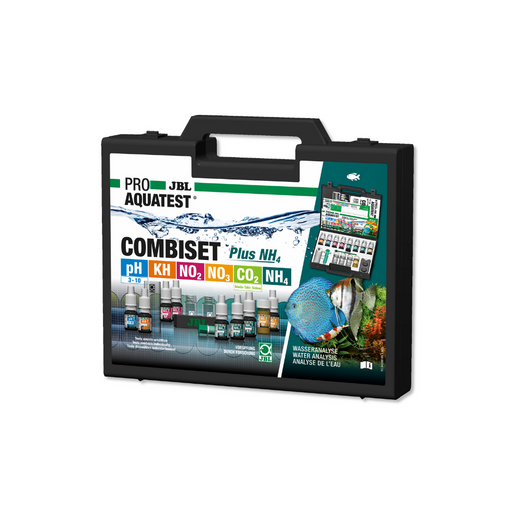
This kit brings together ten drop tests and 22 reagent bottles to monitor the water in a pond or an aquaponic system: pH, KH, GH, ammonium, nitrite, nitrate, phosphate and dissolved oxygen.
pH and phosphate are each read across two ranges, and the comparator block accounts for the natural colour of the water.
 Customer support 7 days a week by email
 Delivery within 2 to 15 business days
100 % secure payment
The summary
- What you receive: the watertight case, 22 reagent bottles, the glassware, the syringes, the thermometer and the comparator block.
- What you measure: 10 drop tests, from pH in two ranges to phosphates in two ranges, as well as dissolved oxygen.
- How long it takes: 2 minutes for total hardness, 17 minutes for ammonium, waiting time included.
- How to choose: this case is the right choice as soon as a pond warms up in summer or houses koi.
- What runs out: the 22 bottles, at very different rates depending on the test.
- Precautions: several reagents are corrosive or flammable, and none of them should ever go into the fish water.
Ten drop tests for the pond, from ammonium to dissolved oxygen
A garden pond changes faster than an indoor tank, because sunshine, rain and leaves get in unfiltered. This kit brings together ten drop tests and 22 reagent bottles, from ammonium to dissolved oxygen, so that each season can be read from measured figures rather than from how the water looks.
🔬 Ten tests in one kit
The ten tests fall into three groups: nitrogen, with ammonium, nitrite and nitrate; the mineral basics, with two pH ranges and the two hardness values; and the measurements specific to ponds, phosphate in two formulations and dissolved oxygen. The ammonium test uses 3 reagents and, via a chart that cross-references pH and temperature, gives the proportion of truly toxic ammonia. All the bottles have child-resistant caps and can be bought individually as refills, in a water-resistant plastic case that can be carried closed to the pond edge.
The nitrogen trio
Ammonium, nitrite and nitrate show how far along the biological filtration is. These are the three values to watch in a pond that is starting up or has just been restocked.
The mineral base
pH, carbonate hardness and total hardness should be read together. KH stabilises the pH, and the pH determines the toxic share of ammonia.
Two phosphate ranges
One formulation reads low concentrations, from 0.05 to 1.8 mg/L. The other takes over for koi water that is already heavily loaded.
Dissolved oxygen
You measure it from 1 to 10 mg/L on a sample drawn without bubbles. At 2 mg/L and below, the colour chart enters its red zone.
The oxygen test tube is filled by immersion
The oxygen test is the only one in the kit whose sample is not measured out with a syringe. Immerse the test tube under the water to fill it to the brim, add 6 drops of reagent 1 and 6 of reagent 2 while letting it overflow, then screw on the cap without trapping a single bubble, otherwise you are measuring the air as much as the water. Shake for 30 seconds, add 6 drops of reagent 3, shake again for 30 seconds and wait 10 minutes before reading. All three reagents are corrosive: work over a sink and rinse thoroughly in case of splashes. Then empty the test tube down the sink, as no reagent should ever go into the fish water.
🌊 Oxygen in summer
Oxygen is the parameter in this kit where a shortfall can lead to fish losses within a few hours. Warm water dissolves less of it than cool water, and a reading of 3 mg/L calls for action the same day. Aim for 5 to 8 mg/L in fresh water, and repeat the measurement at the same time of day, otherwise two readings cannot be compared. The article on pond algae in summer explains why oxygen runs short mostly at the end of the night, and when to measure it.
Re-prime the filter when nitrite is still readable
Nitrite that remains readable for several days in a row, often after a period of low oxygen, indicates that the biological filtration is no longer converting all of the pond's nitrogen load. Concentrated pond bacteria restart colonisation of the filter media, and the test kit shows you, reading after reading, whether colonisation is taking hold, right up to the reading where nitrite is no longer detectable.
🐟 Two pH ranges
The wide range runs from 3.0 to 10.0 and is read on 14 colour blocks, in steps of 0.5 above pH 4.0, which is enough to place an unknown water but not to follow a slow change. The second range covers 7.4 to 9.0, that of hard water and koi ponds, and it is the one that gives the fine resolution you need day to day. That resolution matters because pH determines the share of ammoniacal nitrogen present as ammonia, the only form that is truly toxic: the conversion is read from a chart that cross-references pH and temperature, and the thermometer in the kit is there for exactly that purpose. The guide to keeping koi carp gives the ammonia, nitrite and oxygen thresholds to maintain for this fish.
Temperature matters as much as pH in this calculation. At pH 8, the share of ammonia is around 1.8% of the ammoniacal nitrogen in water at 10 °C, and around 5.4% at 25 °C: the same ammonium content therefore becomes 3 times more toxic between a spring morning and an August afternoon. Take the temperature at the very moment you collect the sample, not the previous day's reading, before consulting the table, and redo the calculation each season rather than keeping last year's figure.
🥬 Nitrate feeds the crops
In a planted pond, nitrate stops being a waste product. Marginal plants and the lettuces on a deep water culture raft take it up, and this kit lets you follow the gap between what the fish produce and what the roots consume. Measure it at least 24 hours after a top-up of water, otherwise you are reading the dilution rather than the production. The colour chart runs from 0.5 to 200 mg/L, enough to cover a heavily stocked pond as well as a planted pond at rest.
Two other values largely determine the colour of the water in spring. Phosphate is measured here in two formulations, one for low concentrations and the other for koi water that is already heavily loaded, because a single scale cannot cover both cases. Check it alongside nitrate before you change anything in your pond, since it is the scarcer of the two nutrients that limits algae growth. The five approaches to dealing with green pond water start from these two readings.
🗂️ Keeping track of the 22 bottles
The 22 bottles do not run out at the same rate. The nitrite, ammonium and pH reagents are used up quickly on a young pond, whereas those for total hardness and for high-concentration phosphate last whole seasons. So keep an eye on the level of these three tests, because they are the ones you will run short of first, and replace them with refills sold separately. The case, test tubes, syringes, measuring spoons, thermometer, comparator block and colour charts stay with you from one year to the next.
🔗 The kit's tests, sold separately
The ten tests are also available as individual boxes, with the same reagents: the pH drop test, which comes in a wide range and in a 7.4 to 9.0 range, carbonate hardness, total hardness, ammonium, nitrite, nitrate, phosphates in the Sensitive or koi version, and dissolved oxygen. A reading from the case and a reading taken with one of these boxes can therefore be compared without any correction. For summer restocking, the oxygen refill and the nitrate refill save you from buying a whole new case, since the thermometer, the glassware and the comparator block stay in service.
Technical specifications
The Koi case at a glance
- Tests included
- 10 drop testspH and phosphate each count double, with a low range and a high range
- Parameters measured
- pH, KH, GH, NH4, NO2, NO3, PO4, O2Eight separate parameters, two of which are read on two different scales
- Reagent bottles
- 22, child-resistant capsFrom 1 bottle for carbonate hardness to 3 for ammonium and for oxygen
- Method
- Liquid reagents, colorimetric readingThe comparator chart allows for the water's own colouring, including leaves and peat
- Waters covered
- Garden pond and koi pondThe two phosphate ranges tell clear water apart from water that is already overloaded
- Manufacturer's reference
- JBL 2407200, PROAQUATEST rangeEAN code 4014162240729
The ten tests, one by one
- pH, wide range
- 3.0 to 10.014 colour fields, in steps of 0.5 above pH 4.0, to gauge an unknown water sample
- pH, alkaline range
- 7.4 to 9.0The one for hard water and koi ponds, fine enough to track a slow change
- KH, carbonate hardness
- Titration, 1 drop = 1 °dKHBelow 5 °dKH, the pH of a pond becomes unstable
- GH, total hardness
- Titration, 1 drop = 1 °dGHFor a 5 ml water sample. The colour change goes from red to green
- NH4 and NH3, ammonium
- Colorimetric, with 3 reagentsFrom 0.05 to 5 mg/L, converted into toxic ammonia using the pH and the temperature from the supplied thermometer
- NO2, nitrites
- 0.025 to 1 mg/LThe target is zero, and it is the reference value during start-up
- NO3, nitrates
- 0.5 to 200 mg/LTo be measured at least 24 hours after topping up with water, otherwise you are reading the dilution
- PO4, Sensitive version
- 0.05 to 1.8 mg/LThe low range, where the trade-off between plants and algae is decided
- PO4, koi version
- 0.1 to 10 mg/LIt takes over on water that the low range saturates
- O2, dissolved oxygen
- 1 to 10 mg/LAim for 5 to 8 mg/L in fresh water. The colour chart turns red at 2 mg/L and below
The technique and the timing
- Volume of water per test
- 5 or 10 mlExcept oxygen, where the test tube is filled by immersion, without any bubbles
- Waiting time
- 0 to 15 minutesNone for KH and GH, 5 minutes for nitrite, 10 for nitrate and oxygen, 15 for ammonium
- Titration tests
- KH and GHYou count the drops until the colour change, with no colour chart to compare against
- Reading
- Colour chart, in daylightIn the shade, in broad daylight, never under a warm-coloured lamp
Aquaponics benchmarks
- Ammonium and nitrite
- Around 0, 1 mg/L at mostFish health starts to decline from 0.25 mg/L of nitrite
- Nitrate
- 5 to 150 mg/LThe plants' nitrogen ration, renewed by the water beyond that
- pH
- 6.4 to 7.5The kit's alkaline range covers the upper end
- Total hardness GH
- 60 to 140 mg/LAround 3 to 8 °dGH
- Dissolved oxygen
- At least 5 mg/L6 to 8 mg/L for cold-water fish
- Temperature
- 18 to 30 °C10 to 18 °C for salmonids
Hazard labelling
- Signal word
- DangerKH, nitrite 1, nitrate, ammonium 2 and 3, phosphates 2, oxygen
- Pictograms
- Flame, corrosion, exclamation mark, health hazard, environmentEach bottle carries its own
- Hazard statements
- H225, H226, H302, H314, H317, H341, H373, H411H314 on most of the classified bottles, H334 for oxygen 3
- Precautionary statements
- P101, P102, P303+P361+P353, P305+P351+P338, P501Keep the original label for a doctor
- Where to dose
- Over a sink, in the open airWear gloves and keep away from flames
- Leftover test water
- At the sinkNever in the pond or in the fish's water
To allow for in addition
- Iron
- An iron (Fe) testYellow foliage between veins that stay green is settled by this figure
- Reagent refills
- Reagents sold individuallyGlassware, syringes, thermometer, comparator block and colour charts all keep well
26 further specifications are available in the detailed view.
In the box
- 1 water-resistant plastic case
- 22 reagent bottles with child-resistant caps
- Glass test tubes
- Plastic test tubes
- Sampling syringes
- Dosing scoops
- 1 thermometer
- 1 laboratory comparator block
- 1 set of colour charts
- 1 ballpoint pen
- 1 set of analysis sheets
- 1 instruction manual
Manufacturer's values (JBL PROAQUATEST LAB Koi 2407200 data sheet and instructions for the tests sold individually). Aquaponic guidelines from the FAO manual.
Manufacturer and product safety
- Manufacturer
- JBL GmbH & Co. KG
- Postal address
- Dieselstraße 3, 67141 Neuhofen, Allemagne
- Contact
- info@jbl.de
- Website
- www.jbl.de
Information provided under Regulation (EU) 2023/988 on general product safety.
Ten tests, six tests or five boxes?
Same drops, same comparator block for all three. The difference lies in the number of parameters monitored and in how you reorder empty bottles.
Dissolved oxygen is tracked with a numerical reading
This set adds oxygen, nitrate, a fine-range pH test and a second phosphate scale. Two answers are enough for the table to highlight the size best suited to your pond.
| Drop-based tests (tests) | pH, KH, ammonium and nitrite | NO3, nitrates | GH, total hardness | PO4, phosphates | O2, dissolved oxygen | pH, fine range from 7.4 to 9.0 | High-concentration PO4, koi version | Single kit with comparator block | Thermometer included | Each parameter in its own box | Price | |
|---|---|---|---|---|---|---|---|---|---|---|---|---|
| 6-in-1 pond water analysis kitYour choice | 6 tests | Yes | No | Yes | Yes | No | No | Yes | Yes | No | No | 52,90 € |
| Recommended 10-in-1 kitYour choice | 10 tests | Yes | Yes | Yes | Yes | Yes | Yes | Yes | Yes | Yes | No | 119,90 € |
| Pack of 5 aquaponics water tests: NH4, NO2, NO3, pH, KHYour choice | 5 tests | Yes | Yes | No | No | No | No | No | No | No | Yes | 63,90 € |
6-in-1 pond water analysis kit
What you are measuring
Drop-based tests (tests)6 tests
pH, KH, ammonium and nitriteYes
NO3, nitratesNo
GH, total hardnessYes
PO4, phosphatesYes
O2, dissolved oxygenNo
pH, fine range from 7.4 to 9.0No
High-concentration PO4, koi versionYes
The format and restocking
Single kit with comparator blockYes
Thermometer includedNo
Each parameter in its own boxNo
Price
10-in-1 kitRecommended
What you are measuring
Drop-based tests (tests)10 tests
pH, KH, ammonium and nitriteYes
NO3, nitratesYes
GH, total hardnessYes
PO4, phosphatesYes
O2, dissolved oxygenYes
pH, fine range from 7.4 to 9.0Yes
High-concentration PO4, koi versionYes
The format and restocking
Single kit with comparator blockYes
Thermometer includedYes
Each parameter in its own boxNo
Price
Pack of 5 aquaponics water tests: NH4, NO2, NO3, pH, KH
What you are measuring
Drop-based tests (tests)5 tests
pH, KH, ammonium and nitriteYes
NO3, nitratesYes
GH, total hardnessNo
PO4, phosphatesNo
O2, dissolved oxygenNo
pH, fine range from 7.4 to 9.0No
High-concentration PO4, koi versionNo
The format and restocking
Single kit with comparator blockNo
Thermometer includedNo
Each parameter in its own boxYes
Price
Parameters, contents and references are taken from the official JBL PROAQUATEST data sheets, then cross-checked against the instructions for the tests sold individually.
Buying guide
Are ten tests justified in your case?
Estimate your
delivery time
Your estimate
Delivery
Estimated time
It covers preparing your order and then the transit time quoted by the carrier, counted in working days.
It is not a guaranteed delivery date: public holidays, peak periods, customs or a carrier delay can extend it. The exact amount, in your currency, is worked out in the cart once your address is entered.
1.9 kg parcel, dispatched within 48 hours by Colissimo or Chronopost to your home, as you choose during checkout. The exact amount is shown in the basket. Once unsealed, this product cannot be returned under the right of withdrawal (article L221-28, 5° of the French Consumer Code), for reasons of hygiene and health protection.
Frequently asked questions
10 questions
6 key questions, 10 in the detailed view
You may also like




Related articles

Understanding
The nitrogen cycle in aquaponics
The nitrogen cycle, which the ammonium, nitrite and nitrate in this case track.
Read the article

Parameters
Regulating pH in an aquaponics system
Adjusting the pH, once the reading has been taken on both ranges.
Read the article

Pond
Green pond water: 5 solutions
Five solutions for green water, to be chosen after reading the test results.
Read the article

Algae

Starting out
Getting started with an aquaponic system
Getting a system off to a good start, following the water test after test.
Read the article

Troubleshooting
Understanding and correcting cloudy water in aquaponics
Understanding and correcting cloudy water, backed by measurements.
Read the article
Let us talk about your project
A question about this product or your setup? Our team will answer and advise you.

Interest-free instalment payments
Offered depending on the cart amount, at checkout.

Delivery in 2 to 15 working days
Depending on the products and shipping sites. Estimate by destination in the estimator on this page.

After-sales service 7 days a week by email or chat
Our team answers all your questions.

Shop responsibly
Become part of the change.
