



Pack of 5 aquaponics water tests: NH4, NO2, NO3, pH, KH
Regular price
63,90 €
Regular price
68,50 €
Sale price
63,90 €
Unit price
/
per
21,30 € × 3 with no fees
Klarna.
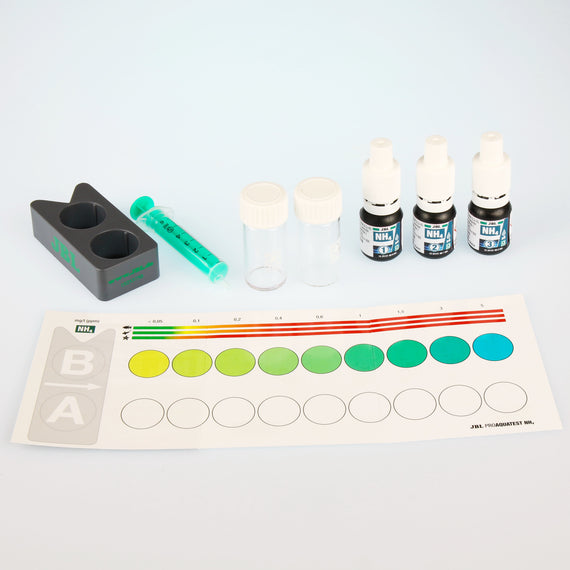
This pack brings together the five tests used to manage an aquaponic system, each in its own box: ammonium, nitrite, nitrate, pH, and carbonate hardness. These drop tests provide 40 to 50 readings per box.
The pack covers a full system start-up, and each box can be repurchased individually once its bottle is empty.
 Customer support 7 days a week by email
 Delivery within 2 to 15 business days
100 % secure payment
The summary
- What you receive: five drop test kits — ammonium, nitrite, nitrate, pH and carbonate hardness.
- Why these five: three track the nitrogen cycle from start to finish, two indicate whether the pH will remain stable.
- How many tests per kit: 40 to 50 measurements per kit depending on the test — enough to cover an entire start-up.
- How long it takes: 2 minutes for KH, 17 minutes for ammonium, including waiting time.
- Individual kits or set: each parameter has its own kit and can be replaced individually when the bottle runs out.
- What gets sent to you: all five kits in their original packaging, reagents upright.
Five JBL drop tests, each in its own box, for managing the nitrogen cycle
In aquaponics, the same water passes through the fish, the bacteria, and the roots, meaning that a single water analysis gives information about all three simultaneously. This pack brings together the five key measurements for this monitoring: ammonium, nitrite, and nitrate track the nitrogen cycle from start to finish, while pH and KH indicate whether the water's chemical balance will remain stable from one week to the next.
♻️ The role of each value
Ammonium is what the fish excrete, and it is the first signal to watch: it must remain below the threshold, otherwise it builds up. Nitrite is the intermediate stage and the most dangerous; its target is zero, since no detectable reading is acceptable. Nitrate is the end product, and it is the only one of the three values you are not trying to eliminate, since your plants take it up as a fertiliser. This sequence is described in full in the article on the nitrogen cycle in aquaponics.
That leaves the two field values. pH is the result of a compromise between two opposing needs: nitrification works more efficiently in slightly alkaline water, while roots absorb iron and phosphorus more readily in slightly acidic water. KH, on the other hand, is not read for its own sake: it measures the buffering capacity of the water, that is, its ability to neutralise the acids produced by nitrification. Below 5 °dKH, your pH can drop sharply overnight, and the activity of the bacteria in the biofilter slows in turn.
Take the reading away from any treatment point and in the middle of the volume
A reading taken the day after a treatment partly reflects the product you added rather than the actual state of your water, so it is better to wait until the treatment has finished. Then sample from the middle of the volume, as water drawn from just below the surface is not representative of the tank as a whole. Finally, read your colours in daylight: artificial evening light shifts the perception of pinks and oranges, and therefore the value you record.
🐟 Start-up, week by week
During start-up, the five tests are not needed at the same frequency. Nitrite and ammonium should be measured every day for the first 3 weeks of a new system, as these are the indicators of danger to the fish. pH and KH should be checked once a day in the first week, then once a week. Nitrate, on the other hand, should be checked once a week from the moment the system is filled: it is the rise in nitrate levels that confirms the biofilter has been fully colonised and that your crops will have a supply of nitrogen.
Restoring buffering capacity with potassium bicarbonate
When the KH test shows that the buffering capacity is running low, it needs to be restored: pick up some potassium bicarbonate at the same time, as it raises the carbonate hardness whilst supplying potassium rather than sodium, an element your crops actually need. On a system fed with rainwater, it is the supplement you will add most often.
Weeks 1 to 3
Measure ammonium and nitrite every day, at the same time. These are the two values that fluctuate during this period.
The end of cycling
Nitrite drops rapidly and nitrate rises, indicating that colonisation of the biofilter is complete.
Then
One full set of readings per week is enough, with pH and KH changing slowly.
After an incident
Resume the daily routine after each addition of fish or pump failure.
📒 The logbook
A single reading is hard to interpret on its own. Note each measurement with its date, the water temperature and the last action taken on the system, and it is that column of dates that will prove most useful: a run of 6 weeks reveals a trend where a single day's measurement shows only a number. The year planner helps you anchor this monitoring on something more solid than intuition.
This monitoring is primarily used to balance fish stocking and crop production. The benchmark published by the FAO for raft or gutter systems is 40 to 50 g of feed per day per square metre of leafy vegetables, and 50 to 80 g for fruiting vegetables. If your nitrate rises week after week, the feed rate exceeds what your growing area can absorb, and it is that area which needs to be increased. If it stays close to zero once the system has finished cycling, your plants are short of nitrogen and the feed rate or fish load is too low.
💧 The step common to all five tests
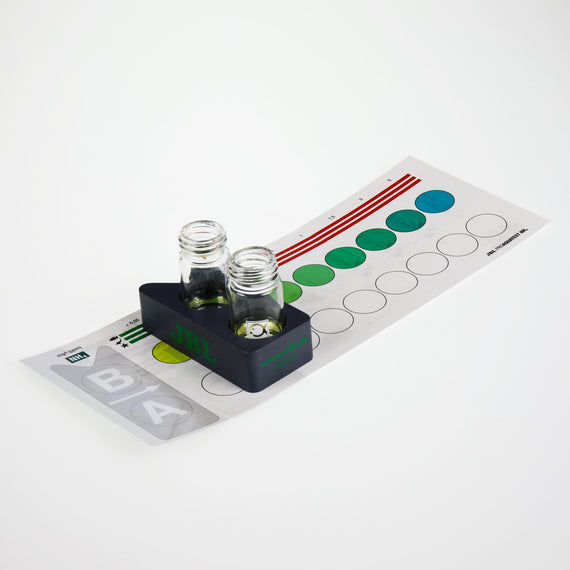
All five tests share the same technique, and it is this technique that determines the accuracy of a reading. Always hold the dropper bottle vertically, nozzle pointing down, and let the drops fall without air bubbles, keeping the outside of the nozzle dry, as a poorly formed drop alters the dose. Rinse the test tube several times with the water to be analysed before filling it, and draw the required volume using a sampling syringe rather than estimating by eye. Store reagents in a dry place at room temperature in their original packaging, and allow a cold sample to return to room temperature before testing, as cold water slows colour development.
Technical specifications
What the kit measures
- Ammonium NH4
- 0.05 to 5 mg/LBelow 0.05 mg/L the test reads zero, which is the expected result on a well-established system
- Nitrite NO2
- 0.025 to 1 mg/LThe target is zero. Unlike nitrate, no readable value is comfortable
- Nitrate NO3
- 0.5 to 200 mg/LThe final product of the cycle, the one your plants take up
- pH
- Wide range, 3.0 to 10.014 colours on the colour chart, in steps of 0.5 above pH 4.0
- KH, carbonate hardness
- Titration, 1 drop = 1 °dKHOn 5 ml of water. At least 5 °dKH for the pH to remain stable
- Common method
- Liquid reagents, colorimetric readingA few drops into a measured volume of water, then read against the colour chart
The technique and the timing
- Water volume per test
- 5 or 10 ml5 ml for pH, KH, nitrite and ammonium, 10 ml for nitrate
- Waiting time
- 0 to 15 minutesNone for KH, 5 minutes for pH and nitrite, 10 for nitrate, 15 for ammonium
- Tests per box
- 40 to 50 depending on the testAround 40 for nitrate, around 50 for ammonium, nitrite and pH.
- Reading
- Colour chart, in daylightA warm artificial light shifts the perception of pink and orange shades
Safety
- Ranking
- Danger across four testsThe pH test carries the word Caution, the lower of the two hazard levels under CLP regulations
- Precautions
- Sink, well-ventilated room, out of reachSeveral reagents are flammable; keep them away from any naked flame. Child-resistant caps.
To budget for separately
- Reagent refills
- Reagents sold individuallyThe glassware and colour charts from each kit are reusable; only the liquids run out
- How to raise the KH
- Potassium bicarbonateIt restores the buffering capacity and supplies potassium to the crops.
6 further specifications are available in the detailed view.
In the box
- 1 NH4 ammonium test, 3 reagent bottles, approximately 50 measurements
- 1 NO2 nitrite test, 2 reagent bottles, approximately 50 measurements
- 1 NO3 nitrate test, 2 reagent bottles, approximately 40 measurements
- 1 wide-range pH test, 1 reagent bottle, approximately 50 measurements
- 1 KH titration test, 1 reagent bottle
Measurement ranges, protocols, number of tests and hazard statements recorded test by test from the official JBL PROAQUATEST data sheets, on 10/09/2026.
Five boxes, or a kit?
All three use the same drop reagents. What sets them apart is the range of what they measure and how you replace what runs out.
A plant that turns pale is not always explained by nitrogen alone
Ammonium, nitrite, nitrate, pH and KH describe the water and the bacteria. Iron and phosphates, on the other hand, describe the nutrients available to your crops.
| Parameters measured (parameters) | NH4, NO2, NO3, pH and KH | Fe, iron | PO4, phosphates | GH, total hardness | O2, dissolved oxygen | Single kit with comparison block | Each parameter in its own box | Price | |
|---|---|---|---|---|---|---|---|---|---|
| Recommended Pack of 5 boxesYour choice | 5 parameters | Yes | No | No | No | No | No | Yes | 63,90 € |
| 6-in-1 Aquarium Water Testing KitYour choice | 6 parameters | Yes | No | No | No | No | Yes | No | 50,90 € |
| 14-in-1 water analysis kit for aquariumYour choice | 14 parameters | Yes | Yes | Yes | Yes | Yes | Yes | No | 119,90 € |
Pack of 5 boxesRecommended
What you're measuring
Parameters measured (parameters)5 parameters
NH4, NO2, NO3, pH and KHYes
Fe, ironNo
PO4, phosphatesNo
GH, total hardnessNo
O2, dissolved oxygenNo
The form and restocking
Single kit with comparison blockNo
Each parameter in its own boxYes
Price
6-in-1 Aquarium Water Testing Kit
What you're measuring
Parameters measured (parameters)6 parameters
NH4, NO2, NO3, pH and KHYes
Fe, ironNo
PO4, phosphatesNo
GH, total hardnessNo
O2, dissolved oxygenNo
The form and restocking
Single kit with comparison blockYes
Each parameter in its own boxNo
Price
14-in-1 water analysis kit for aquarium
What you're measuring
Parameters measured (parameters)14 parameters
NH4, NO2, NO3, pH and KHYes
Fe, ironYes
PO4, phosphatesYes
GH, total hardnessYes
O2, dissolved oxygenYes
The form and restocking
Single kit with comparison blockYes
Each parameter in its own boxNo
Price
Parameters covered and contents of all three references taken from the official JBL PROAQUATEST datasheets on 10/09/2026.
Help choosing
Are five parameters enough for your setup
Estimate your
delivery time
Your estimate
Delivery
Estimated time
It covers preparing your order and then the transit time quoted by the carrier, counted in working days.
It is not a guaranteed delivery date: public holidays, peak periods, customs or a carrier delay can extend it. The exact amount, in your currency, is worked out in the cart once your address is entered.
Parcel containing all five boxes in their original packaging, reagents upright, with the choice of a collection point or Colissimo home delivery at checkout. The exact amount is shown at checkout once your address has been entered.
Frequently asked questions
8 questions
6 key questions, 8 in the detailed view
You may also like




Related articles

Guide
The nitrogen cycle in aquaponics
The three stages of the nitrogen cycle, in the order this pack measures them, and what each level means for your fish.
Read the article

Practical
Getting started with an aquaponic system
What to have to hand before introducing the first fish, and the monitoring schedule for the first two months.
Read the article

Technique
Regulating pH in an aquaponics system
Why an aquaponics pH is negotiated between bacteria and roots, and how KH acts as a buffer.
Read the article

Practical
A practical schedule for success with aquaponics
When to measure, when to correct, when to do nothing. The rhythm of a full year, useful for setting up a monitoring log.
Read the article

Understanding
Is aquaponics suited to animal welfare?
What well-maintained water changes for the fish themselves, beyond the yield of the crops.
Read the article

Season
Pond algae in summer
Green water is not sick water, but it is read using the same figures. Possible causes and chemical-free corrections.
Read the article
Let us talk about your project
A question about this product or your setup? Our team will answer and advise you.

Interest-free instalment payments
Offered depending on the cart amount, at checkout.

Delivery in 2 to 15 working days
Depending on the products and shipping sites. Estimate by destination in the estimator on this page.

After-sales service 7 days a week by email or chat
Our team answers all your questions.

Shop responsibly
Become part of the change.
