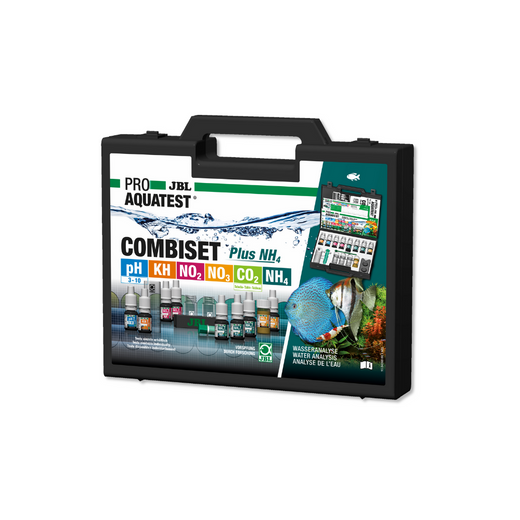


Nitrate NO3 water test in drops
Regular price
19,90 €
Regular price
Sale price
19,90 €
Unit price
/
per
6,63 € × 3 with no fees
Klarna.
This drop-based colorimetric test measures nitrate NO3 in aquariums, ponds, and aquaponic systems, using a colour comparator block and a reference sample. In freshwater, the recommended value should remain below 30 mg/L.
Nitrate is the final stage of the nitrogen cycle: a waste product to dilute in an aquarium, and a nitrogen feed for crops in aquaponics.
 Customer support 7 days a week by email
 Delivery within 2 to 15 business days
100 % secure payment
The summary
- In the box: 2 reagent bottles — one powder, one liquid — 2 glass test tubes, a sampling syringe, a double-ended measuring spoon, a comparator block and a colour chart.
- What it measures: dissolved nitrate, across a nine-field colour chart, using a reference sample that cancels out the natural colour of the water.
- How long it takes: 12 minutes per test, including 10 minutes of waiting time, with approximately 40 tests per kit.
- Useful thresholds: 30 mg/L in a freshwater aquarium, 20 mg/L in marine water, 5 mg/L in a garden pond.
- The one reading worth doing: test your top-up water on its own in a glass as well. Its nitrate content tells you whether a water change dilutes nitrate or actually adds more.
- What gets sent to you: a 0.15 kg parcel, reagents in their original packaging, available for collection point or home delivery.
Nitrate drop test, 40 measurements, aquarium, pond and aquaponics
Nitrate is the final stage of the nitrogen cycle. Proteins break down into ammonium, ammonium becomes nitrite, nitrite becomes nitrate, and nitrification stops there. In a lightly planted aquarium, the plants absorb too little of it to compensate, so it accumulates until the next water change.
🔗 The final stage of the cycle
A nitrate level that rises week on week while ammonium and nitrite remain undetectable tells you two things at once. Your biological filter is working, since the bacteria are converting everything that reaches them, and your nitrogen consumers are not keeping pace with it. In a garden pond, this imbalance is most common in a heavily stocked koi pond with no base grow medium and no planted lagoon zone, or when garden fertilisers run off into the water. The nitrogen cycle follows the same course in an aquarium and in aquaponics, but the conclusions you draw from it differ depending on whether you are keeping fish only or also growing plants.
Nitrate high, ammonium and nitrite at zero
Nitrification is working, but the nitrogen produced is not being consumed sufficiently: check plants, growing surface, or reduce fish numbers.
High nitrate with ammonium
Two separate problems are occurring at once. Treat the ammonium first, as its toxicity is immediate, then correct the nitrate the following day.
Low nitrate in a planted tank
With plenty of plants and just a few small fish, nitrate becomes a deficiency factor and must be supplied via a nitrogen fertiliser.
Low nitrate in aquaponics
The lower leaves pale before the figures raise the alarm. Your fish load is low, the biofilter is slow, or the plants have taken everything up.
Shake the powder down to the grey residue before reading
Reagent 1 is a powder, and the accuracy of the result depends on thorough mixing. Add the large measure of reagent 1 followed by the 6 drops of reagent 2, close the test tube, and shake vigorously until only a few grey powder residues remain. Then allow the full 10 minutes' rest, if you skip this, the colour will not develop completely and you will read a value that is too low. Use the supplied syringe to measure both 10 ml samples rather than estimating by eye.
🥬 A nitrogen ration for your crops
The same figure can be read in two opposite ways. The aquarist measures nitrate to know when to siphon, because in their tank it is a waste product to be removed. If you are growing plants, you measure it to find out whether your lettuces have enough nitrogen for growth: nitrate here is a nitrogen ration that your fish produce and your plants consume. A figure that keeps rising despite well-stocked grow beds signals that the balance between source and consumers has broken down.
Plan to reorder whichever bottle empties first
Order the reagent refill now, because on a working installation, nitrate is measured every week and its bottle will be the first you empty. The glassware, the measure, the comparison block, and the colour chart can all be kept from one purchase to the next. This way you have a full season of weekly readings without having to wait for a new order just when levels start to rise.
When levels exceed what your plants can absorb, several approaches can be combined. Regular partial water changes dilute the concentration, a nitrate-reducing filter medium removes a portion, and you can also increase the planted area or reduce the fish stock. In a garden pond, sufficient substrate for rooted plants contributes too. In aquaponics, adding a grow bed is almost always preferable to draining water loaded with nitrogen your plants could have taken up. For the balance between fish and crops, see also the article Getting started with an aquaponic system.
🚰 Your top-up water matters
Your tap water already contains nitrate. The French regulatory limit for drinking water is set at 50 mg/L, which means perfectly compliant water can contribute a significant amount, and the actual level depends entirely on your local supply. Fill a glass from the tap and measure that water on its own: this reading, which only needs to be done once, tells you whether each water change dilutes the nitrate in your tank or adds to it.
🎨 One colour chart, three environments
The colour chart does not carry a single scale but two rows of figures and three colour bands. The top row is for freshwater and pond use, the bottom row for marine water, because high salinity dampens the colour development of the reaction: the same shade corresponds to a higher concentration. Above each field, a pictogram identifies the environment, a fish for the freshwater aquarium, a koi for the pond, a starfish for the reef, and a green, yellow, or red band indicates whether action is needed. Always read the line for your own environment, as the same value may be green for an aquarium and already yellow for a pond.
These stricter thresholds for ponds come down to algae. A high nitrate level only encourages their growth when the water also contains phosphate, and a pond exposed to sunlight and fluctuating temperatures reacts more quickly than an aquarium. This is why green water is rarely resolved without measuring phosphate at the same time as nitrate, from the same sample. Other approaches, from shading to marginal plants, are covered in the article on green water in ponds.
Technical specifications
The essentials
- Parameter measured
- Nitrate, expressed as NO3The final stage of the nitrogen cycle, produced by bacteria from nitrite
- Measurement range
- 0.5 to 200 mg/LNine-field colour chart, graduated up to 220 mg/L for saltwater
- Tests per kit
- Approximately 40
- Recommended thresholds
- No more than 30 mg/L in freshwater20 mg/L in a marine aquarium, 5 mg/L in a garden pond
- Method
- Powder, drops and block comparatorThe blank tube cancels the natural tint of the water, even when it is heavily coloured
- Reference
- JBL 2412500, PROAQUATEST rangeCode EAN 4014162241252
The procedure
- Water volume
- 2 times 10 mlTwice as long as for ammonium and nitrite. One treated test tube, one control test tube
- Reagents to dose
- 1 level measure and 6 dropsLarge end of the double-ended measuring spoon for reagent 1, in powder form
- The steps
- Rinse, fill, dose, shake, wait, readIn that order. Vigorous shaking is the step most often cut short, and the accuracy of the result depends on it.
- Waiting time
- 10 minutesFull colour development time. Reading earlier will give a lower value
- Total duration
- Approximately 12 minutesHandling included
- Testing frequency
- 1 time per weekAlways at the same time, and at least 24 hours after a water change
Security and parcels
- Ranking
- DangerThe two reagent bottles are classified
- Main risks
- Burns, eye injuries, allergic reactionH314, H318 and H317 hazard statements. H341, suspected genetic defects, for reagent 2
- Precautions
- Gloves, sink, out of reachEmpty the treated test tube down the sink, never into the tank: H411 and H412 statements, aquatic toxicity
- Parcel weight
- 0.15 kgPackaging included
To budget for separately
- Reagent refill
- Reagents only, ref. 2412600The glassware, the syringe, the measuring scoop, the comparator block and the colour chart can all be kept
- To read alongside
- PhosphateAn algae bloom requires both factors in the same water: nitrate alone does not account for it
10 further specifications are available in the detailed view.
In the box
- 2 reagent bottles, one in powder form and one in drops
- 2 glass test tubes with screw caps
- 1 graduated sampling syringe
- 1 double-ended measure, large and small tip
- 1 grey comparator block with reading slot
- 1 colour chart and 1 multilingual instruction leaflet, French included
Reference, EAN code, kit composition, number of tests, protocol, thresholds by medium and hazard statements taken from the manufacturer's product data sheet and instructions for use, 19/09/2026. The range and nine fields are read from the colour chart supplied. The 50 mg/L limit for drinking water is the French regulatory quality standard.
Nitrate alone, or the full nitrogen cycle?
Same drop reagents, same colour comparator block, same manufacturer. What changes is the number of questions the kit can answer.
The nitrate test alone, or a full kit?
Two questions about your setup, and the relevant row highlights automatically.
| Parameters covered (parameters) | Drop tests included (tests) | Nitrate NO3 | Ammonium, nitrites, pH and carbonate hardness | Phosphates, iron, copper, oxygen and silicates | Glass test tubes | Laboratory comparator block | Thermometer | Reagent refill sold separately | Price | |
|---|---|---|---|---|---|---|---|---|---|---|
| Recommended Nitrate NO3 test onlyYour choice | 1 parameters | 1 tests | Yes | No | No | 2 | Yes | No | Yes | 19,90 € |
| 6-in-1 Aquarium Water Testing KitYour choice | 6 parameters | 5 tests | Yes | Yes | No | 3 | Yes | No | Yes | 50,90 € |
| 14-in-1 water analysis kit for aquariumYour choice | 14 parameters | 13 tests | Yes | Yes | Yes | 12 | Yes | Yes | Yes | 119,90 € |
Nitrate NO3 test onlyRecommended
What the kit covers
Parameters covered (parameters)1 parameters
Drop tests included (tests)1 tests
Nitrate NO3Yes
Ammonium, nitrites, pH and carbonate hardnessNo
Phosphates, iron, copper, oxygen and silicatesNo
Equipment supplied
Glass test tubes2
Laboratory comparator blockYes
ThermometerNo
What needs replacing
Reagent refill sold separatelyYes
6-in-1 Aquarium Water Testing Kit
What the kit covers
Parameters covered (parameters)6 parameters
Drop tests included (tests)5 tests
Nitrate NO3Yes
Ammonium, nitrites, pH and carbonate hardnessYes
Phosphates, iron, copper, oxygen and silicatesNo
Equipment supplied
Glass test tubes3
Laboratory comparator blockYes
ThermometerNo
What needs replacing
Reagent refill sold separatelyYes
14-in-1 water analysis kit for aquarium
What the kit covers
Parameters covered (parameters)14 parameters
Drop tests included (tests)13 tests
Nitrate NO3Yes
Ammonium, nitrites, pH and carbonate hardnessYes
Phosphates, iron, copper, oxygen and silicatesYes
Equipment supplied
Glass test tubes12
Laboratory comparator blockYes
ThermometerYes
What needs replacing
Reagent refill sold separatelyYes
Parameters covered, equipment supplied and kit contents recorded from the three product pages on 05/09/2026. Kits compared: 6-in-1 case and 14-in-1 case.
Help choosing
Two questions to help you decide
Documents & manuals
Official manufacturer's instructions, in French
Six-step protocol, volumes and dosage of both reagents, recommended thresholds for fresh water, salt water, and ponds, plus explicit mention of nitrate becoming a deficiency factor in a heavily planted tank.
Document not showing? Some publishers block display inside a frame, so open it in a tab.
Estimate your
delivery time
Your estimate
Delivery
Estimated time
It covers preparing your order and then the transit time quoted by the carrier, counted in working days.
It is not a guaranteed delivery date: public holidays, peak periods, customs or a carrier delay can extend it. The exact amount, in your currency, is worked out in the cart once your address is entered.
Parcel of 0.12 kg, dispatched to a collection point or by Colissimo to your home address, as chosen at checkout. The reagents are sent in their original box, powder and drops kept separate. The exact amount is shown at checkout.
Frequently asked questions
8 questions
6 key questions, 8 in the detailed view
You may also like


Related articles

Guide
The nitrogen cycle in aquaponics
Why nitrate comes last, and why it accumulates when nothing is consuming it.
Read the article

Crops
Which fertiliser should you use in aquaponics?
What the fish already provide, and what still needs to be added when nitrate is sufficient but the leaves are turning pale.
Read the article

Diagnosis
Plant deficiencies in aquaponics
Pale lower leaves are the first sign of insufficient nitrogen, well before any test result becomes alarming.
Read the article

Pond
Green pond water: 5 solutions
Why simply reducing nitrate alone is almost never enough to clear green water.
Read the article

Diagnosis
Identifying deficiencies in aquaponics
Telling apart a nitrogen deficiency from an iron deficiency when both cause yellowing leaves.
Read the article

Troubleshooting
Understanding and clearing cloudy water
Coloured water distorts any reading taken without a blank sample in the comparator block.
Read the article
Let us talk about your project
A question about this product or your setup? Our team will answer and advise you.

Interest-free instalment payments
Offered depending on the cart amount, at checkout.

Delivery in 2 to 15 working days
Depending on the products and shipping sites. Estimate by destination in the estimator on this page.

After-sales service 7 days a week by email or chat
Our team answers all your questions.

Shop responsibly
Become part of the change.
