Iron deficiencies in aquaponics : what to do ?

01 February 2026
carence en aquaponie

Iron deficiencies are among the most common problems encountered by aquaponic growers. Yellow leaves, slowed growth, and plants that stagnate despite clear water and a functioning nitrogen cycle are often the first visible signs of a lack of absorbable iron.

Without appropriate correction, this deficiency severely limits photosynthesis and prevents plants from developing properly, even when nitrates are sufficient.

The most frequent imbalance in aquaponics

In aquaponics, it's common to observe plants that yellow, stagnate, or seem weak even when the system appears stable. The water is clear, the fish are healthy, nitrates are present… and yet, plant production doesn't take off. In the vast majority of cases, this phenomenon is linked to an iron deficiency, one of the most frequent imbalances in aquaponics.

Iron is a paradoxical element : essential for plant growth, yet difficult to maintain in an assimilable form in an aquaponic system. Its availability depends closely on pH, water chemistry, and the form in which it is supplied. Without a precise understanding of these mechanisms, adjustments are often ineffective, temporary, or incorrectly dosed.

The role of iron in plant growth

Iron is an essential micronutrient for plant function. It plays a direct role in photosynthesis, chlorophyll production, and several enzymatic reactions vital for growth. Without readily available iron, a plant is unable to efficiently convert light into energy, even if all other nutrients are present.

In aquaponics, this role is even more critical because plant growth relies on a precise balance between nutrients from the fish and the plants' ability to absorb them. An iron deficiency acts as a biological lock : the system can produce sufficient nitrates, but the plant remains stunted.

Iron is also a non-mobile nutrient in the plant. This means that once a leaf is deficient, the plant cannot redistribute iron from older leaves. This is why symptoms first appear on young shoots.

Identifying iron deficiency in aquaponics

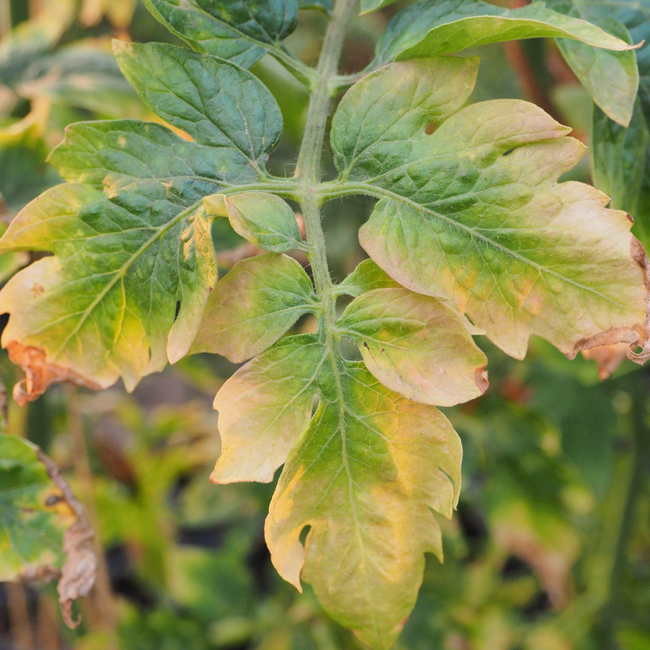
The most common sign of iron deficiency is interveinal chlorosis on young leaves : the leaf tissue turns pale yellow while the veins remain green. Older leaves usually remain relatively healthy at first. This distinction is essential for differentiating iron deficiency from nitrogen deficiency, which initially affects older leaves.

As the deficiency progresses, growth slows noticeably. New leaves become smaller and more fragile, and some plants may stop growing altogether. Fast-growing crops such as lettuce, herbs, tomatoes, or cucumbers are often the first to show visible symptoms.

When these signs appear while nitrates are present and the system is otherwise stable, iron deficiency is almost always the primary cause.

Why are your aquaponic systems lacking iron ?

Contrary to what one might think, the iron naturally provided by fish is largely insufficient to meet the needs of plants in aquaponics.

The main problem stems from the pH. At a pH close to or above 7, free iron precipitates and becomes unavailable to the roots. However, many aquaponic systems naturally operate within a pH range of 6.8 to 7.5, particularly for the well-being of the fish and bacterial stability.

The result : even if iron is present, it is not usable by plants. This is why iron deficiencies appear in both young systems and mature, well-balanced installations.

Chelated iron is essential in aquaponics

To remain available in the water and assimilable by plants, iron must be chelated. Chelation involves surrounding the iron ion with a protective molecule that prevents it from precipitating, even when pH levels are not optimal.

Non-chelated iron is unusable in aquaponics : it precipitates quickly and settles in the system without ever being absorbed. In contrast, chelated iron specifically adapted to aquaponics remains soluble, distributes evenly, and is gradually taken up by plant roots.

For this reason, chelated iron is considered a fundamental input in aquaponics, on the same level as pH management or filtration. Without it, achieving stable and long-term plant growth is extremely difficult.

At Univers Aquaponie, we offer a chelated iron specifically designed for aquaponics, formulated to remain effective within the typical pH ranges of domestic systems.

Which chelated iron should I choose for my aquaponics system ?

Not all chelated irons are created equal. Their effectiveness depends on the type of chelator used and the pH range in which they remain stable. A good chelated iron for aquaponics is :

  1. Stable in water
  1. Easily assimilated
  1. Safe for fish and bacteria,
  1. Easy to dose precisely.

In aquaponics, it is essential to choose a chelated iron compatible with a pH between 6.5 and 7.5, which corresponds to the majority of balanced systems. An unsuitable product can lose its effectiveness very quickly or require excessive dosages.

Correcting an iron deficiency without disrupting the balance

Correcting an iron deficiency should always be done gradually. The goal is not to force growth, but to restore sufficient availability so that plants can function normally.

Chelated iron is added directly to the system water, strictly following the recommended dosages. The first signs of improvement usually appear within a few days, but attention should be focused primarily on new leaves.

Leaves that have already turned yellow do not always regain their green color. New growth, however, should recover a strong coloration, thicker texture, and more consistent growth. To support this phase, using reliable pH tests helps ensure that the added iron remains readily available over time.

Chelated iron and pH : a balance to monitor

Even with high-quality chelated iron, poorly controlled pH levels limit the overall efficiency of the system. Iron therefore serves as an excellent indirect indicator of pH management in aquaponics.

If iron deficiencies reappear frequently despite regular supplementation, this may indicate a pH that is too high or unstable. In such cases, correcting iron alone is not sufficient : the overall stability of the system must be addressed, particularly the biofilter and water inputs.

Recommended complementary article :

How to regulate pH in an aquaponics system? (essential for understanding the link between iron availability and nutrient uptake).

When and how often should chelated iron be added ?

In a productive system, regular and moderate applications are often more effective than a large, one-time application. This approach is more respectful of the system's biology and limits sudden fluctuations. In practice, chelated iron is generally added :

  • during system startup,
  • at the beginning of the growing season,
  • or as soon as the first symptoms of deficiency appear.

Iron, a discreet cornerstone of success in aquaponics

Iron deficiency is one of the most common factors limiting the performance of an aquaponic system, yet it is also one of the easiest to correct when properly understood. By using a suitable chelated iron and monitoring key parameters, it is possible to restore plant growth without compromising water balance or fish health.

Understanding the role of iron, quickly identifying symptoms, and intervening in a gradual manner allows a system that merely “works” to be transformed into a truly productive one. In aquaponics, it is often these invisible details that make all the difference.