





Hydroponic NFT system for 36 plants, 80 mm channels
Regular price
529,00 €
Regular price
Sale price
529,00 €
Unit price
/
per
176,33 € × 3 with no fees
Klarna.
This NFT system grows 36 plants in four 1.85 m channels with a 100 x 80 mm double-wall profile, spaced 200 mm apart: strawberries, herbs grown as bushes, full-size lettuces. It includes the frame, a 64 L reservoir, the pump and 36 net pots of 5 cm.
The system is designed and made in Italy, near Turin.
 Customer support 7 days a week by email
 Delivery within 2 to 15 business days
100 % secure payment
The summary
- What it is: four double-wall channels in which a thin film of nutrient solution trickles beneath the roots.
- What sets it apart: a profile 80 mm high and a 200 mm spacing between centres, against 50 mm and 125 mm on the other two formats.
- Its 36 planting positions: 9 per channel, spaced 200 mm apart, over a length of 210 cm and a depth of 60 cm.
- For which crops: long-season crops, strawberries and bushy herbs, which keep their place for several months.
- Its circuit: a 64 L reservoir and a 1,050 L/h pump for the 4 channels.
- Its dispatch: from the workshop in Robassomero, near Turin, where it is made.
Nutrient film in a double-wall 80 mm channel, 36 planting positions over 210 cm
Growrilla's 36-plant NFT hydroponic system grows 36 plants in four double-walled channels, with a 64 L reservoir and a 1,050 L/h pump. Its 80 mm high profile and 200 mm spacing leave room for the root mass, which suits long-season crops such as strawberries and bushy herbs.
This system lets you grow 36 plants in four 1.85 m channels with a 100 by 80 mm profile, built with a double wall: two layers of food-grade PVC separated by an air gap. Each channel has 9 planting sites spaced 200 mm apart, and the whole unit measures 210 cm long by 60 cm deep, with a 64-litre reservoir that feeds the entire circuit.
🌡️ The double wall
The layer of air trapped between the two walls slows heat exchange between the solution and the air in the room. The channel then behaves like an insulating wall rather than a simple tube: the solution follows the day's swings with a delay, and the roots experience gentler variations between the end of the night and the middle of the afternoon. This damping matters because root-zone temperature affects the crop: a lettuce keeps performing well in a hot climate as long as the solution stays below 20 °C, even with warmer air above it.
Double-walled insulation against the cold once installed
The double wall dampens temperature fluctuations, but it generates no heat. In a space that remains persistently below 10 °C, the solution will eventually reach the same temperature, simply more slowly. If your problem is sustained cold rather than the difference between day and night temperatures, plan for solution heating, as insulation alone will not warm it.
An insulating air gap
The air trapped in the cellular profile slows heat exchange with the room air, day and night alike.
A more rigid profile
The double thickness stiffens the channel, which flexes less between two supports once loaded with plants.
80 mm below the lid
The root system has 30 mm more headroom than in a 50 mm profile.
A removable lid
It is placed by hand for brushing, then repositioned without tools.
🍓 Strawberries and long growing cycles
A lettuce occupies its spot for 6 weeks, whereas a strawberry plant occupies it for a whole season. The longer a plant stays in place, the thicker its root mass grows and the more the height available under the lid matters, which makes everbearing strawberries the crop for which this format will serve you best. Herbs grown as bushes follow the same logic: a basil cut back over several harvests, a mint or a sage, develops a root volume out of all proportion to that of a young lettuce.
Feeding and monitoring a strawberry season
For a crop that runs the whole season, the TriPart pack of four one-litre bottles covers growth and then flowering, with its liquid pH corrector that is dosed drop by drop. An electronic pH tester complements this pack, as it gives a reading to the hundredth where a colour test reads in half-unit steps. This precise reading is useful with strawberries, whose solution is adjusted through the successive stages over several months.
The 200 mm spacing between centres gives each plant room to open out without touching its neighbour, which matches the spacing of around twenty centimetres recommended for leafy vegetables grown to full size. Your headed lettuces therefore reach their adult size here, whereas a tighter spacing forces you to cut them young. Remove the runners from strawberry plants as they appear, since they cannot root in a channel and they draw on part of the plant's reserves.
💧 The 64-litre circuit
The 64-litre tank, measuring 60 x 40 x 32 cm, holds almost the entire volume of the circuit, since the channels retain only a thin film. The submersible pump, a Hailea HR1000 with a nominal flow rate of 1,050 L/h, feeds the four channels through a four-outlet line, and the water returns to the tank via drainage caps and 32 mm push-fit fittings. The caps are glued at the factory at both ends of each channel, so all you have to do is connect the supply and the return.
In summer, the benefit shows mainly in the afternoon, when the air in a greenhouse or conservatory heats up faster than the solution protected by the air gap. The reservoir, however, has no double wall: place it in the shade, since it holds almost all the water in the circuit and sets its starting temperature. A thermometer placed in the reservoir at the end of the day tells you whether you are staying below the 20 °C mark, or whether you need more shading.
🧪 Dosing for strawberry plants
You dose the 64-litre reservoir by multiplying the per-litre dose. During full growth, TriPart is added at 1.8 ml of Grow, 1.2 ml of Micro and 0.6 ml of Bloom per litre, which comes to roughly 115 ml, 77 ml and 38 ml for a full tank, with a conductivity of 1.3 to 1.8 mS/cm. When the strawberry plants flower, the proportions are reversed: 0.8 ml of Grow, 1.6 ml of Micro and 2.4 ml of Bloom per litre, which comes to roughly 51, 102 and 154 ml, for a conductivity of 1.4 to 2.2 mS/cm. Add each bottle separately, stirring as you go.
The pH is adjusted last, once the three parts have dissolved, and it is checked every week in the reservoir. If your system mixes strawberries and herbs, keep a single solution suited to the dominant crop rather than looking for a compromise between very different needs. Every 2 to 3 weeks, empty the reservoir and start again with a fresh solution, because the salts the plants do not take up build up in it. Between two changes, top up evaporated water with clean water. On strawberries, a pH that stays too high for several days shows first on the young leaves, which turn pale between veins that stay green, a sign that the iron has become less available.
📏 Assembling a 2.10 m run
The frame assembles square PVC and aluminium tubes of 23 mm using push-fit fittings, then receives the four channels. Allow two people for the assembly, because a 1.85 m channel is awkward to place with one hand and a profile loaded on a single support will twist. The usual guideline for nutrient film is a slope of about 1 cm per metre, which is close to 2 cm of fall between the two ends of a channel: check it with a spirit level before filling with water.
Next, run a test with clear water, pump on, and watch the flow at the end of each channel before installing a single plant. A channel that does not flow along its whole length can be corrected in a few minutes while it is empty. If your ground slopes, shim the feet of the structure before filling the reservoir rather than afterwards, since 64 litres of water make every adjustment heavier.
🐟 The channel and the fish
Feeding your channels with water from a fish tank is a workable practice, on two conditions. The first concerns pH, which must then suit the fish and the nitrifying bacteria first, around neutral, and you lose the freedom to lower it for the plants; the comparison between aquaponics and hydroponics sets out this trade-off in detail. The second concerns suspended solids, which require mechanical filtration upstream, failing which they settle at the bottom of the channels.
On this profile, the height of 80 mm leaves more margin than a shallow channel before a deposit interferes with the passage of the film. This margin does not replace the filter, it only lengthens the interval between two cleanings. Keep the same habit as on a purely mineral installation, and look at the water coming out at the end of the channels each time you walk past. If the flow drops in a single channel, it is its outlet from the supply line that you should clear first.
📦 What's in the parcel
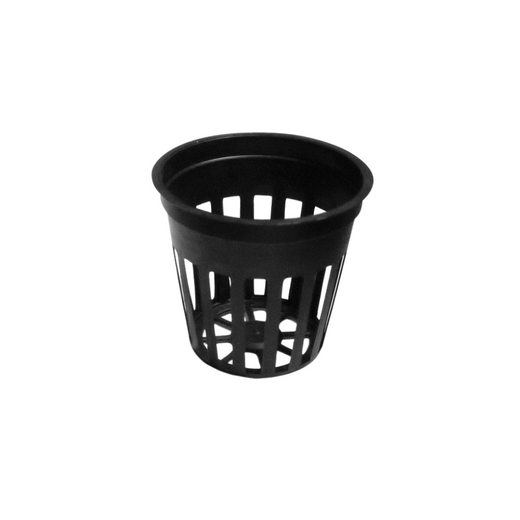
You receive the four double-walled channels with their removable lids and glued-in end caps, the supporting structure, the 64-litre reservoir, the pump and its supply line, the return circuit and 36 baskets measuring 5 cm in diameter by 7 cm in height. If a channel is ever damaged, the replacement channels in the same profile can be ordered individually or in batches.
The way you pack the pots depends on what you are planting. A bare-root strawberry plant sits in the basket, wedged in place by clay pebbles larger than the slots, which hold the crown above the film without retaining water. A herb cutting or a lettuce seedling is better started in a germination sponge or a rockwool cube, which slips whole into the pot. In every case, the crown stays dry and only the roots reach the film of water, which prevents rot at the base of the stem.
Technical specifications
The essentials
- Principle
- Recirculated nutrient filmThe solution flows continuously along the base of sloped channels.
- Slots
- 36, that is 9 per channel
- Channels
- 4 profiles of 100 x 80 mm.
- Channel construction
- Double wallThe air gap buffers the day-to-night temperature difference and stiffens the profile.
Dimensions and circuit
- Channel length
- 1.85 m
- Spacing between slots
- 200 mm
- Footprint
- 210 x 60 x 55 cm
- Reservoir
- 64 L, 60 x 40 x 32 cm
- Pump
- Hailea HR1000, 1,050 L/hNominal flow rate, without head pressure.
- Return
- Push-fit fittings of 32 mm
Materials and origin
- Channels
- Food-grade cellular PVC, white and black
- Load-bearing structure
- PVC and aluminium, 23 mm tubes
- Manufacturing
- Italy, Robassomero
- Warranty
- 2 years
To budget for separately
- Pot filling
- Sponge, rockwool, or clay pebbles
- Nutrition and pH
- 1 complete nutrition and its corrector
- pH reading
- 1 metre or a drop-based test
- Rooted cuttings
- Sown or propagated separately
10 further specifications are available in the detailed view.
In the box
- 4 double-walled growing channels of 1.85 m, with a 100 x 80 mm profile, complete with removable lids pre-drilled with 9 planting holes.
- 4 drainage plugs and 4 end caps, factory-fitted to the channels.
- 1 load-bearing structure in square PVC and aluminium tubes, with its fittings.
- 1 reservoir of 64 L.
- 1 Hailea HR1000 pump, its 4-outlet feed manifold and the 32 mm return circuit.
- 36 baskets, 5 cm in diameter and 7 cm high.
Specifications taken from the manufacturer's data sheet, growrillahydroponics.com, on 07/10/2026. Slope, run length and spacing: FAO guide to small-scale aquaponic food production (2014). Solution temperature: A.J. Both, Cornell.
Manufacturer and product safety
- Manufacturer
- Growrilla di Milone Giulio
- Postal address
- Via Fiano 207, 10070 Robassomero (TO), Italie
- Website
- growrillahydroponics.com
Information provided under Regulation (EU) 2023/988 on general product safety.
Three nutrient film formats
The same principle, the same pump, and the same structure. The table compares capacity, channel, and floor space.
A taller channel rather than more slots
This profile has an 80 mm deep channel and a 200 mm centre spacing over a 2.10 m length. The questionnaire first looks at how long your plants stay in place, then at the available length in your space.
| Slots (plants) | Spacing between slots (mm) | Profile height (mm) | Channel length (cm) | A round lettuce in every slot | Ground length (cm) | Depth and height | Reservoir (L) | Channels | Pump | Structure | Price | |
|---|---|---|---|---|---|---|---|---|---|---|---|---|
| NFT hydroponic system 28 plants, 1 m channelsYour choice | 28 plants | 125 mm | 50 mm | 100 cm | No | 120 cm | 60 x 55 cm | 30 L | 4 | Hailea HR1000, 1050 L/h | PVC and aluminium | 339,00 € |
| Recommended Hydroponic NFT system for 36 plants, 80 mm channelsYour choice | 36 plants | 200 mm | 80 mm | 185 cm | Yes | 210 cm | 60 x 55 cm | 64 L | 4 | Hailea HR1000, 1050 L/h | PVC and aluminium | 529,00 € |
| NFT hydroponic system 60 plants, 2 m channelsYour choice | 60 plants | 125 mm | 50 mm | 200 cm | No | 230 cm | 60 x 55 cm | 64 L | 4 | Hailea HR1000, 1050 L/h | PVC and aluminium | 499,00 € |
NFT hydroponic system 28 plants, 1 m channels
Capacity
Slots (plants)28 plants
Spacing between slots (mm)125 mm
The channel
Profile height (mm)50 mm
Channel length (cm)100 cm
A round lettuce in every slotNo
Footprint and circuit
Ground length (cm)120 cm
Depth and height60 x 55 cm
Reservoir (L)30 L
Common to all three
Channels4
PumpHailea HR1000, 1050 L/h
StructurePVC and aluminium
Hydroponic NFT system for 36 plants, 80 mm channelsRecommended
Capacity
Slots (plants)36 plants
Spacing between slots (mm)200 mm
The channel
Profile height (mm)80 mm
Channel length (cm)185 cm
A round lettuce in every slotYes
Footprint and circuit
Ground length (cm)210 cm
Depth and height60 x 55 cm
Reservoir (L)64 L
Common to all three
Channels4
PumpHailea HR1000, 1050 L/h
StructurePVC and aluminium
NFT hydroponic system 60 plants, 2 m channels
Capacity
Slots (plants)60 plants
Spacing between slots (mm)125 mm
The channel
Profile height (mm)50 mm
Channel length (cm)200 cm
A round lettuce in every slotNo
Footprint and circuit
Ground length (cm)230 cm
Depth and height60 x 55 cm
Reservoir (L)64 L
Common to all three
Channels4
PumpHailea HR1000, 1050 L/h
StructurePVC and aluminium
Manufacturer data sheets, growrillahydroponics.com, retrieved 07/10/2026.
Help choosing
The 80 mm channel , which crops is it suited to?
Estimate your
delivery time
Your estimate
Delivery
Estimated time
It covers preparing your order and then the transit time quoted by the carrier, counted in working days.
It is not a guaranteed delivery date: public holidays, peak periods, customs or a carrier delay can extend it. The exact amount, in your currency, is worked out in the cart once your address is entered.
Shipments leave the workshop in Robassomero, near Turin. The 1.8 m channels travel in a long parcel that cannot be delivered to a collection point: please arrange home delivery, ensure clear access, and have someone available to receive the order. Exact shipping costs and final delivery times are displayed in the basket once your address has been entered. Outside the European Union, import duties and taxes are the responsibility of the recipient.
Frequently asked questions
12 questions
6 key questions, 12 in the detailed view
You may also like




Related articles

Crops
Growing strawberries in aquaponics
Varieties, runner management and fruiting conditions for a crop that runs through the whole season.
Read the article

Crops
What to grow in hydroponics, season by season
How to arrange long-term crops and fast-growing crops across four channels without creating bottlenecks.
Read the article

Understanding
Aquaponics and hydroponics — what's the difference?
What you gain and what you lose when moving from a mineral solution to pond water.
Read the article

Diagnosis
Identifying deficiencies in aquaponics
Over a crop that lasts several months, a deficiency has time to take hold: knowing how to read the signs on the leaf.
Read the article

Season
Maintaining your system in summer
The season when the temperature swings in an unheated room determine the harvest.
Read the article

Nutrition
Which fertiliser should you use in aquaponics?
What a long-running crop consumes and what it leaves behind in the reservoir.
Read the article
Let us talk about your project
A question about this product or your setup? Our team will answer and advise you.

Interest-free instalment payments
Offered depending on the cart amount, at checkout.

Delivery in 2 to 15 working days
Depending on the products and shipping sites. Estimate by destination in the estimator on this page.

After-sales service 7 days a week by email or chat
Our team answers all your questions.

Shop responsibly
Become part of the change.
