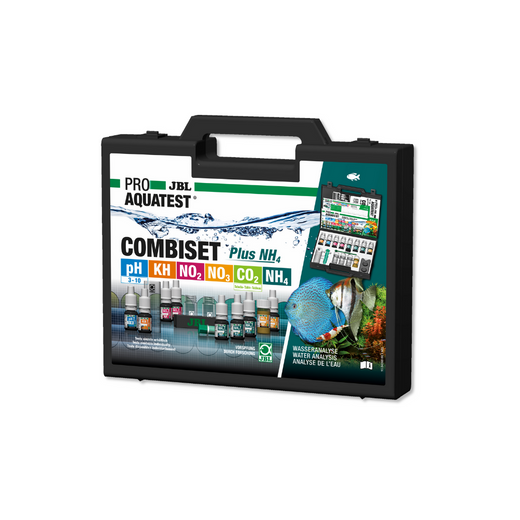


Dissolved oxygen water test in drops
Regular price
14,90 €
Regular price
Sale price
14,90 €
Unit price
/
per
4,96 € × 3 with no fees
Klarna.
A lack of oxygen can kill the fish in a pond in a single summer night. This test measures the actual dissolved oxygen, from 1 to 10 mg/L, in aquariums, ponds, and aquaponics systems.
The difficulty lies in the sampling: the test tube must be filled by immersion, to the brim, and the slightest trapped bubble will skew the result upwards.
 Customer support 7 days a week by email
 Delivery within 2 to 15 business days
100 % secure payment
The summary
- What you receive: 3 reagent bottles, a glass test tube with a screw cap, a syringe and a colour chart.
- What you measure: dissolved oxygen from 1 to 10 mg/L, in fresh water, in sea water and in ponds.
- When to measure: first thing in the morning, before sunrise. This is the low point of the day.
- How long it takes: 12 minutes per measurement, 10 of which are waiting time.
- How to choose: this test is sold on its own, and oxygen is also included in the 13-in-1 aquarium test case and in the 10-in-1 pond test case.
- What is sent to you: a 0.11 kg parcel, with the reagents in their original box.
Dissolved oxygen drop test, from 1 to 10 mg/L, for aquariums, ponds, and aquaponics
A rise in ammonium or nitrite develops over several days, whereas an oxygen deficit becomes dangerous within hours. A single night spent in the red zone of the colour chart, at 2 mg/L or below, can be enough to kill the fish in a pond where nothing seemed wrong the previous evening, because the level reaches its lowest point just before dawn, at a time when measurements are rarely taken. This test is therefore best carried out first thing in the morning, to capture the lowest reading of the day.
🌞 Warm water, less oxygen
The amount of oxygen that water can dissolve depends primarily on its temperature. Saturated fresh water holds approximately 11 mg/L of oxygen at 10 °C, and less than 8 mg/L at 30 °C. A heatwave therefore acts on your pond in two ways at once: it lowers the available ceiling while the heat accelerates the respiration of fish and bacteria, which consume more as a result. This is the mechanism described in the summer system maintenance guide.
Break the surface as soon as oxygen drops below 4 mg/L
Aim for 5 to 8 mg/L in a freshwater community aquarium, 5 to 10 mg/L in a lightly stocked planted tank, in marine water, and in a pond. Below 4 mg/L, break the water surface: an air pump and its diffusers raise the level within a few hours by renewing the water in contact with the air. Then monitor nitrite in the days that follow, as nitrifying bacteria require oxygen to convert ammonium.
🌱 Oxygen in aquaponics
In an aquaponic system, three populations breathe the same water: the fish, the nitrifying bacteria in the biofilter, and the plant roots. The bacteria need oxygen to convert ammonium into nitrate, so a shortage of oxygen often shows up in nitrification before it becomes visible in the fish. Aim for at least 5 mg/L in the fish tank as well as in the grow beds, and take your reading at the least agitated point, the far end of a gutter or the bottom of a media bed, rather than right next to the diffuser. The full start-up process for a system is described in the article Getting started with an aquaponic system.
An end-of-day reading will overestimate your oxygen level
Plants and algae produce oxygen whenever there is light, and consume it throughout the night without producing any. In a well-planted tank or pond, the concentration can even exceed saturation by 1 to 2 mg/L at the end of the photoperiod. The peak concentration is therefore reached in the late afternoon, and the minimum concentration just before sunrise, which means a reading taken at the end of the day gives the highest value without telling you anything about the lowest.
Garden pond in summer
Warm water, high biomass and short nights all combine. Green water pushes the nocturnal minimum even lower.
Aquaponics
The biofilter consumes continuously, on top of the fish. Without oxygen, nitrification stops.
Planted tank with CO2 injection
Oxygen levels drop at night, whilst gas injection sometimes continues.
After a power cut
A pump stopped for a few hours, a treatment, an algae bloom that dies off suddenly: each one can send oxygen levels plummeting within a day.
🫧 Filling without air bubbles
The sample for this test is not drawn with a syringe. Rinse the test tube, then fill it by immersion, right to the brim, and set it on a watertight surface. Add the 6 drops of the first reagent and the 6 drops of the second slowly, allowing the tube to overflow, then screw on the cap without trapping any bubbles. These two reagents chemically fix the oxygen present at the moment of sealing: a bubble trapped at this stage would introduce its own oxygen and your reading would be overestimated. After 30 seconds of agitation, the third reagent develops the colour, ranging from yellow to deep red, and any bubbles trapped when recapping the tube no longer have any effect on the result.
Technical specifications
The essentials
- Parameter measured
- Oxygen dissolved in the waterThe method chemically fixes the oxygen present at the moment of sampling, then reveals it through a colour change from yellow to dark red.
- Measurement range
- 1 to 10 mg/LIn freshwater, milligrams per litre is equivalent to ppm
- Tests per kit
- Approximately 40Each test uses 6 drops from each of the 3 bottles, making 18 drops in total.
- Target values
- 5 to 8 mg/L in fresh water5 to 10 mg/L in a lightly stocked planted tank, in seawater, and in a pond. The colour chart turns red at 2 mg/L and below
- Method
- Chemical fixation, colorimetric readingManganese salt, a strong base followed by an acid indicator: this is the principle behind laboratory oxygen titrations
- Manufacturer's reference
- JBL 2411200, PROAQUATEST rangeCode EAN 4014162241122
The procedure
- Sampling
- Test tube filled by immersionRight up to the brim, with no bubbles, and not with a syringe
- The steps
- Rinse, submerge, dose, shake, develop, readIn that order. The cap is screwed on while letting the test tube overflow.
- Drops per reagent
- 6 drops, three times6 drops of reagent 1, 6 of reagent 2, then 6 of reagent 3 after the first shake
- Shaking and waiting
- 2 times 30 s, then 10 min.Reading before the 10 minutes are up will underestimate the value
- Total duration
- Approximately 12 minutesHandling included
- Reading
- Test tube laid flat, 3 to 5 cm from the colour chartMoved back and forth over the white section until the best colour match is achieved
Security and parcels
- Ranking
- DangerThe three bottles are arranged
- Main risks
- Burns, eye injuriesH314 and H318 warnings on all three bottles, H373 and H412 for reagent 1, H317 and H334 for reagent 3
- Precautions
- Sink, well-ventilated room, out of reachNever smell a bottle or a test tube, and empty the treated test tube down the sink
- Parcel weight
- 0.11 kgPackaging included
To budget for separately
- Reagent refill
- Reagents only, ref. 2411300The glass test tube, its stopper, the syringe, and the colour chart can all be stored
- What to correct with
- An air pump and its diffusersBelow 4 mg/L in the early morning, aeration should be increased that same day
10 further specifications are available in the detailed view.
In the box
- 3 reagent bottles
- 1 screw-top glass test tube
- 1 graduated sampling syringe
- 1 white-backed colour reference chart
- 1 multilingual instruction leaflet, French included
Reference, EAN code, number of tests, protocol, recommended values by water type, and hazard statements taken from the manufacturer's data sheet and instruction manual on 05/09/2026. Saturation levels by temperature are from the FAO table.
Oxygen is not included in all test kits
This is a parameter not included in every test kit. Before buying a kit to measure it, check that it actually contains the relevant test.
Oxygen depletion occurs before sunrise
At night, plants consume oxygen without producing any, and warm water holds less of it in solution. A reading taken in the afternoon therefore misses this minimum.
| Dissolved oxygen | Parameters covered (parameters) | Drop tests included (tests) | pH, KH, nitrites, nitrates and ammonium | GH, iron, phosphates, copper, and silicates | Reagent bottles (bottles) | Glass test tubes | Screw-cap test tube | Thermometer | Reagent refill sold separately | Price | |
|---|---|---|---|---|---|---|---|---|---|---|---|
| Recommended Dissolved oxygen test onlyYour choice | Yes | 1 parameters | 1 tests | No | No | 3 bottles | 1 | Yes | No | Yes | 14,90 € |
| 6-in-1 Aquarium Water Testing KitYour choice | No | 6 parameters | 5 tests | Yes | No | 9 bottles | 3 | No | No | Yes | 50,90 € |
| 13-in-1 water testing kit for aquariumsYour choice | Yes | 12 parameters | 13 tests | Yes | Yes | 23 bottles | 12 | Yes | Yes | Yes | 119,90 € |
Dissolved oxygen test onlyRecommended
What you're measuring
Dissolved oxygenYes
Parameters covered (parameters)1 parameters
Drop tests included (tests)1 tests
pH, KH, nitrites, nitrates and ammoniumNo
GH, iron, phosphates, copper, and silicatesNo
Equipment supplied
Reagent bottles (bottles)3 bottles
Glass test tubes1
Screw-cap test tubeYes
ThermometerNo
Budget
Reagent refill sold separatelyYes
6-in-1 Aquarium Water Testing Kit
What you're measuring
Dissolved oxygenNo
Parameters covered (parameters)6 parameters
Drop tests included (tests)5 tests
pH, KH, nitrites, nitrates and ammoniumYes
GH, iron, phosphates, copper, and silicatesNo
Equipment supplied
Reagent bottles (bottles)9 bottles
Glass test tubes3
Screw-cap test tubeNo
ThermometerNo
Budget
Reagent refill sold separatelyYes
13-in-1 water testing kit for aquariums
What you're measuring
Dissolved oxygenYes
Parameters covered (parameters)12 parameters
Drop tests included (tests)13 tests
pH, KH, nitrites, nitrates and ammoniumYes
GH, iron, phosphates, copper, and silicatesYes
Equipment supplied
Reagent bottles (bottles)23 bottles
Glass test tubes12
Screw-cap test tubeYes
ThermometerYes
Budget
Reagent refill sold separatelyYes
Parameters covered, equipment supplied and kit contents noted from the three product pages on 05/09/2026.
Help choosing
Finding oxygen at night
Documents & manuals
Official manufacturer's instructions, in French
The eight-step protocol, filling the test tube by immersion, and the oxygen saturation table as a function of temperature on the last page.
Document not showing? Some publishers block display inside a frame, so open it in a tab.
Estimate your
delivery time
Your estimate
Delivery
Estimated time
It covers preparing your order and then the transit time quoted by the carrier, counted in working days.
It is not a guaranteed delivery date: public holidays, peak periods, customs or a carrier delay can extend it. The exact amount, in your currency, is worked out in the cart once your address is entered.
0.12 kg parcel, dispatched within 48 hours by Colissimo or Chronopost home delivery, to be chosen at checkout. The reagents ship in their original box. The exact cost is shown in the basket.
Frequently asked questions
6 questions
6 key questions
You may also like


Related articles

Season
Maintaining your aquaponic system in summer
Heat lowers the oxygen ceiling whilst accelerating consumption. The measures that keep a system running in July.
Read the article

Guide
Aquaponics and summer holidays
Going away for three weeks means having aeration that does not depend on you, and taking a reading on the morning of departure.
Read the article

Pond
Pond algae in summer
An algae bloom produces oxygen during the day and consumes it at night: this is what causes the pre-dawn dip.
Read the article

Pond
Green pond water: 5 solutions
A green pond whose algae suddenly die off causes oxygen levels to crash within a few hours. How to treat it without triggering that sudden die-off.
Read the article

Guide
Which fish to choose for aquaponics?
Oxygen requirements vary twofold from one species to another, and determine the maximum stocking load.
Read the article

Breeding
Salmoponics: aquaponics in cold water
Trout are the extreme case: they need cold water, which is naturally rich in oxygen, and will not tolerate any margin of error.
Read the article
Let us talk about your project
A question about this product or your setup? Our team will answer and advise you.

Interest-free instalment payments
Offered depending on the cart amount, at checkout.

Delivery in 2 to 15 working days
Depending on the products and shipping sites. Estimate by destination in the estimator on this page.

After-sales service 7 days a week by email or chat
Our team answers all your questions.

Shop responsibly
Become part of the change.
