

Aquapouss'Mini aquaponic aquarium
Regular price
399,00 €
Regular price
Sale price
399,00 €
Unit price
/
per
133,00 € × 3 with no fees
Klarna.
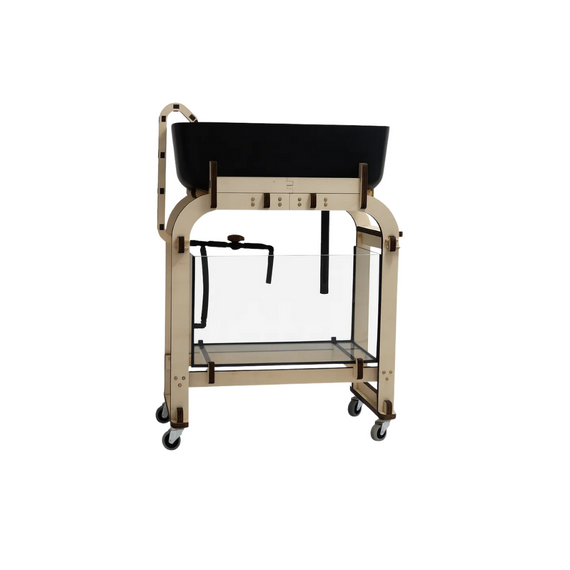
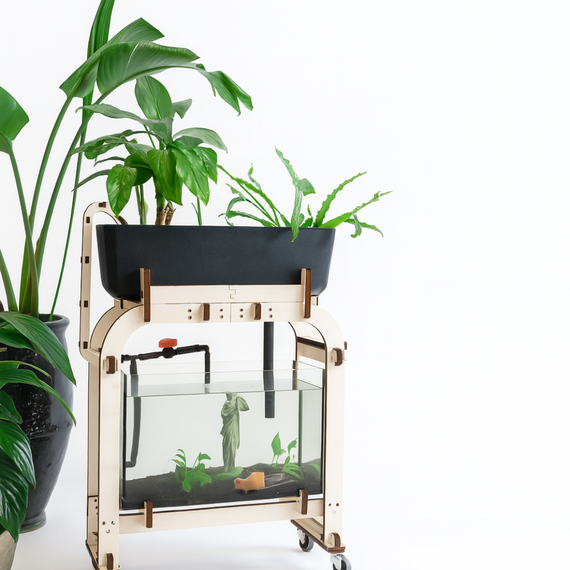
The Aquapouss'Mini is an indoor aquaponic aquarium: a 43-litre fish tank carries a 15-litre grow bed, on an FSC wooden frame mounted on castors. It is well suited to a first aquaponics setup, at home or at school, with small fish such as guppies, freshwater shrimp or snails.
 Customer support 7 days a week by email
 Delivery within 2 to 15 business days
100 % secure payment
The summary
- What you receive: a 43-litre aquarium, a 15-litre grow bed and an FSC-certified wooden frame.
- Dimensions: 64 cm wide, 30 cm deep, 85 cm high, on four castors.
- What it produces: two or three culinary herbs to cut, and a few ornamental fish.
- Getting started: 3 weeks of cycling before the first fish, pump at the very least.
Fish below, herbs above, for an office or a classroom
The Aquapouss'Mini is an indoor aquaponic aquarium that pairs a 43-litre tank with a 15-litre grow bed, on an FSC-certified wooden frame fitted with castors. It suits a first installation at home or in the classroom, with small fish such as guppies and two or three culinary herbs for cutting.
This indoor aquaponics aquarium measures 64 cm wide and 30 cm deep, by 85 cm high. A 43-litre aquarium occupies the lower part, a 15-litre grow bed sits on top of the whole unit, and a 7 W pump circulates the water continuously from one to the other. It is designed for indoor use, at home or in the classroom.
The principle comes down to a loop. The pump submerged in the aquarium lifts the water up to the grow bed, filled with clay pebbles, then the water passes through the pebbles and returns to the aquarium by gravity. During this passage, the bacteria living on the pebbles convert the ammonia excreted by the fish into nitrite, then into nitrate, which the roots absorb as fertiliser. The plants therefore grow without soil or added fertiliser, and the water returning to the fish has been cleared of part of what they excreted.
🏡 An ecosystem set on a piece of furniture
Everything fits within 30 cm of depth, which means you can put it on a console table, a worktop or a classroom trolley. Measure this depth at home before ordering: it is the depth that decides, far more than the height. The four castors let you move the whole unit to run the vacuum cleaner or to bring it closer to a window in winter, without emptying it, and then put it back in place without help. Two side hooks, two plant supports and a food shelf are built into the structure, which assembles by fitting wooden dowels together. The shelf keeps the food tub within reach, out of the water. The grow bed combines 33% wood and 20% recycled plastic, and it is fully recyclable.
🐟 What 43 litres allow
A volume of this size supports a few small ornamental fish and produces herbs for cutting, not vegetables for storing. The species suited to 43 litres are small: guppies, freshwater shrimp or aquarium snails. The 15-litre grow bed is filled with about 10 litres of expanded clay pebbles, which leaves room for two or three mature plants, such as mint, chives, basil or cuttings. For vegetable production, you need to move out into the garden, towards a 500-litre pond or a larger one. This small volume does, however, lend itself to observation, in a classroom or on a desk, since the nitrogen cycle can be followed in full, from feeding to the harvested leaf. A small volume also reacts faster than a large one: you see the effect of an action within a few days instead of a few weeks, and an over-generous ration shows up just as quickly on the test strips. So start with two or three fish and a pinch of food, not a full shoal.
3 weeks before the first fish
First install the plants and the bacteria, then wait 3 weeks before introducing any fish. During this time, the bacterial colony establishes itself on the clay pebbles and becomes able to convert the ammonia. A fish put in the water on the first day finds itself in a tank that is not yet purifying anything, and this is a frequent cause of failure in a small volume. Set the pump to its minimum flow rate during this period.
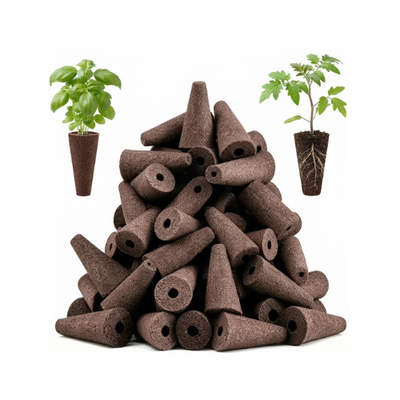
A 10-litre bag of clay pebbles for the grow bed
Add a bag of 10-litre clay pebbles to your order: it's the volume the grow bed needs, and a single bag is enough. The pebbles act both as a support for the roots and as a surface for the nitrifying bacteria, so they work as the system's biological filter from the moment it is filled with water.
🌡️ Water temperature
Guppies are tropical fish, which live between 18 and 28 °C. In a room heated all year round, the aquarium water follows the room temperature and generally stays within this range; in a classroom closed during the holidays or a cool room in winter, it can fall below 18 °C. A submersible aquarium heater then keeps the water at the set value, and a suction-cup thermometer stuck on the glass lets you read it at a glance. Also avoid direct sunlight through a window, which quickly warms a volume of 43 litres.
🌿 What grows in the tank
The grow bed holds herbs, cuttings, seedlings or indoor foliage plants. Their roots reach down into the clay pebbles, where water circulates constantly, and there they find the nitrates produced by the fish waste. Place the unit near a bright window, with no direct sun on the aquarium, because herbs need light to keep a compact habit.
Culinary herbs
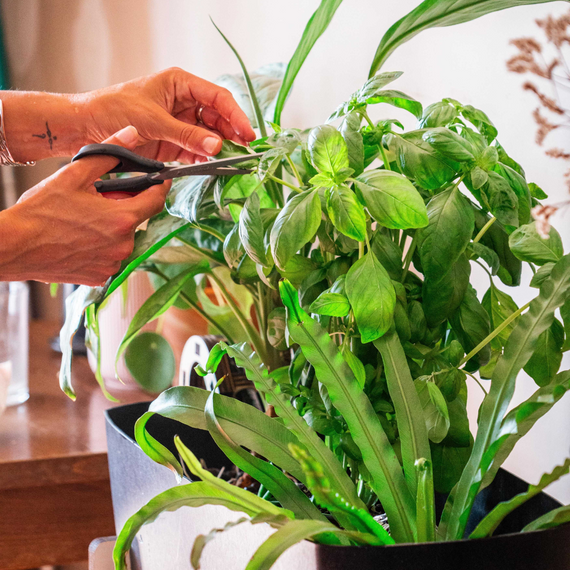
Mint, chives and basil are harvested by cutting and grow back. Two or three mature plants fill the 15-litre grow bed.
Cuttings
A media bed that is always damp and never waterlogged suits cuttings that need to put out their first roots.
Foliage plants
A green houseplant sits in the tank and decorates the cabinet all year round.
The seedlings
The seeds are sown directly between the pebbles, keeping the surface moist until germination.
💧 The pump and flow rate
The NJ600 submersible pump, made in Italy, uses 7 W and its flow rate is adjustable from about 200 to 600 litres per hour. At maximum flow, the volume of the aquarium therefore passes through the grow bed about 14 times an hour, and about 5 times at the minimum setting. The minimum suits the start-up, while the bacterial colony is establishing itself; you then increase the flow if the water in the bed stagnates. Running continuously, the pump uses about 61 kWh per year.
🔧 Push-fit assembly
The structure is made of 15 mm FSC poplar plywood, laser-cut, and is assembled with 28 dowels and 16 screws, with no glue or varnish. The kit comes with its pipework, its filtration grid and illustrated instructions, and assembly requires a screwdriver and a hammer. The wooden parts are cut in Dijon and the whole is assembled in Marseille. The demountable structure makes maintenance and replacing a part easier, and the whole is guaranteed for 2 years.
📦 What arrives in the box
The box contains the 43-litre aquarium, the 15-litre grow bed, the FSC-certified wooden frame, the pump, the pipework system and the filter grid, the 28 dowels and 16 screws, the four castors, the two side hooks, the two plant stakes, the feeding shelf and the illustrated instructions. Assemble the whole unit in the room where it will stay, since the filled aquarium alone holds 43 kg of water and can no longer be carried.
The rest is chosen according to what you want to keep in it: the ornamental fish, the plants, the bottom decoration, the clay pebbles, the food, the fish net, a thermometer and test strips to monitor the water during the first weeks. You then replace about a third of the volume every 3 months, by bucket, which means carrying around fifteen litres each time. Between two water changes, your only daily task is feeding, and it is measured: give what is eaten in one minute, no more, since whatever falls to the bottom ends up as ammonia that the tank will have to process.
Technical specifications
Volumes and dimensions
- Aquarium
- 43 L
- Grow bed
- 15 LIt fills with approximately 10 litres of clay pebbles.
- Dimensions
- 64 × 30 × 85 cmWidth, depth, height: it fits on a console table.
- Mobility
- 4 castors
Circulation and materials
- Pump
- 7 W, model NJ600Adjustable flow of about 200 to 600 L per hour.
- Structure
- FSC wood, assembled with dowels
- Grow bed
- 33 % wood, 20 % recycled plasticFully recyclable at end of life.
- Warranty
- 2 years
Getting started
- Assembly
- Screwdriver and hammer28 dowels and 16 screws, with no glue or varnish.
- Before the fish
- 3 weeksHow long the bacterial colony takes to establish itself on the beads.
- Flow rate at start-up
- Pump at minimum
- Water changes
- One third every 3 months
To budget for separately
- Clay pebbles
- Around 10 L for the tank
- The fish and the plants
- Guppies, shrimp, herbs
- Monitoring the water
- Test strips and thermometer
- The bottom and the food
- Sand, hiding places, landing net, food
8 further specifications are available in the detailed view.
In the box
- 1 aquarium of 43 L and 1 grow bed of 15 L
- 1 FSC wooden frame, 28 dowels and 16 screws
- 1 NJ600 pump, 7 W, with the piping and the filter grille
- 4 castors and 2 side hooks
- 2 plant supports and 1 feeding ledge
- 1 illustrated assembly instruction leaflet
Volumes, dimensions, materials, pump, indoor use and package contents: official Aquapouss page, taken on 11/10/2026. Pump flow rate: Newa NJ600 model data sheet. Guppy temperature: FishBase.
Manufacturer and product safety
- Manufacturer
- SAS AQUAPIM (marque Aquapouss')
- Postal address
- 364 rue d'Endoume, 13007 Marseille, France
- Contact
- d.laude@aquapouss.fr
- Website
- www.aquapouss.fr
Information provided under Regulation (EU) 2023/988 on general product safety.
Indoors or outdoors: two ways to get started
The indoor aquaponic aquarium and the small garden pond, compared on what sets them apart.
The smaller one, or the garden one?
Both circulate the same water between fish and plants. One sits on a console in a heated room, the other stands outdoors and holds ten times more water.
| Water volume (L) | Location | Growing medium | Moves on castors | Inspection portholes | Price | |
|---|---|---|---|---|---|---|
| Recommended Aquapouss'Mini aquaponic aquariumYour choice | 43 L | Indoors | 15 L tub | Yes | No | 399,00 € |
| Small garden aquaponics kit, 500 L pondYour choice | 500 L | Outdoor | 1 m² of growing space | No | Yes | 885,00 € |
Aquapouss'Mini aquaponic aquariumRecommended
What sets them apart
Water volume (L)43 L
LocationIndoors
Growing medium15 L tub
What you notice in use
Moves on castorsYes
Inspection portholesNo
Small garden aquaponics kit, 500 L pond
What sets them apart
Water volume (L)500 L
LocationOutdoor
Growing medium1 m² of growing space
What you notice in use
Moves on castorsNo
Inspection portholesYes
Volumes, locations and equipment taken from the manufacturers' documentation, on 20/09/2026.
Help choosing
Indoors on a piece of furniture, or outdoors in the garden?
Estimate your
delivery time
Your estimate
Delivery
Estimated time
It covers preparing your order and then the transit time quoted by the carrier, counted in working days.
It is not a guaranteed delivery date: public holidays, peak periods, customs or a carrier delay can extend it. The exact amount, in your currency, is worked out in the cart once your address is entered.
The exact shipping cost is calculated at checkout, based on the total weight of your order and the destination. Lead times start from dispatch and remain estimates. For a destination not listed here, write to us at contact@univers-aquaponie.com.
Frequently asked questions
12 questions
6 key questions, 12 in the detailed view


Related articles

Start-up
Getting started with an aquaponic system
Getting an aquaponic system off to a good start, before the first fish.
Read the article

Understanding
The nitrogen cycle in aquaponics
The nitrogen cycle in aquaponics, which this small volume makes visible.
Read the article

Fish
Goldfish in aquaponics
The goldfish in aquaponics, one of the fish that this tank can house.
Read the article

Grow media
Which grow medium to choose for aquaponics?
Which grow medium to choose in aquaponics to fill the grow bed.
Read the article

Plants
Which plants can be grown in aquaponics?
Which plants to grow in aquaponics, to help you choose what goes in the bed.
Read the article
Let us talk about your project
A question about this product or your setup? Our team will answer and advise you.

Interest-free instalment payments
Offered depending on the cart amount, at checkout.

Delivery in 2 to 15 working days
Depending on the products and shipping sites. Estimate by destination in the estimator on this page.

After-sales service 7 days a week by email or chat
Our team answers all your questions.

Shop responsibly
Become part of the change.
