





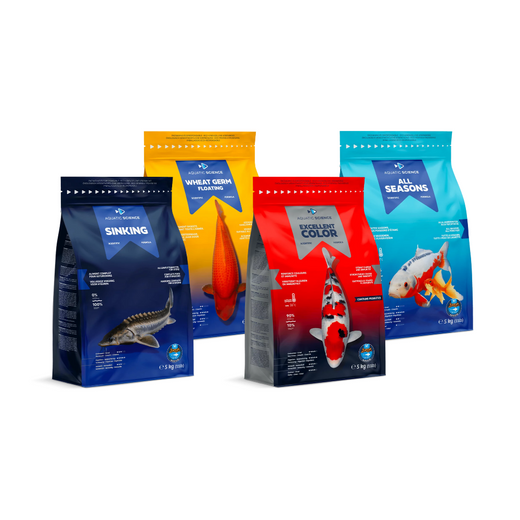
Wheat Germ Floating freshwater food for koi
Regular price
32,90 €
Regular price
Sale price
32,90 €
Unit price
/
per
| Weight | Price | Price per kg | vs 0,5 Kg |
|---|---|---|---|
| 0,5 Kg | 10,50 € | 21,00 € | — |
| 2 Kg | 32,90 € | 16,45 € | −22 % |
| 5 kg | 62,90 € | 12,58 € | −40 % |
These 100% floating pellets in 2 to 3, 4 to 5 or 6 to 7 mm sizes feed koi carp and goldfish when the water is between 5 and 15 °C, in spring as it warms up and in autumn as it cools down.
The formula contains 32% protein, in a resealable bag of 0.5 to 9.5 kg.
 Customer support 7 days a week by email
 Delivery within 2 to 15 business days
100 % secure payment
The summary
- What you receive: a resealable bag of 0.5 to 9.5 kg, pellets of 2 to 3, 4 to 5 or 6 to 7 mm, 100% floating.
- What the analysis says: 32% protein, 9% fat, 0.9% total phosphorus.
- Its working range: from 5 to 15 °C, that of the two shoulder seasons in the pond.
- Why floating: you can see who is feeding, and you remove what is left with a net.
- How many feeds: 1 to 3 a week, with leftovers netted out after 5 minutes.
- How it arrives: parcel of 0.5 to 9.5 kg, to a pick-up point or your door.
100% floating pellets in three sizes, for water at 5 to 15 °C
Wheat Germ Floating is a cool-water food for koi carp and goldfish, to be used when the water is between 5 and 15 °C, in spring and autumn. Its 100% floating pellets come in 2 to 3, 4 to 5 or 6 to 7 mm. With 32% protein, it demands less digestive effort than richer foods.
There is a temperature window where a growth food is no longer appropriate and where stopping feeding altogether is premature. It opens twice a year, in spring when the water warms up and your koi start begging again, then in autumn when it cools down and they are still begging. These pellets cover that window, bounded by 5 to 15 °C, in three sizes, small at 2 to 3 mm, medium at 4 to 5 mm or large at 6 to 7 mm, and in a resealable bag from 0.5 to 9.5 kg.
🍂 Digestion in fresh water
The koi carp is a cold-blooded animal, so the pace of its digestion follows the temperature of the water around it. When the water cools, transit time lengthens and the activity of the digestive enzymes weakens. Between summer and winter, the transit time is 2 to 4 times longer. A rich feed given at that point stays longer in a slowed-down digestive tract, and a larger share of what it contains is not assimilated. What is not assimilated comes out into your water and adds to the nitrogen load that your filtration then has to deal with, as described in the article on the nitrogen cycle. At 32% protein, this pellet demands less digestive work than the maintenance feed at 33.5% or the colour feed at 39.5%.
In spring
The water is back above 5 °C. Give a single, much reduced meal, then run a water test before giving a second.
In autumn
Your koi still beg below 15 °C. Allow 1 to 3 feeds a week, and remove anything still floating after 5 minutes.
Below 5 °C
Feeding stops. Your fish live off their reserves until the spring warm-up.
🧪 The filter at restart
A biological filter restarts more slowly than the fish's appetite. At the end of winter, the nitrifying bacteria are still few in number, and the load you feed shows up in the water several days before it shows on the fish. Two measurements let you decide: an ammonium test for what your fish excrete, and a nitrite test for the intermediate stage, the one that lingers longest in a filter that is restarting. If either value rises, reduce the ration before doing anything else. A bacteria supplement speeds up this recovery.
Reading the water and weighing out the first ration
This 5 to 15 °C window is read in the water, not the air, as the gap between the two can reach several degrees in spring. Get a floating thermometer at the same time as the bag, and a precision scale or a graduated cup to measure out the first reduced ration. Above 15 °C, the next step up is in the pond fish food collection.
The pellet that stays on the surface
These pellets float completely, and that is your lever for controlling the ration: you can see which fish are feeding and which are keeping away, and you net out whatever has not been taken after 5 minutes. Never leave uneaten feed in the pond in cool, fresh water, because it breaks down slowly and loads a filtration system that is already running sluggishly. And never give this feed to ruminants or to any other animal species, as the label reminds you, because it contains fish meal.
🌡️ The two seasonal changeovers
The two windows are not managed in the same way. In autumn, your fish arrive with reserves built up over the summer and a filter still fully active, so the ration is reduced gradually, without urgency, and feeding stops of its own accord. In spring, the situation is the reverse, since the fish are lean and eager to feed while the filter has not yet picked up. A feeding error therefore weighs more heavily in spring, when the build-up must always stay slower than what your fish demand.
🐟 Small, medium or large
The small size, with pellets of 2 to 3 mm, suits fish from 7 cm, goldfish and young kois, and it is prepared to order in 2 or 5 kg bags. The medium, at 4 to 5 mm, is for fish of at least 15 cm, according to the guide printed on the packaging, and the large, at 6 to 7 mm, for kois over 25 cm. Choose the size according to the smallest fish in the pond, since they are the ones that hang back when the pellet is too big.
🌾 The formula and the phosphorus
The formula combines cereal and oilseed products, including the wheat germ that gives the feed its name, with fish meal and fish oil, algae and minerals. Its guaranteed analysis is 32% protein, 9% fat and 0.9% total phosphorus, against 1.3% for the colour feed. This lower content matters in spring, when the water warms up before the pond plants resume growth, because excess phosphorus then favours algae. In aquaponics, the same period is when your crops take up little, so a moderate ration avoids building up nitrates that no plant is yet consuming. Vitamins A, D3, E and C are added at guaranteed minimum levels.
📦 Which bag to choose
A 5 kg bag lasts a long time when the feed is given 1 to 3 times a week. If your pond holds 10 kg of fish, each meal weighs 100 g at the ceiling of 1% of their body weight, and two meals a week use about 860 g a month. The bag therefore covers almost 6 months of the shoulder seasons, generally autumn and the following spring. For a small pond, the 0.5 kg pouch or the 2 kg bag is used up within the season, which avoids keeping a part-used bag from one year to the next. The 9.5 kg bag, prepared to order in medium or large, is intended for large ponds: with 30 kg of fish and the same schedule, it covers about 3.5 months of the shoulder seasons. Closing the bag properly therefore matters more here than with summer feed: reseal it carefully, keep it dry and frost-free, and scoop it out with a dry cup rather than by hand, because moisture turns the fish oil in the formula rancid and encourages mould.
Technical specifications
Guaranteed analysis
- Crude protein
- 32%Less digestive effort at the time of year when transit is at its slowest.
- Crude fat content
- 9%
- Crude fibre
- 4.4%
- Mineral matter
- 8.4%Ash: the indigestible mineral part of the feed.
- Calcium
- 1%
- Total phosphorus
- 0.9%Compared with 1.3% for the colour feed and 1.6% for the sinking sturgeon feed.
Use and packaging
- Temperature range
- 5 to 15 °CMeasured in the water, in the morning, over several days in a row.
- How the pellet behaves
- 100% floatingWhatever is left after 5 minutes can be removed with a net.
- Particle size
- 2 to 3, 4 to 5 or 6 to 7 mmSmall from 7 cm, medium from 15 cm, large from 25 cm.
- Target species
- Koi carp, goldfish
- Fresh water rate
- 1 to 3 meals a weekBelow 5 °C, distribution stops until spring.
- Packaging
- Resealable bag of 0.5 to 9.5 kgThe small, the 5 kg large and the 9.5 kg bags are prepared to order.
Additives and composition
- Vitamin A (E672)
- min. 8,000 IU per kg
- Vitamin D3 (E671)
- min. 1,400 IU per kg
- Vitamin E (3a700)
- min. 160 mg per kg
- Vitamin C (3a312)
- min. 150 mg per kg
- Declared ingredients
- Cereals, oilseeds, fish, algaeCereals and oilseed products and by-products, fish meal, fish oil, algae, minerals.
- Storage
- Bag resealed, kept dry, frost-freeDamp turns fish oil rancid and encourages mould.
To budget for separately
- Pond thermometer
- 1 floating thermometer
- Meal dosage
- 1 set of scales or a graduated cup
12 further specifications are available in the detailed view.
In the box
- 1 resealable bag of 0.5, 2, 5 or 9.5 kg of floating pellets, small, medium or large depending on the variant chosen
- 1 manufacturer's label: composition, guaranteed analysis, batch number and best-before date
Guaranteed analysis, additives, ingredients list, 5 to 15 °C range and buoyancy taken from the manufacturer's Aquatic Science product descriptions on 05/09/2026; pellet sizes and bags from 0.5 to 9.5 kg recorded on 11/10/2026. Feeding schedules are orders of magnitude, to be adjusted to the appetite you observe.
Manufacturer and product safety
- Manufacturer
- AQUATIC SCIENCE SA
- Postal address
- Rue des Biolleux 8, 4800 Verviers, Belgique
- Contact
- info@aquatic-science.com
- Website
- aquatic-science.com
Information provided under Regulation (EU) 2023/988 on general product safety.
Which feed to use when the water is neither warm nor cold
The three floating foods in the range, arranged along the axis that decides mid-season: water temperature, and what the ration sends back into the filter.
A cool-season food: is it the right one for you?
This formula digests well while the water is still cold, when other feeds begin to weigh on a slowed digestive system.
| Lowest operating temperature (°C) | The moment you open the bag | Time of year | Crude protein (%) | Total phosphorus (%) | Ammoniacal nitrogen per 100 g dispensed, as NH4 (g) | Floating proportion | Size sold | Bag sold | |
|---|---|---|---|---|---|---|---|---|---|
| Recommended Fresh water, from 0.5 to 9.5 kgYour choice | 5 °C | From the thaw, 5 °C | Spring getting under way and autumn drawing to a close | 32 % | 0.9 % | 3.3 g | 100 % | 2 to 3, 4 to 5 or 6 to 7 mm | 0.5 to 9.5 kg, some to order |
| All Seasons pond fish food, floating pelletsYour choice | 12 °C | At restart, 12 °C | A long warm season | 33.5 % | 0.99 % | 3.4 g | 90 % | 2 to 3, 4 to 5 or 6 to 7 mm | 0.5 to 10 kg |
| Excellent Color astaxanthin food for koiYour choice | 16 °C | In full heat, 16 °C | Midsummer | 39.5 % | 1.3 % | 4.1 g | 90 % | 2 to 3, 4 to 5 or 6 to 7 mm | 0.5 to 9.5 kg |
Fresh water, from 0.5 to 9.5 kgRecommended
Its temperature window
Lowest operating temperature (°C)5 °C
The moment you open the bagFrom the thaw, 5 °C
Time of yearSpring getting under way and autumn drawing to a close
What the ration returns to the water
Crude protein (%)32 %
Total phosphorus (%)0.9 %
Ammoniacal nitrogen per 100 g dispensed, as NH4 (g)3.3 g
The granule
Floating proportion100 %
Size sold2 to 3, 4 to 5 or 6 to 7 mm
Bag sold0.5 to 9.5 kg, some to order
All Seasons pond fish food, floating pellets
Its temperature window
Lowest operating temperature (°C)12 °C
The moment you open the bagAt restart, 12 °C
Time of yearA long warm season
What the ration returns to the water
Crude protein (%)33.5 %
Total phosphorus (%)0.99 %
Ammoniacal nitrogen per 100 g dispensed, as NH4 (g)3.4 g
The granule
Floating proportion90 %
Size sold2 to 3, 4 to 5 or 6 to 7 mm
Bag sold0.5 to 10 kg
Excellent Color astaxanthin food for koi
Its temperature window
Lowest operating temperature (°C)16 °C
The moment you open the bagIn full heat, 16 °C
Time of yearMidsummer
What the ration returns to the water
Crude protein (%)39.5 %
Total phosphorus (%)1.3 %
Ammoniacal nitrogen per 100 g dispensed, as NH4 (g)4.1 g
The granule
Floating proportion90 %
Size sold2 to 3, 4 to 5 or 6 to 7 mm
Bag sold0.5 to 9.5 kg
Guaranteed analyses, operating temperatures and buoyancy taken from the Aquatic Science manufacturer's descriptions on 05/09/2026. The ammoniacal nitrogen values, expressed as NH4, are an upper-bound order of magnitude per 100 g fed per day. Pellet sizes and bags checked on 11/10/2026.
Help choosing
Is this the right time of year for this feed?
Estimate your
delivery time
Your estimate
Delivery
Estimated time
It covers preparing your order and then the transit time quoted by the carrier, counted in working days.
It is not a guaranteed delivery date: public holidays, peak periods, customs or a carrier delay can extend it. The exact amount, in your currency, is worked out in the cart once your address is entered.
Bag of 0.5 to 9.5 kg, shipped to a pickup point or to your home, as you choose during payment. The small size, the 5 kg bag in large and the 9.5 kg bags are prepared to order, which lengthens the dispatch time. The exact amount is calculated at checkout according to the total weight of your order.
Frequently asked questions
8 questions
6 key questions, 8 in the detailed view
How much should I give, and how long does the 5 kg bag last?
Enter the biomass of your fish, that is, the sum of their weights. The calculation uses 1% of this biomass per meal, the ration ceiling commonly published for koi carp at the upper end of the 12 to 15 °C range. The colder the water, the further the ration drops below this ceiling and the more widely meals are spaced.
kg
1 kg60 kg
0g per meal
Ration for one meal, ceiling set for water at 12 to 15 °C. Give only what is eaten in under 5 minutes.
Monthly consumption at two meals a week
0 g per month
The 1% ceiling comes from the guideline figures commonly published for koi carp and stays below the maximum of 1.5 to 2% of biomass adopted by the FAO for common carp in ponds. The monthly consumption assumes two feeds a week, a mid-season rhythm: it makes no sense in summer. The rule that overrides any calculation remains the 5-minute rule.
You may also like




Related articles

Guide
Koi carp in aquaponics: the complete guide
Volume, filtration and water parameters: the framework within which a mid-season feed rate is set.
Read the article

Species
Salmoponics, aquaponics in cold water
What cold water does to fish metabolism and how it affects running a system.
Read the article

Understand
The nitrogen cycle in aquaponics
Why the unassimilated portion of a meal is excreted as ammonium and then as nitrites.
Read the article

Avoid
Common mistakes in aquaponics
Overfeeding at the spring restart comes top of the list.
Read the article

Guide
Which fish should you choose for aquaponics?
Koi, goldfish or sturgeon: each feeds at a different level of the pond.
Read the article

Problem
Green pond water: 5 solutions without chemicals
The most visible symptom of too high a ration at the return of warmer weather.
Read the article
Let us talk about your project
A question about this product or your setup? Our team will answer and advise you.

Interest-free instalment payments
Offered depending on the cart amount, at checkout.

Delivery in 2 to 15 working days
Depending on the products and shipping sites. Estimate by destination in the estimator on this page.

After-sales service 7 days a week by email or chat
Our team answers all your questions.

Shop responsibly
Become part of the change.
