





Sinking feed for sturgeon and bottom-dwelling fish
Regular price
8,90 €
Regular price
Sale price
8,90 €
Unit price
/
per
| Weight | Price | Price per kg | vs 0,5 Kg |
|---|---|---|---|
| 0,5 Kg | 8,90 € | 17,80 € | — |
| 2 kg | 28,90 € | 14,45 € | −19 % |
| 5 Kg | 59,90 € | 11,98 € | −33 % |
| 9,5 Kg | 99,90 € | 10,52 € | −41 % |
2,96 € × 3 with no fees
Klarna.
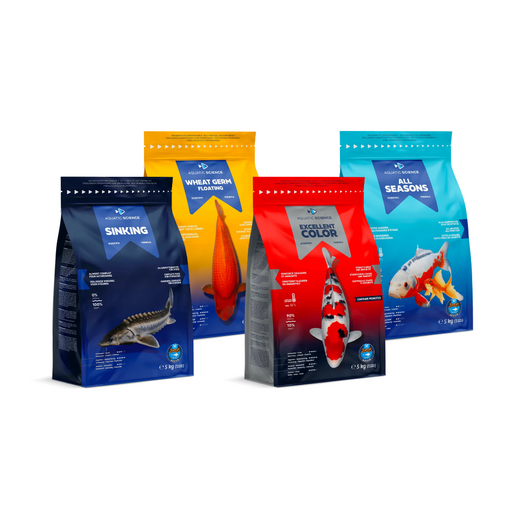
These sinking pellets of 4 to 5 mm feed sturgeon, barbel, tench and orfe, fish that look for their food on the bottom. Supplied in a resealable bag of 0.5 to 9.5 kg, they contain 47% crude protein, with fish meal as the first ingredient.
At an equal ration, this feed delivers more nitrogen to the filter than a maintenance feed: measuring ammonium becomes a useful habit as soon as you introduce it into a pond that is already heavily stocked.
 Customer support 7 days a week by email
 Delivery within 2 to 15 business days
100 % secure payment
The summary
- What you receive: a resealable bag of 0.5, 2, 5 or 9.5 kg, sinking pellets in a medium size, 4 to 5 mm.
- What's in it: 47% crude protein, 13% fat, with fishmeal as the first ingredient.
- Who it's for: sturgeon, barbel, tench and ide, the fish that feed at the bottom.
- How to feed it: at the bottom, away from the koi, and preferably at dusk.
- What else you'll need: a pond thermometer and a dissolved oxygen test.
- How it arrives: parcel of 0.5 to 9.5 kg, to a pick-up point or to your door.
Pellets that sink quickly and stay intact on the bottom, where the sturgeon feeds
The sturgeon looks for its food on the bottom. Its mouth is ventral and protractile, set beneath the rostrum, and it finds what it eats with its barbels. It rarely rises to the surface, and food that floats almost always escapes it. These 4 to 5 mm pellets sink to the bottom, where it finds them.
🐟 A pellet that sinks and holds together
Two qualities matter equally here. The pellet sinks quickly, so it reaches the bottom before the surface fish can grab it. It then stays intact for several minutes, long enough for the sturgeon to locate it with its barbels. A pellet that breaks apart on the way down is no longer eaten: it disperses into fine particles that add to the load your filtration has to deal with. Your koi, on the other hand, feed at the surface, and that is the job of a floating feed such as the colour feed.
Feeding in a mixed pond
If your pond is shared, the sturgeon eats more slowly than the koi. It looks for its food at the bottom, and the koi snatch the feed before it gets there, so the meal seems to be over when the sturgeon has received nothing. A sturgeon deprived of its share loses weight with no visible sign at the surface. The remedy comes down to three steps: give its food at a different spot in the pond, at a different time, and preferably after keeping the koi busy with theirs.
🌙 Feeding time
Ideally, give the sturgeon its meal at the end of the day, in a quiet area and always in the same place, so that it learns its routine. Several small feeds are better than a single one, because it eats slowly and continuously, rooting about on the bottom with its four barbels. As you cannot see the bottom, the ration is adjusted according to the condition of the fish: a sturgeon that is filling out is well fed, whereas one that is getting thinner almost always signals that other fish are eating its share. Unlike koi, it does not truly go dormant over winter and carries on eating as long as the water stays above a few degrees, so this bag is also useful in the cold season, at a reduced ration and at the least cold times of day.
Measuring dissolved oxygen before warm nights
A sturgeon uses a lot of oxygen, and water at 26 °C holds less of it than water at 18 °C. A dissolved oxygen test taken early on a summer morning, when levels are at their lowest, tells you whether the aeration is sufficient before you increase the ration. With a floating thermometer read at the same time each day, you also know when to cut back on feeding, since the Siberian sturgeon's appetite drops off above 28 °C.
The same sack feeds the other cold-water bottom-dwelling fish, barbel, tench and ide, which forage at the same level as the sturgeon. The formula combines 47% protein and 13% fat, with fish meal as the first ingredient, a balance designed for carnivorous or detritivorous fish whose natural diet is based on bottom-dwelling invertebrates. The medium size, 4 to 5 mm, suits fish from 15 cm in length, which covers most garden pond sturgeon, while the koi in your pond keep their floating pellets.
💧 The protein and your filter
The amount of ammoniacal nitrogen a feed produces follows its protein content. 100 g of this feed given over the course of a day produces about 4.8 g of ammoniacal nitrogen, expressed as NH4 as read by the test, compared with 3.4 g for a maintenance feed at 33.5%, which is 40% more for the same quantity fed. This order of magnitude is a maximum, because a planted pond takes up some of it before the filter. In aquaponics, this load is also what your plants feed on, which does not remove the need to measure it. Monitor the ammonium and then the nitrite in your water for the weeks following a change of feed, a mechanism described in the article on the nitrogen cycle.
🌊 The pond before the feed
Your sturgeon needs depth, at least 1.20 m, a volume in the region of 10,000 L per fish, and a clear bottom: the animal swims constantly and cannot reverse, so a planted bed or a cluttered decoration traps it. Then there is storing the bag: with 13% fat, this pellet oxidises quickly once the bag is open: reseal it after each feed, keep it dry and in the shade, and finish it within the season. The rest is detailed in the guide on the sturgeon in a garden pond, and the other formulas are in the pond fish food collection.
Technical specifications
Guaranteed analysis
- Crude protein
- 47%For the same ration, about 40% more ammoniacal nitrogen than a 33.5% feed.
- Crude fat content
- 13%An open bag oxidises quickly: reseal it and use it up within the season.
- Crude fibre
- 2.1%
- Mineral matter
- 10.9%
- Calcium
- 2.4%
- Total phosphorus
- 1.6%That is 1.8 times the phosphorus of a 0.9% feed, at an equal ration.
Use and packaging
- Behaviour in the water
- Sinking, fast-droppingIt reaches the bottom before the surface fish can snatch it.
- Particle size
- 4 to 5 mm, medium sizeA smaller pellet disperses before it reaches the bottom.
- Minimum fish size
- 15 cm
- Target species
- Sturgeon, barbel, tench, ide
- Pond depth
- 1.20 m at leastWith a clear bottom: the sturgeon swims constantly and cannot reverse.
- Packaging
- Resealable bag of 0.5, 2, 5 or 9.5 kg
Composition and additives
- Ingredients, in the declared order
- Fishmeal, cereals, oilseedsFish meal, cereal and oilseed products and by-products, fish oil, minerals.
- Vitamin A (E672)
- min. 12,000 IU per kg
- Vitamin E (3a700)
- min. 340 mg per kg
- Vitamin C (3a312)
- min. 525 mg per kg
To budget for separately
- Pond thermometer
- 1 floating thermometer
- Oxygen monitoring
- 1 dissolved oxygen test
10 further specifications are available in the detailed view.
In the box
- 1 resealable bag of 0.5, 2, 5 or 9.5 kg of sinking pellets, medium size
- 1 manufacturer's label: composition, analysis, batch number and best-before date
Guaranteed analysis, additives, composition and target species taken on 5 September 2026 from the manufacturer's data sheet, Aquatic Science. Pond volume and depth are benchmarks from specialist sites, from 1,000 to 10,000 L per fish. Sizes of 0.5, 5 and 9.5 kg noted on 11/10/2026.
Which feed for a pond sturgeon?
Here, where the fish feeds is what decides: this sinking food, the other sinking one on the shelf, and the floating one that the koi in the same pond take.
A sinking feed, but which one?
A sturgeon rarely swims up to the surface to feed. What remains to be seen is whether it shares the bottom with others, and how large it grows.
| Sinks to the bottom | Target species | Crude protein (%) | Crude fat content (%) | Ammoniacal nitrogen produced per 100 g fed, as NH4 (g) | Grain sizes available | Operating temperature | Bags available | |
|---|---|---|---|---|---|---|---|---|
| Recommended Sinking, 4 to 5 mmYour choice | Yes | Sturgeon, barbel, tench, ide | 47 % | 13 % | 4.8 g | 4 to 5 mm | cold water | 0.5 to 9.5 kg |
| JBL ProPond Goldfish, Sterlet and Biotope pond feedYour choice | Yes | Sturgeon | 40 % | 12 % | 4.1 g | 6 mm or 9 mm depending on the size | 10 to 25 °C | 1.65 kg or 3.3 kg |
| Pond fish food, floating pelletsYour choice | No | All pond fish | 33.5 % | 8.9 % | 3.4 g | 2 to 3, 4 to 5 or 6 to 7 mm | 12 to 25 °C | 0.5 to 10 kg |
Sinking, 4 to 5 mmRecommended
Where the fish finds it
Sinks to the bottomYes
Target speciesSturgeon, barbel, tench, ide
The formula
Crude protein (%)47 %
Crude fat content (%)13 %
Ammoniacal nitrogen produced per 100 g fed, as NH4 (g)4.8 g
Use
Grain sizes available4 to 5 mm
Operating temperaturecold water
Bags available0.5 to 9.5 kg
JBL ProPond Goldfish, Sterlet and Biotope pond feed
Where the fish finds it
Sinks to the bottomYes
Target speciesSturgeon
The formula
Crude protein (%)40 %
Crude fat content (%)12 %
Ammoniacal nitrogen produced per 100 g fed, as NH4 (g)4.1 g
Use
Grain sizes available6 mm or 9 mm depending on the size
Operating temperature10 to 25 °C
Bags available1.65 kg or 3.3 kg
Pond fish food, floating pellets
Where the fish finds it
Sinks to the bottomNo
Target speciesAll pond fish
The formula
Crude protein (%)33.5 %
Crude fat content (%)8.9 %
Ammoniacal nitrogen produced per 100 g fed, as NH4 (g)3.4 g
Use
Grain sizes available2 to 3, 4 to 5 or 6 to 7 mm
Operating temperature12 to 25 °C
Bags available0.5 to 10 kg
Analyses taken on 5 September 2026 from the manufacturers' data sheets. Ammoniacal nitrogen estimated from the protein content, half of the nitrogen being assumed to be excreted, and expressed as NH4.
Help choosing
Who feeds at the bottom in your pond
Documents & manuals
Official manufacturer's data sheet: analysis, composition and vitamins
The Aquatic Science page gives the guaranteed analysis, the composition, the vitamins and the pack sizes of the Sinking food.
Document not showing? Some publishers block display inside a frame, so open it in a tab.
Estimate your
delivery time
Your estimate
Delivery
Estimated time
It covers preparing your order and then the transit time quoted by the carrier, counted in working days.
It is not a guaranteed delivery date: public holidays, peak periods, customs or a carrier delay can extend it. The exact amount, in your currency, is worked out in the cart once your address is entered.
Bag of 0.5 to 9.5 kg, shipped to a pick-up point or to your home, as you choose during payment. The exact cost is calculated in the basket according to the total weight of your order.
Frequently asked questions
8 questions
6 key questions, 8 in the detailed view
You may also like




Related articles

Guide
Sturgeon in a garden pond
Species, depth, oxygenation and feeding: everything you need to know before welcoming one.
Read the article

Understanding
The nitrogen cycle in aquaponics
Why a higher-protein feed puts more demand on your biological filter.
Read the article

Guide
Which fish to choose for aquaponics?
What each species eats, and at which level of the pond it feeds.
Read the article

Guide
Koi carp in aquaponics
The surface neighbours of your sturgeon, and what they change at feeding time.
Read the article

Season
Pond algae in summer
The phosphorus in a rich feed ends up in the water, and algae make use of it.
Read the article

Avoid
Common mistakes in aquaponics
Overfeeding and poorly spacing meals remain the two most costly mistakes.
Read the article
Let us talk about your project
A question about this product or your setup? Our team will answer and advise you.

Interest-free instalment payments
Offered depending on the cart amount, at checkout.

Delivery in 2 to 15 working days
Depending on the products and shipping sites. Estimate by destination in the estimator on this page.

After-sales service 7 days a week by email or chat
Our team answers all your questions.

Shop responsibly
Become part of the change.
