Business, school, care centre : why take up aquaponics ?

09 June 2026
Entreprise, école, centre de soin : Pourquoi se mettre à l'aquaponie ?

We picture aquaponics in a garden or a greenhouse. Rarely in a school playground, a hospital's shared garden or the lobby of a corporate headquarters. And yet, that is where it produces some of its most remarkable effects : calm, curiosity, autonomy, a bond between generations.

More and more organisations are choosing aquaponics, not to produce on a large scale, but for what it does to the people who look after it. Here is why.

When aquaponics leaves the home vegetable patch

Taking aquaponics out of the garden and into the lobby of a listed company or the courtyard of a care home reflects a shift in scale far deeper than a simple expansion. At home, a few fresh salads and berries are enough, but in an institution, you need a measurable return on investment, consistency with regulatory obligations or a concrete impact on the people it serves every day.

The pioneers already up and running show that this is no longer a distant prospect, but a reality that is unfolding at different speeds depending on the sector. This shift rests on concrete and increasingly important drivers : the expectations of job candidates, the search for concrete and lasting educational projects, the therapeutic dimension in care facilities, and so on.

A multi-faceted tool

If we look at who is installing aquaponic systems today, we find a primary school as much as a large Parisian group, a provincial care home as much as a town hall's communal canteen. The diversity of the structures involved says something powerful about the versatility of this practice.

Where most projects call for a trade-off, between teaching and production, between social bonds and concrete usefulness, aquaponics forces no choice. It feeds, teaches, brings people together and soothes in the same gesture.

Understanding this trend first requires distinguishing the techniques. The difference between aquaponics and hydroponics is no small matter ; the two approaches address neither the same needs nor the same audiences.

The enthusiasm reflects a broader transformation, the shared desire to have, in one's school, care setting or workplace, a corner of nature that reminds us that the living world is a fascinating subject.

The living world gains ground

For businesses, environmental reporting obligations are tightening and commitments are becoming visible, verifiable, comparable. For local authorities, public policies seek to relocalise what can be and to reconnect citizens with their food.

But the movement goes further than obligations alone. The relationship with the living world is changing profoundly. Growing, understanding, sharing a place of production at neighbourhood scale is becoming a need shared by very different audiences.

In schools, hospitals, care homes, town halls and offices, the need for a concrete and living medium to give substance to the values being championed has become an everyday matter. Statements of intent are no longer enough ; there must be installations you can touch, visit and talk about.

Aquaponics then becomes a tool serving this need, at once an object of learning, a food resource, a centrepiece for engagement and a signal of commitment.

L'Oréal, multi-site aquaponics

L'Oréal illustrates the most accomplished trajectory in France, with a progressive approach since the global headquarters in Clichy was fitted with a first vegetable garden.

The Saint-Ouen-sur-Seine site inaugurated in 2024 an installation combining aeroponic towers, microgreens and an aquaponic system, designed by Cueillette Urbaine with VEGETO. The produce is distributed to employees and used by the company restaurant.

In Aulnay-sous-Bois, a larger farm supplies the staff catering and serves as an educational tool, from guided tours to awareness workshops on sustainable agriculture.

Beyond CSR reporting, the benefits are concrete. Employees stop, chat around the installation, share the curiosity of a plant growing next to their workstation. A sense of belonging takes hold and the lunch break gains a new flavour when the salad comes from the building's roof.

The Baromate, aquaponics at the office

At Paris airports, at Heineken or in the offices of the Banque de France, the startup AURA Urbaine has installed several Baromates, compact aquaponic structures combining small fish and aromatic plants, integrated directly into workspaces. AURA now equips around twenty clients, including large groups.

The Baromate plays several roles at once. It is a CSR tool that embodies the group's environmental commitment, and an anchor point for the living world in offices dominated by screens and open spaces.

In daily life, the effect is quickly felt. Employees stop in front of the pond, exchange a few words, observe a fish or a leaf that has unfurled since the day before. These micro-interactions weave cross-cutting bonds between departments and soothe the sometimes harsh pace of an open space.

The compact and modular format makes the installation reproducible across several sites without a heavy feasibility study, a key advantage for organisations that want to roll it out on a large scale.

Why the living world changes everything at the office

Biophilic design, which reintroduces the living world into offices, is no longer a matter of intuition. Studies converge on measurable effects : productivity gains, lower stress, better concentration and reduced absenteeism. The initial investment quickly pays for itself.

The context reinforces the stakes. Psychosocial risks weigh heavily on French companies and mental health has become a national priority. Wellbeing at work is shifting from a side topic to a central management criterion.

Aquaponics plays a particular role in this equation. Where a potted plant brings a little greenery, the pond and the grow beds introduce the living animal, plant and mineral world all at once. The visible presence of the fish and the growth of the plants engage continuous attention that is out of the ordinary for an open space.

It is also a topic of conversation. Around the pond, informal moments form that bring teams closer, create cross-cutting bonds between departments and give the break a different feel from the coffee machine.

A daily breath of fresh air

Aquaponics in business does not only change CSR indicators or brand image. It also changes something more discreet, the daily rhythm of teams.

The pond and the grow beds bring a living point of attention into an often abstract work environment. You stop on your way past, you watch a plant that has unfurled, you comment on the colour of a leaf. These micro-breaks weave another tempo, more human.

For newcomers, the tour of the premises tells something other than an onboarding PowerPoint. For existing teams, the shared care of the system creates an unexpected ground for cooperation between departments that rarely cross paths.

The installation becomes an informal landmark. Not a management tool or a communications operation, but a living fixed point that reminds everyone that the company is also a place of life.

Care centres : healing through the living world

Healthcare facilities combine two needs usually handled separately, quality food for patients and a resource space for staff.

On the roof of the Robert Debré hospital in Paris, a vast urban flower farm illustrates the groundswell of the living world in hospital settings as part of the Parisculteurs initiative. It is horticulture rather than strict aquaponics, but the signal is clear : hospitals want the living world on their roofs and in their courtyards.

Aquaponics naturally finds its place there. It adds the nourishing dimension to the landscape dimension, and makes it possible to serve ultra-fresh produce in the central kitchen. The roof-to-plate journey becomes a story you can tell patients and their families alike.

The double benefit feeds the kitchen and serves as a care tool, in an approach that joins that of food sovereignty at the scale of a single site.

Horticultural therapy in care homes

Beyond production, aquaponics opens a therapeutic dimension that goes beyond the simple care garden. The visible presence of fish and the slow growth of plants engage sensory attention suited to vulnerable audiences.

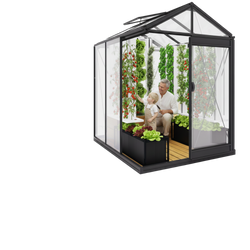
The director of the Saint-Pierre care home reports on its aquaponic installation : "This greenhouse is part of our goal of developing non-medicinal therapies. It clearly contributes to the wellbeing of our residents." The facility even plans to invite young people with disabilities from a nearby institute.

Aquaponics adds three levers compared with a simple garden, the fascination of the fish, a verticality accessible from a wheelchair and a faster cycle that sustains attention over time.

The decisive argument lies in the double benefit. The system feeds the kitchen and serves as a care tool, in an approach that turns an expense into a cross-cutting infrastructure.

Schools and learning about living things

Aquaponics is also moving into schools. In France, the Notre école faisons-la ensemble scheme run by the education authorities can fund aquaponic kits through the Pedagogical Innovation Fund, with the aim of improving success and reducing inequalities.

The educational value goes beyond simply discovering nature. The system combines biology, chemistry, ecology and nutrition in a concrete object that encourages continuous observation over long cycles. Pupils watch a fish grow, seeds germinate, roots lengthen, and understand through practice what a textbook only sketches out.

Aquaponics also touches on the civic dimension. Learning to produce your own food, understanding where it comes from and how it grows, is an education in taste and in food autonomy that leaves a lasting mark.

Third places and community gardens

Aquaponics is not limited to large groups and institutions. It also makes its way into third places, community gardens and citizen projects, where it takes on another face.

In these collectively managed spaces, aquaponics becomes a tool for social bonding. Neighbours, students, retirees and families meet around the grow beds and learn together. The system requires continuous attention that justifies regular get-togethers ; each visit turns into a moment of sharing.

The format lends itself to all scales, from the neighbourhood bed installed on a rooftop terrace to the communal greenhouse set up by an association. The investment remains modest when it is pooled.

For a municipality, supporting this kind of initiative ticks several boxes at once, neighbourhood activity, food awareness, intergenerational bonding and citizens taking ownership of a subject often perceived as technical.

The concrete obstacles to anticipate

A recent parliamentary question sums up the situation well : a lack of regulatory clarity, the absence of dedicated funding and high study costs. The sector is still taking shape despite the momentum.

On the ground, the first obstacle concerns health standards. Food production in a professional setting means complying with HACCP regulations, sometimes veterinary approvals if the fish are eaten, and full traceability. A sanitary control plan becomes an obligatory step that must be anticipated with a competent provider.

Add to this the training of staff in the daily monitoring of a biological system, a higher initial cost than an ornamental planting and sometimes internal resistance to an unusual project. None of these obstacles is prohibitive as long as they are anticipated at the design stage.

Launching an institutional project

Launching an institutional aquaponic project requires a structured approach and the right partner. Several French players have specialised in this segment, each with its own positioning.

The feasibility study phase remains essential to analyse load-bearing capacity, electrical supply, water access and sizing. Then comes the installation, followed by operation, which calls for an annual maintenance budget to be factored in from the outset.

Univers Aquaponie supports professional and institutional projects with its partners, from the initial study to installation and follow-up. Let's discuss together the best configuration for your site and your objectives. We can also offer discounts on certain installations, so do not hesitate to contact us directly.

Far more than a CSR initiative

Aquaponics in a business, a school or a hospital cannot be reduced to a CSR argument, a reporting indicator or an image operation. What strikes you about the pioneers is how much the installation spills beyond the framework in which it was placed. The kitchen, the teaching, the team bond, the conversation, the shared pride, so many effects that no strategy PDF had foreseen.

The movement is only just beginning. The first projects in France and Europe show that the real value of an installation is measured less in kilos of salad or boxes ticked than in the human moments it generates. The organisations that take a step ahead do so less out of calculation than out of conviction, and that is probably why they will last over time.