Pond water evaporation in summer: which strategy to adopt?

06 June 2026
Évaporation de l'eau du bassin en été : quelle stratégie adopter ?

Between July and August, your pond can lose several hundred litres per week without you noticing. Good news: calculating these losses is simple, and topping up without disturbing your fish is just as easy if you avoid two major pitfalls.

Why a pond loses so much in summer

Evaporation is an unavoidable physical phenomenon: under the effect of heat, direct sun and wind, water molecules turn into vapour and leave your pond. A loss of 1 cm per day is completely normal at the height of summer, and can climb to 2 or 3 cm during a dry, windy heatwave.

This guide first gives you the formula to calculate your losses in litres, then the method to measure your actual evaporation. Then comes everything you need to know to top up properly: the two hidden dangers (thermal shock and chloramine), the safe step-by-step method, and the automatic solutions that free you from the tap.

The exact calculation of losses

The formula is simple: 1 millimetre of evaporation over 1 m² of surface = 1 litre. Multiply the daily drop by the surface area of your pond to get the litres lost each day.

A concrete example: a 5 m² pond losing 1 cm per day (10 mm) in a normal summer loses 50 litres daily, i.e. 350 litres per week. A 10 m² pond in a full heatwave, at 2 cm per day, reaches 200 litres per day, i.e. nearly 1,500 litres over 7 days.

These figures are surprising at first, but they can be verified with a simple mark on the wall. Knowing the order of magnitude lets you anticipate and correctly size your top-up water reserve.

Measuring your actual evaporation

The most reliable method is the bucket test. Place a graduated bucket filled with water right next to the pond, with the same sun exposure. After 24 hours, compare the drops: if they are identical, you are indeed dealing with pure evaporation. If the pond drops faster, you have a leak to find.

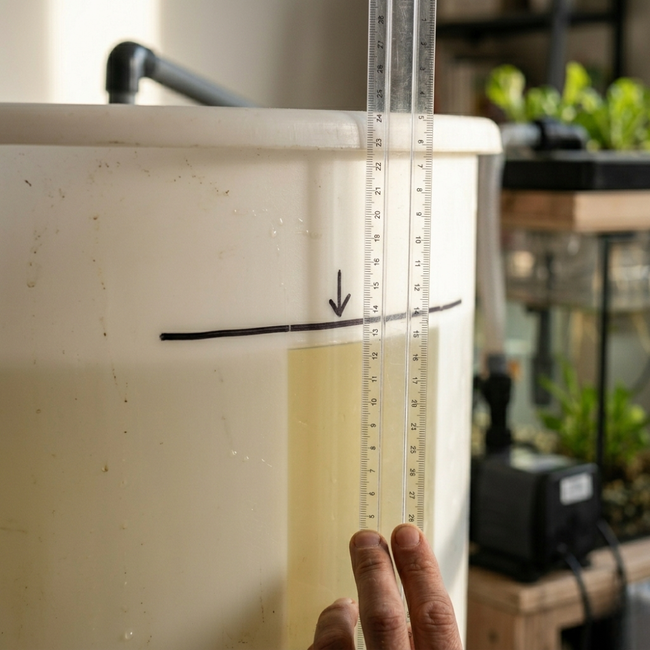
Mark the full level on the wall with a permanent marker and photograph it. A weekly check is enough to anticipate topping up. It is also the method for diagnosing suspected cloudy water linked to a hidden leak.

Write the values down in a small notebook. By cross-referencing with the weather, you will quickly obtain your personal evaporation curve.

The factors that make it worse

A large exposed surface evaporates proportionally more. A waterfall or fountain easily doubles the evaporation rate through the spray effect. Wind also multiplies losses by constantly renewing the dry air above the water.

Bank plants worsen the balance through their evapotranspiration, a combined process of evaporation and leaf transpiration. A dense clump of rushes or papyrus can account for 30 to 50 % of total losses.

To limit this, slow down waterfalls during heat peaks, create a wind-sheltered zone and choose moderately evapotranspiring bank plants. Partial shading with floating plants usefully completes the strategy.

Two hidden dangers of topping up

Compensating for evaporation seems trivial: you open the tap and let it run. That is exactly the gesture that can kill part of your stock. Two dangers combine when no precautions are taken: thermal shock and the presence of chlorine or chloramine in mains water.

Why it kills silently

Koi carp and other pond fish tolerate a wide temperature range, provided changes are slow. A brutal top-up locally drops the temperature by several degrees, weakens immune defences and opens the door to disease. The following sections detail how to avoid these two traps.

The silent thermal shock

Your tap water usually comes out between 12 and 18 °C, even in summer. Your pond water, however, easily rises to 24–28 °C in high season. Pouring this cold water in abruptly creates a local difference of 10 °C or more, fatal to fish.

The absolute rule is never to exceed a 2 to 4 °C difference between the added water and the pond water. Beyond that, immune weakening encourages white spot disease (ich) to appear within just a few days.

If you need to top up a lot of water, do it in several small passes spread over the day, or let the water warm up in a container in the sun for a few hours beforehand.

Chlorine and chloramine: the trap

Tap water always contains chlorine or chloramine, added for drinkability. Chlorine burns fish gills and kills the nitrifying bacteria in the filter. This last consequence is often underestimated but can trigger a destructive ammonia spike.

Simple chlorine evaporates within 24 to 48 hours in the open air. Chloramine, on the other hand, is much more stable and requires active treatment. Activated carbon is the simplest solution: it binds chlorine and chloramine within a few hours.

A commercial water conditioner does the same job in a few minutes, which is handy for urgent top-ups.

The safe step-by-step method

Step one: prepare your water in a closed reserve the day before. Fill it 24 hours in advance with tap water, add a conditioner or let the chlorine evaporate, and let it all warm up in the open air.

Step two: check the pH and the temperature before adding. The difference with the pond must not exceed 2 to 4 °C. Pour gently, never more than 10 to 15 % of the pond's volume at once.

Ideally, top up in the evening, when temperatures stabilise. Watch your fish for the following 30 minutes: swimming, breathing, behaviour.

The automation that changes everything

For outdoor ponds and long summer absences, two combined devices transform maintenance: a float valve installed on a pre-treated buffer tank, plus a good-sized rainwater collector.

The float valve works like a toilet cistern valve: as long as the level drops, it lets water flow; as soon as the mark is reached, it closes. The buffer tank allows the water to be pre-conditioned before it reaches the pond.

Collected rainwater is the gentlest there is: no chlorine, at ambient temperature, perfectly suited. A 1,000-litre tank is enough for a normal summer on a medium-sized domestic pond.

Evaporation: a manageable challenge

Summer evaporation is not inevitable. Understanding the formula, measuring your own losses, identifying the aggravating factors: these are the three keys to anticipating. As for topping up, it rests on two golden rules: a maximum 4 °C temperature difference, and zero residual chlorine in the added water.

With a simple routine or an automatic system, your pond gets through the hottest months without harm to the fish or loss of filter bacteria. Consistency and anticipation are worth a thousand catch-up chemicals.