

Reagent refill for dissolved oxygen test
Regular price
9,20 €
Regular price
Sale price
9,20 €
Unit price
/
per
3,06 € × 3 with no fees
Klarna.
These three bottles are the reagents for the dissolved oxygen test, providing approximately 40 measurements. Each measurement uses 6 drops from each of the three bottles.
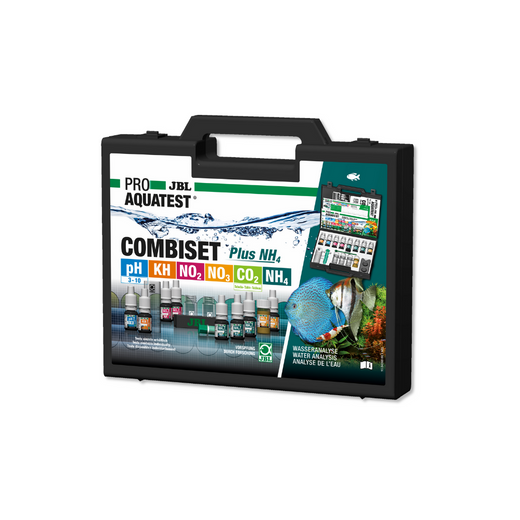
The method fixes the oxygen in the test tube at the moment of sampling, then reveals it through a colour reaction. The glass test tube, its screw cap, the syringe, and the colour chart from your kit remain in use throughout.
 Customer support 7 days a week by email
 Delivery within 2 to 15 business days
100 % secure payment
The summary
- What it measures: the oxygen actually dissolved in the water, in milligrams per litre.
- What the box contains: 3 numbered reagent bottles, 1, 2, and 3.
- Number of tests: approximately 40, at 6 drops from each bottle.
- When to test: early in the morning in summer, when the curve is at its lowest.
- The alert threshold: below 5 mg/L first thing in the morning, aeration should be increased the same day.
- Refill or complete kit: the refill is sufficient if your test tube still seals without leaking and your colour chart shows shades of red.
Reagents 1, 2 and 3 for the oxygen test, approximately 40 measurements, from 1 to 10 mg/L
Dissolved oxygen leaves the water the moment it is poured or agitated, which is why this test fixes it chemically inside the test tube at the very moment of sampling, before revealing it through a colour change. These three numbered bottles, 1, 2 and 3, are the reagents for this process, providing approximately 40 measurements between 1 and 10 mg/L.
🧪 Three reagents in order
Fill the test tube to the brim by submerging it in the water, then slowly add 6 drops of reagent 1 and 6 drops of reagent 2, allowing it to overflow slightly. Seal it without trapping any air bubbles and shake vigorously for approximately 30 seconds. Only then do you add 6 drops of reagent 3, reseal and shake again for 30 seconds, at this stage an air bubble no longer affects the result. After 10 minutes, lay the test tube on its side and move it back and forth 3 to 5 cm above the white section of the colour chart, whose shades range from yellow to dark red.
🐟 Three oxygen consumers
Fish are not the only organisms consuming oxygen in your water: the bacteria in the filter also need oxygen to convert ammonium into nitrate, and the roots of your crops consume it too. In aquaponics, the working range is between 5 and 8 mg/L. The amount of oxygen water can dissolve decreases as temperature rises, whilst plants in light can exceed saturation by 1 to 2 mg/L by the end of the day. Measure early in the morning, when the value is at its lowest, and the guide to maintaining your system in summer sets out the key actions for that period.
An air pump when the morning reading drops
If your morning reading drops below 5 mg/L, an aquarium air pump with one or two outlets increases gas exchange at the surface, where water recharges with oxygen. Take another reading the following morning at the same time to check the effect of the aeration. For a pond, the complete pond aerator performs the same role over a larger volume.
The three-bottle refill follows the red colour chart
This refill is intended for the current oxygen test, which uses three reagents and a colour chart in shades of red. An older two-reagent kit came with a colour chart in beige tones, and these new bottles cannot be read against it. Please check the colour of your chart before ordering: if it is beige, you need the complete oxygen test.
All three reagents are classified Danger, with hazard statements H314 and H318, indicating serious skin burns and eye damage. Reagent 1 also carries statements H373 and H412, and Reagent 3 carries H317 and H334, indicating a risk of skin and respiratory sensitisation. Work over a sink in a well-ventilated room, keep your face away from any treated test tube, and empty it down the sink rather than into your tank.
📆 40 tests, a complete set
Each measurement uses 18 drops, 6 from each of the three bottles, which accounts for the count of approximately 40 measurements. At the recommended rate of one measurement per week for a new water setup, plus an extra one whenever your fish show signs of oxygen deficiency, the kit covers several months of monitoring. Store the three capped bottles in a dry place at room temperature in their original packaging, and replace them all together, as they are used at the same rate.
Technical specifications
What the refill contains
- Contents
- 3 reagent bottlesReagents 1, 2 and 3, numbered on the label
- Measurements
- Approximately 40Six drops from each bottle per measurement, making 18 drops in total.
- Reading range
- 1 to 10 mg/LIn freshwater, milligrams per litre is equivalent to ppm
- Target values
- 5 to 8 mg/LWorking range in aquaponics. Saturation decreases as the water warms up
- Manufacturer's reference
- JBL 2411300, PROAQUATEST rangeNot to be confused with 2411200, which is the complete test kit
- Hazard classification
- Danger, all 3 bottlesH314 and H318 on all three, H373 and H412 on reagent 1, H317 and H334 on reagent 3
To budget for separately
- Test tube with screw cap
- Those from the oxygen testThe test tube is filled by immersion and sealed as it overflows, with no air trapped inside
- Colour comparison chart
- The one from the oxygen testThe current colour chart, in shades of red, corresponds to the three reagents
In the box
- 3 reagent bottles, numbered 1, 2 and 3
Reference, EAN code, contents, protocol, number of tests and hazard statements taken from the JBL data sheet and instructions on 07/10/2026. Saturation by temperature: table from the JBL instructions. Range of 5 to 8 mg/L: FAO, small-scale aquaponics, 2014.
Top up the reagents, or replace the kit?
Three bottles on one side, the same three bottles plus the glassware on the other. What tips the balance is the condition of what you keep from one year to the next.
An oxygen reading depends on an airtight seal
The three reagents will not give an accurate result if the test tube lets a bubble in when closing, or if the white background of the colour chart has yellowed.
| Reagent bottles (bottles) | Possible readings (measurements) | Glass test tube with screw cap | Graduated sampling syringe | Red colour chart with white section | Price | |
|---|---|---|---|---|---|---|
| Recommended Reagent refill for dissolved oxygen testYour choice | 3 bottles | 40 measurements | No | No | No | 9,20 € |
| Dissolved oxygen water test in dropsYour choice | 3 bottles | 40 measurements | Yes | Yes | Yes | 14,90 € |
Reagent refill for dissolved oxygen testRecommended
What gets used up
Reagent bottles (bottles)3 bottles
Possible readings (measurements)40 measurements
What keeps well
Glass test tube with screw capNo
Graduated sampling syringeNo
Red colour chart with white sectionNo
Budget
Dissolved oxygen water test in drops
What gets used up
Reagent bottles (bottles)3 bottles
Possible readings (measurements)40 measurements
What keeps well
Glass test tube with screw capYes
Graduated sampling syringeYes
Red colour chart with white sectionYes
Budget
Contents of both columns taken from the supplier's data sheet and instruction leaflet, on 05/09/2026.
Help choosing
Three bottles, or the complete oxygen kit
Estimate your
delivery time
Your estimate
Delivery
Estimated time
It covers preparing your order and then the transit time quoted by the carrier, counted in working days.
It is not a guaranteed delivery date: public holidays, peak periods, customs or a carrier delay can extend it. The exact amount, in your currency, is worked out in the cart once your address is entered.
Parcel weight 0.08 kg, dispatched to a collection point or to your home address — your choice at checkout. All three bottles are sent in their original packaging. The exact shipping cost is shown in the basket.
Frequently asked questions
6 questions
6 key questions
You may also like


Related articles

Season
Maintaining your aquaponic system in summer
The period when this parameter reaches its lowest values, and when readings converge.
Read the article

Organisation
Aquaponics and summer holidays
What to check before you leave, so you don't come back to an unpleasant surprise.
Read the article

Pond
Pond algae in summer
A mat of algae produces gas during the day and consumes it at night, which is why readings are taken in the morning.
Read the article

Species
Sturgeon in a garden pond
A species that is particularly demanding on this point, and unforgiving of a nocturnal dip.
Read the article

Species
Raising perch in aquaponics
Fresh, well-supplied water, and how to verify that it really is.
Read the article

Pond
Pond evaporation in summer
Less water and more heat — the two conditions for a dip first thing in the morning.
Read the article
Let us talk about your project
A question about this product or your setup? Our team will answer and advise you.

Interest-free instalment payments
Offered depending on the cart amount, at checkout.

Delivery in 2 to 15 working days
Depending on the products and shipping sites. Estimate by destination in the estimator on this page.

After-sales service 7 days a week by email or chat
Our team answers all your questions.

Shop responsibly
Become part of the change.
