



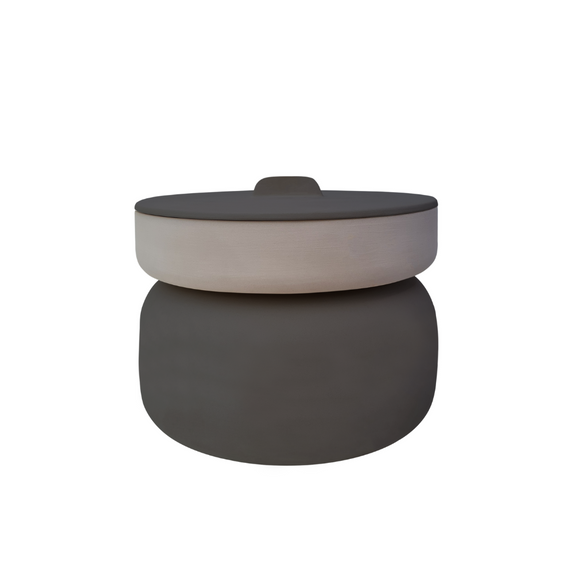
Indoor terracotta worm composter
Regular price
248,90 €
Regular price
Sale price
248,90 €
Unit price
/
per
82,96 € × 3 with no fees
Klarna.
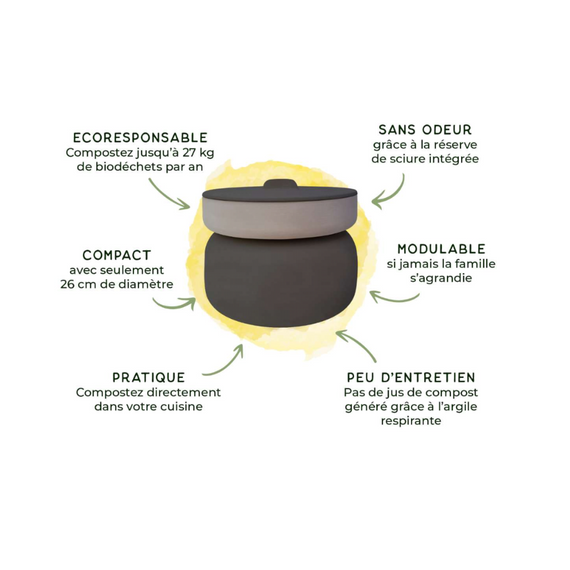
This indoor worm composter made from terracotta turns your kitchen peelings into compost for your pots and houseplants. Its clay wall allows excess moisture to evaporate, and its built-in sawdust reservoir keeps odours at bay.
 Customer support 7 days a week by email
 Delivery within 2 to 15 business days
100 % secure payment
The summary
- What it is: a clay kitchen worm composter with its integrated sawdust reservoir.
- Who it's for: a one- to two-person household, three to four with a second ring.
- How long it takes: around 6 months for the first compost, 3 months thereafter.
- How to choose: the kitchen pot, the large stacking tray unit, or the balcony planter.
Kitchen worm composter, 8 litres for one to two people
This indoor worm composter made from terracotta sits on a worktop and takes your peelings as you cook. Compost worms transform them into a fine compost that you can then return to your pots, window boxes and houseplants, without storing a bag of food waste until the end of the day.
Food waste accounts for around 30% of the weight of our household bins, and since 1 January 2024 every local authority has been required to offer residents a way to sort it at source. If you live in a flat, this pot lets you process a proportion of that waste in your own kitchen, without waiting for a collection. The volume decreases as the worms and micro-organisms break down the material, it takes around 20 kg of peelings to produce 1 kg of compost, so the pot continuously compacts between deposits.
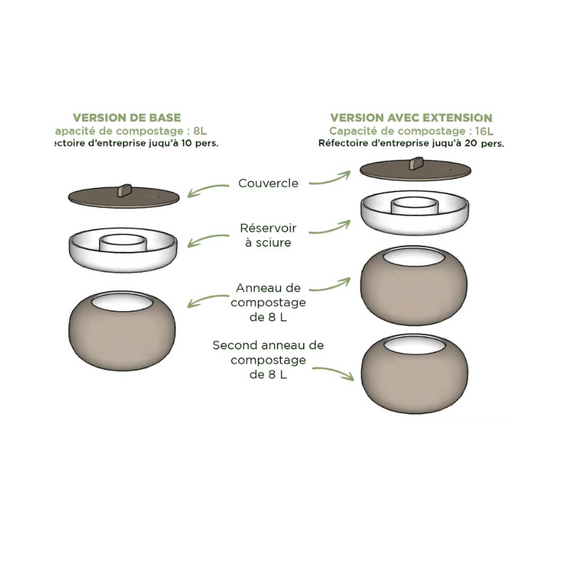
🏺 Three clay pieces stacked together
The composter consists of three terracotta pieces that fit together, each with a specific role. The micro-porous clay is at its heart: it allows excess water to evaporate through the wall, so no leachate collects at the bottom and there is nothing to empty or drain. This evaporation through the wall keeps the material moist without waterlogging it, which corresponds exactly to the state the worms prefer, that of a wrung-out sponge.
The lid
It closes the composter at the top; lift it each time you add material, then replace it.
The sawdust reservoir
It fits under the lid and keeps the sawdust within reach for the handful added after each contribution.
The 8-litre ring
This is the chamber where the worms live, and its porous clay wall evaporates excess water.
Worms for a container pot raised off the ground
Sitting on a work surface, this composter has no contact with any ground from which worms might naturally colonise it. A worm starter kit provides an instant colony of adults, juveniles and eggs, which cuts the time to first compost from 12 months down to 6. You can order it alongside the composter, or later, when you decide to get started, as the bin keeps perfectly well when empty.
Garlic and onion stay out of the bin
Garlic, onion, and leek act as vermifuges on worms, and are among the most common causes of a rotting smell. Place them, along with citrus peel, meat, and fish, in your local authority's food waste bin, which collects what you do not compost at home.
The integrated reservoir addresses a challenge particular to flat living: the carbon-rich material you find in a garden, dead leaves, for example, is simply not to hand indoors. The sawdust provides the carbon that kitchen peelings lack, absorbs their moisture, and helps keep the compost aerated. Add a handful after each addition of waste, and the alternating layers of peelings and sawdust maintain the balance. A well-balanced compost smells of humus or woodland floor; an unpleasant odour indicates compost that is too wet or too nitrogen-rich, which you correct with an extra handful of sawdust.
🌞 The right climate for worms
Compost worms are most active between 15 and 25 °C, in material that is moist but never waterlogged, and they need a good supply of oxygen. Below 5 °C or above 30 °C, temperatures can be fatal to them, which rules out a sun-facing windowsill, proximity to an oven or radiator, and a balcony in winter. They also dislike vibration: avoid placing the unit on a washing machine or next to a fridge. A temperate kitchen, a larder, or a corner of a room away from direct light suits them perfectly, and it keeps the composter conveniently close to the chopping board.
🥕 What goes into the pot
Add your raw or cooked peelings, provided they carry no sauce or dressing, along with coffee grounds, opened tea bags, crushed eggshells, mushroom trimmings, and spent flowers. Cut peelings into small pieces, as the finer the material, the faster it breaks down. Keep out of the pot, however: meat, fish, pasta, bread and brioche, oil, milk, citrus fruit, and walnut or rhubarb leaves. Do not store fruit peelings in a bucket before adding them either: the fermentation attracts fruit flies, whereas peelings added straight away and covered with sawdust go unnoticed.
📅 From first deposit to compost
A wormery starts slowly, because the worm colony must first multiply according to the food available. Allow around 6 months before harvesting the first compost. Once the worms fill the entire ring, the cycle shortens to 3 months, and to 2 months if you add a compost activator once the pot is full, which speeds up decomposition by around 30% for one month. Without worms, composting remains purely bacterial and takes around twelve months. The compost is ready when you find almost no worms left in it, a sign that decomposition has run its course. During periods away, a break of 3 to 4 weeks without adding material causes no problem for the colony.
🌱 Compost in your growing beds
The worm compost produced has the appearance of very fine potting compost. It is mixed at roughly two thirds soil or compost for repotting, seedlings, window boxes and houseplants, and is best used within 6 months of harvesting. If you run an aquaponic system, it also makes an excellent nursery medium: seedlings raised in a mix enriched with worm compost develop a well-nourished plug by the time you transplant them into the grow beds. The compost itself should never be poured into the fish water, and the vermiponics guide explains how worms can live directly in a grow bed on grow medium.
📐 Extend with a second ring
At 26 centimetres in diameter and 22 centimetres tall, the composter fits on a corner of a worktop, and it weighs 5.5 kg empty, so choose its spot before you fill it. Its 8-litre ring keeps pace with the kitchen scraps of a one- to two-person household. If your household grows, a second composting ring stacks on top of the first, doubling the volume to 16 litres and catering for three to four people; the composter then stands around 37 cm tall, which is worth checking against overhead cupboards. The lid and the sawdust reservoir serve both tiers.
📦 The parcel
The worm composter arrives in three terracotta pieces, the lid, the sawdust reservoir, and the 8-litre composting ring, along with an instruction leaflet listing all accepted waste. These pieces are made by a German ceramics company less than 200 kilometres from Haguenau in Alsace, where the composter was designed; the clay then develops a patina over time, giving each piece its own distinctive shade. For a year's worth of deposits, the annual accessories pack includes two bags of coarse sawdust and two bags of activator, with or without worms depending on the version you choose.
Technical specifications
The composter and its rhythm
- Composting volume
- 8 L per ringA second ring brings the volume to 16 L and the height to approximately 37 cm.
- Hearth
- 1 to 2 peopleIt composts up to 27 kg of organic waste per year; the household benchmark depends on fresh vegetables cooked.
- Material
- Micro-porous clayExcess moisture evaporates through the walls, with no leachate to drain.
- Footprint
- Ø 26 x h 22 cmIt weighs 5.5 kg empty, so position it before filling it.
- First compost
- Approximately 6 monthsThat is how long the worm colony takes to multiply.
- Established cycle
- 3 months, 2 with activator
To budget for separately
- Compost worms
- A starter batch
- Coarse sawdust
- A sachet for the reservoir
In the box
- 1 terracotta lid
- 1 terracotta sawdust reservoir
- 1 terracotta composting ring of 8 L
- 1 instruction leaflet
Volumes, dimensions, weight, indicative household numbers, composting durations and parcel contents: figures from the manufacturer Agrotonome, sourced on 07/10/2026. Household numbers and durations are indicative estimates.
Three ways to compost at home
Kitchen pot, stacking tray bin, or balcony vegetable planter
Unsure which of these three composters to choose?
They all compost with worms, but not in the same location, volume, or for the same purpose.
| Composting volume (L) | Location | Material | Integrated planter | Worm tea tap | Stated capacity | Price | |
|---|---|---|---|---|---|---|---|
| Recommended Indoor terracotta worm composterYour choice | 8 L | Work surface | Clay | No | No | 1 to 2 people, 3 to 4 with a second ring | 248,90 € |
| Wormery with 2 stackable trays and a tapYour choice | 28 L | On the floor, indoors or outdoors under shelter | Recycled plastic | No | Yes | Up to 6 people | 139,90 € |
| Wooden balcony planter-composter, 50 x 50 cmYour choice | 15 L | Balcony or terrace | Douglas fir and stainless steel | Yes | No | 2 kg of organic waste per month | 309,90 € |
Indoor terracotta worm composterRecommended
Composting volume (L)8 L
LocationWork surface
MaterialClay
Integrated planterNo
Worm tea tapNo
Stated capacity1 to 2 people, 3 to 4 with a second ring
Wormery with 2 stackable trays and a tap
Composting volume (L)28 L
LocationOn the floor, indoors or outdoors under shelter
MaterialRecycled plastic
Integrated planterNo
Worm tea tapYes
Stated capacityUp to 6 people
Wooden balcony planter-composter, 50 x 50 cm
Composting volume (L)15 L
LocationBalcony or terrace
MaterialDouglas fir and stainless steel
Integrated planterYes
Worm tea tapNo
Stated capacity2 kg of organic waste per month
Volumes, materials, equipment and capacities recorded from the manufacturers' product pages on 07/10/2026. For the tray tank, the volume given is that of the 2 trays supplied.
Help choosing
Which composter suits your home?
Estimate your
delivery time
Your estimate
Delivery
Estimated time
It covers preparing your order and then the transit time quoted by the carrier, counted in working days.
It is not a guaranteed delivery date: public holidays, peak periods, customs or a carrier delay can extend it. The exact amount, in your currency, is worked out in the cart once your address is entered.
Three clay pieces, fragile and heavy: 5.5 kg empty, packed accordingly. Delivery takes longer than for the rest of the catalogue. Exact shipping costs are shown at checkout once you enter your address.
Frequently asked questions
12 questions
6 key questions, 12 in the detailed view
You may also like


Related articles

Guide
Worm castings, a natural fertiliser
Worm castings, the natural fertiliser your peelings will become.
Read the article

Technique
Vermiponics, worms in aquaponics
Worms in aquaponics, to go further with your earthworms.
Read the article

Fertilisation
Which fertiliser should you use in aquaponics?
Which fertiliser to use, to place worm castings among the other inputs.
Read the article

Autonomy
Can you achieve food self-sufficiency with aquaponics?
To place kitchen composting within a food self-sufficiency approach.
Read the article

Understanding
Plant deficiencies in aquaponics
Plant deficiencies in aquaponics, to understand the role of a natural fertiliser.
Read the article
Let us talk about your project
A question about this product or your setup? Our team will answer and advise you.

Interest-free instalment payments
Offered depending on the cart amount, at checkout.

Delivery in 2 to 15 working days
Depending on the products and shipping sites. Estimate by destination in the estimator on this page.

After-sales service 7 days a week by email or chat
Our team answers all your questions.

Shop responsibly
Become part of the change.
