



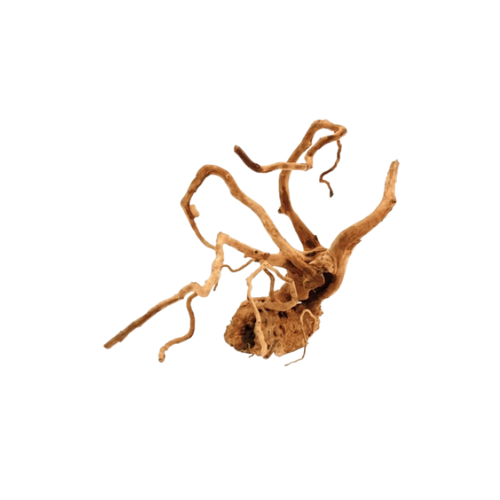


Dragon stone for aquariums, 0.8 to 1.2 kg
Regular price
6,50 €
Regular price
Sale price
6,50 €
Unit price
/
per
This aquascaping stone is hollowed with cavities, and each piece weighs 0.8 to 1.2 kg. Its uneven surface holds moss and shelters bottom-dwelling fish.
It is a clay-based rock that is brittle, which can be rinsed under a jet of water and shaped with a chisel.
 Customer support 7 days a week by email
 Delivery within 2 to 15 business days
100 % secure payment
The summary
- What you receive: a stone weighing 0.8 to 1.2 kg, with unique hollows and contours.
- What it allows: building an angular landscape in a small volume, and attaching mosses in its crevices.
- Before filling with water: rinse it with a jet of water, cavity by cavity, to flush the clay out of the hollows.
- How to work it: the rock is brittle, and can be shaped with a chisel to create a flat base.
- Its effect on the water: the vinegar test gives a clear answer in 10 seconds, on the very stone you have received.
- Shipping: stone wedged securely in its parcel, can be combined with the rest of your order.
Stone full of hollows, for aquascaping contours and anchoring mosses
Dragon rock (Ohko) is an aquascaping stone of 0.8 to 1.2 kg, hollowed out with cavities and ridges reminiscent of a cliff face. It allows you to build a dense landscape with little volume, while its hollows hold moss and shelter bottom-dwelling fish. Brittle, it can be shaped with a chisel.
Dragon rock, also called Ohko, is recognisable by its surface: hollows, cavities and ridges that give the impression of a cliff seen from afar. It is a clay-based, porous rock, which explains both its hollows and its fragility. When wet, its ochre colour darkens noticeably, so you see the true appearance as soon as you rinse it.
🐉 Plenty of relief, little volume
Cavities
The hollows hold foams, which sit there sheltered from the current.
Stacking
The angular faces lock into one another across two layers.
Bottom-dwelling fish
Every crevice makes one more hiding place in the same volume.
You therefore get a dense decor with few stones, which matters in a small tank where every stone takes away water volume. Place the stone directly on the bottom of the tank, or on a slate slab, before adding the substrate, because a stone resting on the substrate ends up sinking on one side. Then group the pieces into a tight cluster, which gives the cliff effect far better than scattered stones.
Glue down any relief taller than twice the height
Beyond two layers, or as soon as burrowing fish live in the tank, an underwater-setting adhesive fixes the stack in place without emptying the tank. It lets you build an overhang or an arch that would not hold by simple support, and it comes in a 450 g cartridge, to be loaded into a caulking gun. Apply it in small dabs on brushed faces, then prop the piece in place while it sets.
🔨 Cutting and rinsing the stone
This rock is brittle, which works in your favour: it can be shaped. A sharp blow of a chisel placed on an edge chips off a flake or splits the stone in two, and so you get a flat base that stands upright, or two pieces of similar size from a single one. Work on a protected floor, wearing goggles, and keep the chips: they fill the gaps between two stones or dress the foot of a rock feature.
The hollows in the rock hold a fine clay soil, which needs to be flushed out before filling. Rinse the stone under a strong jet of water, aiming the jet into each cavity, and use a wooden skewer for the deep hollows; clay left at the bottom of a hole is harmless to the tank. Avoid a wire brush, however, as it rounds off the edges of this brittle rock and makes it lose its relief.
🧪 The effect on hardness
Depending on the batch, this rock may contain a little limestone and slightly harden soft water. Before filling, put a few drops of white vinegar on a dry area: fizzing indicates limestone, and therefore a stone that would raise hardness. In a hard-water cichlid tank, this effect is not a problem; in a planted tank or a freshwater shrimp tank, measure the hardness before placing it and again 15 days later with a total hardness test.
Technical specifications
The essentials
- Weight of the part
- 0.8 to 1.2 kg
- Surface
- Hollowed with cavitiesMosses settle in it and attach themselves to the cotton thread.
Handling
- Nature
- Brittle clay rockIt is chiselled to give a flat base.
- Rinsing
- With a jet, cavity by cavityClay left at the bottom of a hollow is harmless to the tank.
In the box
- 1 dragon stone of 0.8 to 1.2 kg
Weight recorded on 20/09/2026 from the batch in stock. Clay-like nature, chisel shaping, rinsing and vinegar test recorded on 11/10/2026 from aquascaping guides devoted to this rock.
Estimate your
delivery time
Your estimate
Delivery
Estimated time
It covers preparing your order and then the transit time quoted by the carrier, counted in working days.
It is not a guaranteed delivery date: public holidays, peak periods, customs or a carrier delay can extend it. The exact amount, in your currency, is worked out in the cart once your address is entered.
This stone is shipped wedged in its parcel, as it chips on impact. It is combined with the rest of your order, and the exact cost is calculated in the basket based on your destination.
Frequently asked questions
6 questions
6 key questions


Related articles

Plants
Which plants can be grown in aquaponics?
Plants that grow attached to a support rather than in soil.
Read the article

Fish
Which fish to choose for aquaponics?
The species that occupy the bottom and look for a cave.
Read the article

Water
Understanding and clearing cloudy water
The mineral dust released by a poorly rinsed rock.
Read the article

Bases

Grow medium
Which grow medium to choose for aquaponics?
The weight of rock that displaces water volume in a small tank.
Read the article

pH
Regulating pH in an aquaponics system
What a carbonate stone really does to carbonate hardness.
Read the article
Let us talk about your project
A question about this product or your setup? Our team will answer and advise you.

Interest-free instalment payments
Offered depending on the cart amount, at checkout.

Delivery in 2 to 15 working days
Depending on the products and shipping sites. Estimate by destination in the estimator on this page.

After-sales service 7 days a week by email or chat
Our team answers all your questions.

Shop responsibly
Become part of the change.
