Indoor Hydroponics : Where to Start ?

31 May 2026
Tour hydroponique d'intérieur en cuisine moderne avec salades, basilic et menthe sous éclairage LED rosé

Dreaming of harvesting salads, basil, or strawberries at home, in an apartment or kitchen, without soil and regardless of the season ? Indoor hydroponics allows you to produce year-round with less water, higher yields, and total control. Here's how to get started.

Indoor hydroponics : where to start ?

Growing lettuce in four weeks in a corner of your home, harvesting basil all year round in a Parisian apartment, or producing strawberries in winter without soil or a garden – this is what hydroponics makes possible. This cultivation technique, which involves directly nourishing roots with a nutrient solution enriched with mineral salts, is gaining ground each year in French households, driven by a desire for food autonomy and fresh produce readily available.

However, getting started requires a minimum of method to avoid classic pitfalls such as stagnant water, rotting roots, or plants yellowing for no apparent reason. This guide covers the 5 most commonly used systems, essential pH and EC parameters, the choice of light, substrate, and nutrients, easy-to-start plants, climate management, mistakes to avoid, and a realistic budget to get started in 2026.

Hydroponics in a nutshell

Hydroponics is a cultivation method where plants grow without soil. Their roots are immersed in water enriched with mineral salts, known as a nutrient solution, which directly provides the elements they need to grow.

Without soil as an intermediary, nutrient absorption becomes extremely efficient. Plants save time ; they no longer have to search a substrate for their food and can concentrate their energy on producing leaves, flowers, and fruits.

The results speak for themselves. A lettuce that took six weeks in open ground can be harvested here in four to five weeks, with less water consumed since the solution circulates in a closed loop within a reservoir. This principle explains why soil-less cultivation is now attracting urban gardeners and self-taught enthusiasts alike.

The challenge is not the technology used. A simple glass bottle and a few grams of soluble fertilizer are enough to grow mint. The challenge is to understand what roots truly need.

The 5 systems you need to know

Hydroponics encompasses several techniques that share a common principle but differ in their degree of complexity and cost. Five stand out for a smooth start.

DWC, or Deep Water Culture, floats roots in oxygenated water using an air stone. It is the simplest and most forgiving. NFT, Nutrient Film Technique, circulates a thin film of enriched water along an inclined tube, ideal for lettuce and herbs in a series.

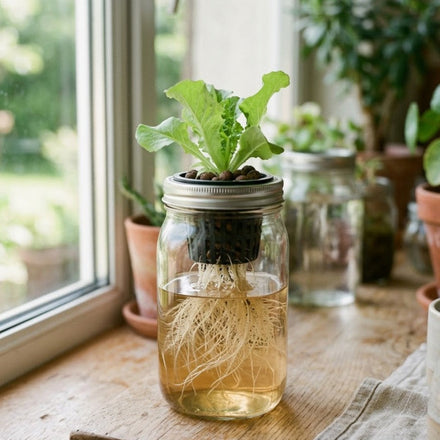
The Kratky method works without a pump or electricity. The plant draws from a water reservoir that gradually recedes, allowing air to reach the roots. Perfect for a simple jar on a shelf.

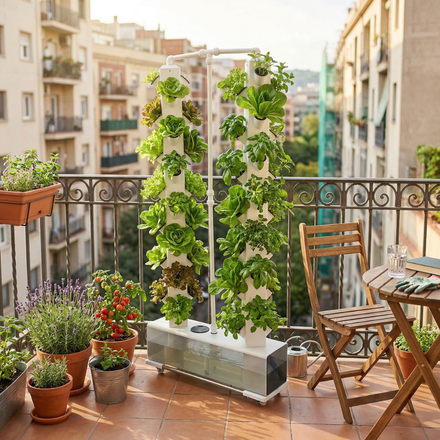
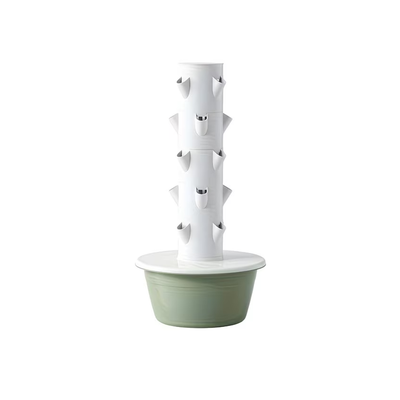
The Ebb & Flow system floods and drains a tray several times a day. Wick culture, which is passive, is suitable for very small plants. Finally, the vertical hydroponic tower stacks crops to produce a lot in a small footprint.

The DWC, perfect for beginners

DWC, or Deep Water Culture, is the recommended system for anyone starting out. The principle is simple to understand, the equipment is readily available, and the margin of error is comfortable.

Specifically, an opaque bucket or container holds the nutrient solution. A perforated lid receives a net pot in which the plant grows. An air pump connected to a submerged air stone continuously oxygenates the water, which prevents roots from rotting and accelerates their growth.

To start, you'll need a 15 to 20-liter container for one to three plants, a 7 to 8 cm net pot, some clay pebbles to support the plant, a 2 to 5-watt aquarium air pump, and an air stone. The whole setup takes less than an hour to assemble.

The great advantage of DWC lies in its inertia. The large volume of water dampens variations in temperature and nutrient concentration, which forgives a beginner's oversight. A lettuce grown this way reaches harvest size in less than 30 days.

pH and EC, the key parameters

Without soil to act as a buffer, two parameters become the cornerstone of any hydroponic system : pH and EC. Understanding them well means avoiding 80% of the deficiency and failed growth problems that beginners encounter.

pH measures the acidity of the water. It is set between 5.5 and 6.5 for almost all hydroponic crops. Below or above this range, certain elements such as iron, manganese, or calcium can no longer be assimilated by the roots, even if they are present in the water. The plant then shows a visual deficiency, such as yellowing between the veins, when the culprit is simply an unregulated pH.

EC, or electrical conductivity, measures the concentration of dissolved mineral salts. The higher it is, the more nutritious the solution. During germination, it remains around 0.8 to 1.0 mS/cm. During growth, it increases to 1.2 to 1.6. During flowering or fruiting, it aims for 1.6 to 2.0. An EC that is too high burns the roots, while an EC that is too low starves the plant.

Investing in an electronic pH tester and an EC tester, or a two-in-one combo, is non-negotiable. Checking two to three times a week initially is enough to anticipate deviations before they damage the plants.
What kind of light for growing ?

Indoors, light from a window is rarely enough to produce vigorous growth. Without several hours of direct sunlight per day, leaves become etiolated and production stagnates. Artificial lighting then becomes the key to a regular harvest.

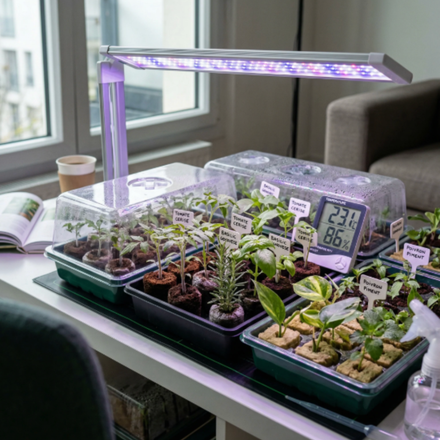
Horticultural LEDs have replaced old sodium lamps in almost all domestic uses. They consume little, generate little heat, and emit a spectrum adapted to photosynthesis, with that characteristic pink-purple rendering that combines blue and red wavelengths.

The photoperiod is set between 14 and 18 hours of light per day for leafy greens and herbs, and 12 hours as soon as you want to trigger flowering. An electric timer automates this cycle effortlessly.

In terms of power, aim for 30 to 50 watts of quality LEDs per leafy plant, more for a demanding plant. Rather than looking at watts alone, pay attention to the advertised PPFD, which is more representative of the light actually received by the plant.

The substrate that changes everything

The substrate serves to hold the plant in place and provide some material around the roots, without competing with the nutrient solution. In hydroponics, we look for an inert material that adds nothing, retains nothing, and allows total control over the water.

Expanded clay pebbles remain the go-to for beginners. Lightweight, washable, reusable for years, they offer perfect porosity that retains water without drowning the root system. A good rinse before the first use is sufficient.

Rockwool comes in small cubes or blocks that are soaked in solution. Widely used for germination, it needs to be soaked in pH-balanced water before use. Coir, which is more ecological, needs to be rinsed thoroughly.

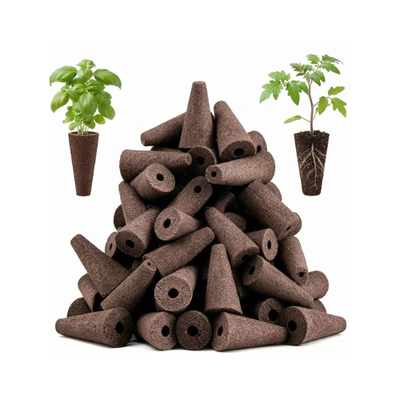
For seedlings, compressed peat sponge pods directly accommodate the seed. The young plant then migrates into the net pot, without root shock or transplant loss.

Properly Dosing Your Nutrients

The nutrient solution is the fuel of the system. It replaces everything that soil would normally provide in terms of water and minerals. If well-composed, it determines the vigor, taste, and yield of the harvest.

Hydroponic fertilizers are generally sold in liquid kits of two or three bottles. The principle is to separate incompatible elements to prevent precipitation. Dosing is done according to the plant's stage, following the manufacturer's instructions, then the reservoir's EC is adjusted.

Three macroelements are essential: nitrogen for leaf growth, phosphorus for roots and flowering, and potassium for fruit quality. In addition, there are calcium, magnesium, sulfur, and a series of trace elements such as iron, manganese, or zinc.

The golden rule is that gradual and regular dosing is better than a large one-time dose. The solution is completely refreshed every two to three weeks, cleaning the reservoir to prevent salt accumulation.

Easy-to-start plants

Not all plants adapt to hydroponics. To get started well, it is best to choose species with rapid growth, compact roots, and low nutritional needs.

Leafy greens come first. Lettuce can be harvested in four to six weeks and tolerates pH variations well. Spinach, arugula, lamb's lettuce, and kale offer extended production by harvesting outer leaves.

Aromatic herbs grow wonderfully in all systems. Basil, mint, chives, parsley, and cilantro provide a continuous harvest, leaf by leaf. Mint grows to the point where it sometimes needs to be controlled.

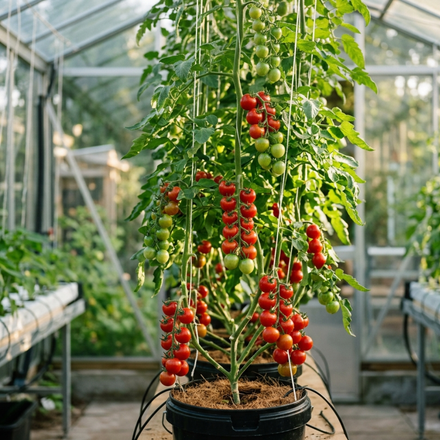
Fruiting vegetables like cherry tomatoes, strawberries, or peppers are accessible once the basics are mastered, but require more light. Root vegetables, on the other hand, do not tolerate a permanent bath well. To learn more, see what to plant in hydroponics according to the seasons.

Indoor Climate : The Invisible Balance

An indoor hydroponic setup isn't just about the equipment on the table. Around the plants, air, temperature, and humidity play as crucial a role as the nutrient solution. It's the climate balance that transforms a simple grow box into a productive ecosystem.

The ideal air temperature is between 20 and 24 °C during the day and drops a few degrees at night, just as in nature. The nutrient solution temperature should remain below 22 °C. Above this, oxygen dissolves less effectively in the water, roots suffocate, and undesirable bacteria proliferate.

Relative humidity should be around 50 to 70% during vegetative growth, lower during flowering to prevent mold. Gentle and continuous air circulation, provided by a simple clip-on fan, strengthens stems, reduces the risk of fungi, and equalizes temperatures in the room.

Finally, consider air renewal. Plants consume CO2 and release oxygen. Opening a window for fifteen minutes twice a day, or ventilating the room, is sufficient in a domestic environment without extensive setup.

5 common mistakes at the beginning

A beginner's first few weeks are almost always marked by the same mistakes, which are easy to avoid if identified in advance.

The first comes from a transparent reservoir. Light passing through the walls causes green algae to proliferate, consuming nutrients meant for plants and suffocating the roots. The container should always be opaque or wrapped in a black film.

The second concerns root rot, which appears as soon as the water exceeds 24°C or lacks oxygen. The roots turn brown, become slimy, and the plant collapses. The air pump must run continuously.

The third, nutrient overdose due to enthusiasm, burns the roots. The fourth is forgetting about pH, which drifts within a few days. The fifth concerns hard tap water poured without correction. Measure, observe, adjust that's the discipline that transforms a hesitant setup into a stable system.

What budget do you need to get started ?

Hydroponics doesn't require a massive investment to get started. Three budget ranges cover the majority of home projects.

The minimalist option comes in under 50 euros. A Kratky vase, a few seeds, a bottle of nutrient solution, and a little substrate are enough to grow an herb on a shelf. Ideal for experimenting before investing.

The intermediate option ranges from 100 to 250 euros. It covers a complete DWC system or a small vertical tower, with LED lighting, an air stone, substrate, pH and EC testers, and a quality fertilizer kit. This is the most common setup for growing salads and herbs year-round.

The complete option, from 300 to 700 euros, funds a large tower or an NFT station, with powerful LED lighting and professional equipment. The monthly cost of nutrients remains modest, between 3 and 10 euros depending on the intensity of cultivation.

Start small, observe, adjust

Indoor hydroponics is not an exact science ; it's a practice of observation. The best results rarely come from the most expensive equipment, but from daily attention to the signals plants send. A change in leaf color, a root turning brown, or slowed growth always tells a story to those who know how to read it.

The right approach for beginners is to start small, ideally with a Kratky system or a single-plant DWC, and to measure pH and EC until these actions become automatic. Once the ecosystem is stable, adding a vertical tower, more powerful lighting, or a second crop becomes obvious. Progress comes naturally, plant by plant, harvest by harvest.