
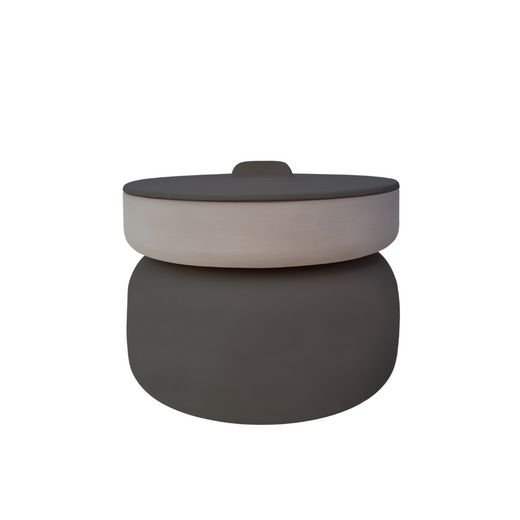


Wormery with 2 stackable trays and a tap
Regular price
139,90 €
Regular price
Sale price
139,90 €
Unit price
/
per
Product rating: 4.1
(18 reviews)
46,63 € × 3 with no fees
Klarna.
This wormery with 2 stackable trays, fitted with a leachate collection tray and a tap, processes kitchen waste from a household of up to 6 people. The worms migrate of their own accord towards the fresh material in the top tray and leave finished compost ready to harvest from the one below.
It can be set up in a kitchen, utility room, garage, or on a shaded balcony, and produces solid worm castings as well as worm tea to draw off at the tap.
 Customer support 7 days a week by email
 Delivery within 2 to 15 business days
100 % secure payment
The summary
- How many people it serves: up to 6, with 2 trays included and the option to stack up to 5.
- What you receive: the lid, 2 trays, the juice collector, its tap, 4 legs and the guide in French.
- What it produces: solid worm castings and worm tea to draw off at the tap, without dismantling.
- Space required: 56 x 38 cm footprint, 66 cm tall, 7.1 kg empty.
- Effort involved: deposit waste, add dry material, place a new tray when the previous one is full.
- How to choose: the kitchen caddy, this tray system or the balcony growing kit.
Tray-based unit with a worm tea tap, for a household of up to 6 people
Placed on the floor in a kitchen, larder, or garage, this stackable tray worm composter in recycled black plastic turns your peelings into two fertilisers for your plants: a solid compost and a liquid one, the worm leachate, which you draw off via the tap. Of Australian design, it is one of the larger tray-based models, supplied with 2 working trays and the option to stack up to 5.
🪱 Worm migration
The principle relies on a simple behaviour: compost worms always move towards fresh food. You add your peelings to the top tray, and when the one below is full, you place a new tray on top. The worms migrate upwards through the perforated base of the trays, drawn by the new material, while the matter left below finishes breaking down. The base of the lowest tray has a textured surface that makes this movement easier. You therefore never need to turn the material: the worms' tunnels aerate it at room temperature and without odour, provided the inputs remain balanced.
The lid
Handles beneath the lid allow you to leave it open while you place items inside.
The trays
Each 26 L tray offers 14 L of composting space, and 4 aeration vents keep the material well ventilated.
The drip tray
It collects the liquid that percolates through and directs it towards a drain tap.
The 4 feet
The tap sits 23 cm from the ground, high enough to slide a bottle underneath.
A colony sized for your household
The live compost worms are delivered sorted and weighed, in bags of 250 g to 5 kg, and it is the starting weight that determines how quickly the wormery gets going. Allow 250 g for a one- to two-person household, 500 g for three to four people, and 1 kg or more beyond that. A correctly sized colony will process your additions from the first few weeks, rather than letting them accumulate in the tray.
A composting worm ingests on average its own body weight in waste per day, which gives the sizing rule: to process 250 g of peelings daily, you need at least 250 g of worms. The 2 trays supplied provide a total of 28 L of composting capacity, and this model suits households of up to 6 people, with the colony multiplying on its own according to the food available. If your inputs increase, simply add a tray to the top of the stack, up to 5 in total, without changing the unit or moving the worms.
The tank away from direct sunlight
Compost worms thrive between 15 and 25 °C, and temperatures above 30 °C can be fatal to them. A black plastic bin left in direct summer sun heats up very quickly, so keep it in full shade throughout the day if it lives on a balcony, and bring it indoors to a frost-free room when winter sets in.
The liquid collected by the drip tray, the worm tea, can be drawn off at the tap without dismantling the trays, and the 23 cm of clearance means you can fill a bottle directly underneath. It is highly concentrated, so dilute it at a ratio of one part worm tea to 9 parts water before applying it to your potted plants, planters or vegetable patch. A copious flow signals bedding that is too wet, which you correct by adding dry material; conversely, a tray that yields almost nothing after several weeks is simply lacking moisture.
🏠 Where to place the bin
The unit takes up approximately 56 cm by 38 cm of floor space and stands 66 cm tall, less than half a square metre. It can be installed in a kitchen, utility room, cellar, or garage, and outdoors provided it is sheltered from intense heat. Choose a temperate spot, away from direct light and far from the vibrations of a washing machine or refrigerator, which worms will avoid. If placed in a garage, raise it slightly off the ground to keep it clear of exhaust fumes. Its feet keep it away from the floor, which limits access for ants, and at 7.1 kg empty, it can be moved easily as long as the trays are not loaded.
🍂 Starting the first bedding layer
At the start, place just one tray on the collection sump. Line it with roughly 5 cm of bedding made from unfluted brown cardboard, egg boxes, or shredded paper, moistened to the texture of a wrung-out wet sponge, with a handful of compost or potting compost. Place the worms on the surface and let them burrow down on their own, then wait a few days before the first additions, which should be small and finely chopped. Increase the quantities as the colony grows; allow 3 to 4 months for a worm composter to reach its full working capacity.
⚖️ Balancing your inputs
Your bin stays balanced when it receives roughly one third dry material to two thirds wet material. Fruit and vegetable peelings, raw or cooked, along with leftover rice or pasta without fat, provide the moisture; plain uncoated brown cardboard, egg boxes, unbleached kitchen roll and coffee grounds with their filter provide the dry material, while corrugated cardboard stays out, as its adhesive would end up in the compost. Cut melon and squash rinds and cores into pieces no larger than 2 cm. Keep garlic, onion, leek and shallot out of the bin, as they act as vermifuges, along with citrus fruit, meat, fish, dairy products and fats. An unpleasant smell almost always indicates waste the worms cannot process quickly enough, or bedding that is too damp: reduce inputs and add dry material.
🧺 Harvesting the bottom tray
After 3 to 4 months, the material in the bottom tray resembles fine compost and contains almost no worms: the worm castings are ready. To drive out the remaining inhabitants, place this tray at the top of the stack with the lid open, the light pushes them down into the trays below. Mix the worm castings with roughly two thirds of soil or compost for your plants and planters, and use it within 6 months if possible. The tray you have just emptied goes back to the top of the stack, ready to receive the next additions. During periods of absence, the colony can go 3 to 4 weeks without being fed.
🐟 Compost tea in aquaponics
The liquid drawn off at the tap is reserved for watering plants and should not be added to the fish water, while compost tea is prepared from a fully matured worm compost: a few large handfuls enclosed in a net bag are steeped in 20 litres of water kept continuously agitated by an aquarium air pump for 2 to 3 days, then the liquid is strained and diluted at a ratio of 1 to 10. It is applied as a root drench, and if it is introduced into an aquaponic system, this should only be done in small doses of around 50 ml, observing how the crops respond before adding more. Continuous aeration prevents anaerobic fermentation. The worm composting guide covers its other uses, and the article on deficiencies in aquaponics helps identify which crops stand to benefit.
🛠️ Assembly and box contents
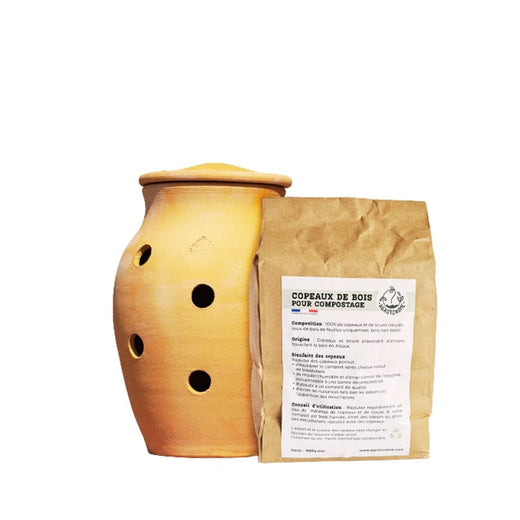
The box contains the lid, the 2 working trays, the juice collection tray, its tap, and the 4 legs, along with a guide to worm composting and assembly instructions in French. The unit is assembled by hand: the tap fits onto the juice tray, the legs are placed underneath, then the first tray and the lid are put in position. The worm composter is designed by Tumbleweed, manufactured in Australia from 100% recycled plastic, and guaranteed for 2 years. For the dry bedding needed in the first few months, a bag of coarse wood shavings makes a useful addition to plain, non-corrugated cardboard.
Technical specifications
The essentials
- Hearth
- Up to 6 peopleThe colony is sized from the outset: 250 g of worms for 1 to 2 people, 1 kg for more than 4.
- Trays
- 2 supplied, up to 5An extra tray sits on top as your inputs increase.
- Composting volume
- 28 L (2 x 14 L)Each tray measures 26 L, of which 14 L actually receive the grow medium.
- Lombrithé
- Tap at 23 cm from the groundA bottle slides underneath; the liquid is diluted at 1 part to 9 parts water.
- Material
- 100 % recycled plasticKeep in the shade if used outdoors: the black absorbs heat quickly in sunlight.
- Footprint
- 56 x 38 x 66 cmIt weighs 7.1 kg empty.
To budget for separately
- Compost worms
- A colony of 250 g to 1 kg
- Dry matter
- Coarse sawdust or brown cardboard
In the box
- 1 lid
- 2 composting trays of 26 L
- 1 juice tray
- 1 draw-off tap
- 4 feet
- 1 worm composting guide and its assembly instructions in French
Dimensions, weight, volumes, base, material, origin, warranty and box contents: Worm Café 2-tray (Tumbleweed) specification sheet from its distributor, recorded on 07/10/2026.
Three ways to compost at home
Stacking tray bin, kitchen pot, or balcony vegetable planter
Tray unit or a more compact model?
All three compost with worms; the stacking tray unit handles the largest household and is the only one with a tap.
| Composting volume (L) | Location | Material | Integrated planter | Worm tea tap | Stated capacity | Price | |
|---|---|---|---|---|---|---|---|
| Indoor terracotta worm composterYour choice | 8 L | Work surface | Clay | No | No | 1 to 2 people, 3 to 4 with a second ring | 248,90 € |
| Recommended Wormery with 2 stackable trays and a tapYour choice | 28 L | On the floor, indoors or outdoors under shelter | Recycled plastic | No | Yes | Up to 6 people | 139,90 € |
| Wooden balcony planter-composter, 50 x 50 cmYour choice | 15 L | Balcony or terrace | Douglas fir and stainless steel | Yes | No | 2 kg of organic waste per month | 309,90 € |
Indoor terracotta worm composter
Composting volume (L)8 L
LocationWork surface
MaterialClay
Integrated planterNo
Worm tea tapNo
Stated capacity1 to 2 people, 3 to 4 with a second ring
Wormery with 2 stackable trays and a tapRecommended
Composting volume (L)28 L
LocationOn the floor, indoors or outdoors under shelter
MaterialRecycled plastic
Integrated planterNo
Worm tea tapYes
Stated capacityUp to 6 people
Wooden balcony planter-composter, 50 x 50 cm
Composting volume (L)15 L
LocationBalcony or terrace
MaterialDouglas fir and stainless steel
Integrated planterYes
Worm tea tapNo
Stated capacity2 kg of organic waste per month
Volumes, materials, equipment and capacities recorded from the manufacturers' product pages on 07/10/2026. For the tray tank, the volume given is that of the 2 trays supplied.
Help choosing
Which composter suits your home?
Estimate your
delivery time
Your estimate
Delivery
Estimated time
It covers preparing your order and then the transit time quoted by the carrier, counted in working days.
It is not a guaranteed delivery date: public holidays, peak periods, customs or a carrier delay can extend it. The exact amount, in your currency, is worked out in the cart once your address is entered.
Bulky parcel: 56 x 38 x 66 cm, weighing 8 to 10 kg, with trays nested together. Shipping is charged on volume as well as weight. The exact cost and final delivery times are shown at checkout once your address has been entered.
Frequently asked questions
10 questions
6 key questions, 10 in the detailed view
You may also like



Related articles

Guide
Worm castings, a natural fertiliser
What vermicompost actually contains, and how to apply it to crops.
Read the article

Diagnosis
Identifying deficiencies in aquaponics
The symptoms that the organic supplement most commonly corrects.
Read the article

Grow media
Which grow medium to choose for aquaponics?
The medium that will receive the worm castings, and how it affects water retention.
Read the article

Practical

Reflection
Can you achieve food self-sufficiency with aquaponics?
Closing the waste loop, and what that actually means in practice.
Read the article

Seasons
Preparing your aquaponic system for autumn
When everything slows down, including the worm colony.
Read the article
Let us talk about your project
A question about this product or your setup? Our team will answer and advise you.

Interest-free instalment payments
Offered depending on the cart amount, at checkout.

Delivery in 2 to 15 working days
Depending on the products and shipping sites. Estimate by destination in the estimator on this page.

After-sales service 7 days a week by email or chat
Our team answers all your questions.

Shop responsibly
Become part of the change.
