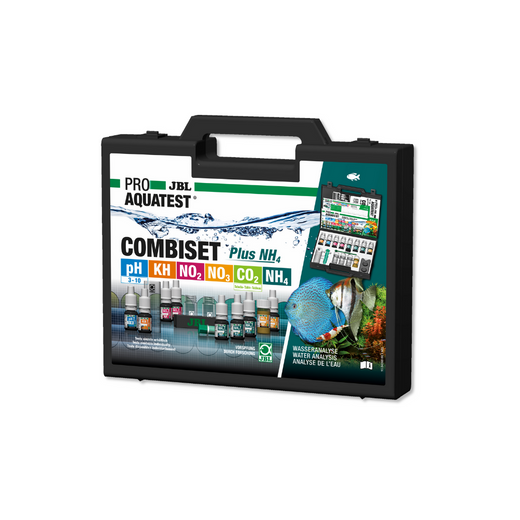


Reagent refill for pH test, three ranges
Regular price
¥1,100
Regular price
Sale price
¥1,100
Unit price
/
per
¥367 × 3 with no fees
Klarna.
This bottle is the reagent for the pH test, sold separately. Use the selector to choose the range of your test kit — 3.0 to 10.0, 6.0 to 7.6, or 7.4 to 9.0 — as it is the colour chart that interprets the result you obtain: approximately 50 readings on the wide range, 80 on the narrow range.
 Customer support 7 days a week by email
 Delivery within 2 to 15 business days
100 % secure payment
The summary
- What it measures: the pH, the acidity or alkalinity of your water.
- What's in the box: 1 reagent bottle.
- How many tests: approximately 50 on the wide range, 80 on the narrow range.
- Which range to choose: the one matching your test kit, as the reagent is read against that range's colour chart.
- Where and when to sample: mid-water column, always at the same point.
- The test that goes with it: carbonate hardness, which determines pH stability.
The reagent bottle on its own, 50 to 80 tests depending on the range selected
pH indicates whether your water is acidic or alkaline, on a logarithmic scale where a difference of one unit represents a factor of 10 in actual acidity. This bottle is the reagent alone for the drop-based pH test, available in three ranges: the wide range from 3.0 to 10.0, and the two narrow ranges from 6.0 to 7.6 and from 7.4 to 9.0. It replaces the empty bottle in your test kit.
🎯 Three ranges, two protocols
The wide-range scale is used for orientation testing: fill a 5 ml test tube, add 5 drops, then read the colour against a white background after 5 minutes, each bottle covers approximately 50 tests. The narrow-range scales are read using two test tubes placed in a comparator block, one treated with 4 drops and the other kept with untreated water to compensate for the water's natural tint. The reading is taken after 3 minutes, and each bottle covers approximately 80 tests.
The colour chart in your kit determines the range
Order the refill for the same range as your kit, as each colour chart is printed for a single reagent and it is that reagent which converts the colour into a value. A fine-range reagent read against a wide-range colour chart, or vice versa, produces a shade with no reliable match. If you are no longer sure which range you have, check the values printed on the first and last field of your colour chart.
🌿 Fish, bacteria and plants
In a system where fish, bacteria and plants share the same water, the pH value affects all three simultaneously, yet it depends primarily on the carbonate hardness that stabilises it. For this reason, it is worth measuring both pH and KH on the same day using the carbonate hardness test, aiming for at least 5 °dKH. For a garden pond, the ideal range is between 7.5 and 8.5. The guide to adjusting pH in aquaponics explains the correct order in which to correct these two values.
Order the KH reagent alongside the pH one
If your carbonate hardness test kit is already partly used, add the KH test refill to the same order. A pH value that drops from one week to the next can only be interpreted alongside the carbonate hardness reading taken on the same day, and an empty KH bottle would leave you without that second figure. Both refills are dispatched together and store in the same box.
The reagent is classified Warning, with hazard statements H226 and H319, as it is a flammable liquid that causes serious eye irritation. For this reason, store the capped bottle in a dry place at room temperature in its original packaging, away from any source of ignition. If splashed in the eye, rinse carefully with water for several minutes, and keep the box out of reach of children despite its child-resistant cap.
🔁 The right time to replenish
The test count gives the first reference point: approximately 50 for the broad range, 80 for the narrow ranges. At the recommended rate for a new system start-up, one test per day in the first week, then one per week, the broad-range bottle therefore lasts nearly 10 months. You can also keep an eye on the drop itself: hold the bottle vertically with the tip pointing down and dry on the outside, since a drop that comes out with an air bubble will distort the dose. When the drops become irregular despite this, the bottle is nearing the end of its life and your refill takes over.
Technical specifications
What the refill contains
- Contents
- 1 reagent bottlepH reagent, child-resistant cap
- Measurements
- Approximately 50 or 8050 on the wide range, 80 on the 6.0 to 7.6 or 7.4 to 9.0 range
- Water volume
- 5 mlOne test tube in the wide range, two test tubes and a comparator block in the narrow range
- Drops and waiting time
- 5 drops, 5 min, or 4 drops, 3 minThe first protocol applies to the wide range, the second to the narrow ranges
- Manufacturer's reference
- JBL 2410200, 2410400, 2410600Range 3.0 to 10.0, then 6.0 to 7.6, then 7.4 to 9.0
- Hazard classification
- Please note, single bottleHazard statements H226 and H319. Store in a dry place, at room temperature, away from any naked flame.
To budget for separately
- Test tube and colour chart
- Those from the pH testThe colour chart is printed for a given range, and it is the chart that converts the colour into a value
- The matching test
- A carbonate hardness testAim for at least 5 °dKH to keep your pH stable
In the box
- 1 bottle of pH reagent, with a child-resistant cap
Reference, EAN code, contents, protocol, number of tests, and hazard statements recorded from the JBL product sheet and instructions on 07/10/2026. The 5 °dKH benchmark comes from the JBL carbonate hardness test instructions.
Estimate your
delivery time
Your estimate
Delivery
Estimated time
It covers preparing your order and then the transit time quoted by the carrier, counted in working days.
It is not a guaranteed delivery date: public holidays, peak periods, customs or a carrier delay can extend it. The exact amount, in your currency, is worked out in the cart once your address is entered.
Package weight 0.02 kg, dispatched to a collection point or to your home address, your choice at checkout. The bottle is sent in its original packaging. The exact shipping cost is shown in the basket.
Frequently asked questions
6 questions
6 key questions
You may also like


Related articles

Parameters
Regulating pH in an aquaponics system
The order of corrections, and why this figure is adjusted last.
Read the article

Discovery
What is aquaponics?
Three living things in the same water, and one figure that concerns all three.
Read the article

Start-up
Getting started with an aquaponic system
The first few weeks, when this parameter needs checking more often than later on.
Read the article

Project
Setting up your aquaponic system
Testing equipment is part of the project, just as much as the pump.
Read the article

Pond
Koi carp in aquaponics
In a pond, this figure varies more from morning to evening than you might think.
Read the article

Guide
Common mistakes in aquaponics
Correcting a value without looking at what is driving it comes top of the list.
Read the article
Let us talk about your project
A question about this product or your setup? Our team will answer and advise you.

Interest-free instalment payments
Offered depending on the cart amount, at checkout.

Delivery in 2 to 15 working days
Depending on the products and shipping sites. Estimate by destination in the estimator on this page.

After-sales service 7 days a week by email or chat
Our team answers all your questions.

Shop responsibly
Become part of the change.
