

Copper Cu water test in drops
Regular price
¥3,000
Regular price
Sale price
¥3,000
Unit price
/
per
Copper is tested to confirm it is absent from the water: at doses a fish can tolerate, it kills your shrimps, snails, and freshwater shrimps.
This test measures dissolved copper in fresh water, ponds, and salt water, using a colour comparator block that cancels out the natural tint of your water.

7/7 customer service by e-mail

Payment in instalments, free of charge
The summary
- What you receive: 2 reagent bottles, 2 glass test tubes with screw caps, a syringe, a grey comparator block and a colour chart.
- What you measure: dissolved copper in the water, in freshwater aquariums, saltwater aquariums and garden ponds.
- What the figure means: a fish can tolerate doses that will kill a shrimp. The gap between the two is a factor of one thousand.
- When to use it: before introducing invertebrates, after a treatment, or when testing water drawn from an old installation.
- How to choose: copper is only included in the more comprehensive of the two kits.
- What gets sent to you: a parcel weighing 0.12 kg, with reagents in their original box.
Drop test for dissolved copper, 50 measurements, for shrimps, snails and fish
Copper is a trace element essential to every living cell and a cellular poison beyond a certain concentration. What makes it distinctive is its selectivity: copper-based antiparasitic treatments work precisely because the target concentrations are tolerated for a time by fish, while parasites cannot withstand them. What applies to a parasite applies equally to a shrimp, a snail, and a freshwater shrimp. If your invertebrates are disappearing while your fish remain in perfect health, you have good reason to look here before looking elsewhere.
🚰 Where copper comes from
Very few fishkeepers add copper deliberately, yet it enters the tank by four routes, three of which go unnoticed. Identifying those routes matters more than the measurement itself, since testing serves little purpose if the source continues to top up the tank between readings. Go through these four entry points before you even open your kit, because an identified source can be removed, whereas a measured concentration can only be noted.
Pet shop treatments
Many antiparasitic treatments and some algaecides contain it, and this is only visible in the ingredient list.
The pipe, not the resource
When water sits in copper pipes, significant quantities leach out. Flush before filling.
Nutrients for the plants
Several aquatic fertilisers contain it as a trace element. No effect on fish, but worth monitoring in a shrimp tank.
Guttered rainwater
A single copper gutter is enough to contaminate collected water. This water is not suitable for an invertebrate tank.
🧫 Dissolved copper and fixed copper
This test measures dissolved copper only, whereas copper rapidly forms insoluble compounds that settle to the bottom. A portion of what has been added therefore leaves the water column within a few hours, binding to the grow medium, filter media, décor and mulm, where the test can no longer detect it. In a treated body of water, around 90% of the copper is bound to sediment within minutes, and 99% within 2 days. The copper does not disappear, however: it simply moves from the water column into the sediment, from where it can be released again if the pH drops or the substrate is disturbed.
The order of magnitude that puts everything in perspective
Perfectly compliant tap water can contain up to 2 mg/L of copper, as that is the European regulatory limit, and also the top of the scale on this test. Yet the value that protects 95% of freshwater species is 0.0014 mg/L, a thousand times lower. A perfectly safe drinking water is therefore not a water safe for invertebrates, and nothing on your water bill will tell you so.
Removing residual copper after a treatment
Once the treatment is complete, the fraction still dissolved continues to affect any invertebrates you wish to reintroduce. Activated carbon adsorbs it within a few days, something that no partial water change achieves as thoroughly, and it also removes residues of the active compound in the process. Place it in the filter as soon as the treatment ends, then retest before adding so much as a single shrimp. One litre is sufficient for a standard-sized tank and should be replaced after each use.
🧪 When to use this test
There are three situations that warrant getting it out, and outside of those it can stay in its drawer without any issue. The first is a loss of invertebrates in your tank with no fish deaths, which is the most common indicator. The second is monitoring an ongoing treatment, where the reading confirms that the concentration remains within the effective range. The third is any doubt about the top-up water, whether from an older copper installation or from rainwater collected under a gutter. In this respect the test is similar to the iron test: a metal is measured when there is a reason to do so, not every week.
🪸 Treating without writing off the tank
A tank that has received a copper treatment does not become safe for shrimp again with a simple water change, because the insoluble compounds remain in the substrate. They can only be removed by discarding the substrate entirely, which means stripping the tank down completely. Always treat in a hospital tank whenever possible, or consider the substrate as lost before you even add the first dose. This is a decision to make before treatment, never after. Our articles on choosing a fertiliser and on green pond water cover the two situations where this question comes up most often.
Technical specifications
The essentials
- Parameter measured
- Copper dissolved in the waterCopper already bound to the substrate, décor or filter media is not counted
- Measurement range
- 0.15 to 2 mg/LBelow 0.15 mg/L the test can no longer distinguish anything and simply reads less than.
- Tests per kit
- Around 50
- Method
- Two samples at the comparator blockOne treated, one control, which cancels out the natural tint of your water, even if it is amber
- When to use it
- Water start-up, die-off, treatment dosagePlus any water drawn from an old installation
- Manufacturer reference
- JBL 2411400, PROAQUATEST rangeCode EAN 4014162241146
The procedure
- Water volume
- 2 times 5 mlOne treated sample and one untreated control, drawn with the supplied syringe
- The steps
- Rinse, fill, dose 1, dose 2, wait, readFive drops of each reagent in the single treated test tube
- Waiting time
- 15 minutesUntil the colour has fully developed. An early reading will underestimate the actual level.
- Total duration
- Approximately 17 minutesWaiting time included
- Reading
- In daylight, inside the blockNever under the tank lighting, as the colour cast skews the comparison
- Media covered
- Freshwater, pond, saltwaterSalt dampens the reaction, so the marine scale is distinct
Security and parcels
- Ranking
- WarningThe lower of the two CLP regulation thresholds
- Main risks
- Flammable, severe eye irritationH226 and H319 hazard statements. Both bottles are affected
- Precautions
- Rinse the eye with water, keep out of reachPrecautionary statements P101, P102, P305 with P351 and P338, and P501a for disposal.
- Parcel weight
- 0,12 kgPackaging included
To budget for separately
- Reagent refill
- Reagents only, ref. 2411500The glassware, the comparator block and the colour chart keep well
- What to use to remove copper
- Activated carbon for filtrationIt captures dissolved copper, not copper already bound to the grow medium
10 further specifications are available in the detailed view.
In the box
- 2 reagent bottles
- 2 glass test tubes with screw caps
- 1 graduated sampling syringe
- 1 grey comparator block with reading notch
- 1 colour chart and 1 multilingual instruction leaflet, French included
Reference, EAN code, number of tests, kit contents, protocol, applications and hazard statements taken from the manufacturer's product sheet and instructions on 05/09/2026. The range of 0.15 to 2 mg/L comes from an earlier manufacturer text, reproduced in a reseller description. The limit of 2 mg/L in drinking water is the European regulatory value; the value of 0.0014 mg/L is a guideline value for the protection of freshwater species.
One single metal, or all the water chemistry?
Copper is absent from entry-level test kits. That is the primary reason to buy this test individually, and the only question to settle is what you will actually be measuring.
What treats a fish will sterilise a shrimp tank
A few hundredths of a milligram per litre is enough to kill shrimps and snails. Copper can enter via a treatment product, old pipework, or a borehole.
| Parameters covered (parameters) | Drop tests included (tests) | Copper Cu | pH, KH, nitrites, nitrates, ammonium | GH, iron, phosphates, oxygen, silicates | Reagent bottles (bottles) | Glass test tubes | Laboratory comparator block | Thermometer | Reagent refill sold separately | Price | |
|---|---|---|---|---|---|---|---|---|---|---|---|
| Recommended Copper test onlyYour choice | 1 parameters | 1 tests | Yes | No | No | 2 bottles | 2 | Yes | No | Yes | ¥3,000 |
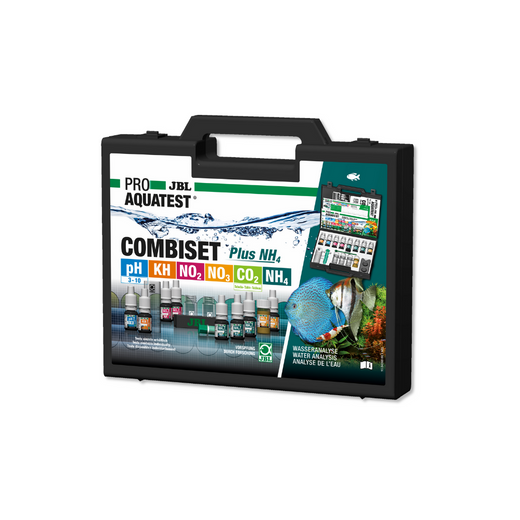
| 6-in-1 Aquarium Water Testing KitYour choice | 6 parameters | 5 tests | No | Yes | No | 9 bottles | 3 | Yes | No | Yes | ¥7,800 |
| 14-in-1 water analysis kit for aquariumYour choice | 14 parameters | 13 tests | Yes | Yes | Yes | 23 bottles | 12 | Yes | Yes | Yes | ¥16,400 |
Copper test onlyRecommended
What you are measuring
Parameters covered (parameters)1 parameters
Drop tests included (tests)1 tests
Copper CuYes
pH, KH, nitrites, nitrates, ammoniumNo
GH, iron, phosphates, oxygen, silicatesNo
Equipment supplied
Reagent bottles (bottles)2 bottles
Glass test tubes2
Laboratory comparator blockYes
ThermometerNo
Budget
Reagent refill sold separatelyYes
6-in-1 Aquarium Water Testing Kit
What you are measuring
Parameters covered (parameters)6 parameters
Drop tests included (tests)5 tests
Copper CuNo
pH, KH, nitrites, nitrates, ammoniumYes
GH, iron, phosphates, oxygen, silicatesNo
Equipment supplied
Reagent bottles (bottles)9 bottles
Glass test tubes3
Laboratory comparator blockYes
ThermometerNo
Budget
Reagent refill sold separatelyYes
14-in-1 water analysis kit for aquarium
What you are measuring
Parameters covered (parameters)14 parameters
Drop tests included (tests)13 tests
Copper CuYes
pH, KH, nitrites, nitrates, ammoniumYes
GH, iron, phosphates, oxygen, silicatesYes
Equipment supplied
Reagent bottles (bottles)23 bottles
Glass test tubes12
Laboratory comparator blockYes
ThermometerYes
Budget
Reagent refill sold separatelyYes
Parameters covered, equipment supplied and kit contents recorded from the three product sheets on 05/09/2026.
Help choosing
Testing for copper, or monitoring nitrogen
Documents & manuals
Official manufacturer's instructions, in French
Complete six-step protocol, the source of copper in tap water, and the instruction explaining how to remove insoluble compounds.
Document not showing? Some publishers block display inside a frame, so open it in a tab.
Estimate your
delivery time
Your estimate
Delivery
Estimated time
It covers preparing your order and then the transit time quoted by the carrier, counted in working days.
It is not a guaranteed delivery date: public holidays, peak periods, customs or a carrier delay can extend it. The exact amount, in your currency, is worked out in the cart once your address is entered.
Parcel weighing 0.12 kg, dispatched to a collection point or via Colissimo to your home address, your choice at checkout. Reagents are sent in their original packaging. The exact amount is shown in the basket.
Frequently asked questions
8 questions
6 key questions, 8 in the detailed view
Vous aimerez aussi


Related articles

Guide
Common mistakes in aquaponics
Adding a treatment to the main tank is one of the costliest mistakes you can make — and one you only notice afterwards.
Read the article

Crops
Which fertiliser should you use in aquaponics?
Copper appears as a trace element in several micro-nutrient blends. Whatever is added to the growing system ultimately ends up in the tank.
Read the article

Diagnostic
Identifying deficiencies in aquaponics
How to tell a genuine micro-element deficiency from something that looks just like one, before making corrections blind.
Read the article

Pond
Green pond water: 5 solutions
Five ways to treat green water without using an algaecide, some of which are copper-based.
Read the article

Fish
Koi carp in aquaponics
A koi pond receives treatments, and it also harbours freshwater shrimps and snails that cannot tolerate them.
Read the article

Guide
The nitrogen cycle in aquaponics
Nitrifying bacteria cope poorly with treatments. What to monitor after a course of medication.
Read the article
Let us talk about your project
Une question sur ce produit ou votre installation ? Notre équipe vous répond et vous conseille.

Paiement plusieurs fois sans frais
Proposé selon le montant du panier, au moment du paiement.

Livraison sous 5 à 15 jours ouvrés
Selon les produits et sites d'expédition. Estimation par destination dans l'estimateur de cette page.

SAV 7/7 par mail ou chat
Notre équipe répond à toutes vos questions.

Faire un achat engagé
Devenez acteurs du changement.
