Build your aquaponic system

Written by Ulysse Hay · April 3, 2026
Montage d'un système aquaponique domestique

Do you dream of growing your own fresh vegetables and fish at home, in just 2 m² of garden, without pesticides, without weeding, and using roughly 90% less water than in the ground? It is not a pipe dream. It is exactly what aquaponics makes possible. But between the appeal of the concept and the reality of your first working system, there is a journey to make — and mistakes to avoid.

In this article, we give you the foundations for understanding how an aquaponic system works, what you really need to know before getting started, and how a structured training course can save you months of trial and error.

What exactly is an aquaponic system?

It is a system based on aquaponics that combines two types of cultivation: aquaculture, which is the rearing of fish, and hydroponics, which is the growing of plants without soil. The principle is as simple as it is clever. Fish produce waste rich in nitrogen. Bacteria convert this waste into nutrients that plants can absorb directly. The plants filter the water by taking up those nutrients. The purified water then flows back into the fish pond. A closed, self-sustaining ecosystem in which each element feeds the other.

The result: vegetables grown without chemical fertilisers, fish reared without antibiotics, and a production you control from start to finish. On a small 2 m² system, published yields in aquaponics are in the region of 1.2 to 2.6 kg of lettuce per square metre per growing cycle, with modest energy consumption on a well-optimised system.

Why get started? The figures speak for themselves:

  • Around 90% less water than growing in open ground, with up to 92% measured for lettuce
  • Growth sustained by nutrients from the fish and by uninterrupted access to water
  • 2 m² is enough to set up a fully working system
  • 27 W stated by the manufacturer for the energy consumption of a T'Air-Eau system

The result: vegetables grown without chemical fertilisers, fish reared without antibiotics, and a production you control from start to finish. On a single 2 m² system, the manufacturer T'Air Eau states approximately 30 kg of fish and 20 kg of vegetables per year.

Why do so many beginners give up along the way? Essential Pack : Aquaponics water analysis (NH4, NO2, NO3, pH, KH)

Why do so many beginners give up along the way ?

Aquaponics is fascinating. It also relies on a delicate biological balance. Without guidance, beginner mistakes tend to follow the same pattern: a system started too quickly, a poorly calibrated pH, fish introduced before the bacterial colony is established, plants chosen that aren't suited to the system's current stage.

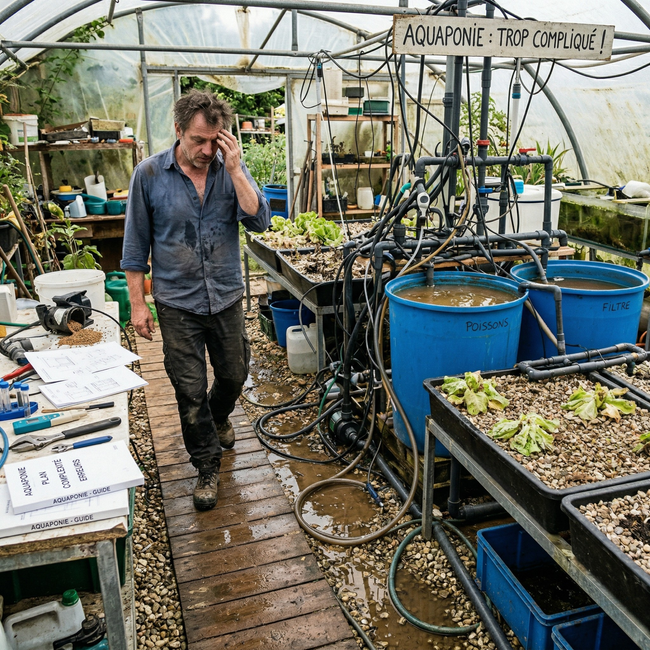
PROBLEM No. 1: Isolation. Finding yourself alone facing a complex problem, with contradictory sources of information online, not knowing whether what you're seeing is normal or a sign that something is about to go wrong. The most common frustration: unstable water parameters, a sudden ammonia spike, fish in distress, and no harvest in sight after weeks of effort.

The difference between those who succeed and those who give up isn't down to motivation. It comes down to method and the quality of support at the outset.

"In aquaponics, success doesn't depend on your garden or your budget. It depends above all on your understanding of the biological cycle and the quality of your support at the start."

The 5 key steps to creating your first system


1) Understanding the nitrogen cycle, the foundation of everything

Everything relies on this fundamental cycle. Fish produce ammonia, a compound toxic to them. Nitrifying bacteria, first Nitrosomonas, then Nitrobacter, transform this ammonia into nitrites, then into nitrates. Plants absorb these nitrates as a natural fertilizer. The purified water then returns to the tank.

Without good bacterial colonization, known as "cycling," your system will never be stable. This phase lasts between 3 and 6 weeks. It's the most critical step, and the one most often rushed by beginners who want to go fast. Spending time on this phase will save you weeks of trouble later.

2) Choosing your system and equipment

There are several possible aquaponics configurations : the flood and drain system with substrate, called a media bed ; NFT, or Nutrient Film Technique ; and DWC, or Deep Water Culture. For a first system, the flood and drain system with expanded clay pebbles is the simplest and most forgiving of errors. It hosts bacteria and plant roots, and drains water regularly without saturation.

Essential equipment to get started: a fish tank, a grow bed, a pump, an air stone, substrate, a drainage system (bell siphon or timer), and a water testing kit. Do not skimp on the testing kit : it's your dashboard, and it will save you from many unpleasant surprises.
3) Choosing your fish and plants Reine de Mai lettuce seeds

3) Choosing your fish and plants

To start, prioritize robust and tolerant species. For fish, koi carp and perch are good choices for a first system in a temperate region. For plants, leafy greens are the stars of beginner aquaponics : lettuce, spinach, basil, arugula. Fast-growing, low nutrient requirements, and excellent for stabilizing the nitrogen cycle.

Fruiting vegetables, such as tomatoes, peppers, and zucchini, are possible but should be reserved for a mature system, at least two to three months after startup. Before that, your bacteria need to work undisturbed, without the additional pressure of intensive production.

4) Mastering water parameters

In aquaponics, water is your dashboard. The parameters to monitor as a priority: pH, ideally between 6.8 and 7.2; ammonia, which should remain at 0 ppm once cycling is complete; nitrite, which should also drop to 0; nitrate, acceptable up to 40–80 ppm; and temperature suited to your species.

A liquid test kit is far more accurate than test strips. Test your water at least twice a week during the first two months. Once the system has stabilised, a weekly test is sufficient to keep things in check.

5) Adapting your management over time

An aquaponic system improves with experience. Fish density, fish-to-plant ratio, pump cycle frequency, mineral supplementation with chelated iron or calcium carbonate to stabilise pH: these are all variables you'll fine-tune week by week. This is where being part of an active community really makes a difference. Having someone you can ask a specific question at the right moment is worth far more than hours spent trawling through contradictory forum threads.

The T'Air Eau training, to avoid starting from scratch Aquaponics training : Tairoponie e-learning

The T'Air Eau training, to avoid starting from scratch

If you want to structure your learning and avoid the classic mistakes, the online course "Taireauponie" by T'Air Eau was designed precisely for that.

It guides you from setting up your first system through to your first harvests, with step-by-step video tutorials, a clear method, and an active community so you're never left stuck. Complete beginners welcome. Accessible from a smartphone, at your own pace.

To give you an idea: a beginner with proper guidance typically gets through those first few weeks without giving up, whereas many people struggle alone without any frame of reference. The difference between them and those who quit after three weeks? A solid method and someone to ask the right questions at the right time.

Univers Aquaponie gives you a 5% discount on the course with the code UNIVERS-TAIREAU5.

Conclusion : Aquaponics, accessible to all with the right start

Aquaponics is not just for experts or large-scale operations. In just 2 m², with the right method, it is entirely possible to produce your own vegetables and fish, all year round, without pesticides or weeding. What makes all the difference is the quality of the initial learning.

Whether you're just curious or ready to take action, discover T'Air Eau's support to ensure you're never alone with your ecosystem.

Sources

New Mexico State University, Important Water Quality Parameters in Aquaponics Systems (Circular 680), Rossana Sallenave, Target values for pH, dissolved oxygen, alkalinity and hardness cited in the FAQ.

Oklahoma State University Extension, Recirculating Aquaculture Tank Production Systems: Aquaponics, Integrating Fish and Plant Culture, Sustainable feed rate per square metre according to crop type and chelated iron input.

UF/IFAS Extension, A Practical Guide for Aquaponics as an Alternative Enterprise (HS1252), Richard Tyson and Eric Simonne, Sensible fish stocking density and feed rations expressed as a proportion of live weight.

Tsoumalakou et al., Precise Monitoring of Lettuce Functional Responses to Minimal Nutrient Supplementation, Agriculture 12(8), 2022, Lettuce yields measured in aquaponics, from 1.2 to 2.6 kg per square metre per cycle.

Barbosa et al., Comparison of Land, Water, and Energy Requirements of Lettuce Grown Using Hydroponic vs. Conventional Agricultural Methods, IJERPH 12(6), 2015, Water consumption of hydroponically grown lettuce compared with field growing — around 92% less water used.

SMIDAP, Rapport du programme OPRA 2, aquaponics, Approximate water saving in aquaponics, around 90% compared with soil-based growing.

Virginia Tech, Calculating and Using Daily Light Integral (DLI): An Introductory Guide (SPES-720), Eric Stallknecht, Daily light requirements for vegetable crops, useful for positioning a home system.

Frequently asked questions

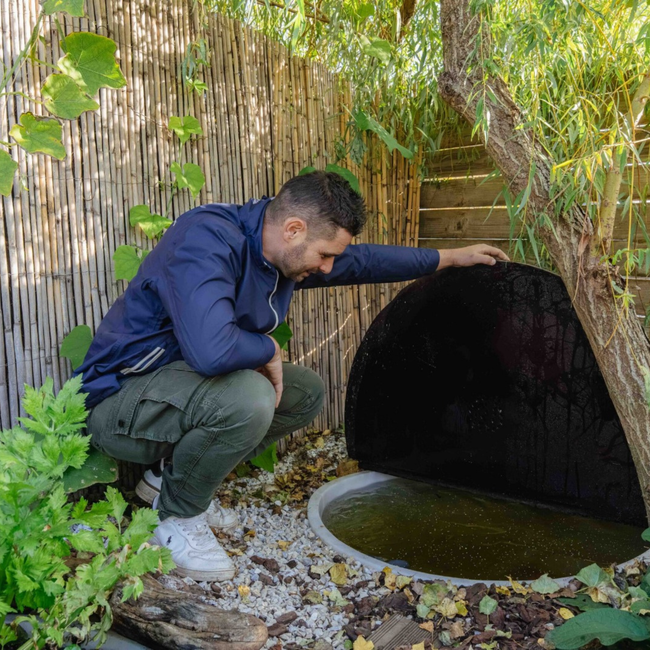
Yes, provided it previously held a food-grade product, has been thoroughly rinsed, and has been made opaque — light causes algae to proliferate.

Three main materials dominate. Expanded clay pebbles are lightweight, chemically neutral, and easy to rinse, but they float until thoroughly waterlogged and they are expensive per cubic metre. Pumice is denser, less costly, and offers a highly porous surface that suits bacteria well. Washed gravel also works, with one caveat that catches beginners out: it must contain no limestone whatsoever. Limestone gravel continuously leaches carbonate, drives pH upwards, and makes any correction futile. The test is instant — a few drops of vinegar on a handful of grow medium: if it fizzes, reject that batch.

In terms of sizing, a particle size of around eight to sixteen millimetres allows water to flow freely without trapping roots, and a depth of around thirty centimetres provides both the wet zone where bacteria work and the dry surface layer that discourages fungus gnats. Rinse the grow medium until the water runs clear; fine particles clog the bed and create anaerobic pockets.

Finally, keep in mind that the type of grow medium determines how much load the system can handle. Oklahoma State University's extension guidance puts the sustainable feed rate at around 60 to 100 grams of feed per square metre of growing area per day in deep water culture, and recommends staying at roughly a quarter of that figure for gravel beds and NFT channels. A home-built flood-and-drain system therefore cannot be managed like a deep water culture unit — it requires more growing area for the same quantity of feed distributed.

A pump should always be chosen on two figures, never just one. The flow rate stated on the packaging corresponds to zero head pressure, and it drops sharply as soon as the water has to be lifted. Read the manufacturer's curve at the actual head height between the pond surface and the outlet point.

  • Aim for a full turnover of the fish tank volume at least once per hour.
  • Factor in the lift height, then add a margin of around thirty per cent for bends and head losses.
  • Choose a submersible pump with a removable strainer — it can be cleaned without draining the circuit.
  • Check that wear parts — impeller and seals — are sold separately.
  • Keep a spare pump; pump failure is the one breakdown that gives you the least time to react.

Significant oversizing is counterproductive: too strong a current stresses the fish and stirs up sediment. A bypass valve returning excess flow to the pond allows fine adjustment of the flow rate without throttling the pump.

This is the hallmark of an iron deficiency, the most common in aquaponics. Fish feed does not supply enough, and mineral iron precipitates out at the operating pH of the system. Oklahoma State University Extension recommends adding chelated iron to maintain the concentration at around 2 mg per litre — in chelated form precisely because it remains available to the roots.

Iron is not always the sole cause. A study published in Agriculture in 2022 measured lettuce yields of 1.2 kg per square metre with no supplement, 1.5 kg with iron alone, and 2.6 kg with iron and potassium together. In other words, correcting the iron deficiency restores leaf colour, but it is often potassium that unlocks the harvested volume.

A timer is the safest option to build: it has no moving parts and takes only seconds to set, but it does require level monitoring and an overflow safety. The bell siphon is more elegant and more energy-efficient — it drains the bed on its own as soon as the water reaches the bell, provided it is calibrated once and for all to the exact flow rate of your pump. It loses its prime if the flow varies or if fine particles block the standpipe, which makes it a setup best left to patient hobbyists. For a first system, a timer will save you from many a flood.

Because nitrification is an acidifying reaction, it consumes the water's alkalinity over the course of weeks. New Mexico State University Circular 680 recommends maintaining alkalinity at 100 ppm of CaCO3 or above and hardness between 50 and 100 ppm, precisely to prevent pH drift. If your starting water is soft, the drop is rapid and keeps repeating.

Correction is made through small additions, alternating between calcium carbonate and potassium carbonate rather than always using the same one — which also tops up two minerals that plants are frequently short of. Measure alkalinity, not just pH: a correct pH reading in unbuffered water can shift overnight.

Read next

Aquaponics and Summer Holidays

Aquaponics and Summer Holidays

You're going away for two weeks in July and your aquaponics system will be running without you : this thought rightly makes you anxious, because heatwaves, evaporation, and fish feeding raise practical questions. Good

Read the article
Salmonponics: aquaponics in cold water

Salmonponics: aquaponics in cold water

Aquaponics is often associated with pond fish like goldfish and koi. However, there is a variant perfectly suited for our temperate regions, cool climates, and winters : salmoponics. Trout, char, brook trout, these iconic

Read the article
Is aquaponics suitable for animal welfare ?

Is aquaponics suitable for animal welfare ?

We often talk about what aquaponics produces. But rarely about what the fish that make it work experience. Are they simply tolerated in a system designed for production, or can aquaponics truly respect their

Read the article
15 plants to grow in aquaponics

15 plants to grow in aquaponics

Aquaponics is ideal for growing a wide variety of plants, both indoors and outdoors. Some varieties adapt particularly well to this soilless growing method, with a constant supply of nutrient-rich water.

Read the article
Iron Deficiency in Aquaponics

Iron Deficiency in Aquaponics

Iron deficiencies are among the most common problems encountered by aquaponic growers. Yellow leaves, slowed growth, and plants that stagnate despite clear water and a functioning nitrogen cycle are often the first visible signs

Read the article