


GH total hardness water test in drops
Regular price
¥1,800
Regular price
Sale price
¥1,800
Unit price
/
per
¥600 × 3 with no fees
Klarna.
Total hardness accounts for dissolved calcium and magnesium — in other words, what your water contributes to living organisms. It is read by titration, counting the drops until the colour shifts from red to green, within 2 minutes.
This value determines the strength of a shrimp's shell, a snail's shell, and a share of a fish's mineral balance.
 Customer support 7 days a week by email
 Delivery within 2 to 15 business days
100 % secure payment
The summary
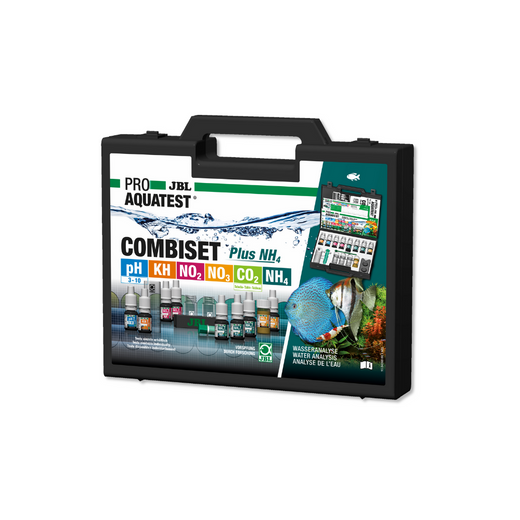
- What you receive: 1 bottle of GH reagent, 1 graduated plastic test tube, and the multilingual instruction leaflet.
- What you measure: dissolved calcium and magnesium — the two minerals on which moulting, shell formation, and root development depend.
- How to read the result: count the drops until the colour shifts from red to green. One drop equals 1 °dGH per 5 ml of water.
- How long it takes: 2 minutes, with no waiting time. The colour change is immediate.
- How to choose: total hardness is also included in the 14-in-1 aquarium kit and in both pond test kits.
- What is sent to you: a parcel weighing 0.09 kg, reagent in its original box.
Drop-titration test, one drop equals 1 °dGH, calcium and magnesium combined
Total hardness combines dissolved calcium and magnesium. These are nutrients that everything living in your water draws on constantly. A shrimp uses the calcium for its shell, a snail for its shell, a plant its magnesium, and calcium helps a freshwater fish limit its mineral salt losses through the gills.
🔀 GH and KH, two measurements
Confusing GH and KH is a common mistake, and it has a real practical consequence: a total hardness reading taken to stabilise the pH has no effect on that pH at all, since total hardness measures calcium and magnesium; it is carbonate hardness that measures carbonates, and carbonate hardness alone that stabilises the pH. The two values have no fixed relationship: rainwater corrected with bicarbonate will show a correct KH and an almost zero GH, whereas osmosis water remineralised with carbonate-free salts will show the opposite. In practice, an unstable pH points to the KH, and failed moults point to the GH.
Check the bottle before counting the drops
Both the total hardness and carbonate hardness tests are carried out on 5 ml of water and read by counting the drops, but their colour changes go in opposite directions: red to green here, blue to orange-yellow for KH. Rinse the test tube several times with the water to be tested between the two measurements, and read the bottle label before you start, as using one reagent instead of the other gives a result that looks plausible but is wrong.
🦐 Shrimps and snails
Neocaridina, 6 to 10 °dGH
These are the standard red, orange and blue varieties. Below 5 °dGH the shell stays soft after moulting.
Caridina, 4 to 6 °dGH
These are the Crystal and Taiwan Bee varieties, almost always kept in remineralised osmosis water.
Moulting is the critical moment
A moult interrupted halfway through, the animal stuck in its shell, indicates water that is too poor.
Snails, the first visible sign
A shell that develops white pits and then crumbles at the top of the spire is a sign of water too low in calcium.
Separate magnesium from calcium using a second test
Total hardness adds calcium and magnesium together without separating them. If you are growing in aquaponics or in a planted bed and the older leaves are yellowing between veins that remain green, also run the magnesium test: it will tell you whether it is that element that is lacking. Epsom salt corrects it on its own, without affecting calcium or carbonates.
Maintenance ranges are expressed in German degrees, as are the test results. Most freshwater fish and plants do well between 8 and 25 °dGH, a lightly stocked planted tank is better kept between 3 and 10 °dGH, a garden pond between 6 and 20 °dGH, and Malawi and Tanganyika cichlids between 5 and 20 °dGH. These are maintenance ranges, not danger thresholds.
🪨 The hardness of your water
Tap water hardness depends on the local geology, and the variation from one region to another can be tenfold: water that runs through granite bedrock, as in Brittany, often comes out below 5 °f, whereas water from limestone areas sometimes exceeds 40 °f, roughly 2.8 and 22 °dGH respectively. Measure your tap water before choosing your species, then select those that thrive in it rather than constantly correcting it.
🌧️ Rain, evaporation and GH
In a garden pond, the total hardness reading is often low because rainfall dilutes the water with every shower. Summer produces the opposite effect: water evaporates, minerals remain, and each top-up from the mains supply adds its own hardness to what is already in the pond. A reading in spring and another at the end of summer will show you which direction your pond is moving, and the article on pond evaporation in summer explains how to compensate without causing shock.
Technical specifications
The essentials
- Parameter measured
- Total hardness, denoted GHCalcium and magnesium added together as a single value. The test does not separate them.
- Measurement principle
- Titration, counting dropsNo fixed range, no colour chart: you add the reagent until the colour change and count the drops
- Value of one drop
- 1 °dGH per 5 mlOver 10 ml, one drop equates to only 0.5 °dGH: this is how greater precision is achieved with soft water
- Equivalences
- 1.78 °fH, 1.25 °eThe French degree is used in drinking water analyses in France
- Colour change
- From red to greenThe opposite of the carbonate hardness test: mixing up the two reagents gives a plausible but incorrect result
- Manufacturer's reference
- JBL 2410800, PROAQUATEST rangeCode EAN 4014162241085
The procedure
- Water volume
- 5 mlMeasured in the graduated test tube supplied. It is this volume that determines the value of one drop
- The steps
- Rinse, fill, dose drop by drop, countSwirling after each drop
- Waiting time
- NoneThe colour change is immediate; there is no colour development time to observe
- Total duration
- Approximately 2 minutesThe harder the water, the more drops you need to count
- Recommended frequency
- 1 per day, then 1 per weekEvery day during the first week after filling, then as part of routine maintenance.
- Environments covered
- Freshwater and garden pondThis test is not suitable for saltwater
Security and parcels
- Ranking
- WarningThe lower of the two threshold levels under CLP regulations
- Main risks
- Flammable, causes skin and eye irritationH226, H315 and H319 statements
- Precautions
- Sink, well-ventilated room, out of reachChild-safety cap, keep away from all flames
- Parcel weight
- 0.09 kgPackaging included
To budget for separately
- How to remineralise
- A shrimp mineral salt, or Epsom saltThe first raises the total GH, the second raises only the magnesium fraction without affecting the carbonates
- Reagent refill
- Reagent only, ref. 2410900The graduated cylinder keeps well
10 further specifications are available in the detailed view.
In the box
- 1 bottle of GH reagent with child-safety cap
- 1 graduated plastic test tube from 5 to 20 ml
- 1 multilingual instruction leaflet, French included
Reference, EAN code, kit contents, protocol, reading guide, recommended frequency, and equivalences between degrees and hazard statements taken from the manufacturer's datasheet and instructions on 05/09/2026. The maintenance ranges come from the manufacturer and their UK retailers. The hardness ranges for shrimps come from specialist breeding guides.
Total hardness , in which kit?
Same manufacturer, same reagent drops. The 6-in-1 kit covers the nitrogen cycle and pH; total hardness is available in this test alone and in the 14-in-1.
A moulting shrimp needs calcium in the water
Below 5 °dGH, moults fail and shells become pitted. Above 25 °dGH, most freshwater fish and plants are outside their maintenance range.
| Parameters covered (parameters) | Drop tests included (tests) | Total hardness GH | Carbonate hardness KH | pH, nitrites, nitrates and ammonium | Iron, phosphates, copper and oxygen | Reagent bottles (bottles) | Glass test tubes | Laboratory comparator block | Thermometer | Reagent refill sold separately | Price | |
|---|---|---|---|---|---|---|---|---|---|---|---|---|
| Recommended Total hardness test onlyYour choice | 1 parameters | 1 tests | Yes | No | No | No | 1 bottles | 0 | No | No | Yes | ¥1,800 |
| 6-in-1 Aquarium Water Testing KitYour choice | 6 parameters | 5 tests | No | Yes | Yes | No | 9 bottles | 3 | Yes | No | Yes | ¥7,700 |
| 14-in-1 water analysis kit for aquariumYour choice | 14 parameters | 13 tests | Yes | Yes | Yes | Yes | 23 bottles | 12 | Yes | Yes | Yes | ¥16,100 |
Total hardness test onlyRecommended
What you're measuring
Parameters covered (parameters)1 parameters
Drop tests included (tests)1 tests
Total hardness GHYes
Carbonate hardness KHNo
pH, nitrites, nitrates and ammoniumNo
Iron, phosphates, copper and oxygenNo
Equipment supplied
Reagent bottles (bottles)1 bottles
Glass test tubes0
Laboratory comparator blockNo
ThermometerNo
Budget
Reagent refill sold separatelyYes
6-in-1 Aquarium Water Testing Kit
What you're measuring
Parameters covered (parameters)6 parameters
Drop tests included (tests)5 tests
Total hardness GHNo
Carbonate hardness KHYes
pH, nitrites, nitrates and ammoniumYes
Iron, phosphates, copper and oxygenNo
Equipment supplied
Reagent bottles (bottles)9 bottles
Glass test tubes3
Laboratory comparator blockYes
ThermometerNo
Budget
Reagent refill sold separatelyYes
14-in-1 water analysis kit for aquarium
What you're measuring
Parameters covered (parameters)14 parameters
Drop tests included (tests)13 tests
Total hardness GHYes
Carbonate hardness KHYes
pH, nitrites, nitrates and ammoniumYes
Iron, phosphates, copper and oxygenYes
Equipment supplied
Reagent bottles (bottles)23 bottles
Glass test tubes12
Laboratory comparator blockYes
ThermometerYes
Budget
Reagent refill sold separatelyYes
Parameters covered, equipment supplied and kit contents recorded from the three data sheets on 05/09/2026. A titration test uses neither a colour comparator block nor a glass measuring tube.
Help choosing
Does hardness matter for your livestock?
Documents & manuals
Official manufacturer's instructions, in French
Full four-step titration protocol, reference volume, equivalences between German, English and French degrees of hardness, and correction advice.
Document not showing? Some publishers block display inside a frame, so open it in a tab.
Estimate your
delivery time
Your estimate
Delivery
Estimated time
It covers preparing your order and then the transit time quoted by the carrier, counted in working days.
It is not a guaranteed delivery date: public holidays, peak periods, customs or a carrier delay can extend it. The exact amount, in your currency, is worked out in the cart once your address is entered.
Package weight 0.12 kg, dispatched to a collection point or by Colissimo to your home address, your choice at checkout. The reagent is sent in its original box. The exact shipping cost is shown in the basket.
Frequently asked questions
6 questions
6 key questions
You may also like


Related articles

Pond
Koi carp in aquaponics
A garden pond is managed between 6 and 20 °dGH, and the value shifts with rainwater inputs.
Read the article

Guide
Which fish to choose for aquaponics?
Choosing species suited to your water costs less than correcting the water all year round.
Read the article

Crops
Identifying deficiencies in aquaponics
Magnesium is the central atom of chlorophyll: a deficiency shows up on the oldest leaves first.
Read the article

Crops
Plant deficiencies in aquaponics
Calcium and magnesium are nutrients, and a productive system removes them with every harvest.
Read the article

Troubleshooting
Understanding and clearing cloudy water
A whitish haze in very hard water does not have the same cause as a bacterial bloom.
Read the article

Parameters
Regulating pH in an aquaponics system
The key lever for pH is carbonate hardness, never total hardness: the two are often confused.
Read the article
Let us talk about your project
A question about this product or your setup? Our team will answer and advise you.

Interest-free instalment payments
Offered depending on the cart amount, at checkout.

Delivery in 2 to 15 working days
Depending on the products and shipping sites. Estimate by destination in the estimator on this page.

After-sales service 7 days a week by email or chat
Our team answers all your questions.

Shop responsibly
Become part of the change.
