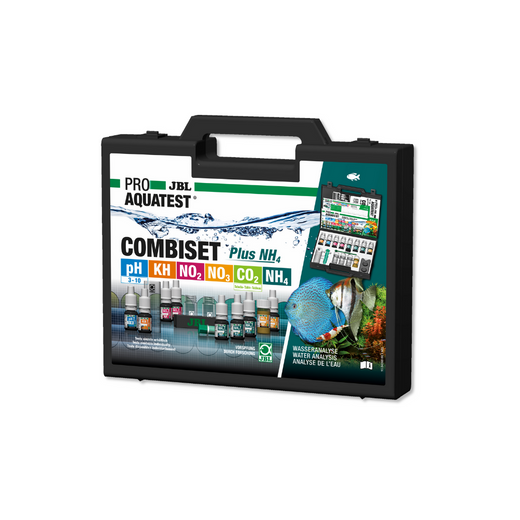


10-in-1 water analysis kit for ponds
Regular price
¥21,700
Regular price
Sale price
¥21,700
Unit price
/
per
Product rating: 5.0
(27 reviews)
¥7,233 × 3 with no fees
Klarna.
This kit brings together ten drop tests and 22 reagent bottles to monitor the water in a pond or an aquaponic system: pH, KH, GH, ammonium, nitrite, nitrate, phosphate and dissolved oxygen.
pH and phosphate are each read across two ranges, and the comparator block accounts for the natural colour of the water.
 Customer support 7 days a week by email
 Delivery within 2 to 15 business days
100 % secure payment
The summary
- What you receive: the waterproof case, 22 reagent bottles, glassware, syringes, a thermometer, and the colour comparator block.
- What you measure: 10 drop tests, from pH across two ranges to phosphates across two ranges, through to dissolved oxygen.
- How long it takes: 2 minutes for total hardness, 17 minutes for ammonium, including waiting time.
- How to choose: this kit is the right choice as soon as a pond heats up in summer or is home to koi.
- What gets used up: the 22 bottles, at very different rates depending on the test.
- What gets sent to you: the closed case, bottles in their original slots.
Ten drop tests for the pond, from ammonium to dissolved oxygen
A garden pond changes more quickly than an indoor tank, because sunlight, rain, and leaves enter it without any filter. This kit brings together ten drop tests and 22 reagent bottles, from ammonium to dissolved oxygen, so that each season can be read from recorded figures rather than the appearance of the water.
🔬 Ten tests in one kit
The ten tests are grouped into three families: nitrogen, covering ammonium, nitrite, and nitrate; the mineral baseline, covering two pH ranges and both hardness values; and pond-specific measurements, phosphate in two formulations and dissolved oxygen. The ammonium test uses 3 reagents and, via a table that cross-references pH and temperature, gives the proportion of ammonia that is genuinely toxic. All bottles have child-resistant caps and can be repurchased individually, stored in a water-resistant plastic case that closes securely and can be carried to the poolside.
The nitrogen trio
Ammonium, nitrite and nitrate show where biological filtration stands. These are the three key readings for a pond that is starting up or has just been restocked.
The mineral base
pH, carbonate hardness, and total hardness are read together. KH stabilises pH, and pH determines the toxic proportion of ammonia.
Two phosphate ranges
One formulation reads low concentrations, from 0.05 to 1.8 mg/L. The other takes over in koi water that is already heavily loaded.
Dissolved oxygen
You measure it from 1 to 10 mg/L on a sample taken without air bubbles. At 2 mg/L and below, the colour chart enters its red zone, the point at which you need to act.
The oxygen test tube is filled by immersion
The oxygen test is the only one in the kit where the sample is not measured using a syringe. Submerge the test tube under water to fill it to the brim, add 6 drops of reagent 1 and 6 drops of reagent 2 while allowing it to overflow, then screw on the cap without trapping any air bubbles, otherwise you will be measuring the air as much as the water. Shake for 30 seconds, add 6 drops of reagent 3, shake again for 30 seconds, and wait 10 minutes before reading the result. All three reagents are corrosive: work over a sink and rinse thoroughly if any splashing occurs.
🌊 Oxygen in summer
Oxygen is the parameter in this kit where a deficit can lead to fish losses within a matter of hours. Warm water dissolves less of it than cold water, and a reading of 3 mg/L calls for action the same day. Aim for 5 to 8 mg/L in freshwater, and always take repeat measurements at the same time of day, otherwise two readings simply cannot be compared. Our notes on pond algae in summer set out the order in which corrections should be made.
Re-seed the filter when nitrite remains detectable
A nitrite reading that remains detectable for several consecutive days, often after a period of low oxygen, indicates that the biological filtration is no longer converting all the nitrogen load in the pond. The concentrated pond bacteria restart the colonisation of the filter media, and the kit shows you measurement by measurement whether that colonisation is taking hold. You can then decide to stop dosing based on a dated reading rather than a gut feeling, and you know exactly how many days it takes for the load to be absorbed again.
🐟 Two pH ranges
The wide range spans 3.0 to 10.0 and is read across 14 colour fields, in 0.5 steps above pH 4.0, which is enough to place an unknown water but not to track a slow change. The second range covers 7.4 to 9.0, the zone for hard water and koi ponds, and it is this one that provides the day-to-day precision that really matters. That precision counts because pH determines how much of the ammoniacal nitrogen is present as ammonia, the only truly toxic form: the conversion can be read from a table that cross-references pH and temperature, and the thermometer included in the kit is there for exactly that purpose. Our guide to keeping koi carp covers these reference points.
Temperature matters just as much as pH in this calculation. At pH 8, the proportion of free ammonia accounts for approximately 1.8% of total ammoniacal nitrogen in water at 10 °C, and around 5.4% at 25 °C: the same ammonium concentration therefore becomes 3 times more toxic between a spring morning and an August afternoon. Record the temperature at the exact moment of sampling, not the previous day's reading, before consulting the table, and redo the calculation each season rather than relying on last year's figure.
🥬 Nitrate feeds your crops
In a planted pond, nitrate ceases to be a waste product. Marginal plants and the lettuces in a deep water culture raft take it up, and this kit lets you monitor the gap between what the fish produce and what the roots consume. Measure at least 24 hours after a top-up, otherwise you are reading the dilution rather than the production. The colour chart runs from 0.5 to 200 mg/L, enough to cover both a heavily stocked pond and a planted one at rest.
Two other values largely determine water colour in spring. Phosphate is measured here in two formulations, one for low concentrations and one for water in a koi pond that is already heavily loaded, because a single scale cannot cover both cases. Test it alongside nitrate before making any changes to your pond, as it is the scarcer of the two nutrients that limits algae growth. Our five approaches to dealing with green pond water are based on these two readings.
🗂️ Tracking all 22 bottles
The 22 bottles do not empty at the same rate. The nitrite, ammonium and pH reagents are used up quickly in a young pond, whereas those for total hardness and high-range phosphate last entire seasons. Keep a close eye on the levels of these three tests, as they are the ones you will run out of first, reorder them as refills sold separately. The case, the test tubes, the syringes, the measuring spoons, the thermometer, the comparator block and the colour charts will last you from one year to the next.
Technical specifications
The essentials
- Tests included
- 10 drop testspH and phosphate each count for two, with a low range and a high range
- Parameters measured
- pH, KH, GH, NH4, NO2, NO3, PO4, O2Eight separate parameters, two of which are read on two different scales
- Reagent bottles
- 22, child-resistant capsFrom 1 bottle for carbonate hardness to 3 for ammonium and for oxygen.
- Method
- Liquid reagents, colorimetric readingThe comparator block accounts for the natural colour of the water, including leaves and peat
- Covered water
- Garden pond and koi pondThe two phosphate ranges distinguish clear water from water that is already loaded.
- Manufacturer's reference
- JBL 2407200, PROAQUATEST rangeCode EAN 4014162240729
The ten tests, one by one
- pH, wide range
- 3.0 to 10.014 colour fields, in steps of 0.5 above pH 4.0, to identify an unknown water sample
- pH, alkaline range
- 7.4 to 9.0For hard water and koi ponds, precise enough to track a slow change over time
- KH, carbonate hardness
- Titration, 1 drop = 1 °dKHAt least 5 °dKH in a pond to keep the pH stable
- GH, total hardness
- Titration, 1 drop = 1 °dGHOn 5 ml of water. The colour change goes from red to green
- NH4 and NH3, ammonium
- Colorimetric, using 3 reagentsThe truly toxic proportion of ammonia is read from a table cross-referencing pH and temperature
- NO2, nitrites
- 0.025 to 1 mg/LThe target is zero, and that is the reference value during a start-up
- NO3, nitrates
- 0.5 to 200 mg/LTake readings at least 24 hours after a top-up, otherwise you are measuring the dilution.
- PO4, Sensitive version
- 0.05 to 1.8 mg/LThe lower range, where the balance between plants and algae is decided
- PO4, koi version
- High concentrationsIt takes over on water that the lower range saturates
- O2, dissolved oxygen
- 1 to 10 mg/LAim for 5 to 8 mg/L in freshwater. The colour chart turns red at 2 mg/L and below.
The technique and the timing
- Water volume per test
- 5 or 10 mlExcept for oxygen, whose test tube is filled by submersion, without any bubbles
- Waiting time
- 0 to 15 minutesNone for KH and GH, 5 minutes for nitrite, 10 for nitrate and oxygen, 15 for ammonium
- Titration tests
- KH and GHCount the drops until the colour change, with no colour chart to compare against
- Reading
- Colour chart, in daylightA warm artificial light shifts the perception of pink and orange shades
To budget for separately
- Iron
- An iron Fe testYellowing foliage between veins that remain green stands out against this figure.
- Reagent refills
- Reagents sold individuallyGlassware, syringes, thermometer, comparison block, and colour charts keep well
14 further specifications are available in the detailed view.
In the box
- 1 water-resistant plastic case
- 22 reagent bottles with child-safety caps
- Glass test tubes
- Plastic test tubes
- Water sampling syringes
- Dosing measures
- 1 thermometer
- 1 laboratory comparator block
- 1 set of colour charts
- 1 ballpoint pen
- 1 set of analysis record sheets
- 1 instruction leaflet
Tests, kit contents, reference and EAN code taken from the official JBL PROAQUATEST LAB Koi product sheet on 20/09/2026, EAN code cross-checked against a French retailer. Ranges, protocols and waiting times recorded test by test from the instructions of the same tests sold individually.
Ten tests, six tests or five boxes?
All three use the same drop reagents and the same colour comparator block. What sets them apart is the range of parameters they cover and how you restock what runs out.
Dissolved oxygen is tracked as a numerical reading
This kit adds oxygen, nitrate, a fine pH range and a second phosphate scale. Answer two questions and the chart will identify the version that suits you.
| Drop tests (tests) | pH, KH, ammonium and nitrite | NO3, nitrates | GH, total hardness | PO4, phosphates | O2, dissolved oxygen | pH, narrow range of 7.4 to 9.0 | PO4 at high concentration, koi version | Single kit with comparison block | Thermometer included | Each parameter in its own box | Price | |
|---|---|---|---|---|---|---|---|---|---|---|---|---|
| 6-in-1 pond water analysis kitYour choice | 6 tests | Yes | No | Yes | Yes | No | No | Yes | Yes | No | No | ¥9,600 |
| Recommended 10-in-1 test kitYour choice | 10 tests | Yes | Yes | Yes | Yes | Yes | Yes | Yes | Yes | Yes | No | ¥21,700 |
| Pack of 5 aquaponics water tests: NH4, NO2, NO3, pH, KHYour choice | 5 tests | Yes | Yes | No | No | No | No | No | No | No | Yes | ¥11,600 |
6-in-1 pond water analysis kit
What you're measuring
Drop tests (tests)6 tests
pH, KH, ammonium and nitriteYes
NO3, nitratesNo
GH, total hardnessYes
PO4, phosphatesYes
O2, dissolved oxygenNo
pH, narrow range of 7.4 to 9.0No
PO4 at high concentration, koi versionYes
The form and restocking
Single kit with comparison blockYes
Thermometer includedNo
Each parameter in its own boxNo
Price
10-in-1 test kitRecommended
What you're measuring
Drop tests (tests)10 tests
pH, KH, ammonium and nitriteYes
NO3, nitratesYes
GH, total hardnessYes
PO4, phosphatesYes
O2, dissolved oxygenYes
pH, narrow range of 7.4 to 9.0Yes
PO4 at high concentration, koi versionYes
The form and restocking
Single kit with comparison blockYes
Thermometer includedYes
Each parameter in its own boxNo
Price
Pack of 5 aquaponics water tests: NH4, NO2, NO3, pH, KH
What you're measuring
Drop tests (tests)5 tests
pH, KH, ammonium and nitriteYes
NO3, nitratesYes
GH, total hardnessNo
PO4, phosphatesNo
O2, dissolved oxygenNo
pH, narrow range of 7.4 to 9.0No
PO4 at high concentration, koi versionNo
The form and restocking
Single kit with comparison blockNo
Thermometer includedNo
Each parameter in its own boxYes
Price
Parameters, contents and references of the three test kits sourced from the official JBL PROAQUATEST datasheets on 20/09/2026, then cross-checked test by test against the instructions for the same tests sold individually.
Help choosing
Are ten tests justified in your situation
Estimate your
delivery time
Your estimate
Delivery
Estimated time
It covers preparing your order and then the transit time quoted by the carrier, counted in working days.
It is not a guaranteed delivery date: public holidays, peak periods, customs or a carrier delay can extend it. The exact amount, in your currency, is worked out in the cart once your address is entered.
Parcel weighing 2.11 kg, dispatched to a Mondial Relay collection point or via Colissimo to your door, your choice at checkout. The exact amount is shown in the basket.
Frequently asked questions
10 questions
6 key questions, 10 in the detailed view
You may also like


Related articles

Understanding
The nitrogen cycle in aquaponics
The nitrogen cycle, which the ammonium, nitrite and nitrate in this kit track.
Read the article

Parameters
Regulating pH in an aquaponics system
Adjust the pH once the reading has been taken across both ranges.
Read the article

Pond
Green pond water: 5 solutions
Five solutions for green water, to be chosen after reading your test results.
Read the article

Algae
Pond algae in summer
Pond algae in summer, to be compared against your phosphate reading.
Read the article

Start-up
Getting started with an aquaponic system
Getting a system off to a good start, tracking the water test by test.
Read the article

Troubleshooting
Understanding and correcting cloudy water in aquaponics
Understanding and correcting cloudy water, backed up by measurements.
Read the article
Let us talk about your project
A question about this product or your setup? Our team will answer and advise you.

Interest-free instalment payments
Offered depending on the cart amount, at checkout.

Delivery in 2 to 15 working days
Depending on the products and shipping sites. Estimate by destination in the estimator on this page.

After-sales service 7 days a week by email or chat
Our team answers all your questions.

Shop responsibly
Become part of the change.
