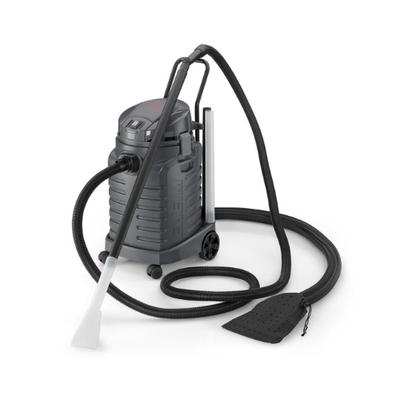



Pond sludge vacuum, 40-litre tank
Regular price
¥38,400
Regular price
¥42,100
Sale price
¥38,400
Unit price
/
per
This pond vacuum removes mud and decomposing leaves from the bottom down to 2 metres below the surface, collecting them in a 40-litre tank.
Operation and emptying cycle automatically: the unit draws in water, stops, empties itself, then starts again. It carries a 3-year manufacturer's guarantee.

7/7 customer service by e-mail

Payment in instalments, free of charge
The summary
- What you receive: the unit on wheels, a 4-metre intake pipe, a 2.5-metre discharge pipe and its universal nozzle.
- What it removes: bottom sludge and decomposing plant matter, before it ferments and depletes the oxygen.
- How deep it reaches: 2 metres below the rim, with a 1,300-watt motor and a 40-litre tank.
- How it works: it draws in water, stops, empties via the discharge pipe, then starts again, without any intervention on your part.
- Vacuum or scrub: this unit works in the water, with the fish still inside. The other machine scrubs surfaces dry.
- Delivery: heavy parcel, 14 kg on the scales, delivered by carrier.
Pond vacuum cleaner, 40-litre tank and fully automatic cycle
At the bottom of a garden pond, a soft layer of leaves, fish waste, and decomposing plant matter accumulates over time. This layer ferments, and fermentation consumes the oxygen in your water. This device reaches down to 2 m below the surface and draws that sludge into a 40-litre tank, while your fish remain in the pond. You work from the bank, without a wetsuit and without emptying anything, which makes this job very different from a full drain-down, which resets the entire biological balance of the pond.
🪣 The tank and its automatic cycle
The automatic cycle is the feature that makes all the difference in practice. The unit draws water until its 40 litres are full, cuts the motor, allows the water to leave through the discharge pipe, then restarts on its own. An integrated timer controls the alternation, and there is nothing for you to trigger. You will therefore hear the machine stopping and starting again at regular intervals throughout the job, which is normal operation and not a fault. During the draining phases, leave the nozzle in place and prepare for the next pass. The only adjustment that matters is where you position the unit: place it on the bank, on a flat surface, with the discharge pipe running downwards rather than back up. Whatever you might lose by fighting gravity, you will gain back in draining time.
🔌 What the wattage changes
The motor delivers 1,300 watts on a standard domestic supply of 220 to 240 volts. This reserve is primarily useful for heavy matter, since waterlogged sludge and a mat of wet leaves weigh considerably more than dry sediment, and that is exactly where smaller machines labour or block. The maximum suction head is 2 m, measured between the water surface and the machine sitting on the bank, which covers the vast majority of garden ponds and a good proportion of koi ponds. Beyond that, it is the height of the water column to be drawn up that limits suction. Check your head before ordering by measuring from the water surface to where you intend to place the machine, not from the bottom to your feet.
Suction pipe
It measures 4 m long and 35 mm in diameter, allowing you to reach the centre of a pond from the bank.
Discharge pipe
Direct this 2.5 m, 50 mm diameter pipe towards a flower bed rather than the drain.
Filter medium
It retains large solid debris at the tank outlet and is rinsed under clean water after each session, which is all that is needed to maintain it for several seasons.
The accessory kit for corners
To reach into corners, between stones and along narrow areas, add the accessory kit, which includes a flat nozzle, a round brush and a floor jet. Also keep a large-mesh net to hand to remove whole leaves before you start, as they block the nozzle within seconds and force you to disassemble mid-job.
A project that requires careful preparation beforehand
First remove whole leaves and branches by hand, as the universal nozzle is designed for silt, not a mat of dead leaves. Then work across the bottom in strips, without trying to do everything at once, and stop when the pond level has visibly dropped. A heavily silted pond requires several sessions spread over time, and trying to tackle it in a single day costs more in terms of biological balance than it saves in time. If the bottom silts up again at the same rate each year, maintenance bacteria are the right solution to use between hoovering sessions.
🐟 Your fish during vacuuming
You are working on a pond with its inhabitants still inside, and two habits are enough. Move slowly, giving the fish time to move away from the nozzle, and keep an eye on the tank so you can stop and release immediately if one of them enters it. Watch the water level too, because the water you remove does not come back. A thorough session can draw off several hundred litres, and a pond already low at the end of summer can lose enough in an hour to shift its parameters significantly. The article on compensating for evaporated water explains how to top up that volume without causing a shock. Bear in mind as well that the bottom layer harbours part of your bacterial population, and removing it entirely in one session is asking your filter to start again from scratch at the worst possible moment. Working in strips over two or three weekends protects both the water level and the biological balance, and gives you time to see how the water responds between sessions. This precaution matters most on a heavily stocked pond, where the margin for error is slim.
🌱 Cloudy water is a fertiliser
What comes out of the waste pipe is water loaded with organic matter and fish waste. Direct this pipe towards a border, the base of a tree, or a row of vegetables rather than a drain, since you are turning a maintenance chore into a fertilising irrigation, which is precisely the loop we aim for in aquaponics. The waste pipe works by gravity and must therefore run downhill all the way to its destination, which means choosing the area to be watered before positioning the unit rather than afterwards. A border situated higher than the bank is out of reach, and a pipe extension will not change that.
📥 What's included
You receive the motor unit and its tank pre-assembled, the 4 m suction pipe, the 2.5 m discharge pipe, the universal suction nozzle with its tube, the filter element, and the mounting bracket. The power cable measures 7.5 m. The unit weighs 14 kg and measures 39 cm wide by 82 cm tall, making it a permanent fixture rather than something you put away in a cupboard. The manufacturer's warranty runs for 3 years. Plan a sheltered storage spot from the moment of purchase: a unit of this size left in a corner of the garden will gradually fill with leaves and deteriorate faster when idle than when in use. A garden shed, garage, or simple storage box is sufficient, provided it is frost-free.
📅 Two visits per year
The unit is used twice a year on most garden ponds, once after leaf fall and once at the spring restart. These two sessions are not equal in importance. The autumn pass removes organic matter before it ferments under ice, and it is the more useful of the two, as it prevents oxygen depletion over winter. The spring pass prepares for the season and is carried out earlier than the filter restart, while the water is still cold and the fish are barely moving. Between the two, whatever settles is broken down biologically, that is the job of the bacterial filter media placed in the filter. A heavily shaded pond surrounded by deciduous trees will, however, require a third pass during autumn, otherwise the accumulated layer exceeds what a single tank can process in one day.
🧰 Maintaining the unit
A pond vacuum stores clean or it won't start next time. Drain the tank completely after use, rinse it with clean water, then remove the filter element and run it under the tap until the water runs clear. Both pipes can be rinsed simply by letting them run full from a high point, which flushes out any silt left in the folds. Leave everything to dry thoroughly before storing, because a tank sealed over a residue of silt will develop, within a few days, an odour you will not forget come the following spring. Store the machine in a frost-free place: water trapped in the seals and the pump is what causes them to split. The filter element should be replaced when rinsing no longer restores its appearance, usually after several seasons, and it is the only genuine wearing part on the machine.
🧪 What to monitor afterwards
A vacuuming session disturbs two balances, the water level and the bacterial population, and the days that follow are worth keeping an eye on. Make up the removed volume with water at room temperature rather than straight from a pipe in full sun, and spread that refilling over time if the loss was significant. Then run an ammonia test and a nitrite test within 48 hours, as this is the point at which a depleted filter shows up in the water before it shows up in the fish. Reduce feeding for a few days as well, to give the bacterial population in the filter time to resume the work that the bottom layer was doing. A pond vacuumed thoroughly will usually return to equilibrium within one to two weeks, and it is precisely during this window that overfeeding comes at a steep price.
Technical specifications
The essentials
- Tank capacity
- 40 litresIt empties itself automatically once full, then suction resumes.
- Suction head
- 2.0 m maximum
Pump and pipes
- Power and voltage
- 1 300 W, 220 to 240 V
- Pipes included
- Suction 4 m, discharge 2.5 mDiameters of 35 and 50 millimetres.
Footprint and warranty
- Dimensions
- 392 x 507 x 844 mm
- Manufacturer's warranty
- 3 years7.5-metre power cable.
To budget for separately
- Corner fittings
- 4-piece kit for narrow spaces
- Fishing net
- To remove leaves before vacuuming
In the box
- 1 motor unit and its 40-litre tank, on castors.
- 1 suction pipe of 4 m, diameter 35 mm
- 1 discharge pipe of 2.5 m, diameter 50 mm
- 1 universal intake nozzle with its tube
- 1 filter medium
- 1 fixing bracket
Power, suction head, tank capacity, dimensions, pipe and cable lengths, delivery contents and warranty recorded on 19/09/2026 from the EHEIM product page for the VAC40.
Vacuum the bottom, or scrub the surrounds
Two EHEIM units working at different points in the pond.
One goes into the water, the other stays dry
The bottom of an inhabited pond is treated by suction. An encrusted stone out of the water is treated by pressure.
| Retains waste inside a tank | Power output (W) | Detergent reservoir | Hose length (m) | Working depth | Manufacturer's warranty (years) | Price | |
|---|---|---|---|---|---|---|---|
| Recommended Pond sludge vacuum, 40-litre tankYour choice | Yes | 1300 W | none | 4 m | 2 m below the rim | 3 years | ¥38,400 |
| High pressure pond cleanerYour choice | No | 2500 W | 600 ml | 8 m | Out of water | 2 years | ¥54,100 |
Pond sludge vacuum, 40-litre tankRecommended
What the machine does with what it lifts off
Retains waste inside a tankYes
Power output (W)1300 W
Detergent reservoirnone
Range and terrain
Hose length (m)4 m
Working depth2 m below the rim
Manufacturer's warranty (years)3 years
On the shop
High pressure pond cleaner
What the machine does with what it lifts off
Retains waste inside a tankNo
Power output (W)2500 W
Detergent reservoir600 ml
Range and terrain
Hose length (m)8 m
Working depthOut of water
Manufacturer's warranty (years)2 years
On the shop
Power, lengths, working depth and warranty recorded on 19/09/2026 from the EHEIM data sheets for the VAC40 and the BEASTER180e.
Help choosing
What you have in front of you dictates the machine
Estimate your
delivery time
Your estimate
Delivery
Estimated time
It covers preparing your order and then the transit time quoted by the carrier, counted in working days.
It is not a guaranteed delivery date: public holidays, peak periods, customs or a carrier delay can extend it. The exact amount, in your currency, is worked out in the cart once your address is entered.
This unit weighs 14 kilos and ships as a heavy parcel via courier. The exact delivery charge is calculated at checkout based on your address.
Frequently asked questions
12 questions
6 key questions, 12 in the detailed view
Vous aimerez aussi


Related articles

Pond
Pond evaporation in summer
Replacing the withdrawn volume without shifting the parameters all at once.
Read the article

Season
Feeding your fish in winter
The season when the substrate loads up fastest, and what's happening underneath.
Read the article

Fish

Basics
What is aquaponics?
Why a pond's loaded water is a resource rather than a waste product.
Read the article

Pond

Pond
Protecting your pond from predators
Fish stressed by building work hide away and become more vulnerable.
Read the article
Let us talk about your project
Une question sur ce produit ou votre installation ? Notre équipe vous répond et vous conseille.

Paiement plusieurs fois sans frais
Proposé selon le montant du panier, au moment du paiement.

Livraison sous 5 à 15 jours ouvrés
Selon les produits et sites d'expédition. Estimation par destination dans l'estimateur de cette page.

SAV 7/7 par mail ou chat
Notre équipe répond à toutes vos questions.

Faire un achat engagé
Devenez acteurs du changement.
