Watering your plants with an olla

Written by Tristan Ulrich · March 14, 2026
Olla en terre cuite enterrée au pied de cultures potagères

The Olla, also called an Oya, is a microporous clay pot buried near plants. It slowly releases water according to the roots' needs, allowing for deep, economical, and consistent irrigation. Increasingly popular, this system is appealing due to its efficiency and simplicity. But what are its real advantages ?

Watering your plants with an Olla, a smart, self-regulating irrigation system

An olla (or oya) works thanks to the microporosity of terracotta. Buried at the foot of your plants, this jar releases the water it holds slowly, at the pace the plants need it. As soon as the soil dries out, water seeps out gradually by capillary action. Conversely, when the moisture level is sufficient, the process stops naturally.

This self-regulating mechanism makes it a particularly effective tool during dry spells or long absences. It keeps hydration levels constant, with no need for daily attention.

Here are its main advantages:

  • 60 to 70% less water used than when watering the surface by hand with a watering can.
  • No loss at the surface: the water goes straight to the roots.
  • It is particularly useful in regions subject to water restrictions or prolonged dry periods.

Terracotta olla buried at the foot of the crops, the water diffusing by capillary action towards the roots

A significant reduction in water consumption

One of the major strengths of the olla is its ability to considerably reduce water waste. Unlike surface watering, where water can quickly evaporate or run off without soaking in deeply, the water delivered by the olla is directly available to the roots.

Trials published by the University of Arizona's agricultural extension put the water saving at between 60 and 70% compared with manual watering with a watering can, and not compared with drip irrigation, which is already economical by design. The water stays confined to the root zone, which limits losses and encourages deep, robust rooting.

This system is therefore particularly relevant in regions subject to water restrictions or during the hottest months of the year.

Gardener working the soil of a raised vegetable bed between the rows of tomatoes

A tool in the service of plant health

By promoting regular, targeted watering, the olla supports healthy plant growth. Excessive or irregular watering is often the cause of fungal diseases, root rot or water stress that harms growth.

With an olla:

  • Moisture stays constant, without waterlogging.
  • Roots explore the soil in depth, which makes them more resilient.
  • The plant's natural cycles are respected, without sudden shocks.

This method of irrigation also helps to reduce weed growth, as weeds generally thrive on the surface moisture created by conventional watering.

Rows of raw terracotta jars, evidence of an ancient watering technique Olla to plant out in unglazed terracotta

An eco-friendly, sustainable solution

Choosing an olla is part of an eco-friendly approach. Made from natural materials (raw terracotta), it produces no plastic waste, needs no energy to work, and can be reused season after season.

  • There is no need for an electrical connection, a pump or a timer.
  • At the end of its life, the olla is recyclable or biodegradable.
  • Some handmade models are made locally, which limits the carbon footprint.

By including ollas in a growing space, you encourage more economical use of resources and a return to simple, effective techniques.

Stainless steel watering can pouring water over a plant in a terracotta pot Buried irrigation jar

A time saver

By reducing how often you water (often only once or twice a week, depending on the size of the olla and the type of soil), this method makes garden upkeep lighter and less demanding.

  • Ideal for people with little time or who are regularly away;
  • Less watering also means fewer tools to handle, fewer hoses to unroll and fewer systems to maintain.

It is therefore a practical solution, particularly for gardeners or for balcony growing.

Terracotta ollas set into pots and planters of different sizes

Versatility of use

Oyas can be used in a wide variety of settings:

  • Vegetable gardens, in the ground or in raised beds;
  • Container growing, in troughs, planters or large pots;
  • Greenhouses, polytunnels or growing shelters;
  • Flower borders or ornamental plants.

They are simple and discreet to install. Models are now available to suit every need, from the small balcony pot to the jar holding several litres for larger crops.

Conclusion:

Using an olla means choosing a natural, economical and effective irrigation solution. Thanks to its simplicity of use, its many benefits for plants, and its respect for the environment, it proves a valuable ally in a more responsible approach to gardening. Whether you are growing a small patch of greenery in town or a large vegetable garden, the olla lets you water less, but better.

Sources

University of Arizona Cooperative Extension, Irrigating with Ollas (AZ1911), Water savings of 60 to 70% compared with hand watering, wetted radius and plant spacing.

PACE Project, Buried Clay Pot Irrigation, Action Sheet 44, Efficiency compared with hand watering, jar volumes and refilling frequency.

Sustainability, Innovations in Clay-Based Irrigation Technologies, A Systematic Review (2024), Measured savings compared with furrow irrigation and buried porous pipes.

Penn State Extension, Drip Irrigation for Vegetable Production, Water consumption of drip irrigation versus overhead spraying, emitter blockage and filtration.

Oklahoma State University Extension, Evaporation Losses from Shallow Water Bodies in Oklahoma, The influence of solar radiation, wind and air humidity on evaporation losses.

Frequently asked questions

Both systems aim to do the same thing, deliver water to the roots without wetting the foliage, but they are managed in completely different ways. A drip system delivers a set volume decided in advance, either by a timer or by you. It therefore irrigates just as much on a rainy day as on a hot, windy one, unless you constantly readjust it. A porous olla only releases what the soil draws from it, since it is the drying of the earth against the wall that pulls water outwards.

Drip irrigation has two clear advantages: it covers long bed lengths, and once connected to the mains it requires no manual filling. On the other hand it demands thorough filtration, emitter blockage remains its main weakness, and it deteriorates quickly in sunlight. An olla needs neither pressure nor electricity, but it does mean making rounds with a watering can, and it only irrigates a limited circle around itself.

In practice, the choice comes down to area. Over a few square metres of vegetable bed, containers, or planters, an olla almost always wins. Beyond around twenty square metres planted in tight rows, the number of ollas to fill becomes a burden and drip irrigation regains the upper hand. There is nothing to stop you combining both, reserving ollas for thirsty plants and for areas you keep the least eye on.


The published figures vary widely because they depend on what you are comparing against. Trials reported by the University of Arizona's agricultural extension place water savings at between 60 and 70% compared with watering by hand. A 2024 review paper records savings of around 69% against furrow irrigation, and 70 to 80% against buried porous pipes.

Focus on the mechanism rather than the percentage. Water never wets the surface, so it barely evaporates, does not run off, and does not feed weeds. Compared with a well-adjusted drip system, the difference narrows considerably, and any gains then come mainly from eliminating overwatering.

Restrictions apply to uses and times, not to equipment. Check the by-law in force in your area before filling your jars.

The buried pot is not a universal solution. Here are a few situations where it falls short.

  • Seedlings sown in situ, whose seeds germinate in the very top centimetres, which remain dry.
  • Grassed surfaces and ground cover, where water needs to be distributed evenly across the whole area.
  • Very small pots, in which the pot takes up more volume than the roots.
  • Very stony soils, where contact between the clay and the surrounding earth is incomplete.
  • Established trees and shrubs, whose roots extend well beyond the wetted circle.

In these cases, occasional surface watering remains simpler and more reliable.

Start by measuring the wetted radius. The most widely cited observation, echoed by the University of Arizona extension service, is that the wetted circle reaches roughly twice the diameter of the pot, and maize trials quoted in the same document give spacings in the region of 20 to 30 cm between the plant and the source.

On a bed three metres long and 80 cm wide, three to four medium-sized pots therefore cover most of the area, provided plants are positioned close by. It is better to move plants closer to the pots than to add more pots, the most common mistake is planting too far away.

The calculation depends mainly on water costs and surface area, but two points are fundamental. A pot has no wearing parts, no seals, no timer, and it lasts several seasons provided it is never frozen when full or allowed to fur up with scale. A drip irrigation system, by contrast, is replaced section by section over the years.

That said, the cost per unit of covered surface remains higher for pots, since one needs to be buried every 40 to 60 cm. The real question is therefore not the raw return on investment, but the value you place on a kitchen garden that looks after itself while you are away.

Read next

Pollinating Plants Indoors

Pollinating Plants Indoors

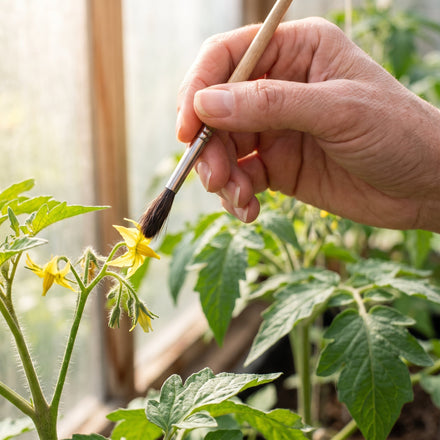
Indoors, far from bees and wind, many flowers remain sterile and drop without setting fruit. Replicating the pollinator's action by hand is simple, quick, and transforms the yield of a flat garden, greenhouse, or

Read the article
Aquaponics with children

Aquaponics with children

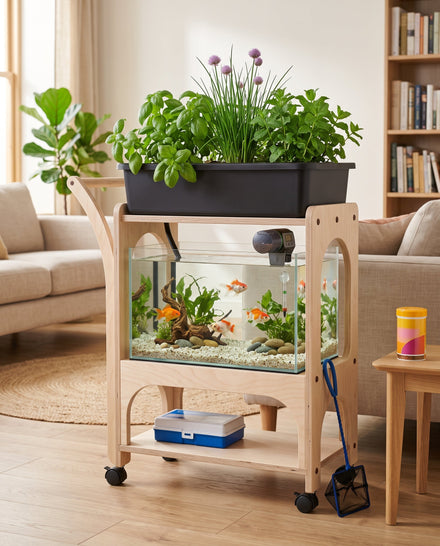
Setting up a small aquaponic system at home gives children a complete ecosystem to observe every day, with fish, bacteria and plants all at work. This guide brings together ages, species, fast-growing crops and

Read the article
Solar aquaponics, a self-sufficient system

Solar aquaponics, a self-sufficient system

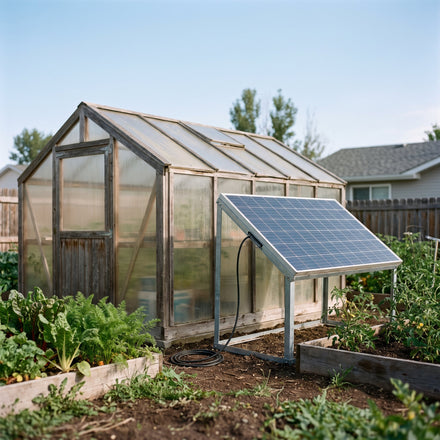
The sun can do far more than power a pump: it oxygenates the tank, circulates the water, cooks the fish and dries the herbs from the harvest. Here is how to make a small

Read the article
LED lighting for indoor growing

LED lighting for indoor growing

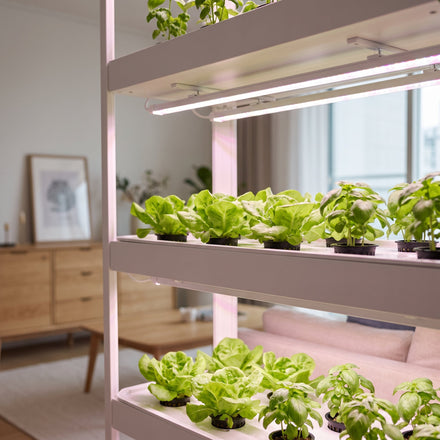
A horticultural lamp is chosen neither by watts nor by lumens, but by the amount of usable light it delivers to the leaves each day. This guide gives the figures you need to light

Read the article
Herbs in aquaponics

Herbs in aquaponics

Quick, generous and undemanding, herbs are among the most rewarding crops for getting started in aquaponics. Basil, mint and chives grow fast, can be harvested continuously and readily forgive small imbalances in the system.

Read the article
Heating your greenhouse in winter

Heating your greenhouse in winter

When the frosts arrive, an aquaponic greenhouse cools down quickly and puts the fish, bacteria and crops at risk. Well insulated and well regulated, it gets through the winter without interruption and at a

Read the article

Discover our aquaponics greenhouses and kits:

View all
Produits du rayon Kits d'aquaponie chez Univers Aquaponie

Aquaponics kits

Aquaponics kits ready to install in the garden, on a patio or in a greenhouse, with fish tank, grow beds and pump.

Discover
Produits du rayon Univers Plantes chez Univers Aquaponie

Plants

Seeds, grow media, fertilisers and aquatic plants for successful growing in aquaponics, hydroponics and the vegetable garden.

Discover
Produits du rayon Univers Équipements chez Univers Aquaponie

Equipment Universe

The equipment that keeps a system running: soilless growing, water circulation and aeration, filtration, temperature, plumbing and lighting.

Discover
Produits du rayon Serres d'aquaponie chez Univers Aquaponie

Aquaponics greenhouses

Greenhouses designed for aquaponics, supplied with their fish tank and grow towers.

Discover
Produits du rayon Univers Poissons chez Univers Aquaponie

Fish

Feed, monitor the water and care for your pond, aquarium or aquaponic fish.

Discover
Produits du rayon Univers Formation chez Univers Aquaponie

Learning

Books and practical courses on aquaponics, hydroponics and food self-sufficiency.

Discover