

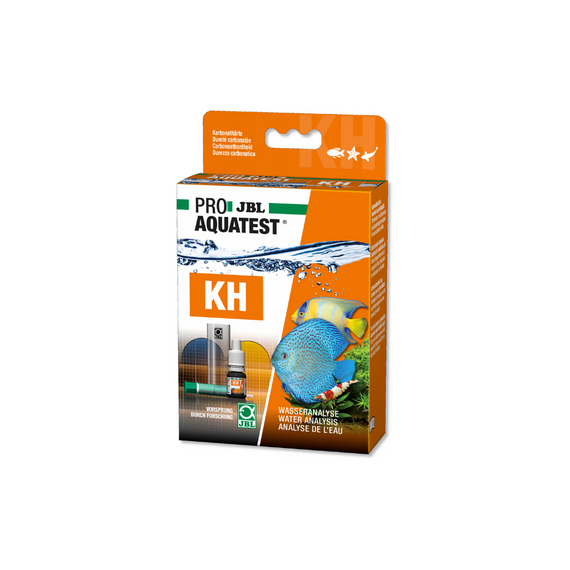

KH carbonate hardness water test in drops
Regular price
$12.00
Regular price
Sale price
$12.00
Unit price
/
per
$4.00 × 3 with no fees
Klarna.
Carbonate hardness is the buffering capacity of your water — its ability to neutralise acidification without the pH fluctuating. This test measures it in aquariums, ponds, and aquaponics systems.
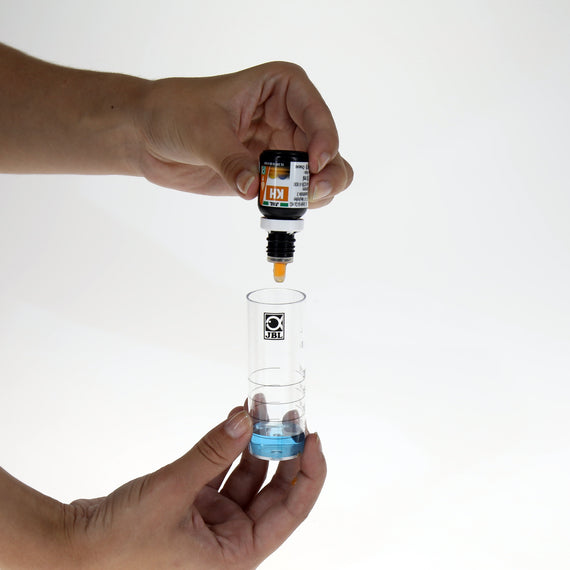
The measurement is done by titration: you count the drops until the colour changes from blue to orange-yellow, and each drop equals 1 °dKH.
 Customer support 7 days a week by email
 Delivery within 2 to 15 business days
100 % secure payment
The summary
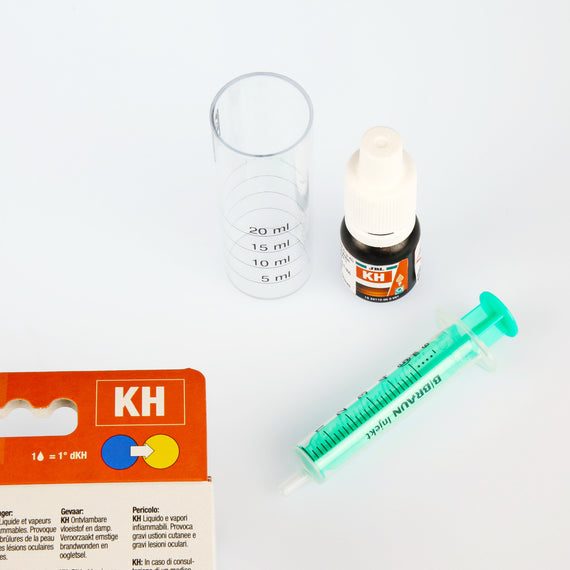
- What you receive: 1 bottle of KH reagent, 1 graduated plastic test tube from 5 to 20 ml, and the multilingual instruction leaflet.
- What you measure: the carbonates that stabilise your pH, in fresh water, ponds, salt water, and aquaponics.
- How to read the result: by titration — one drop equals 1 °dKH. No colour chart, no shade to interpret, simply count the drops.
- How long it takes: 2 minutes, with no waiting time. The colour change is immediate.
- How to choose: this test should always be used alongside a pH test, never on its own.
- What gets sent to you: a parcel of 0,09 kg, reagent in its original box.
Drop titration test, one drop equals 1 °dKH, for aquariums, ponds and aquaponics
Carbonate hardness, written as KH, measures dissolved carbonates and bicarbonates, in other words, the buffering capacity of the water: these compounds neutralise the acids produced in the tank and keep the pH stable. A pH that fluctuates noticeably from one day to the next is almost always a sign of KH that is too low, because once these carbonates are exhausted, every acid input causes the pH to drop with nothing to cushion it.
🧱 The 5 °dKH floor
Carbonate hardness should not drop below 5 °dKH, whether in a garden pond or a tank where you inject CO2, and most freshwater fish and plants thrive between 5 and 16 °dKH. Below that level, there are no longer enough carbonates to buffer the acids continuously produced by your fish's respiration and by nitrification, and the pH can crash sharply overnight. A sudden drop like that is far more dangerous for fish than a persistently incorrect pH, which is why you measure KH at the same time as pH, never separately.
🌿 KH in aquaponics
Nitrification is an acidifying reaction: the bacteria that convert ammonium into nitrites and then into nitrates release protons, which are neutralised by the alkalinity of your water. Nitrifying 1 mg/L of ammoniacal nitrogen consumes approximately 0.4 °dKH, meaning that a system converting 5 mg/L of nitrogen loses around 2 °dKH. Your system therefore loses alkalinity week after week, with nothing to replenish it if your top-up water is soft. Potassium bicarbonate raises the KH while simultaneously supplying potassium to your crops.
Low KH, low and unstable pH
This is the most common situation: raise the KH first, and the pH will then stabilise on its own.
Low KH, high pH
This pH is unbuffered, so the first acidification will cause it to drop sharply.
High KH, pH difficult to lower
The buffering capacity neutralises the acidifier as you add it: first reduce the KH by diluting the water with RO water.
A limestone rock
It barely dissolves above pH 7, which is why it raises the KH so little.
The two things that drain your KH
Switching from tap water to RO water or rainwater reduces the KH in proportion to the blend, and this drop often goes unnoticed until the pH crashes. A technical soil for planted tanks also locks up carbonates, lowering the KH for several months, which often leads to the test being wrongly suspected of being faulty.
Measure the GH separately for mineral levels in living systems
KH measures carbonates, and therefore buffering capacity, but not calcium or magnesium. If you keep shrimps or snails, or if your plants show a magnesium deficiency, also use the total hardness test: it measures calcium and magnesium, the minerals on which fish, shrimps, and plants depend. The two values have no fixed relationship, so this second figure helps you avoid correcting the wrong parameter.
☀️ Biogenic decalcification
When carbon dioxide runs short, aquatic plants and particularly algae, which take it up very rapidly through photosynthesis, draw carbon from the bicarbonates dissolved in the water. This phenomenon, known as biogenic decalcification, lowers the carbonate hardness and causes pH to rise to levels that are dangerous for fish, most often towards the end of a sunny day in an algae-laden pond. A KH that drops without any addition of osmotic water or rainfall, accompanied by a high pH in the afternoon, therefore points to this mechanism rather than to a faulty reagent. It is one more reason to keep your pond above 5 °dKH.
Technical specifications
The essentials
- Parameter measured
- Carbonate hardness, denoted KHDissolved carbonates and bicarbonates, that is to say the buffering capacity of the water
- Measurement principle
- Titration, counting dropsNo fixed range, no colour chart: you add the reagent until the colour change and count the drops
- Value of one drop
- 1 °dKHThe number of drops is directly the carbonate hardness in German degrees
- Equivalences
- 1.78 °fH, 0.36 mmol/LOne drop also equals 21.8 mg/L of hydrogen carbonate
- Minimum threshold
- Never below 5 °dKH5 to 16 °dKH suits most freshwater tanks
- Manufacturer's reference
- JBL 2411000, PROAQUATEST rangeCode EAN 4014162241108
The procedure
- Water volume
- 5 mlThis is what sets one drop at 1 °dKH. A different volume changes the rule
- The steps
- Rinse, fill, dose drop by drop, countSwirl after each drop; if you don't, the colour change comes too late
- Colour change
- From blue to orange-yellowStop at the first drop that shifts the colour, not when the yellow turns fully clear
- Waiting time
- NoneThe colour change is instant, with no development time required
- Total duration
- Approximately 2 minutesIn water of average hardness
- Environments covered
- Freshwater, saltwater, pondThe reading method is the same throughout, as there is no colour chart to change
Security and parcels
- Ranking
- DangerThe single bottle is classified, and it is flammable
- Main risks
- Flammable, burns, eye damageH226, H314 and H318 statements
- Precautions
- Sink, well-ventilated room, out of reachChild-safety cap, keep away from all flames
- Parcel weight
- 0.09 kgPackaging included
To budget for separately
- How to raise the KH
- Potassium bicarbonateIt provides alkalinity and leaves potassium available to your crops
- Reagent refill
- Reagent only, ref. 2411100The graduated cylinder keeps well
10 further specifications are available in the detailed view.
In the box
- 1 bottle of KH reagent with child-safety cap
- 1 graduated plastic test tube from 5 to 20 ml
- 1 multilingual instruction leaflet, French included
Reference, EAN code, kit contents, protocol, value per drop, recommended minimum, range of 5 to 16 °dKH, and hazard statements taken from the manufacturer's datasheet and instructions on 05/09/2026. The alkalinity consumption by nitrification, 7.14 mg/L per mg/L of ammoniacal nitrogen, is a standard value in water treatment. The number of tests per bottle depends on the hardness of the water being analysed, since each test consumes as many drops as the water has degrees of hardness.
The buffer alone, or the complete kit?
Carbonate hardness is always measured alongside pH. The three columns differ in what they cover around this pair of parameters.
KH is the buffering capacity that limits pH from dropping
Hard tap water carries a KH of 10 to 20 °dKH and varies little. Reverse osmosis water starts at 0, meaning the pH is no longer buffered once nitrification begins.
| Parameters covered (parameters) | Drop tests included (tests) | Carbonate hardness KH | pH, nitrites, nitrates and ammonium | Total hardness GH, iron, phosphates, copper, oxygen | Reagent bottles (bottles) | Glass test tubes | Laboratory comparator block | Thermometer | Reagent refill sold separately | Price | |
|---|---|---|---|---|---|---|---|---|---|---|---|
| Recommended Carbonate hardness test onlyYour choice | 1 parameters | 1 tests | Yes | No | No | 1 bottles | 0 | No | No | Yes | $12.00 |
| 6-in-1 Aquarium Water Testing KitYour choice | 6 parameters | 5 tests | Yes | Yes | No | 9 bottles | 3 | Yes | No | Yes | $49.00 |
| 14-in-1 water analysis kit for aquariumYour choice | 14 parameters | 13 tests | Yes | Yes | Yes | 23 bottles | 12 | Yes | Yes | Yes | $102.00 |
Carbonate hardness test onlyRecommended
What you're measuring
Parameters covered (parameters)1 parameters
Drop tests included (tests)1 tests
Carbonate hardness KHYes
pH, nitrites, nitrates and ammoniumNo
Total hardness GH, iron, phosphates, copper, oxygenNo
Equipment supplied
Reagent bottles (bottles)1 bottles
Glass test tubes0
Laboratory comparator blockNo
ThermometerNo
Budget
Reagent refill sold separatelyYes
6-in-1 Aquarium Water Testing Kit
What you're measuring
Parameters covered (parameters)6 parameters
Drop tests included (tests)5 tests
Carbonate hardness KHYes
pH, nitrites, nitrates and ammoniumYes
Total hardness GH, iron, phosphates, copper, oxygenNo
Equipment supplied
Reagent bottles (bottles)9 bottles
Glass test tubes3
Laboratory comparator blockYes
ThermometerNo
Budget
Reagent refill sold separatelyYes
14-in-1 water analysis kit for aquarium
What you're measuring
Parameters covered (parameters)14 parameters
Drop tests included (tests)13 tests
Carbonate hardness KHYes
pH, nitrites, nitrates and ammoniumYes
Total hardness GH, iron, phosphates, copper, oxygenYes
Equipment supplied
Reagent bottles (bottles)23 bottles
Glass test tubes12
Laboratory comparator blockYes
ThermometerYes
Budget
Reagent refill sold separatelyYes
Parameters covered, equipment supplied and kit contents recorded from the three data sheets on 05/09/2026. A titration test uses neither a colour comparator block nor a glass measuring tube.
Help choosing
Measure the KH according to the water you add
Documents & manuals
Official manufacturer's instructions, in French
Full titration test protocol, reference volume, endpoint reading rule and recommended values by installation type.
Document not showing? Some publishers block display inside a frame, so open it in a tab.
Estimate your
delivery time
Your estimate
Delivery
Estimated time
It covers preparing your order and then the transit time quoted by the carrier, counted in working days.
It is not a guaranteed delivery date: public holidays, peak periods, customs or a carrier delay can extend it. The exact amount, in your currency, is worked out in the cart once your address is entered.
Package weight 0.12 kg, dispatched to a collection point or by Colissimo to your home address, your choice at checkout. The reagent is sent in its original box. The exact shipping cost is shown in the basket.
Frequently asked questions
6 questions
6 key questions
You may also like


Related articles

Parameters
Regulating pH in an aquaponics system
A pH that won't hold steady is corrected through KH, not with a product that pushes the pH up.
Read the article

Guide
The nitrogen cycle in aquaponics
Nitrification consumes alkalinity with every milligram of nitrogen converted.
Read the article

Guide
Which grow medium to choose for aquaponics?
Some grow media release carbonates, others absorb them: the KH tells you which.
Read the article

Guide
Which fish to choose for aquaponics?
Hardness requirements vary considerably between species, from koi to tilapia.
Read the article

Guide
Common mistakes in aquaponics
Top up with rainwater only, then watch the pH crash without understanding why.
Read the article

Crops
Plant deficiencies in aquaponics
A high KH pulls the pH upwards and blocks iron uptake by the roots.
Read the article
Let us talk about your project
A question about this product or your setup? Our team will answer and advise you.

Interest-free instalment payments
Offered depending on the cart amount, at checkout.

Delivery in 2 to 15 working days
Depending on the products and shipping sites. Estimate by destination in the estimator on this page.

After-sales service 7 days a week by email or chat
Our team answers all your questions.

Shop responsibly
Become part of the change.
