


Iron Fe water test in drops
Regular price
$19.00
Regular price
Sale price
$19.00
Unit price
/
per
$6.33 × 3 with no fees
Klarna.
Iron is one of the first elements to run short in an aquaponic system, and its deficiency shows in the foliage. This test gives the truly dissolved iron, from 0.02 to 1.5 mg/L, in 12 minutes.
The manufacturer recommends one measurement per week after filling. Around an addition, one measurement just before and another 24 to 48 hours afterwards show you what your system really consumes.
 Customer support 7 days a week by email
 Delivery within 2 to 15 business days
100 % secure payment
The summary
- What you receive: a bottle of reagent, two glass test tubes, a syringe, a grey comparator block and the colour chart, for around 50 tests.
- What you read: dissolved iron, from 0.02 to 1.5 mg/L, across nine colour fields, in fresh water, in ponds and in sea water.
- What level to aim for: 0.1 to 0.2 mg/L in a planted aquarium, around 2 mg/L for the crops of an aquaponic system according to the FAO, and 0.05 mg/L at most in sea water.
- When to test: just before an addition, then one to two days afterwards. In two readings you know your actual consumption.
- How to choose: iron is included in the 13 in 1 case, not in the 6 in 1.
- What is sent to you: a 0.13 kg parcel, with the bottle and glassware wedged in the original box.
Drop test for dissolved iron, from 0.02 to 1.5 mg/L, for managing chelate dosing
In aquaponics, fish feed provides very little iron, making it the most common deficiency in grow beds. It shows up visually well before it can be measured, provided you look at the right part of the plant, as three other deficiencies produce a similar yellowing of the foliage. This test measures the iron actually dissolved in your system's water and allows you to draw a firm conclusion.
🍃 Where the yellowing starts
Iron is one of the least mobile elements within a plant. Once fixed in a leaf, it is no longer redistributed to younger organs, so the deficiency appears on the uppermost leaves, where the blade turns pale between veins that remain green. The oldest leaves lower down the stem may meanwhile stay perfectly green for several weeks. By contrast, nitrogen and magnesium travel through the sap and are drawn back towards new growth, so their deficiency starts at the bottom of the plant. Observing where the yellowing begins therefore remains the only reliable first step before any testing, and the guide on iron deficiency in aquaponics covers this species by species.
🧲 Precipitation and chelate form
There remains a chemical constraint that governs the choice of product. In aerated water, unchelated iron does not stay in solution; above pH 6.5, it oxidises and precipitates within a few hours. An aquaponic system combines precisely these two conditions, since it brings together heavily oxygenated water and a pH that most often stays above 6.5. A zero reading taken the day after dosing therefore indicates precipitation rather than plant uptake, and telling the two apart completely changes how you should respond. This is why iron is sold in chelated form, with a complexing molecule keeping it dissolved; and since each chelating agent has a pH threshold beyond which it releases the iron, the form you choose should be based on the pH of your water rather than on the measured iron level.
EDTA 13 %
Lowest pH threshold. Reserved for acidic water, it releases iron as soon as pH rises.
DTPA 11 %
The standard compromise, stable up to neutral to slightly alkaline water.
EDDHA 6 %
Upper pH limit, for hard water. It turns the water red.
Preliminary measurement
Measure your water's pH before buying the chelate, as it is the pH that determines the correct form.
The ammonium reagent skews the iron reading
A trace of ammonium test reagent left in a test tube will push the iron reading upward, and this is by far the most common cause of an abnormally high result. Rinse your test tubes three times with the water you are testing before each measurement, and avoid using the same glassware for both tests without that rinse. Dedicated glassware for each parameter remains the safest approach once you are monitoring several values.
Choose the chelate form before the dose
pH determines whether an iron supplement will remain available or precipitate, making it the measurement to take before you even place your order. The liquid pH test can be carried out on the same water sample. Above pH 7, the EDDHA 6% chelate remains stable where an EDTA has already released its iron, whereas between 6 and 7, DTPA 11% is sufficient and does not colour the water. Choosing the right form based on pH, rather than picking one at random off the shelf, means you avoid repeated applications with no visible improvement in the foliage.
🧪 Bracket a dosing with two measurements
Unlike nitrates, whose concentration rises on its own as long as the fish are being fed, the iron content depends entirely on what you add. It rises after each addition, then falls as plants absorb it and a portion precipitates. A single measurement therefore tells you little, whereas by bracketing each addition with two readings, one just before and another 24 to 48 hours after, you can directly gauge how much iron remained available. The rate at which the value declines over the following days then tells you the interval to observe between additions. Both of these markers depend on the pH of your water, the area under cultivation, and the species in place, which means that no general dosing guideline can replace them.
🌿 When iron levels are sufficient
A correct reading is just as useful as a low one, since it rules out iron as the cause and directs you elsewhere. Two causes tend to dominate when the level is adequate yet young leaves remain pale. A high pH blocks uptake long before the element disappears from the water, and a manganese deficiency produces a very similar leaf pattern. If the yellowing starts at the bottom of the plant instead, the tests to run are for magnesium or potassium, and the guide to deficiencies in aquaponics presents these patterns side by side.
Technical specifications
The essentials
- Parameter measured
- Dissolved iron, in mg/LThe reaction colours the iron that has stayed in solution; what has settled at the bottom of the tank is not counted
- Colour chart range
- 0.02 to 1.5 mg/LFirst field marked below 0.02, last field 1.5
- The colour fields
- 0,02 · 0,05 · 0,1 · 0,2 · 0,4 · 0,6 · 0,8 · 1,0 · 1,5Nine steps, packed closer together at the bottom of the scale, where the decision to add is made
- Target values
- 0.1 to 0.2 mg/L in a planted aquariumAround 2 mg/L in aquaponics, read from a sample diluted by half. Up to 0.6 mg/L in a heavily planted tank, and no more than 0.05 mg/L in seawater
- Tests per kit
- Approximately 50A single reagent bottle, 5 drops per measurement
- Manufacturer's reference
- JBL 2411600, PROAQUATEST rangeNot to be confused with the refill, reference 2411700
The procedure
- Sample volume
- 2 times 5 mlOne test tube receives the reagent, the other is left as it is and serves as the control
- The steps
- Rinse, draw the sample, add the reagent, mix, wait, read5 drops from a single bottle, held vertically, with a dry nozzle and no bubbles
- Resting time
- 10 minutesFull colour development. Reading earlier underestimates the value
- Total duration
- Approximately 12 minutesRinsing and reading included
- Reading
- In the notch of the comparator blockThe block slides along the colour chart until the two shades match.
- A pitfall to know about
- Rinse beforehand, several timesTraces of ammonium reagent in the test tube make the iron reading come out too high
Security and parcels
- Ranking
- WarningThe lower of the two threshold levels under CLP regulations
- Main risks
- Harmful if swallowed, skin allergyStatements H302, H317 and H319. Wear gloves if your skin is sensitive
- Storage
- Store dry, at room temperatureIn its original packaging, away from direct light
- Parcel weight
- 0.13 kgPackaging included
To budget for separately
- Iron dosing
- A chelate suited to your pHEDTA in acidic water, DTPA in neutral water, EDDHA in hard water
- Reagent refill
- Reagent only, ref. 2411700The glassware, comparator block and colour chart can be kept
10 further specifications are available in the detailed view.
In the box
- 1 Fe reagent dropper bottle
- 2 glass test tubes with screw caps
- 1 graduated syringe for drawing off 5 ml
- 1 grey comparator block with two compartments
- 1 colour chart with nine fields, from 0.02 to 1.5 mg/L
- 1 multilingual leaflet with the protocol in French
Reference, EAN code, number of measures, kit contents, protocol, interference with the ammonium reagent and hazard statements taken from the manufacturer's data sheet and instructions on 05/09/2026. The range and the nine steps are taken from the photograph of the colour chart supplied.
The iron test on its own, or a test kit that includes it
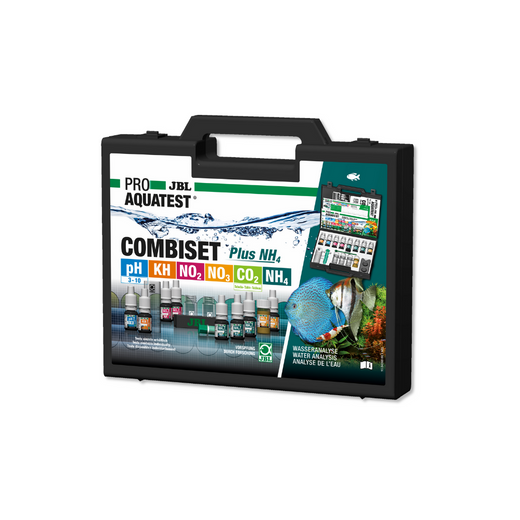
Iron is included in the 13-in-1 set but not in the 6-in-1.
Chlorosis always starts with the young leaves
Iron does not move within the plant: the deficiency strikes new growth and leaves the veins green. If your older leaves are yellowing, look to nitrogen instead.
| Parameters covered (parameters) | Drop tests included (tests) | Iron Fe | pH, KH, nitrites and nitrates | GH, phosphates, copper, silicates, oxygen | Reagent bottles (bottles) | Glass test tubes | Laboratory comparator block | Thermometer | Reagent refill sold separately | Price | |
|---|---|---|---|---|---|---|---|---|---|---|---|
| Recommended Iron test onlyYour choice | 1 parameters | 1 tests | Yes | No | No | 1 bottles | 2 | Yes | No | Yes | $19.00 |
| 6-in-1 Aquarium Water Testing KitYour choice | 6 parameters | 5 tests | No | Yes | No | 9 bottles | 3 | Yes | No | Yes | $59.00 |
| 13-in-1 water testing kit for aquariumsYour choice | 12 parameters | 13 tests | Yes | Yes | Yes | 23 bottles | 12 | Yes | Yes | Yes | $138.00 |
Iron test onlyRecommended
What you're measuring
Parameters covered (parameters)1 parameters
Drop tests included (tests)1 tests
Iron FeYes
pH, KH, nitrites and nitratesNo
GH, phosphates, copper, silicates, oxygenNo
Equipment supplied
Reagent bottles (bottles)1 bottles
Glass test tubes2
Laboratory comparator blockYes
ThermometerNo
Budget
Reagent refill sold separatelyYes
6-in-1 Aquarium Water Testing Kit
What you're measuring
Parameters covered (parameters)6 parameters
Drop tests included (tests)5 tests
Iron FeNo
pH, KH, nitrites and nitratesYes
GH, phosphates, copper, silicates, oxygenNo
Equipment supplied
Reagent bottles (bottles)9 bottles
Glass test tubes3
Laboratory comparator blockYes
ThermometerNo
Budget
Reagent refill sold separatelyYes
13-in-1 water testing kit for aquariums
What you're measuring
Parameters covered (parameters)12 parameters
Drop tests included (tests)13 tests
Iron FeYes
pH, KH, nitrites and nitratesYes
GH, phosphates, copper, silicates, oxygenYes
Equipment supplied
Reagent bottles (bottles)23 bottles
Glass test tubes12
Laboratory comparator blockYes
ThermometerYes
Budget
Reagent refill sold separatelyYes
Parameters covered, equipment supplied and kit contents noted from the three product pages on 05/09/2026.
Help choosing
Iron, or nitrogen first
Documents & manuals
Official manufacturer's instructions, French section
The full six-step protocol, the reference volume of 2 times 5 ml, the 5 drops of reagent, the 10 minutes' standing time, and the warning about test tubes shared with the ammonium test.
Document not showing? Some publishers block display inside a frame, so open it in a tab.
Estimate your
delivery time
Your estimate
Delivery
Estimated time
It covers preparing your order and then the transit time quoted by the carrier, counted in working days.
It is not a guaranteed delivery date: public holidays, peak periods, customs or a carrier delay can extend it. The exact amount, in your currency, is worked out in the cart once your address is entered.
0.12 kg parcel, dispatched within 48 hours by Colissimo or Chronopost home delivery, your choice at the time of payment. The reagent bottle is sent in its original cardboard box, with the glassware wedged in place. The exact shipping cost is shown in your basket.
Frequently asked questions
8 questions
6 key questions, 8 in the detailed view
You may also like


Related articles

Guide
Iron deficiency in aquaponics
The signs on the foliage, the possible causes and the order in which to rule them out before dosing anything.
Read the article

Diagnosis
Identifying deficiencies in aquaponics
Top or bottom of the plant, green veins or not: the reading grid that tells iron from magnesium and manganese.
Read the article

Growing
Plant deficiencies in aquaponics
Why a well-cycled system feeds its fish without feeding its plants, and which elements run short first.
Read the article

Nutrition
Which fertiliser should you use in aquaponics?
What you can add without putting the fish at risk, and at what point in the growing cycle to do it.
Read the article

Parameters
Regulating pH in an aquaponics system
The parameter that governs iron availability, and how to lower it without harming the biofilter.
Read the article

Practical
Common mistakes in aquaponics
Dosing blind, measuring at the wrong time, changing test mid-way through monitoring: the mistakes that cost a harvest.
Read the article
Let us talk about your project
A question about this product or your setup? Our team will answer and advise you.

Interest-free instalment payments
Offered depending on the cart amount, at checkout.

Delivery in 2 to 15 working days
Depending on the products and shipping sites. Estimate by destination in the estimator on this page.

After-sales service 7 days a week by email or chat
Our team answers all your questions.

Shop responsibly
Become part of the change.
