

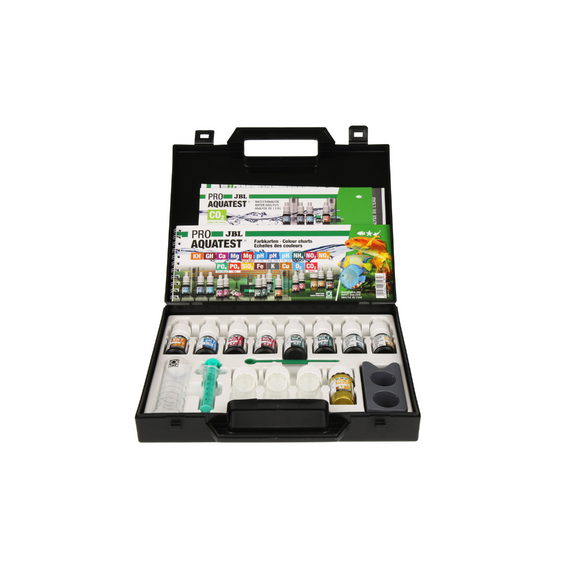


6-in-1 Aquarium Water Testing Kit
Regular price
$50.00
Regular price
Sale price
$50.00
Unit price
/
per
Note du produit : 5.0
(22 avis)
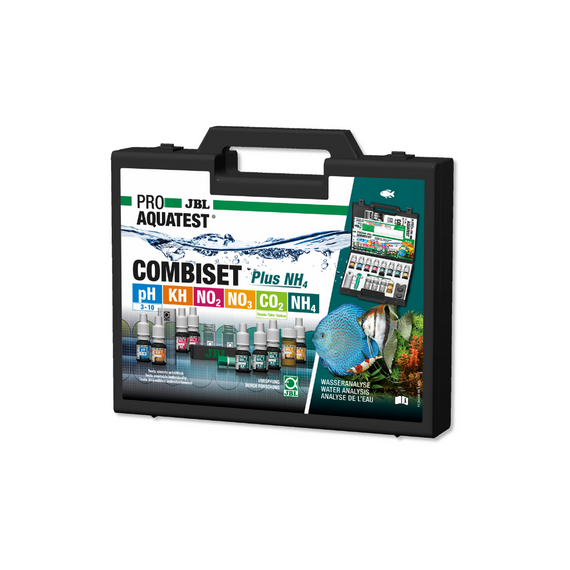
This kit brings together five drop tests to measure pH, KH, ammonium, nitrite and nitrate, and an additional chart gives CO2 readings. The reagents, glassware, syringe, comparator block and colour charts are all included in the case.
The kit allows you to monitor a system day by day during start-up, then carry out routine checks on an aquarium, a pond or an aquaponic system.

7/7 customer service by e-mail

Payment in instalments, free of charge
The summary
- What you receive: a set of 5 drop tests, 9 reagent bottles, 3 glass test tubes, a syringe and a colour comparator block.
- What you measure: pH, KH, ammonium, nitrite and nitrate, plus CO2 read from a chart, without reagent.
- How long it takes: 2 minutes for KH, 17 minutes for ammonium, including waiting times.
- Suitable for: a first aquarium, a pond, an aquaponic system where monitoring focuses on nitrogen and pH.
- What gets used up: the 9 bottles only. The glassware, syringe, comparator block and colour charts remain.
- What is dispatched to you: the sealed kit, reagents in their original housing.
JBL box of 5 drop tests covering the nitrogen cycle, pH and KH
Clear water tells you nothing about what is happening beneath the surface. Between the moment ammonium starts to accumulate and the moment fish are hanging at the surface, several days can pass with no visible sign. This kit gives you the five measurements that make those days readable, using drop reagents and a laboratory colour comparator block rather than a strip dipped in for two seconds.
🧪 The six parameters in the kit
Five drop tests cover pH, KH, ammonium, nitrite, and nitrate. The sixth parameter, carbon dioxide, uses no reagent at all, as it is read from a table that cross-references the pH and KH readings you have just taken. The 9 bottles are distributed as follows: three for ammonium, two for nitrite, two for nitrate, one for pH, and one for KH. The first three are sufficient to monitor the nitrogen cycle from day one through to stabilisation.
⏱️ How a session unfolds
Sample
Fill the test tube in the middle of the tank, never at the surface or against the substrate. Rinse it first with tank water.
Dose
Count the drops into 5 ml of water, 10 ml for nitrate, swirling after each reagent is added.
Wait
KH turns immediately; pH and nitrite take 5 minutes; nitrate 10; ammonium 15.
Read
Place the test tube in the comparator block and read the colour against the shade card in natural daylight.
Three mistakes that skew the reading
Rinsing glassware under the tap leaves residues that skew readings for some time, whereas rinsing with water from the tank costs nothing. Laying a dropper bottle on its side lets air in and produces irregular drops, giving a false KH titration: always hold the tip vertically downwards. Finally, reading a colour under a warm bulb shifts your perception of greens and blues, which particularly affects nitrite and pH readings.
The refills that run out first
Nitrite and ammonium are the two reagents you go through during a start-up, because they are the ones you reach for every day. The nitrite reagent refill and the ammonium refill use exactly the same bottles, without the glassware or colour charts you already have. Pick them up together if you are cycling a new tank, so you are not left short during the week when the readings matter most.
This kit covers the nitrogen cycle and the acid-base balance, but leaves aside what plants actually live on. Iron, phosphate, and total hardness are not included, so yellowing foliage with veins that remain green will not find its explanation here. If your crops matter as much as your fish, the 14-in-1 test kit adds these parameters, while the iron test alone complements this one for considerably less money.
🌱 Nitrogen in aquaponics
In aquaponics, these five values are not read the same way as in an aquarium. Nitrate becomes a resource here, feeding your lettuce, whereas an aquarist wants to drive it down. Ammonium and nitrite remain the two figures to watch every day until the biofilter has established, and KH tells you whether your pH will hold through the week. That's why the start-up of a system depends on daily measurements over three weeks. The day nitrite drops back to zero while nitrate rises, your biological filtration has cycled.
🔁 How often to take readings
The frequency changes as the system matures, and that is what makes this kit economical in everyday use. During the first three weeks, a daily reading of ammonium and nitrite is warranted, as these are the two values that can kill within 48 hours. Once the cycle is established, a weekly reading of all five parameters is sufficient, and a monthly reading is adequate for a stable, lightly stocked tank. Return to daily testing after any medication course, a filter clean, or the arrival of new fish, as these are the three situations in which the bacterial population can drop sharply in a short space of time.
Technical specifications
The essentials
- Parameters measured
- pH, KH, NO2, NO3, NH4, CO2CO2 uses no reagent; it is read from a chart cross-referencing the pH and KH.
- Drop tests included
- 5, or 9 bottlesThree bottles for ammonium, two for nitrite, two for nitrate, one for pH, one for KH
- Method
- Liquid reagents, colorimetric readingThe comparator block supplied cancels out the natural tint of the water at the point of reading
- Media covered
- Freshwater, pond, aquaponicsEach colour chart has a reading strip for each type of water
- Cabinet dimensions
- 26.6 x 22.6 x 5.2 cm
- Bottle safety
- Child-resistant capsThe case itself is water-resistant
The five tests, one by one
- pH
- Wide range, 3.0 to 10.0It places an unknown water. Fine-tuning to the nearest tenth requires a narrow range
- KH, carbonate hardness
- Titration, 1 drop = 1 °dKHUsing 5 ml of water. There is no colour chart for this test — count the drops until the colour changes
- NH4 and NH3, ammonium
- Colorimetric, 3 reagentsThe genuinely toxic fraction of ammonia is derived from a table cross-referencing pH and temperature
- NO2, nitrites
- Colorimetric, 2 reagentsOn 5 ml of water, read after 5 minutes. This is the reference test during cycling.
- NO3, nitrates
- Colorimetric, 2 reagentsPer 10 ml of water. In aquaponics, this is the nitrogen ration for the crops
- CO2, carbon dioxide
- No reagent, reading from a chartThe value is read by cross-referencing the pH and KH already measured
The procedure
- Water volume per test
- 5 or 10 ml5 ml for pH, KH, nitrite and ammonium, 10 ml for nitrate
- Waiting time
- 0 to 15 minutesNone for KH; 5 minutes for pH and nitrite; 10 for nitrate; 15 for ammonium
- The steps
- Rinse, fill, dose, shake, wait, readIn that order. Shaking is the step people rush, and it determines the result.
- Reading
- Colour chart, in natural daylightWarm artificial light shifts the perception of pink and orange tones
To budget for separately
- Reagent refills
- Reagents sold individuallyThe glassware, the syringe, the measure, the comparator block and the colour charts can be kept
- Iron and phosphates
- Iron test and phosphate testThe two parameters that matter as soon as you are growing fruiting plants
10 further specifications are available in the detailed view.
In the box
- 1 water-resistant plastic case
- 5 drop tests, comprising 9 child-resistant reagent bottles
- 3 graduated glass test tubes
- 1 plastic test tube
- 1 sampling syringe
- 1 measuring spoon for the powdered reagent
- 1 laboratory comparator block
- 1 set of colour charts
- 1 CO2 conversion table, with pH and KH inputs
- 1 set of analysis record sheets
Parameters, equipment, and kit dimensions taken from the official JBL PROAQUATEST data sheets on 10/09/2026. The 6-parameter count adds CO2 to the 5 tests, read from the included chart.
Five tests or thirteen?
Both kits use the same drop reagents and the same colour comparator block. What sets them apart is the range of parameters they let you monitor and the amount of space they take up.
The five-test kit covers nitrogen, pH and KH
It gives you pH, KH, ammonium, nitrite, nitrate and CO2 in a table. Answer three questions and the table fills in automatically.
| Parameters covered (parameters) | Drop tests included (tests) | Reagent bottles (bottles) | pH, KH, nitrites, nitrates, ammonium and CO2 by table | GH, total hardness | PO4, phosphates | Fe, iron | O2, dissolved oxygen | Glass test tubes | Laboratory comparator block | Thermometer | Box width (cm) | Case thickness (cm) | Price | |
|---|---|---|---|---|---|---|---|---|---|---|---|---|---|---|
| Recommended 6-in-1 kitYour choice | 6 parameters | 5 tests | 9 bottles | Yes | No | No | No | No | 3 | Yes | No | 26,6 cm | 5,2 cm | $50.00 |
| 14-in-1 water analysis kit for aquariumYour choice | 14 parameters | 13 tests | 23 bottles | Yes | Yes | Yes | Yes | Yes | 12 | Yes | Yes | 38,2 cm | 8,5 cm | $104.00 |
6-in-1 kitRecommended
What each kit measures
Parameters covered (parameters)6 parameters
Drop tests included (tests)5 tests
Reagent bottles (bottles)9 bottles
pH, KH, nitrites, nitrates, ammonium and CO2 by tableYes
GH, total hardnessNo
PO4, phosphatesNo
Fe, ironNo
O2, dissolved oxygenNo
Equipment supplied
Glass test tubes3
Laboratory comparator blockYes
ThermometerNo
Footprint
Box width (cm)26,6 cm
Case thickness (cm)5,2 cm
Price
14-in-1 water analysis kit for aquarium
What each kit measures
Parameters covered (parameters)14 parameters
Drop tests included (tests)13 tests
Reagent bottles (bottles)23 bottles
pH, KH, nitrites, nitrates, ammonium and CO2 by tableYes
GH, total hardnessYes
PO4, phosphatesYes
Fe, ironYes
O2, dissolved oxygenYes
Equipment supplied
Glass test tubes12
Laboratory comparator blockYes
ThermometerYes
Footprint
Box width (cm)38,2 cm
Case thickness (cm)8,5 cm
Price
Parameters covered, equipment supplied, and dimensions of both kits taken from their official data sheets on 10/09/2026.
Help choosing
Are five tests enough for your needs?
Estimate your
delivery time
Your estimate
Delivery
Estimated time
It covers preparing your order and then the transit time quoted by the carrier, counted in working days.
It is not a guaranteed delivery date: public holidays, peak periods, customs or a carrier delay can extend it. The exact amount, in your currency, is worked out in the cart once your address is entered.
Kit dispatched sealed, reagents in their original housing, with the choice of collection point or home delivery via Colissimo at checkout. The exact cost is displayed in the basket once your address has been entered.
Frequently asked questions
8 questions
6 key questions, 8 in the detailed view
Vous aimerez aussi


Related articles

Guide
The nitrogen cycle in aquaponics
Ammonium, nitrite, nitrate: the sequence these five tests make visible, and the point at which fish can finally be introduced.
Read the article

Practical
Getting started with an aquaponic system
The schedule for the first three weeks, when ammonium and nitrite are measured every day.
Read the article

Technical
Regulating pH in an aquaponics system
KH holds the pH, and pH determines everything else. Why it drifts upward, and what can realistically be done to keep it in check.
Read the article

Diagnostic
Understanding and correcting cloudy water in aquaponics
Cloudy water cannot be read by eye. What measurements reveal about a bacterial haze — and what they do not.
Read the article

Understand
Common mistakes in aquaponics
The start-up mistakes that show up in a test reading before they show up in the tank, and the order in which to address them.
Read the article

Breeding
Which fish should you choose for aquaponics?
Fish stocking level determines the amount of nitrogen produced. The species that tolerate infrequent monitoring, and those that tolerate none at all.
Read the article
Let us talk about your project
Une question sur ce produit ou votre installation ? Notre équipe vous répond et vous conseille.

Paiement plusieurs fois sans frais
Proposé selon le montant du panier, au moment du paiement.

Livraison sous 5 à 15 jours ouvrés
Selon les produits et sites d'expédition. Estimation par destination dans l'estimateur de cette page.

SAV 7/7 par mail ou chat
Notre équipe répond à toutes vos questions.

Faire un achat engagé
Devenez acteurs du changement.
