Solar aquaponics, powering your system

Written by Tristan Ulrich · October 24, 2026
Panneau solaire installé à côté d une serre de jardin pour alimenter un système aquaponique

Running a pump and air stone on solar energy is within reach of any homeowner, provided you start from actual consumption rather than panel wattage. Here is the calculation method, the useful equipment and the limits you need to know before investing.

Running your system on solar power

Aquaponics consumes little, but it consumes continuously. A pump that stops for three hours usually does no harm; an aerator that stops for three hours in full heat can kill every fish. It's this demand for continuity, far more than raw power, that makes solar both worthwhile and demanding.

A small domestic system often runs on just 15 to 40 watts continuously, equivalent to an old light bulb. Here we'll see how to measure this consumption, how to size panels and battery from watt-hours rather than guesswork, how to protect aeration in the event of a power failure, what happens to output in winter, and which mistakes cause most amateur installations to fail.

Water pump, air diffuser and heater, the three power consumers in an aquaponic system Chauffage solaire à air Sunaero 2.0, de 750 à 3 000 W

What consumes power in a system

Three devices account for virtually the entire electricity bill. The water pump runs most of the time continuously and draws between 5 and 40 watts on a domestic system, more once the discharge head exceeds one metre. The aerator consumes little, usually 3 to 10 watts, but it runs day and night as well.

The third item changes everything. Water heating requires 50 to 300 watts, and supplementary horticultural lighting can exceed 100 watts over twelve hours. These two pieces of equipment are beyond the reach of a small standalone solar installation and must remain on mains power, or simply be avoided by choosing species suited to your climate.

An unheated, unlit system therefore remains the only realistic target for domestic solar power, and that's already quite something.

Connection of a pump to a sealed external outlet to measure its consumption

Calculate your actual consumption

The whole approach rests on a single unit: watt-hours per day. The formula is straightforward—you multiply the power in watts by the number of hours of daily operation. A 20-watt pump running continuously consumes 480 Wh per day, and a 5-watt aerator running continuously 120 Wh, making 600 Wh per day altogether.

Don't rely on the power rating printed on the device; it's often overstated. A plug-in wattmeter costs around fifteen pounds and gives you the actual consumption over twenty-four hours, which prevents you from oversizing the entire installation based on a theoretical figure. Measure under normal conditions, with the pump primed and pipes in place.

Note down the result—it's the only figure you'll need for the rest of your sizing calculations.

Photovoltaic panel on a frame facing the sun to power a greenhouse

Size the solar panel

A panel does not produce its rated output all day long. We work with equivalent peak sun hours, a value that ranges from 2 to 3 hours per day on average annually in northern Europe, and 3.5 to 4 hours around the Mediterranean. A 100-watt panel therefore provides roughly 250 to 400 Wh per day depending on region, annual average.

To cover our 600 Wh daily requirement, you would need at least 150 to 250 watts of panel capacity on average over the year. Most guides recommend adding at least 25 per cent margin for overcast days, and experience shows that a factor of two is more prudent if you're aiming for winter continuity.

Face due south with an inclination close to 35 degrees, and prefer an adjustable frame that lets you tilt the panel higher in winter.

Real solar yield by region

The reference figures used by European engineering firms come from the Commission's PVGIS tool. They are expressed in kilowatt-hours produced per year per installed kilowatt-peak. In mainland France, annual yield generally ranges from 900 to 1,050 kWh per kWp in the north and north-west, around 1,050 to 1,250 in the Île-de-France region and central France, 1,200 to 1,350 in the south-west and the Rhône valley, and 1,300 to 1,500 around the Mediterranean.

Scaled to a small system, a 200-watt panel installed near Lille will produce around 190 kWh per year, against nearly 280 kWh near Montpellier, for identical investment. The 50 per cent difference between northern and southern Europe is no minor detail; it completely changes the system size you need to plan.

The trap is the annual average. It masks extreme seasonality, with a ratio of one to five, sometimes more, between December and June production. Sizing on annual average guarantees a breakdown in the middle of winter. Sizing on December leads to an oversized, costly installation ten months of the year. The sensible compromise is to aim for complete autonomy from March to October and accept mains backup for the rest of the year.


Deep-cycle battery in a sealed enclosure to store solar energy

Choose the battery and its capacity

Without a battery, your pump stops at sunset. Storage is therefore not optional in aquaponics, unlike with a watering pump. The standard practice is to size for one to two days of operation with no solar input whatsoever.

Let's return to our 600 Wh per day. Over two days, that's 1,200 Wh. A slow-discharge lead battery must not fall below 50 per cent charge, so you need to provide for 2,400 Wh, or roughly 200 Ah at 12 volts. A LiFePO4 battery accepts 80 per cent discharge and offers significantly longer life, bringing the requirement down to around 125 Ah with considerably less bulk and weight.

Site the battery away from frost and heat, in a ventilated enclosure, and never directly beneath the panel in sunlight.

Solar charge regulator, fuses and terminal block mounted on a wooden panel

The regulator and wiring

Between the panel and battery, a charge controller is essential. MPPT models generally recover 10 to 30 per cent more energy than PWM models, an advantage that's especially marked in cloudy weather and winter. On an installation that needs to run through December, the price difference is well justified.

Two wiring choices are available. Running 12-volt DC devices avoids any conversion and eliminates inverter losses, which often reach 10 to 20 per cent. Going through a 230-volt inverter lets you keep your existing equipment, at the cost of that loss and constant standby consumption. Install a fuse as close to the battery as possible—it's the most important protection in the entire system.

Use generous cable cross-sections; voltage drop at 12 volts quickly becomes a penalty beyond a few metres.

Reduce consumption before investing

Every watt saved costs far less than a watt produced. Before buying a single panel, spend half a day reducing your system's needs; you'll often cut the solar bill in half.

  • Place the fish tank higher to reduce discharge head; every metre gained lightens the pump load.
  • Shorten pipes and remove unnecessary bends, which increase pressure drop.
  • Choose a pump that's slightly oversized but throttled by a valve rather than one pushed to its limit.
  • Switch the grow medium bed to intermittent irrigation with a timer; fifteen minutes per hour is often enough.
  • Clean the strainer and impeller twice a year; a clogged pump consumes more while delivering less.

One point deserves emphasis. The water pump can often stop at night on a grow medium bed without consequence, whereas the air pump cannot. Running the pump only during the day, when the panel produces, mechanically halves the battery requirement or so. This trick doesn't apply to raft cultivation, where circulation must remain continuous.

Submerged pump removed from a tank, main electrical consumption in aquaponics

The pump, highest power consumer

The pump typically accounts for 70 to 80 per cent of consumption in an unheated system. Its selection therefore dictates the entire solar installation. A pump rated at 1,000 litres per hour may only deliver 600 litres once installed, because flow drops with discharge head.

Read the manufacturer's flow-head curve rather than the commercial figure, and choose the model that achieves your desired flow at your actual head with the lowest power consumption. Two pumps delivering the same service can consume anywhere from half to twice as much as each other. Continuous 12-volt pumps do exist and eliminate the need for an inverter, but the choice remains limited and reliability varies by model.

Finally, keep a spare pump stored dry—a failure always happens at the worst possible time.

Air diffuser in operation at dusk above a fish tank in a greenhouse Amtra Air System 60 UPS battery-powered backup air pump

The air diffuser, absolute priority

If you're only securing one piece of equipment, make it this one. Dissolved oxygen is what depletes fastest in a fish tank, particularly at night, when plants and bacteria consume it without any photosynthesis to compensate. In warm water, the time before the first signs of distress is counted in hours.

The good news is that the energy cost is trivial. An air pump rated at 5 watts running continuously uses only 120 Wh per day, which means a modest backup battery can keep it going for several days. Many aquaponics enthusiasts also keep a small battery-powered air pump in a drawer—an insurance policy costing just a few pounds that has already saved countless tanks.

On a solar installation, wire the air pump directly to the battery, before any other circuit, so it's the last to shut down.

What to do if there's a power cut

A solar installation is not a substitute for a backup plan—it is part of one. Failures can also come from the regulator, a blown fuse, a damaged cable or a battery reaching the end of its life. Here's the order of priority to follow when the power fails, whatever the cause.

  • Restore aeration first, using a battery-powered air stone or a small portable power station.
  • Stop feeding the fish immediately; a fish without food consumes far less oxygen.
  • Stir the surface by hand or with a watering can, pouring water from a height, if you have nothing else.
  • Shade the tank in warm weather to limit temperature rise and oxygen depletion.

A desktop uninterruptible power supply (UPS), also called an uninterruptible power supply unit, makes an effective short-term solution for an hour or two powering an air stone and a small pump. It is not a replacement for a solar battery, but it covers the brief interruptions that account for the majority of incidents. To learn more, our article on going on holiday details remote monitoring devices that alert you before the situation becomes critical.

Frosted solar panel in winter in front of a greenhouse, reduced photovoltaic output Solar-powered air pump for pond, 120 L/h, 5 W panel

Winter, the real weak point

This is the limit that few articles acknowledge. In December and January, at our latitudes, a panel often produces four to six times less than in June, with short days, low sun angle and overcast skies lasting several days running. An installation sized to the annual average will fail precisely when you're not outside to notice.

Three strategies exist. Oversizing the panel array by a factor of three to four, which remains costly but works. Reducing the system's winter activity by cutting fish stock and thus oxygen demand. Or keeping a grid connection as backup—by far the most cost-effective option for a householder.

Also consider snow and frost, which block production entirely. A steep panel angle helps snow slide off.

Autonomous garden aquaponic system with fish tank, growing area, solar panel and battery

Should you aim for complete autonomy

The question deserves a straight answer. If your garden is grid-connected, a 25-watt continuous system uses roughly 220 kWh per year, which represents a modest amount on an annual bill. Complete off-grid operation is therefore almost never justified by economics alone.

It makes real sense in three cases. An unconnected plot, a shared garden or a remote parcel where running a line would cost several thousand pounds. A deliberate commitment to self-sufficiency where energy counts as much as food production. Or an area subject to frequent outages, where solar with battery first becomes a security measure.

In all other cases, the hybrid approach remains the smartest option—solar during the day and grid as automatic backup.

Sealed electrical enclosure placed at height with a drip loop above a pond

Electrical safety around water

Electricity and water don't forgive carelessness. Any 230-volt circuit near a pond must be protected by a 30 mA residual current device, and outdoor sockets must be waterproof type, closed after each use.

The most useful reflex is also the simplest: the drip loop. Run the cable down below the socket level before taking it back up to the socket itself—water trickling down the wire drops at the lowest point instead of entering the socket. Mount junction boxes high, above the water surface, never at ground level where splashes and overflows always eventually reach.

On the solar side, an open lead battery gives off hydrogen and requires a ventilated space, which is not the case with sealed or lithium models.

Solar panel shaded by branches and covered with leaves, sizing error

Sizing errors

The most costly problem is partial shading. A single branch crossing the panel at the end of the day can cut output by far more than the area involved, because cells are wired in series. Watch the location throughout an entire day before fixing the frame, and during the season when trees are in leaf.

Next come forgetting the battery, which cuts off the pump at sunset, and sizing for the annual average rather than the worst month. A panel fouled by dust, pollen and bird droppings also loses several per cent—a rinse with clean water twice a year is enough to recover it.

Last mistake: forgetting the fuse and circuit breaker protection. It costs nothing until something goes wrong. Other common pitfalls are covered in our common errors guide.

Solar aquaponics across Europe by country

The calculation remains the same everywhere, but the result varies considerably depending on latitude. In Spain, southern Italy, Portugal and Greece, a 150 to 200-watt panel comfortably covers a small system year-round, including winter. The focus shifts to heat management, because a panel loses efficiency above 25 degrees cell temperature and a battery ages faster in an overheated space.

In the temperate zone covering France, Belgium, Germany and the Netherlands, autonomy is comfortable from March to October and difficult from November to February. This is where the hybrid approach proves its value, with automatic switchover to the grid when the battery drops below a threshold.

In Scandinavia, the Baltic states and Ireland, complete winter autonomy becomes very costly and many aquaponics enthusiasts prefer to shut the system down in winter. One more point worth knowing: administrative rules for a small off-grid autonomous installation, without grid feed-in, are generally far lighter than for a grid-connected system, but they vary from country to country and deserve local verification before installation.

Conclusion: start with the air pump, not the solar panel

Solar aquaponics is no technical fantasy, it's straightforward arithmetic. Measure your actual consumption in watt-hours per day, choose a panel that covers it with a comfortable margin, add a battery capable of lasting two days without sunlight, and protect everything with a fuse and a residual current device. Everything else follows from these four decisions.

The right way to start isn't by buying a large panel, but by securing aeration. A small 50-watt system with a modest battery, dedicated solely to the air pump, already delivers most of the peace of mind for a modest budget. You'll add the water pump later, once you know your actual consumption well.

Keep seasonality in mind. An installation that gives you autonomy for eight months a year and accepts mains backup in winter is far more sensible than an oversized setup to cover a fortnight in December.

Sources

European Commission, Joint Research Centre, Photovoltaic Geographical Information System (PVGIS), Supplies irradiation and estimated photovoltaic output for a specific geographical location, which underpins the reasoning in equivalent peak sun hours and panel sizing calculations.

U.S. Department of Energy, Energy Saver, Grid or Stand-Alone Renewable Energy Systems, Lists the essential equipment for a standalone installation—batteries, charge controller, power conditioning and safety devices—and demonstrates the value of off-grid systems on remote land.

Ifremer, Recirculating systems, benefits and use cases, Quantifies the energy consumption of recirculation, from 0.5 to 2 kWh per kilogramme in open system to over 6 kWh in recirculated systems, the reference used to assess the running costs of a domestic system.

Scientific Reports, Comparative socioeconomic, environmental and technical analysis of conventional versus smart sustainable integrated multi-trophic aquaponics systems, Provides consumption per 180-day cycle and the updated cost of solar electricity compared to mains supply, basis for the economic comparison presented in the article.

Southern Regional Aquaculture Center, Recirculating Aquaculture Tank Production Systems, A Review of Current Design Practice (SRAC 453), Provides aeration and recirculation flow requirements relative to daily feed ration, which justifies the absolute priority given to the air pump in a standalone system.

Frequently asked questions

That works for watering, never for a fish tank. As soon as the sun drops, circulation stops and dissolved oxygen falls overnight, exactly when plants and bacteria need it most. Storage is part of the system, not an optional extra.

The PVGIS tool from the Joint Research Centre of the European Commission provides free production estimates for a specific location, based on satellite data and reanalysis, worldwide except at the poles.

You enter three elements.

  • The exact position of the future panel
  • Its tilt and orientation
  • The planned peak power and system losses

Look at the results month by month rather than the annual average, because December is what determines your array size.

A study published in 2025 in Scientific Reports compares instrumented aquaponic systems and puts the levelised cost of solar electricity at $0.003 per kilowatt-hour against $0.029 for grid supply, over 180-day cycles consuming 1,200 to 1,500 kWh.

These figures apply to professional installations amortised over several years. On a garden system consuming a few hundred kilowatt-hours per year, savings in euros remain modest and the real benefit lies elsewhere, in independence from the grid and in service continuity during outages.

The U.S. Department of Energy lists supplemental heating among the standard strategies for standalone installations, alongside consumption reduction. On a small aquaponic system, a properly sized buffer battery makes a generator unnecessary. It only makes sense on an isolated site where several sunless days repeat every winter.

Prepare for outages before they happen. An air stone on backup batteries kept charged, a power loss alarm and a thermometer read each morning turn an incident into mere inconvenience. If the outage lasts, reduce feeding to lower oxygen demand, and restore power to the air stone first rather than the pump.

Calculated per kilogramme of fish produced, recirculation is energy-intensive. Ifremer provides clear benchmarks.

  • 0.5 to 2 kWh per kilogramme in open circuit
  • 2.5 to 4 kWh per kilogramme in simple recirculated circuit
  • Over 6 kWh per kilogramme on the most heavily equipped installations

An unheated, unlit domestic tank largely escapes this logic, since output remains modest and equipment is limited to a pump and air stone.

Read next

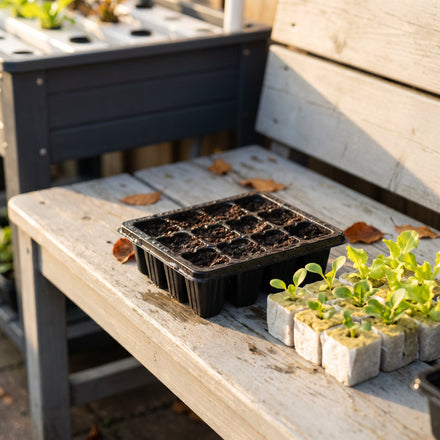
What to sow in autumn in aquaponics

What to sow in autumn in aquaponics

Autumn is not the end of the growing season — it is the start of the most peaceful one. Here is what to sow, when to do it and how to achieve leaf harvests

Read the article
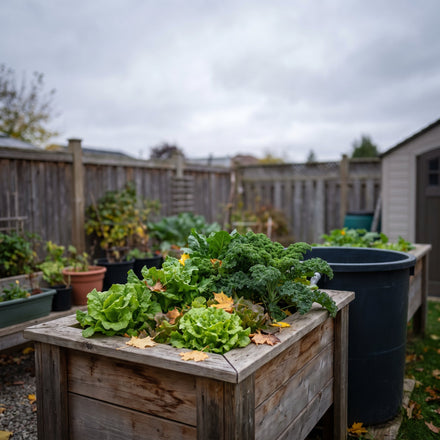
Preparing your aquaponic system for autumn

Preparing your aquaponic system for autumn

Autumn is the season that determines the health of your system throughout winter, as the water cools faster than the aquaponist's habits tend to change. Here is how to manage this transition without stressing

Read the article
Aquaponics and Summer Holidays

Aquaponics and Summer Holidays

You're going away for two weeks in July and your aquaponics system will be running without you : this thought rightly makes you anxious, because heatwaves, evaporation, and fish feeding raise practical questions. Good

Read the article
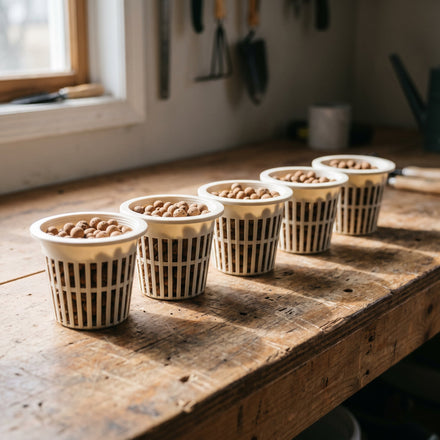
Growing pots for aquaponics

Growing pots for aquaponics

The net pot is an unassuming but decisive accessory in aquaponics: it supports the plant, houses the grow medium and allows water and oxygen to circulate freely. This guide explains how to choose the

Read the article
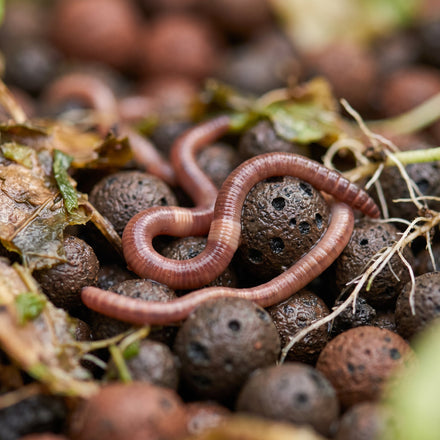
Vermiponics: worms in aquaponics

Vermiponics: worms in aquaponics

Vermiponics involves introducing compost worms into the grow medium beds of an aquaponic system, where they break down fish sludge and plant debris that bacteria then convert into assimilable nutrients. This page covers suitable

Read the article
Growing tomatoes in aquaponics

Growing tomatoes in aquaponics

Hungry for nutrients and a lover of warmth, the tomato finds aquaponics an ideal growing environment. This comprehensive guide takes you from choosing a variety through to harvest, covering pH, hand pollination, and pruning,

Read the article

Discover our aquaponics greenhouses and kits:

View all
Produits du rayon Kits d'aquaponie chez Univers Aquaponie

Aquaponics kits

Aquaponics kits ready to install in the garden, on a patio or in a greenhouse, with fish tank, grow beds and pump.

Discover
Produits du rayon Univers Plantes chez Univers Aquaponie

Plants

Seeds, grow media, fertilisers and aquatic plants for successful growing in aquaponics, hydroponics and the vegetable garden.

Discover
Produits du rayon Univers Équipements chez Univers Aquaponie

Equipment Universe

The equipment that keeps a system running: soilless growing, water circulation and aeration, filtration, temperature, plumbing and lighting.

Discover
Produits du rayon Serres d'aquaponie chez Univers Aquaponie

Aquaponics greenhouses

Greenhouses designed for aquaponics, supplied with their fish tank and grow towers.

Discover
Produits du rayon Univers Poissons chez Univers Aquaponie

Fish

Feed, monitor the water and care for your pond, aquarium or aquaponic fish.

Discover
Produits du rayon Univers Formation chez Univers Aquaponie

Learning

Books and practical courses on aquaponics, hydroponics and food self-sufficiency.

Discover