Feeding your fish in winter

Written by Tristan Ulrich · September 5, 2026
Carpes koï immobiles au fond d'un bassin de jardin en eau froide l'hiver

Every autumn, the same question arises at the pond's edge: should you keep feeding your fish as the water cools? The answer comes down to a few precise temperature thresholds, switching to the right feed at the right time, and cutting rations significantly.

Feeding your fish in winter: temperature is everything

Below 12 °C, a garden pond behaves nothing like it does in summer. Fish slow right down, their digestive enzymes lose efficiency, and the same handful of pellets that delighted them in July becomes a health risk in December.

This guide gives you the precise thresholds, appropriate feeds, rations, and feeding frequency to follow from early autumn through to the spring recovery. You will also find the classic mistakes that cost fish every winter, as well as the case of species that continue to eat throughout.

Ectothermic fish sluggish near the bottom in cold winter water

In winter, a fish cannot warm itself unaided

A fish is an ectotherm — its internal temperature follows that of the water to within half a degree. When the pond drops from 20 to 8 °C, its entire metabolism follows the same trajectory: heart rate, swimming speed, production of digestive enzymes, and oxygen consumption.

In practical terms, a fish that digested a meal in six to eight hours at 22 °C may take several days to process the same quantity at 8 °C. This is not a matter of appetite but of chemistry — enzymes work progressively more slowly as temperature falls.

This thermal dependence explains why no universal feeding schedule works. A mild coastal winter and a cold continental winter inland call for neither the same dates nor the same rations, and altitude shifts the schedule by several weeks further. The thermometer decides, never the calendar.

Temperature probe submerged in a frozen pond in winter Floating pond thermometer

Measure the water temperature rather than the air temperature

Air temperature drops far more quickly than water temperature. A 5,000-litre pond has considerable thermal inertia and typically runs two to four days behind the frosts forecast in the weather report.

Take your reading where the fish actually live — near the bottom — not in the first few centimetres of the surface, which cool down first. In winter, a difference of 2 to 3 °C between the surface and the deepest point is common in a pond one metre deep.

One reading per day, always at the same time and in the same spot, is more than sufficient. It is the trend over several days that should drive your decisions, not a single reading taken on one particular morning. A remote probe means you never have to lean over a frozen coping stone.

Feeding your fish according to temperature thresholds

Rather than thinking in months, think in thresholds. Each one corresponds to a genuine physiological change in pond cyprinids — koi carp and goldfish chief among them. The benchmarks below are those most commonly found in aquaculture literature and among European fish keepers; they give you a framework you can apply directly at the pond side.

  • Above 18 °C, normal feeding, protein-rich pellets, two to three meals per day.
  • Between 14 and 18 °C, one meal a day is sufficient; gradually introduce wheatgerm food.
  • Between 10 and 14 °C, wheatgerm exclusively, one meal every two days at most.
  • Between 8 and 10 °C, a token ration twice a week, only if the fish come to the surface of their own accord.
  • Below 8 °C, feeding stops completely until the temperature has risen durably above that threshold.

These values are guidelines, not absolute rules. Several sources differ by one or two degrees on the cut-off point, some placing it at 10 °C, others at 9 or 8 °C depending on the species and the quality of the food. The prudent approach is to go with the higher end of the range: a fish that fasts for a few extra weeks is at virtually no risk, whereas a fish that digests poorly can die from it.

Uneaten pellets floating on a cold-water pond

Below 10 °C, digestion stalls

Below around 10 °C, the intestinal flora of cyprinids slows down and the production of proteolytic enzymes drops sharply. A fish may still swallow a pellet by reflex, but it can no longer process it.

This undigested food ferments in the digestive tract. The risk is far from theoretical — it manifests as intestinal inflammation, bloating, and in severe cases the death of the fish a few days later, often wrongly attributed to the cold itself.

The second effect concerns the water. Rejected pellets break down on the bottom, feed heterotrophic bacteria, and release ammonia into a pond whose biofilter is only running at a fraction of its capacity. The details of this mechanism are covered in our guide on the nitrogen cycle.

Koi carp gulping floating pellets at the surface of a pond Floating food for koi carp in cool water

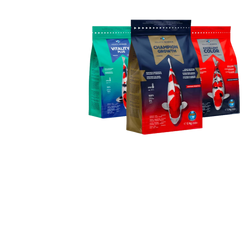
The wheat germ for cold water

Wheat Germ is a plant-based food whose starch and lipids are more easily absorbed in cold water than the animal proteins found in growth pellets. This is why European manufacturers offer it in a so-called winter or all-seasons formula.

Expect a protein content in the region of 25 to 32 per cent, compared with 38 to 45 per cent in a summer food, bearing in mind that these figures vary considerably from one brand to another. The Wheat Germ floating pellet remains visible at the surface, making it easy to remove anything left uneaten after five minutes.

The switch doesn't happen overnight. Mix both foods for around a week from 16 to 18 °C onwards — this avoids a sudden refusal and gives the intestinal flora time to adapt.

A small measured dose of pellets to reduce fish rations in winter

What ration to feed in cold weather

In summer, the commonly cited figure is between 1.5 and 2 per cent of body mass per day, with some sources going up to 3 per cent in peak heat. The number seems high until you remember what it applies to — 10 kilograms of fish is already around ten adult koi. For a domestic pond stocked with two or three kilograms, the daily ration drops to 30 or 40 grams, a small handful.

Around 14 °C, this ration falls to approximately 0.5 per cent of body mass, and not every day. Around 10 °C, it drops further still, to one or two tenths of a per cent — a negligible quantity on a pond scale.

The practical rule remains the most reliable: feed only what is consumed within five minutes and remove any surplus with a net. If the fish do not come to the surface within that time, they are not hungry, and the next meal should simply be skipped.

The biofilter slows down too

It is easy to forget that nitrifying bacteria are also sensitive to cold. The genera Nitrosomonas and Nitrobacter work at their best between 25 and 30 °C, and their activity drops noticeably once the water falls below 15 °C. Around 10 °C, several aquaculture studies report an efficiency loss in the region of half, and activity becomes very low around 5 °C without disappearing entirely.

This slowdown has a direct impact on feeding. Every gram of food distributed will ultimately produce ammonia, both through waste and through uneaten leftovers. In summer, a fully active biofilter processes this load within a few hours. In winter, the same load takes far longer to break down and nitrogen accumulates in the water.

This is an additional reason to reduce rations well before reaching the threshold at which feeding stops altogether. A system receiving little food produces little nitrogenous waste and remains stable even with a biofilter running at reduced capacity. Take the opportunity to check your water parameters once a week rather than once a month. Never rinse the biological media with tap water during this period — the chlorine would finish off a colony that is already weakened.

Pond fish fed at midday during the warmest part of a winter's day

Feeding at the right time of day

In winter, the useful feeding window is short. Water temperature reaches its peak in the early to mid-afternoon, between 13:00 and 15:00 approximately, a few hours after the height of sunlight.

This is when fish are most capable of digesting food. Feeding early in the morning, when the water is at its coldest, is asking them for an effort they simply cannot make. An evening feed is even worse, as the overnight drop in temperature catches them mid-digestion.

Choose a mild, sunny day, check the temperature before reaching for the feed bucket, then offer a single feeding. Over a typical November, this often amounts to just three or four meals in total — which comes as quite a surprise to beginners used to the summer routine.

Comparison between high-protein pellets and wheatgerm pellets

Foods to avoid in autumn

Colour-enhancing pellets, rich in spirulina and carotenoids, are designed for warm water and an active metabolism. Their high protein content makes them unsuitable below 15 °C.

The same applies to growth foods intended for young fish, to high-fat sticks, and to protein supplements such as dried larvae. Bread, lettuce and kitchen scraps never have a place in a pond — in winter least of all.

One final point concerns storage. A bag opened in June and then forgotten in a damp garage will see its vitamins degrade and its fats go rancid. Buy pack sizes suited to your winter consumption, which will be far lower than you might expect.

Species by species: who's still feeding

Not all species respond to cold in the same way, and applying a koi carp protocol to a mixed pond can cause problems. Here are the main groups found in European gardens and aquaponic systems, along with their dominant winter behaviour.

  • Koi carp and goldfish: feeding stops below 8–10 °C, overwintering at the bottom of the pond.
  • Tench and crucian carp: very similar behaviour, with an even greater tolerance for cold.
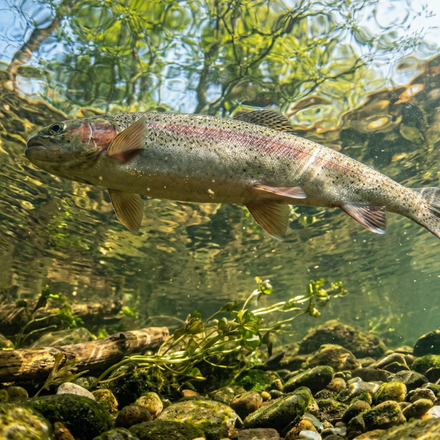
  • Trout and other salmonids: active throughout the cold season, continuing to feed down to around 4 °C.
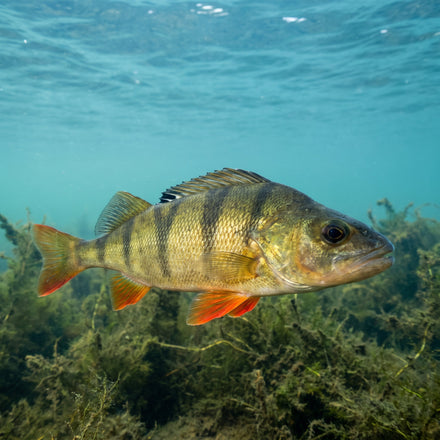
  • Common perch: slowed but not stopped — a very small ration remains feasible around 6–8 °C.
  • Sturgeon: a special case covered in more detail below; it must receive feed all year round.

In a pond that combines koi and sturgeon, or trout and goldfish, it is the most demanding species that dictates the protocol. You will therefore continue to distribute a sinking feed for the sturgeon even after you have stopped feeding the koi, which means targeting an area of the pond where the cyprinids cannot help themselves. Our guide on choosing fish covers these thermal profiles species by species, and the article dedicated to salmonid aquaponics looks at managing trout in cold water.

Sterlet sturgeon searching for sinking pellets at the bottom of a pond in winter Sinking food for sturgeon : Aquatic Science

The sturgeon, the great exception

Sturgeon do not hibernate. Their metabolism remains active in cold water and they continue to search for food at the bottom of the pond, even under a layer of ice. Withholding food for three months, as one does with koi, weakens them durably and causes avoidable losses every winter.

They require a specific sinking food, rich in protein and fat, which cyprinids cannot intercept at the surface. Two feedings per week is a commonly recommended frequency during cold periods, to be adjusted according to the size of the fish and what you observe.

Finally, keep an area of the pond free of ice — without it, you will be unable to feed them at the very moment they need it most.

Frozen garden pond with an anti-freeze cloche keeping an opening clear 200W pond heater

Ice, frost and gas exchange

A continuous layer of ice cuts off gas exchange between the water and the atmosphere. Decomposition gases build up beneath the surface while oxygen slowly depletes — a situation made all the more dangerous when the bottom is laden with silt and dead leaves.

Maintain a permanent opening using a frost-protection bell or an air diffuser positioned at mid-depth, never at the lowest point. A low-wattage pond heater does the same job by keeping one area frost-free, without attempting to warm the entire volume. The aim is not to raise the temperature but to keep a passage open — and above all, not to disturb the warmest layer of water where the fish have taken refuge.

Never break the ice by striking it, as the shock wave can be fatal to the fish. If the opening has closed over, simply place a pan of hot water on the ice until it melts through.

An indoor aquaponic system in winter with heating and supplemental lighting

Indoors, winter simply doesn't exist

In an indoor aquaponic system kept between 22 and 26 °C, the season has no influence on feeding. The fish eat at their usual rate, the biofilter remains efficient and the crops continue to take up the nitrates produced.

The real consideration then becomes lighting, since natural day length falls below ten hours, along with heating costs. An immersion heater controlled by a thermostat consumes less energy when the room is kept warm and the tank is covered at night.

Do bear in mind, however, unheated conservatories and greenhouses, which are often in between. Water temperatures there frequently drop to between 8 and 14 °C, in which case the full winter protocol applies in exactly the same way as for an outdoor pond.

Mistakes that cost you fish

The first mistake, by far the most common, is feeding because the fish come to the surface. A cyprinid retains a feeding reflex well below the threshold at which it can actually digest food, so surfacing is not a green light. Trust the thermometer rather than the behaviour.

The second is resuming feeding at the first mild spell in February. Three days at 12 °C followed by a return to 5 °C leave food sitting in the digestive tract that the fish will no longer be able to process. Wait for a sustained rise in temperature — at least one week above the threshold.

Next come maintenance errors: letting dead leaves accumulate on the bottom, switching off mechanical filtration while organic load is still present, or conversely cleaning the biological media in the middle of the cold season. Add to this the overlooked water parameter checks, because cold, sparsely fed water is not necessarily healthy water, and a winter ammonia spike is a very real possibility. Our article on cloudy water covers the warning signs to look out for. The final mistake is more insidious: stopping watching the pond altogether from November to March, when a weekly two-minute check is all it takes to spot an isolated fish, a clamped fin, or unusual behaviour.
Pond fish active again in spring near the surface

Restarting in Spring

Spring proves trickier than autumn. Fish emerge from winter lean, their reserves depleted and their immune systems at their lowest — at precisely the moment when pathogenic bacteria are recovering faster than they are.

Start feeding again with wheatgerm, in very small amounts every two or three days, as soon as water temperature holds steadily above 8 to 10 °C. Only return to a protein-rich feed once 15 to 16 °C is consistently confirmed, increasing the ration gradually over two to three weeks.

This is also the period when a visual health check is essential: white spots, wounds, marked weight loss. A fish weakened by winter is far easier to treat when spotted in March than in May.

A Nordic garden pond frozen over and covered in snow

Winter across European countries

The protocol is the same everywhere, but its duration varies dramatically. Around the Mediterranean and in southern Europe, water rarely drops below 10 °C and a complete rest period may last only a few weeks, or may not be necessary at all.

In temperate oceanic zones and across Western Europe, the rest period generally runs from mid-November to the end of March, with local variations of several weeks depending on altitude and pond aspect.

Further north — in Scandinavia, Poland, or the Baltic states — the fasting period can exceed five months, and depth becomes a survival criterion. A minimum of 1.20 metres is commonly targeted there, compared with 80 centimetres to 1 metre in a temperate climate.

Conclusion: getting through winter by feeding less

Feeding pond fish in winter is mainly about knowing when to stop. The instinct to do the right thing — the one that leads you to toss in a handful of pellets out of concern — is precisely what causes the most losses between November and March.

A reliable thermometer, a wheatgerm food introduced from 16 to 18 °C, a ration reduced to a third or a quarter, and then a clean stop below 8 °C covers the essentials. Everything else comes down to observation: keeping an opening in any ice, removing leaves, carrying out a weekly water check, and regularly watching how the stock is behaving.

A healthy pond fish will get through four months of fasting without difficulty — this is a behaviour written into its physiology, not a deprivation. The real winter achievement is not to keep it growing, but to provide it with clean, well-oxygenated water until it starts feeding again.

Sources

Connecticut Department of Energy and Environmental Protection, Winter Fish Kills, Winter mortality from lack of oxygen beneath the ice

Oklahoma State University Extension, Nitrification and Maintenance in Media Bed Aquaponics (HLA-6729), Slowing of biofilter nitrification in cold water

University of Florida IFAS Extension, HS1252, A Practical Guide for Aquaponics as an Alternative Enterprise, Feeding rates expressed as a percentage of biomass according to fish size and water temperature

FAO, Cultured Aquatic Species Information Programme, Oreochromis niloticus, Lethal low temperatures for tilapia and feeding rates expressed as a proportion of biomass

FishBase, Acipenser baerii, Siberian sturgeon, Thermal tolerance range and benthic behaviour of sturgeon, justifying winter feeding

University of Florida IFAS Extension, Fish Health Management Considerations in Recirculating Aquaculture Systems - Part 2: Pathogens (Circular 121), Pathogens to watch for at the spring restart and the effect of treatments on the biofilter

Frequently asked questions

No. Searching for food is a reflex and in no way proves that digestion is keeping pace. Feed given out of sympathy most often ends up as organic matter on the bottom of the pond.

It all depends on the depth of the pond and the equipment installed. Three simple benchmarks help you decide.

  • A deep pond benefits from keeping a slow circulation, returned to the surface rather than drawn from the lowest point.
  • Water kept constantly agitated breaks up the stratification and chills the refuge zone where the fish have gathered.
  • A filter left stopped for several weeks will lose its bacterial colony and will need to be re-seeded in spring.

Many owners therefore opt for a reduced flow rate, with the strainer raised to mid-depth.

An adult specimen that enters the cold season with good reserves can endure several months without feeding, since its metabolism is greatly slowed. The risk mainly concerns young or lean fish, and species that remain active in cold water — the sturgeon above all, whose viable temperature range extends down to around 1 °C. It is therefore autumn that determines winter survival, far more than winter itself.

Yes, and this is the most overlooked point. Their decomposition consumes oxygen and releases ammonia at the very moment when the pond exchanges least with the air. A net laid in October and a pass with a landing net before the first frosts are all it takes to resolve the issue.

No, as long as the temperature remains well above the thresholds at which digestion breaks down. The relevant benchmark is always the water temperature, never the calendar.

There is also the question of cost, and above all the breakdown scenario. A pond kept artificially at 18 °C that drops to 6 °C within two days puts fish in a far more dangerous situation than a natural cooling spread over several weeks. Think through this possibility before installing a heater.

Several signs can be spotted as soon as temperatures begin to rise.

  • A sunken back and prominent neck ridge, indicating significant weight loss.
  • Ragged fins or reddish sores on the flanks.
  • A fish that hangs back from the group at feeding time.

In this case, resume feeding very gradually and check the water parameters before considering any treatment whatsoever.

Read next

Raising tilapia in aquaponics

Raising tilapia in aquaponics

Tilapia is the most widely farmed fish in the world in aquaponics, renowned for its hardiness and rapid growth. Understanding its actual requirements in terms of temperature, volume and feeding is the key to

Read the article
Raising perch in aquaponics

Raising perch in aquaponics

The common perch is the predatory fish of European temperate waters: hardy, with sought-after flesh, and perfectly suited to aquaponic systems in temperate climates. Here is how to raise this fish, the temperatures to

Read the article
Goldfish in aquaponics

Goldfish in aquaponics

The goldfish remains the most popular species for starting an aquaponic system, and not without reason. Its hardiness, tolerance of cool water and high waste output make it a surprisingly effective partner for your

Read the article
Pond evaporation in summer

Pond evaporation in summer

Between July and August, your pond can lose several hundred litres per week without you noticing. Good news: calculating these losses is simple, and topping up without disturbing your fish is just as easy

Read the article
Salmonponics: aquaponics in cold water

Salmonponics: aquaponics in cold water

Aquaponics is often associated with pond fish like goldfish and koi. However, there is a variant perfectly suited for our temperate regions, cool climates, and winters : salmoponics. Trout, char, brook trout, these iconic

Read the article
Is aquaponics suitable for animal welfare ?

Is aquaponics suitable for animal welfare ?

We often talk about what aquaponics produces. But rarely about what the fish that make it work experience. Are they simply tolerated in a system designed for production, or can aquaponics truly respect their

Read the article