Raising perch in aquaponics

Written by Tristan Ulrich · September 5, 2026
Perche commune Perca fluviatilis nageant en eau claire, élevage en aquaponie

The common perch is the predatory fish of European temperate waters: hardy, with sought-after flesh, and perfectly suited to aquaponic systems in temperate climates. Here is how to raise this fish, the temperatures to target, stocking densities, and the practices that make all the difference.

The perch, a hardy native predator

Raising perch in aquaponics means working with a species that already lives in the rivers and lakes around you. Perca fluviatilis tolerates temperate water, copes with significant seasonal variation, and accepts pellet feeding once weaned — making it a credible alternative to tilapia for anyone unwilling to heat their pond year-round.

Its reputation as a demanding fish stems mainly from a reality this article addresses directly: the pronounced growth disparity between individuals, which requires regular grading to prevent cannibalism. Here you will find the useful temperature ranges, sensible stocking densities, feeding management, expected growth rates, where to source fish, and the mistakes that cause most first batches to fail.

Head and spiny dorsal fin of a common perch, key identification features

Identifying the common perch

The European perch is immediately identifiable by its five to seven dark vertical bars on a golden flank, its bright orange pelvic and anal fins, and its spiny first dorsal fin marked by a dark spot at the rear.

Its body is deep and laterally compressed, covered in ctenoid scales that feel rough to the touch. The broad mouth, lined with fine, velvety teeth, leaves no doubt about its diet — the perch is a predator that hunts by sight and readily preys on smaller members of its own species. This anatomy accounts for a good part of the husbandry precautions described further on.

Do not confuse it with the pike-perch, which is more elongated and lacks distinct bars, nor with the pumpkinseed, which is rounder, considerably smaller and classified as an invasive species. Choosing the right species is a fundamental decision — our guide on aquaponic fish places the perch in the context of all available options.

Shoal of common perch seen from below with sunlight breaking through the water surface

The right temperature all year round

Perch is a temperate-water species, and its useful range is broader than most people realise. Husbandry guides put its tolerance at roughly 2 to 28 °C, with optimal growth around 20 to 25 °C.

In practice, aiming for 18 to 24 °C from spring through to autumn gives good results without heating in most European regions. In winter, the water can drop to around 4 to 8 °C without causing harm — the fish simply stop feeding. What rarely kills them is cold itself; it is sudden temperature swings, and any change exceeding 2 °C per day will durably weaken a stock.

In summer, shading a sunken pond or covering it with a light-coloured cloth remains the most economical way to keep temperatures below 26 °C. Our advice on managing summer heat applies directly to a perch pond.

Dissolved oxygen: important, but not a dealbreaker

You will sometimes read that perch are hypersensitive to low oxygen levels. This reputation deserves some qualification, as it often stems from care sheets written about other perch species. In the wild, common perch are found mainly in calm environments — lakes, ponds, gravel pits, canals, and slow river backwaters — which are not among the best-oxygenated waters. They occupy a middle ground: considerably more tolerant than trout, yet less so than carp or goldfish.

That is no reason to skip aeration, but the real motive is not fish survival. In a closed system, available oxygen sets the ceiling for the stocking density you can maintain and the amount of feed you can distribute each day — all the more so because the nitrifying bacteria in the filter consume a significant share. Water close to saturation allows normal feeding, whereas below 4 to 5 mg/L appetite drops and growth slows, well before the stock is in any danger.

Physics makes things harder in summer. The warmer the water, the less oxygen it holds, while the fish's own consumption rises with temperature. Water at 25 °C has a saturation ceiling of around 8.2 mg/L, compared with nearly 11 mg/L at 10 °C. It is precisely when biomass is at its highest that the margin is at its thinnest, which is why a continuous-run air pump or fine diffuser is justified.

A few straightforward reference points will keep you on the right side of things.

  • Measure oxygen at the end of the night, when it is at its lowest.
  • Maintain visible surface agitation at all times.
  • Reduce the daily ration as soon as the temperature exceeds 26 °C.
  • Have a backup aeration system ready, running from a battery or UPS.

The remaining parameters follow the standard rules of a balanced system: a pH close to 6.8 to 7.2, with undetectable ammonia and nitrite levels. If any of this seems unclear, start by revisiting the nitrogen cycle.

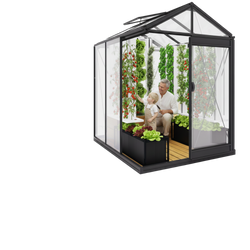
Round fish-rearing tank and grow medium bed inside an aquaponic greenhouse Above-ground fish pond

Choosing the Right Pond

A dark-coloured round or oval pond suits the purpose better than a pale rectangular tank. The circular shape encourages a gentle current and central removal of waste, while the dark colour reduces the stress of a fish that, in the wild, hunts amongst weed beds and avoids bright light.

Allow for a minimum volume of 1,000 litres for a serious first batch — a benchmark commonly found in fish farming guides — with around 500 litres for a pre-growing phase. Below that, fluctuations in temperature and water quality become too rapid to buffer, and perch respond poorly to instability. A depth of 80 cm to 1 m helps considerably, providing thermal inertia and a cool zone in summer.

Finally, plan for shaded areas — a few large-diameter PVC pipes or a floating board are sufficient. If you are starting from scratch, our guide to creating an aquaponic system covers the full sizing process in detail.

A group of perch spread throughout a pond at a sensible stocking density

What stocking density to aim for in practice

Professional recirculating farms push perch to 40 or 60 kg per cubic metre, but with industrial filtration and injected oxygen. For a home system, those figures are meaningless.

A density of 10 to 15 kg per cubic metre at the end of the cycle is a realistic and safe target — roughly 40 to 60 perch of 200 to 250 g in a well-aerated 1,000-litre tank. Growth studies also show that lower densities produce the best weight gains and feed conversion ratios; overcrowding damages fins well before it kills.

Start well below your target and let the biomass build up gradually. The grow bed area must increase in parallel, otherwise nitrates accumulate — a subject we cover in detail in common mistakes in aquaponics.

Sorting perch by size into separate tanks to prevent cannibalism Telescopic pond net

Grading by size is essential

This is the point that sets a successful perch setup apart from all the rest. Within a single batch from the same spawning, some individuals grow two to three times faster than their siblings. This phenomenon is recognised as one of the long-standing challenges of the sector, and it opens the door to cannibalism if nothing is done — all the more so because perch become piscivorous quite early, typically around twelve centimetres in length.

The rule can be stated in a single sentence: once a fish can swallow another, it will. Grading every four to six weeks during the first year, separating the larger fish from the smaller ones into two distinct tanks, dramatically reduces losses. Grading is carried out with a soft-mesh net, fish by fish, in water at the same temperature as the source pond.

Always handle with wet hands and keep time out of the water to a few seconds. These practices connect with the principles covered in detail in our article on animal welfare.

Feeding a predatory fish without polluting the system

Perch are carnivorous. Very young fry start on zooplankton, then the diet shifts fairly quickly towards larger prey: earthworms, larvae and insects, crustaceans and crayfish, and above all other fish — fry and small coarse fish — including their own younger companions when food is scarce. It is this transition to piscivory that makes size-grading essential.

In farming conditions, perch feed on extruded high-protein pellets, typically formulated with 45 to 50% protein and 12 to 18% lipids for the grow-out stages. Trout feeds work well and are widely available across Europe.

The daily ration is calculated as a percentage of biomass and depends directly on temperature. Allow roughly 1.5 to 2% of body weight per day at 20 to 24 °C, 0.5 to 1% at around 14 to 16 °C, and stop feeding altogether below 8 to 10 °C. Splitting feeds into two or three meals rather than one improves growth and reduces competition between individuals, which is why farming guides often recommend an automatic feeder to limit cannibalism.

The real pitfall is overfeeding. Every uneaten pellet decomposes, consumes oxygen and releases ammonia. The practical rule is to distribute only what is consumed within five minutes, then stop. Our fish foods cover the main pellet sizes required.

The worm filter: producing some food on-site

Since earthworms are part of the perch's natural diet, it makes sense to produce them at home. That is the whole point of the worm filter, a filtration stage where compost worms break down the sludge and solids from the pond before the water reaches the growing beds. The system solves two problems at once: it mineralises particles that would otherwise clog the grow medium, and it maintains a self-renewing worm population.

Regularly removing a portion of that population to feed the fish means a fraction of the daily ration can be covered by a resource produced entirely on-site, at no cost. On a domestic system, this rarely accounts for the bulk of the diet, but it is a genuine step towards self-sufficiency, and perch respond to live worms with an appetite that no pellet ever seems to trigger.

A few precautions are still necessary. Worms are a supplement rather than a complete food — their nutritional profile does not meet the needs of a growing carnivore — so extruded pellets remain the foundation of the ration. Offer measured quantities, taking into account what the fish actually consume, and rinse the worms before feeding to avoid reintroducing organic matter into the pond. Finally, keep the worm filter on a separate circuit, with a controlled return to the main system, to avoid sending a sudden organic load into water you want to keep stable.

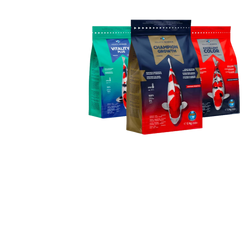
Carnivore pellets in two sizes for feeding perch Large capacity worm composter : 64 liters

The question of weaning, best left to the hatchery

Weaning is the transition from live prey to inert feed. In perch, this has historically been one of the biggest bottlenecks in the industry, on a par with uneven growth and poor larval survival rates. Larviculture draws directly on marine techniques, with a live-prey phase followed by a gradual transition to inert feed, and success rates remain variable even among professionals.

For a domestic system, the conclusion is straightforward: this is not a step to attempt at home. Buy juveniles that are already weaned onto pellets. Always ask for this information before ordering, along with the average size of the batch.

One detail often makes a real difference on arrival. Also ask which feed and which pellet size the hatchery was using, and start with the same. A weaned batch may refuse an unfamiliar pellet for several days, and any change should be made gradually by mixing the two feeds over one to two weeks. Finally, bear in mind that a perch caught in the wild will generally never accept pellets — only fish raised in captivity are accustomed to them.

Three perch of increasing sizes showing growth progression

Growth and harvest size

It is worth being honest: perch do not grow quickly. In European rivers, they rarely reach 25 cm before eight to ten years of age. In controlled farming conditions, with water kept within the right range and regular feeding, the pace changes completely.

Commercial fish farms commonly report a portion size of 120 to 200 g in 12 to 18 months from a weaned fry. In a domestic unheated system, where growth stops throughout winter, plan on 18 to 24 months to reach that size. That is the price of not heating the water, and it remains very acceptable given the quality of the flesh.

Perch are harvested with a landing net, one fish at a time, which allows harvests to be staggered. This type of production fits naturally into a broader approach to food self-sufficiency.

Deep water culture raft with lettuces and herbs, roots submerged in water Reine de Mai lettuce seeds

Which plants to pair with perch

Good news: a perch pond places no particular restrictions on what you can grow. The 18 to 24 °C range the water sits in from spring to autumn matches that of a conventional aquaponic system, and virtually all common crops perform well within it.

Lettuces and herbs — basil, parsley, chives, mint — form the simplest and most productive foundation. Spinach, chard, cabbage, and kale round out the rotation during cooler seasons, and fruiting crops such as tomatoes or peppers remain an option in midsummer as long as the water stays below 26 °C. Deep water culture suits leafy crops particularly well: it makes the most of the water volume without requiring any grow medium, and harvesting can be done in successive cuts.

The one genuine constraint is seasonal and applies to all systems: water that warms up causes lettuces to bolt — a problem we cover in our dedicated article on bolting. To broaden your rotation, see also the fifteen essential crops to grow in aquaponics.

Stock health: parasites and prevention

A healthy perch holds position in the current, reacts sharply to approach, and presents intact fins. The first warning signs are always behavioural — a fish lingering at the surface, rubbing against a wall, or refusing to feed for two consecutive days warrants immediate attention.

In a closed system, the most common conditions are parasitic or bacterial in origin, and they almost always follow an identifiable trigger. A temperature spike, rough handling during a sort, a drop in oxygen, or turbid water after overfeeding all create an opening for problems.

Prevention rests on three pillars that are more effective than any treatment. Maintain stable water and test it regularly, observe a quarantine period of two to three weeks before introducing any new fish, and avoid unnecessary handling.

If you are in any doubt about a symptom, isolate the fish in a quarantine tank rather than treating the whole system. This is the single most important point in this entire section, because most veterinary compounds also affect the nitrifying bacteria on which your system's balance depends, and some are persistent in a grow medium bed. A simple separate tank, aerated, filled with water from the system and kept at the same temperature, allows you to observe, treat and decide without putting the rest of the system at risk. It is in this context that our fish treatments belong — never added directly to an aquaponic system in production.

Outdoor pond in winter with fallen leaves and an insulating panel for overwintering 200W pond heater

Getting through winter without stress

This is one of the species' great advantages. Unlike tilapia, which dies below 12 °C, perch get through a European winter without heating, even under a thin layer of ice, provided the pond is deep enough.

The fish then enters a metabolic slowdown. It stops feeding, stays close to the bottom, and barely moves. Your work is limited to three tasks: removing any dead leaves that fall into the water, keeping a clear area at the surface for gas exchange, and stopping feeding as soon as the temperature drops below 8 to 10 °C.

Be aware, however, of the plant side of the system, which ticks over slowly and consumes almost no nitrate. Either reduce the fish load or accept higher nitrate levels until spring, keeping a close eye on your test results.

Uneaten pellets accumulated on the bottom of a tank, an overfeeding mistake

The mistakes that cost you a whole batch

Most failures with this species come down to a handful of well-identified mistakes, all of which are avoidable.

The first is the absence of grading, which turns a uniform batch into a few well-fed large individuals and many that have disappeared. The second is overfeeding, which loads the water, causes oxygen levels to drop, and triggers disease. The third involves starting a perch pond on a system whose nitrogen cycle is not yet complete — a serious mistake with a species that tolerates ammonia poorly.

Two less obvious mistakes should also be mentioned: introducing fish without gradual acclimatisation, and mixing individuals of very different sizes sourced from separate suppliers. Before getting started, have a read of our guide on getting started with an aquaponic system.

Where to source perch, and under what conditions

There are three routes, and they are far from equal.

The first, and most reliable, is through specialist hatcheries that produce juveniles already weaned onto pellets, intended for grow-out. This is exactly what you need for an aquaponic system, since the fish will eat from day one whatever you provide. This supply chain is well established in Switzerland, France, and central Europe.

The second is through restocking fish farms, of which there are many in France, selling small perch and pond-reared perch by the kilo or by the hundred, typically delivered in autumn and winter. Supply is plentiful and prices are low, but do ask about weaning before you order, as a fish raised in extensive pond conditions has often never encountered a pellet. These fish farms do, however, have a good handle on transport, and many provide detailed guidance on reception and acclimatisation.

The third option — catching fish yourself from the nearest lake or river — seems the most obvious and turns out to be the worst. On a practical level, wild perch will generally never accept pellets, making them impossible to keep in a closed-loop system. On the regulatory side, the transport of live fish and the stocking of a body of water are tightly governed in France; capture and transport for breeding or restocking purposes requires administrative authorisation, and certain species, including pumpkinseed sunfish, cannot legally be transported alive. Finally, a wild fish arrives with its own parasitic flora, with no quarantine or health monitoring.

Regardless of origin, transport remains the riskiest part of the whole operation, and perch are particularly vulnerable during this stage. The rules are the same everywhere: fast the fish for twenty-four to forty-eight hours before departure to limit waste build-up, use a well-oxygenated bag or tank, keep stocking density low, maintain cool water, and keep the journey as short as possible. On arrival, equalise temperatures slowly, over thirty to sixty minutes, before releasing the fish, then leave them undisturbed without feeding for twenty-four to forty-eight hours. Delivering in cold weather, when the water is naturally well oxygenated and metabolism is slow, considerably reduces losses.
Across European countries

The perch is naturally present across almost all of continental Europe, which makes things considerably simpler than with an exotic species. It is nonetheless a freshwater fish whose farming and transport are regulated, and the rules vary from one country to another.

In the Nordic countries, natural water temperatures suit the species perfectly but shorten the growing season, which extends the production cycle. In southern Europe, the constraint is reversed: the challenge becomes keeping the water below 26 °C during the summer months, which calls for a sunken, shaded, or sheltered pond.

One point warrants your attention regardless of country. Keeping, transporting, and above all releasing fish into a body of water connected to the natural environment is subject to national and sometimes regional regulations. A closed domestic pond rarely raises any issues, but do check with your relevant local authority before purchasing. Never release a farmed fish into a watercourse.

Raising perch in aquaponics: the key points to remember

Perch is not the easiest fish in aquaponics, and it makes no pretence of being so. It requires regular grading, measured feeding management and stable water conditions. In return, it frees you from heating costs, adapts to the European climate without any artifice, and produces flesh of a quality that few farmed species can match.

Three decisions matter more than all the others, and they are made before the fish even arrive. A fully established nitrogen cycle before the first introduction. Juveniles already weaned onto pellets, purchased from a producer who can tell you exactly which feed they were using. And a grading schedule noted in advance, every four to six weeks during the first year.

The rest comes down to daily observation, which will teach you far more than any table of values. Raising perch is ultimately a choice to work with a species already adapted to its environment, rather than bending the environment to suit a species from elsewhere.

Sources

FishBase, Perca fluviatilis, European perch, Habitats ranging from lagoons to lakes and medium-sized rivers, thermal tolerance range, and opportunistic feeding that shifts towards piscivory at around 12 cm

Wikipedia, Perche commune (Perca fluviatilis), Quiet frequented habitats — lakes, ponds and slow-moving rivers — and a diet including worms, larvae, insects, crayfish, fry and cannibalism when food is scarce.

Wicri Eau, Perche commune, élevage et points de blocage, Larviculture inspired by marine methods, live prey followed by weaning onto inert feed, with weaning, size variation and survival identified as the key bottlenecks in the industry.

Negofishkoi, care and husbandry guide for perch, Temperature range from 2 to 28 °C with an optimum of 20 to 25 °C, tank volumes of 500 and 1,000 to 1,500 litres, a diet that includes earthworms, and refusal of pellets by wild specimens.

Pisciculture Cardon, sale of live fish for ponds and garden ponds, transport, receipt, and acclimatisation, Restocking supply chain, transport conditions, receipt, and acclimatisation of live fish deliveries

Légifrance, Code de l'environnement, authorisations for the capture and transport of fish intended for breeding or restocking, French legal framework for the capture and transport of live fish for breeding or restocking purposes

University of Florida IFAS Extension, Fish Health Management Considerations in Recirculating Aquaculture Systems - Part 2: Pathogens (Circular 121), Pathogens in recirculating systems, biosecurity measures, and the benefits of a quarantine tank over in-system treatment

SMIDAP et Lycée O. Guichard de Guérande, Optimisation Pilote Régional Aquaponie (OPRA2), A French pilot farm running temperate-water species on a seasonal cycle under glass, with target pH, aeration rate, and water exchange rate

Anses, Freshwater fish consumption and PCBs, Guideline of two fish portions per week and the framework of PCB-related restrictions

ITAVI, Regulations and aquaponics: an initial overview, ICPE threshold of 20 tonnes per year for a freshwater fish farm

Frequently asked questions

Two supply routes exist. Specialist hatcheries sell juveniles already weaned onto pellets — this is the preferred option. Restocking fish farms, which are very common in France, sell young pond perch at low prices, but they are often reared extensively and have never been introduced to pellets. Always ask three questions before ordering: has the fish been weaned, what feed and what size were used, and what is the average size of the batch.

In practice, this is the worst possible solution, for three reasons.

  • A wild perch will generally never accept pellets; only farm-raised fish are accustomed to them.
  • The transport of live fish and the stocking of a body of water are strictly regulated, as capture and transport for breeding or restocking purposes require administrative authorisation.
  • A wild fish arrives with its own parasitic flora and no health monitoring whatsoever.

Go through a registered producer — the cost is modest compared to the risk you avoid.

This is the riskiest moment of the entire operation. The rules are straightforward: a fast of twenty-four to forty-eight hours before departure, a heavily oxygenated container, low stocking density, cool water, and a short journey.

On arrival, equalise temperatures slowly, over thirty to sixty minutes, before releasing the fish, then withhold food for twenty-four to forty-eight hours. Delivery during cold weather, when water is naturally well oxygenated and metabolism is slow, considerably reduces losses.
Less than is commonly said. This reputation often comes from husbandry sheets written for other perch species. In the wild, the common perch inhabits lakes, ponds, gravel pits and canals — which are not the best-oxygenated waters in Europe. It sits between the trout, which is very demanding, and the carp, which is very tolerant.

That said, in a closed system the available oxygen caps both the stocking density you can maintain and the ration you can distribute, particularly since the bacteria in the biofilter also consume it. A continuously running air pump therefore remains the rule — less for the survival of the stock than for its growth.

Yes, and it is one of the strongest arguments for domestic closed-circuit fish farming. French health guidelines are based on two portions of fish per week, one of which should be rich in long-chain fatty acids, and the restrictions that have been published are aimed primarily at wild fish from areas contaminated with PCBs.

A fish fed on pellets in a tank supplied with rainwater or mains water sits outside this bioaccumulation logic, since the contamination chain is broken. You know exactly what the animal has eaten and what water it has lived in — something no purchase from a fishmonger can offer.

The usual precautions still apply: a maintained cold chain after slaughter, a clean work surface and prompt consumption.

No. A perch will swallow anything that fits in its mouth, and a slow-moving goldfish with long fins makes an ideal target. These two species cannot be kept together.

For a family pond, no. The threshold that triggers the regulations on classified installations is set at 20 tonnes of annual production for a freshwater fish farm — a figure entirely unrelated to a domestic system.

Two points do deserve your attention, however. The first concerns water discharge, which must never reach a watercourse without precaution. The second concerns the origin of the fish, as river capture falls under fishing regulations and the transport of live animals has its own rules. Buy from a registered fish farmer and the question no longer arises.

No, it is a predator that ignores plant matter entirely. When damage appears on rafts, the cause lies elsewhere.

  • Excessive flow agitating the panels
  • Snails or larvae established in the net pots
  • An excess of organic matter suffocating the roots

It all depends on the time of year. Perch is a temperate water species whose activity drops sharply when the water cools, and a cessation of feeding in autumn is perfectly normal behaviour, not a sign of disease. The fish will hold near the bottom, show no lesions and resume feeding in spring.

During the main growing season, however, a refusal to feed is a strong warning sign. Check the water first — dissolved oxygen above all, then ammonia and nitrites. Then check the temperature; a sudden shift of several degrees in a single day is enough to suppress appetite across an entire batch for several days.

A newly delivered batch that refuses to feed may simply not recognise your pellet, if the hatchery was using a different one.

Read next

Raising tilapia in aquaponics

Raising tilapia in aquaponics

Tilapia is the most widely farmed fish in the world in aquaponics, renowned for its hardiness and rapid growth. Understanding its actual requirements in terms of temperature, volume and feeding is the key to

Read the article
What to sow in autumn in aquaponics

What to sow in autumn in aquaponics

Autumn is not the end of the growing season — it is the start of the most peaceful one. Here is what to sow, when to do it and how to achieve leaf harvests

Read the article
Growing pots for aquaponics

Growing pots for aquaponics

The net pot is an unassuming but decisive accessory in aquaponics: it supports the plant, houses the grow medium and allows water and oxygen to circulate freely. This guide explains how to choose the

Read the article
Goldfish in aquaponics

Goldfish in aquaponics

The goldfish remains the most popular species for starting an aquaponic system, and not without reason. Its hardiness, tolerance of cool water and high waste output make it a surprisingly effective partner for your

Read the article
Aquaponics and Summer Holidays

Aquaponics and Summer Holidays

You're going away for two weeks in July and your aquaponics system will be running without you : this thought rightly makes you anxious, because heatwaves, evaporation, and fish feeding raise practical questions. Good

Read the article
Koi carp in aquaponics

Koi carp in aquaponics

Koi carp is one of the most popular species used in ornamental aquaponics. Hardy, gregarious, and producing a good amount of waste, it integrates perfectly into a well-designed system. This comprehensive guide gives you

Read the article