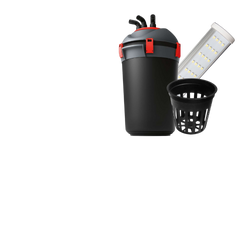
Pond evaporation in summer

Written by Joan Canals · June 6, 2026
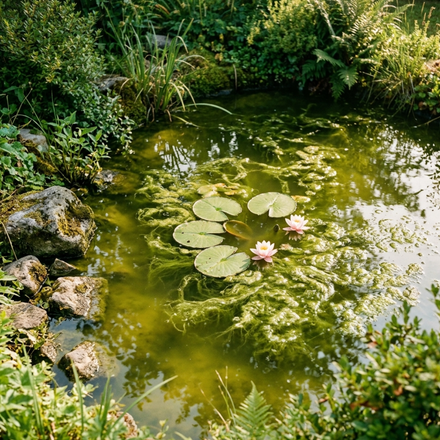
Bassin de jardin dont le niveau d'eau baisse en été

Between July and August, your pond can lose several hundred litres per week without you noticing. Good news: calculating these losses is simple, and topping up without disturbing your fish is just as easy if you avoid two major pitfalls.

Why a pond loses so much in summer

Evaporation is an unavoidable physical phenomenon: under the effect of heat, direct sun and wind, water molecules turn into vapour and leave your pond. A loss of 1 cm per day is completely normal at the height of summer, and can climb to 2 or 3 cm during a dry, windy heatwave.

This guide first gives you the formula to calculate your losses in litres, then the method to measure your actual evaporation. Then comes everything you need to know to top up properly: the two hidden dangers (thermal shock and chloramine), the safe step-by-step method, and the automatic solutions that free you from the tap.

Calculating Exact Losses

The exact calculation of losses

The formula is simple: 1 millimetre of evaporation over 1 m² of surface = 1 litre. Multiply the daily drop by the surface area of your pond to get the litres lost each day.

A concrete example: a 5 m² pond losing 1 cm per day (10 mm) in a normal summer loses 50 litres daily, i.e. 350 litres per week. A 10 m² pond in a full heatwave, at 2 cm per day, reaches 200 litres per day, i.e. nearly 1,500 litres over 7 days.

These figures are surprising at first, but they can be verified with a simple mark on the wall. Knowing the order of magnitude lets you anticipate and correctly size your top-up water reserve.

Measuring your actual evaporation White Bucket

Measuring your actual evaporation

The most reliable method is the bucket test. Place a graduated bucket filled with water right next to the pond, with the same sun exposure. After 24 hours, compare the drops: if they are identical, you are indeed dealing with pure evaporation. If the pond drops faster, you have a leak to find.

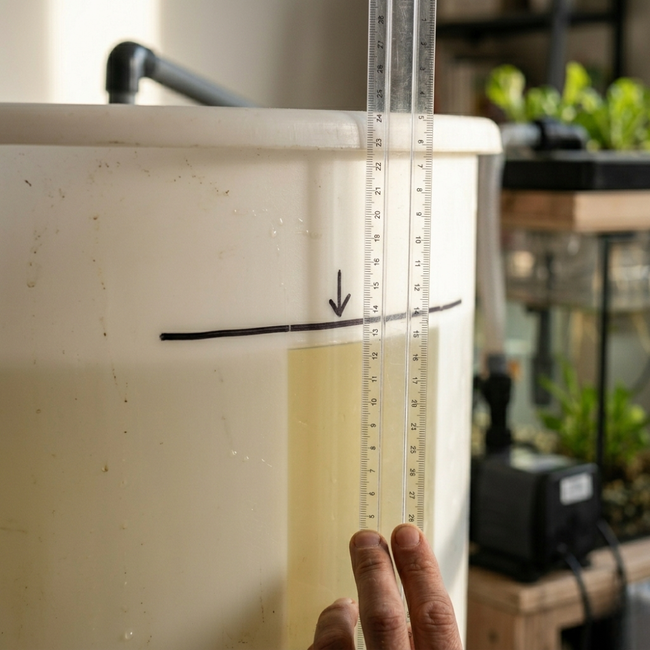
Mark the full level on the wall with a permanent marker and photograph it. A weekly check is enough to anticipate topping up. It is also the method for diagnosing suspected cloudy water linked to a hidden leak.

Write the values down in a small notebook. By cross-referencing with the weather, you will quickly obtain your personal evaporation curve.

Factors That Make It Worse

The factors that make it worse

A large exposed surface evaporates proportionally more. A waterfall or fountain easily doubles the evaporation rate through the spray effect. Wind also multiplies losses by constantly renewing the dry air above the water.

Bank plants worsen the balance through their evapotranspiration, a combined process of evaporation and leaf transpiration. A dense clump of rushes or papyrus can account for 30 to 50 % of total losses.

To limit this, slow down waterfalls during heat peaks, create a wind-sheltered zone and choose moderately evapotranspiring bank plants. Partial shading with floating plants usefully completes the strategy.

Two hidden dangers of topping up

Compensating for evaporation seems trivial: you open the tap and let it run. That is exactly the gesture that can kill part of your stock. Two dangers combine when no precautions are taken: thermal shock and the presence of chlorine or chloramine in mains water.

Why it kills silently

Koi carp and other pond fish tolerate a wide temperature range, provided changes are slow. A brutal top-up locally drops the temperature by several degrees, weakens immune defences and opens the door to disease. The following sections detail how to avoid these two traps.

The silent thermal shock Floating pond thermometer

The silent thermal shock

Your tap water usually comes out between 12 and 18 °C, even in summer. Your pond water, however, easily rises to 24–28 °C in high season. Pouring this cold water in abruptly creates a local difference of 10 °C or more, fatal to fish.

The absolute rule is never to exceed a 2 to 4 °C difference between the added water and the pond water. Beyond that, immune weakening encourages white spot disease (ich) to appear within just a few days.

If you need to top up a lot of water, do it in several small passes spread over the day, or let the water warm up in a container in the sun for a few hours beforehand.

Chlorine and chloramine: the trap Immune Booster & Water Conditioner

Chlorine and chloramine: the trap

Tap water always contains chlorine or chloramine, added for drinkability. Chlorine burns fish gills and kills the nitrifying bacteria in the filter. This last consequence is often underestimated but can trigger a destructive ammonia spike.

Simple chlorine evaporates within 24 to 48 hours in the open air. Chloramine, on the other hand, is much more stable and requires active treatment. Activated carbon is the simplest solution: it binds chlorine and chloramine within a few hours.

A commercial water conditioner does the same job in a few minutes, which is handy for urgent top-ups.

The safe method, step by step

The safe step-by-step method

Step one: prepare your water in a closed reserve the day before. Fill it 24 hours in advance with tap water, add a conditioner or let the chlorine evaporate, and let it all warm up in the open air.

Step two: check the pH and the temperature before adding. The difference with the pond must not exceed 2 to 4 °C. Pour gently, never more than 10 to 15 % of the pond's volume at once.

Ideally, top up in the evening, when temperatures stabilise. Watch your fish for the following 30 minutes: swimming, breathing, behaviour.

The automation that changes everything Float valve for automatic refilling

The automation that changes everything

For outdoor ponds and long summer absences, two combined devices transform maintenance: a float valve installed on a pre-treated buffer tank, plus a good-sized rainwater collector.

The float valve works like a toilet cistern valve: as long as the level drops, it lets water flow; as soon as the mark is reached, it closes. The buffer tank allows the water to be pre-conditioned before it reaches the pond.

Collected rainwater is the gentlest there is: no chlorine, at ambient temperature, perfectly suited. A 1,000-litre tank is enough for a normal summer on a medium-sized domestic pond.

Evaporation: a manageable challenge

Summer evaporation is not inevitable. Understanding the formula, measuring your own losses, identifying the aggravating factors: these are the three keys to anticipating. As for topping up, it rests on two golden rules: a maximum 4 °C temperature difference, and zero residual chlorine in the added water.

With a simple routine or an automatic system, your pond gets through the hottest months without harm to the fish or loss of filter bacteria. Consistency and anticipation are worth a thousand catch-up chemicals.

Sources

Oklahoma State University Extension, Evaporation Losses from Shallow Water Bodies in Oklahoma, Evaporation losses measured on shallow water surfaces from May to October and the key determining factors.

University of Florida IFAS, FA171, Teach Aquaculture Curriculum, Chlorine, Friend or Foe, Toxicity of chlorine and chloramine to fish, off-gassing by aeration and active treatments.

New Mexico State University, Circular 680, Aquaponics, Dissolved oxygen threshold and the drop in oxygen solubility as water warms.

Oklahoma State University Extension, Nitrification and Maintenance in Media Bed Aquaponics, Sensitivity of nitrifying bacteria and the pH and nitrate ranges to maintain when topping up.

Goddek et al., Challenges of Sustainable and Commercial Aquaponics, Sustainability 2015, Target compromise pH in a system with regular top-ups.

Frequently asked questions

No, that figure represents the higher end of the range. Evaporation measurements from shallow water bodies published by the Oklahoma State University Extension give, for the period from May to October, cumulative losses of between 28 and 44 inches depending on the region — roughly 700 to 1,130 millimetres over six months. Averaged out over a day, that places the seasonal mean at around four to six millimetres, with considerably higher peaks during hot, dry, and windy spells.

In other words, a centimetre per day corresponds to a fine summer's day in a dry climate, not to the average across an entire season. An oceanic climate, high humidity, or a pond sheltered from the wind will bring this figure down considerably, whereas a south-facing exposed pond with a waterfall running continuously may exceed it.

The only figure that matters is your own. Three readings taken a week apart, noted alongside the day's weather, are worth far more than any regional average when it comes to sizing your top-up reservoir.
Yes, and this is the real trap of top-ups made solely to maintain the water level. The water leaves, but everything it contained stays behind. In a pond that loses a significant proportion of its volume every week, mineralisation therefore builds up month by month if nothing is ever renewed.

  • Conductivity that rises steadily from one reading to the next.
  • A white deposit along the waterline and on the walls.
  • Nitrates that remain high despite plants in full growth.

The correction is straightforward. Once or twice during the season, replace a small fraction of the volume with prepared fresh water, rather than simply topping up what is missing. Rainwater, which is naturally very low in minerals, does the best job here.

On an inert roof surface and into a clean tank, yes. Simply discard the first few litres after a prolonged dry spell, which carry away dust and bird droppings.

For free chlorine, vigorous aeration for around twenty-four hours is enough to off-gas it, and that is exactly what a simple air stone placed in the preparation barrel does. A barrel left to stand, with no water movement, takes considerably longer.

Chloramine, on the other hand, does not off-gas as easily. If your water supplier uses it, simply waiting achieves nothing and an active treatment is required — activated carbon or a water conditioner. If in doubt, your local water quality report will state which disinfectant is used, and that information is worth looking up once and for all.

It reduces it considerably, since it eliminates direct contact between dry air and the surface, but it also cuts off gas exchange. In a stocked pond, a full and permanent cover in the heat of summer can cause dissolved oxygen to drop below the comfort threshold, all the more so because warm water already holds less of it.

A sensible compromise is to cover only part of the surface, leave an open area above the water return, and maintain active aeration beneath the cover. Shade netting stretched above the pond, without touching the water, often provides a better balance between water saved and risk taken.

Yes, and it is a classic mistake. Salt does not evaporate, so its concentration rises with every centimetre of water lost, and again with every top-up that simply restores the level. A pond treated in June can end up in August at a salinity far above the target dose, without anyone having added a thing.

Remember the rule: after a salt treatment, never recalculate the dose against the total volume — only against the volume of water actually replaced. And monitor conductivity until the treatment has been fully flushed out by a water change.

Read next

Summer recipes from the kitchen garden

Summer recipes from the kitchen garden

Summer turns the vegetable garden into a machine of abundance, and that's precisely where the biggest waste occurs, due to not knowing what to do with the harvest. Cooking and preserving what you've grown

Read the article
Pond algae in summer

Pond algae in summer

Summer pushes your pond to its biological limits, and algae thrive on the slightest weakness. Here's how to understand the mechanics of summer proliferation and regain control naturally.

Read the article
Aquaponics and Summer Holidays

Aquaponics and Summer Holidays

You're going away for two weeks in July and your aquaponics system will be running without you : this thought rightly makes you anxious, because heatwaves, evaporation, and fish feeding raise practical questions. Good

Read the article
Maintaining your aquaponic system in summer

Maintaining your aquaponic system in summer

Aquaponics is an effective solution to water shortages and increasingly hot summers, where traditional agriculture is struggling. Yet, the summer season remains a challenge : intense heat, rapid evaporation, and strained plants. Fortunately, with

Read the article
Salmonponics: aquaponics in cold water

Salmonponics: aquaponics in cold water

Aquaponics is often associated with pond fish like goldfish and koi. However, there is a variant perfectly suited for our temperate regions, cool climates, and winters : salmoponics. Trout, char, brook trout, these iconic

Read the article
Is aquaponics suitable for animal welfare ?

Is aquaponics suitable for animal welfare ?

We often talk about what aquaponics produces. But rarely about what the fish that make it work experience. Are they simply tolerated in a system designed for production, or can aquaponics truly respect their

Read the article