Germination failure : Causes and solutions

29 March 2026
univers aquaponie pousse

Failed seedlings are a gardener's nightmare. In aquaponics, stunted growth impacts the entire nitrogen balance. If your seeds don't sprout, it's not a foregone conclusion : it's an unlifted biological "lock." A seed is a battery awaiting a specific signal. To succeed, you need to perfectly simulate nature.

Germination failure. Why aren't your seeds germinating ?


Whether you're preparing your plants for a traditional vegetable garden or an aquaponics setup, this step determines the vigor and productivity of your future harvests. Yet, the outcome is often the same : despite all the best intentions, some cells remain empty, delaying your entire growing schedule and wasting sometimes costly seeds.

Why are your seeds unresponsive ? Is it a quality problem, an unsuitable environment, or a simple technical handling error ? Understanding the complex mechanics of emergence is essential to avoid wasting time and energy.

Feasibility : The water glass test

Before blaming your technique, check your basic equipment. Seeds have an expiry date. While some (like melon) can last 5 years, others like onion or leek lose their germinative power in just one year. A seed stored in a damp or overly warm place sees its embryo die prematurely.

Perform the "water glass test". Immerse your seeds in a glass of room temperature water for 12 to 24 hours. Those that sink are generally viable (they are dense and full of reserves). Those that float are often hollow or dry : you can discard them, they will never germinate.

Temperature : Thermal shock

For tropical plants such as tomatoes, peppers, or eggplants, soil temperature should be between 24°C and 28°C.

Below 20°C, the seed enters into a slowed metabolism and sometimes ends up rotting before germinating. Conversely, cold-weather plants like lettuce can go into dormancy if the temperature exceeds 25°C.

Direct contact with a Seedling Heat Mat guarantees a stable temperature of 25°C at the heart of the substrate : the only way to achieve germination in 4 days instead of 12.

Substrate : Avoid root asphyxiation

A germinating seed consumes a phenomenal amount of oxygen. If you use a classic potting soil that is too rich, too heavy, or worse, if you compact it with your fingers to "hold the seed," you create an airtight barrier. Without air, the seed suffocates : this is anaerobiosis.

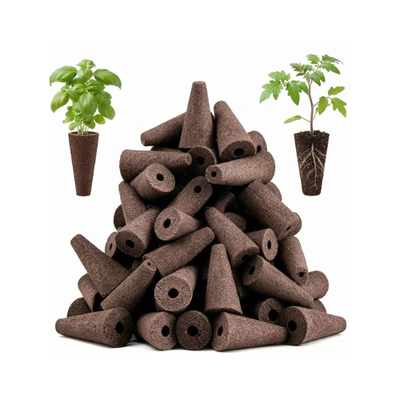
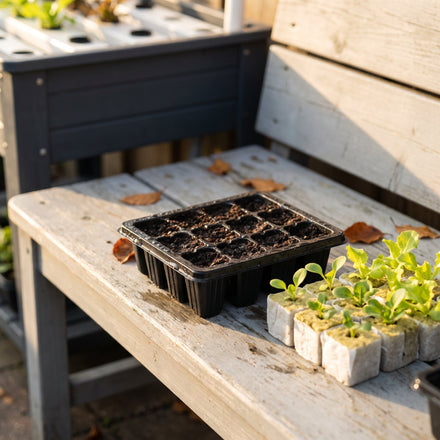
The substrate must be able to retain water by capillarity while allowing air to circulate. This is why professionals use rock wool plugs or coco sponges. They offer almost no resistance for the first roots (radicles) while being saturated with oxygen.

Damping off : Standing moisture

If you've seen a small sprout emerge then collapse at the stem in a few hours, you've experienced "damping-off." This is a fungal attack (Pythium or Rhizoctonia) favored by excessive humidity and lack of air circulation.

Sprinkle a little cinnamon or crushed charcoal on your seedlings. These are powerful natural antifungals. But above all, as soon as the seed has germinated, remove the lid of your greenhouse for a few hours a day to circulate the air effectively.

Depth : Buried or exposed ?

We often learn that we need to bury seeds. This is a partial truth. Some seeds are called "positive photoblastic" : they absolutely need light to germinate. This is the case for lettuce, celery, or mint. If you cover them with 5mm of potting soil, they will remain dormant forever.

Conversely, large seeds (squash, beans) dislike light and need depth to anchor themselves. The professional rule : bury them at a depth of 2 times the diameter of the seed. No more.

Light : avoid "etiolation" of plants

Even though light is not always necessary for the germination stage itself, it becomes the number one factor as soon as the first leaf (the cotyledon) appears. If your lighting is too dim, your plant will "etiolate" : it will grow a tall, white, and fragile stem to reach for the light. This plant will eventually fall over and die.

Indoors, behind a window, light is often insufficient in winter or early spring. To obtain stocky and robust plants, artificial light supplementation is often the key to success.

Scarification : when the casing is too hard

Some seeds have a seed coat (shell) so hard that water cannot penetrate to awaken the embryo. In nature, these seeds pass through the stomachs of animals or are exposed to winter frost to erode.

Our advice : For difficult seeds, practice light scarification. Gently rub the seed between two sheets of very fine sandpaper. This will create micro-fissures, allowing moisture to enter. A prior soaking of 12 hours in lukewarm water is also a formidable germination accelerator.

Diligence makes the gardener

Successful sowing is not a matter of having a "green thumb," but of precision. By controlling the temperature to the nearest degree via a heating mat, respecting the sowing depth, and ensuring immediate artificial light, you guarantee a strong start for your crops. In aquaponics, a strong plant from the beginning means more efficient nitrate filtration and happier fish.

Ready to take it to the next level ? Find all the professional equipment to secure your next harvests in our "Plant Universe" collection.