

NFT hydroponic system 60 plants, 2 m channels
Regular price
$571.00
Regular price
Sale price
$571.00
Unit price
/
per
$190.33 × 3 with no fees
Klarna.
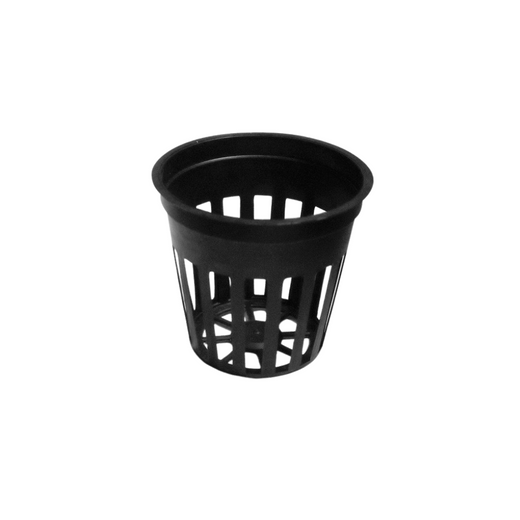
This NFT system provides 60 planting sites across four 2 m channels with a 100 x 50 mm profile, fed by a single 64 L reservoir, for growing lettuces, seedlings and herbs in rotation. It includes the frame, the pump and 60 net pots of 5 cm, with an overall footprint of 230 x 60 x 55 cm.
The system is designed and manufactured in Italy, near Turin.
 Customer support 7 days a week by email
 Delivery within 2 to 15 business days
100 % secure payment
The summary
- What it is: four 2 m channels carrying a film of nutrient solution, fed from a single 64 L reservoir.
- What sets it apart: 60 planting sites — 15 per channel — the highest number of positions across the three formats.
- How much space it needs: 230 cm long by 60 cm deep, with clearance at the ends for laying out the channels.
- What pace it suits: 15 plants harvested each week, if you replant one channel per week.
- What you choose with it: pot filling and a complete hydroponic nutrient solution.
- Where it ships from: from the workshop in Robassomero, near Turin.
Thin film across four 2 m channels, 60 positions in a single circuit.
This system brings together 60 plant sites across four 2 m channels, 15 per channel spaced 125 mm apart, all fed from a single 64-litre reservoir and a single pump. You mix just one solution, monitor just one level, and correct just one pH for the entire crop, across a footprint of 230 cm long by 60 cm deep.
The principle is that of the nutrient film, or NFT: the solution does not fill the channel, it flows through it as a thin film a few millimetres deep, with the root tips immersed in it while the rest of the roots breathe in the air inside the channel. The pump drives the solution to the high end of all four channels via a four-outlet manifold; the slope carries it to the other end, where it falls back into the reservoir through 32 mm fittings. Nothing is lost to the ground: any water and fertiliser that your plants do not take up returns to the circuit.
📐 A footprint of 2.30 m
This length is the first dimension to check, since a 2 m channel cannot be shortened to fit the space. The system takes up 230 cm in length by 60 cm in depth, and a little extra clearance is needed at one end to slide the channels into the frame during assembly. A greenhouse aisle, a garage wall or a dedicated room all work well; a balcony will rarely be long enough. The 55 cm height is modest: the unit sits directly on the floor without additional supports, and the square PVC and aluminium tube frame goes together with push-fit fittings. Bear weight in mind too: the system weighs 31 kg, plus the 64 litres the reservoir holds when full, which calls for a stable, level floor.
The return flow, something to check every day
There is no water reserve beneath the roots: if the pump stops, all four channels empty within minutes and 60 root systems are left exposed to the air at once. Make a habit of checking that water is falling back into the reservoir every time you walk past, it's the quickest sign of a fault to spot. Plug the pump into a dedicated socket, and check that it restarts automatically after a power cut.
🔁 Staggered transplanting
The 60 positions are managed in transplanting waves. Planting all 60 at once gives you 60 lettuces in the same week, followed by a month of nothing. The approach that suits this format is to transplant one complete channel per week, 15 plants, and harvest it all at once when it reaches maturity, so that after a month each week sees one channel cleared and replanted.
A second set of baskets for the next batch
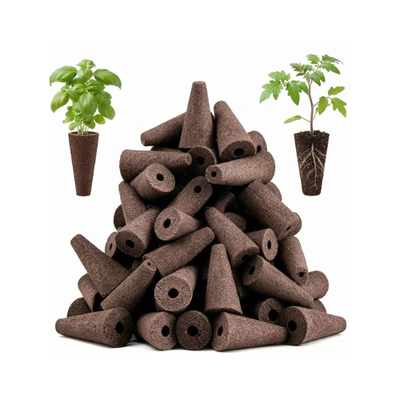
Staggered transplanting means the next batch must be ready when a channel becomes free. A set of 5 cm net pots lets you start those 15 plants separately, while the supplied pots remain occupied in the channels. Fill them with peat germination pods, which take the seed directly and are transplanted whole. On harvest day, the already-rooted net pot simply takes the place that has just been freed.
One channel per week
You transplant 15 plants into a single channel, then move on to the next one the following week.
A one-month offset
After 4 weeks, all four channels are occupied and the first one is ready to harvest.
A weekly harvest
Each week, one channel is cleared entirely and replanted straight away.
One species per channel
Grouping one species per channel makes cutting and cleaning between batches much simpler.
Prepare the plants separately on an indoor seedling table, roughly 3 weeks ahead of transplanting. Several batches are therefore running at the same time: those germinating on the seedling table, and those occupying the four channels at different stages. Note the transplanting date for each channel on a label fixed to its end, that is all you need to know which one to harvest the following week.
🥗 Lettuces and young shoots
The profile measures 100 by 50 mm and the positions are spaced every 125 mm, giving the planting density suited to short-cycle leafy crops: cut lettuces, young-harvested batavias, lamb's lettuce, rocket, spinach, basil, parsley, and coriander. Their rootball stays light and their root system won't clog the channel before harvest. If you're aiming for a full-sized head lettuce, leave every other position empty, as it needs around twenty centimetres between plants.
Plants that bulk up over several months will eventually fill the full depth of the channel, and their root mass will then start to restrict flow rather than follow it. If your project involves a long-term crop, strawberries or herbs grown as bushes, it is an 80 mm deep channel, spaced at 200 mm, that you should be looking at. Tomatoes and peppers, meanwhile, require a proper volume of water per plant, which only a deep water culture system can provide.
🧪 One reservoir for 60 plants
The 64-litre reservoir is dosed by multiplying the per-litre rate by the volume. At the appearance of the first true leaves, each of the three parts of TriPart is added at 1 ml per litre, giving 64 ml of each. At full growth, TriPart is dosed at 1.8 ml of Grow, 1.2 ml of Micro and 0.6 ml of Bloom per litre, which equates to approximately 115 ml, 77 ml and 38 ml for a full reservoir, with a conductivity of 1.3 to 1.8 mS/cm. Conductivity reflects the quantity of dissolved salts and tells you whether the solution is keeping up with plant uptake. For lettuce, adjust the pH to between 5.6 and 6.0 once all three parts have dissolved.
When all 60 positions are occupied, the solution is depleted much more quickly than with a single planted channel, and it becomes unbalanced proportionally sooner. Use conductivity as your guide rather than the calendar: if it rises without you having added anything, the plants are drawing water faster than salts, and topping up with clean water corrects the imbalance. Replace the entire solution every 2 to 3 weeks, and more frequently when all four channels are full of mature plants.
🐟 Connecting a pond
Tank water from a fish system can feed these channels, provided it first passes through mechanical filtration: a film just a few millimetres thick blocks quickly, and 60 positions multiply the spots where deposits can build up. You also give up the option of freely lowering the pH, since the range that suits fish and nitrifying bacteria, around neutral, takes priority over that of the plants.
The benefit lies in the growing surface: the more plants there are, the more nitrogen they take up, and 60 growing positions help to balance a pond where the fish produce a high output. This nitrogen comes from the breakdown of fish waste by bacteria, as described in the nitrogen cycle. The pond volume then acts as a buffer, and both pH and temperature fluctuate far more slowly there than in a 64-litre tank.
🔧 What needs doing each week
Check the pH and conductivity in the reservoir, top up the level, adjust the nutrient solution, and verify that water flows freely from all four channels. The standard reference in nutrient film technique is a slope of approximately 1 cm per metre, meaning a 2 cm drop between the two ends of a 2 m channel. A spirit level placed on each empty channel is sufficient to check this after moving or cleaning the system. While you're at it, rinse the pump strainer, since a partially blocked filter reduces the flow across all four outlets well before the film appears abnormal.
Twice a year, when a channel is empty, remove its cover and brush the interior along its full length. On a two-metre run, this is also a good opportunity to check that the profile has not sagged in the middle: a dip of just a few millimetres is enough to hold a puddle, and that standing water will turn green. If you find one, a support placed under the lowest point resolves the issue; if the flow remains uneven, replacement channels in the same profile can be ordered individually.
📦 What the system includes
You receive the four 2 m channels with their removable covers drilled with 15 planting sites and their factory-glued end caps, the support frame in 23 mm square-section tubing, the 64-litre reservoir, the Hailea HR1000 pump with a rated flow of 1,050 L/h complete with its supply line, the return circuit, and 60 net pots of 5 cm. The covers lift off by hand, giving access to the full length of the channel for cleaning.
Technical specifications
The essentials
- Principle
- Recirculated nutrient filmA film of water just a few millimetres deep, with no reservoir beneath the roots.
- Slots
- 60, that is 15 per channel
- Channels
- 4 profiles of 100 x 50 mm, 2 m
- Spacing
- 125 mm
Dimensions and circuit
- Footprint
- 230 x 60 x 55 cmLeave a little clearance at one end to engage the channels.
- Reservoir
- 64 L, 60 x 40 x 32 cmA single solution to dose for all 60 positions.
- Pump
- Hailea HR1000, 1,050 L/h
- Return
- Push-fit fittings of 32 mm
Materials and origin
- Channels
- Food-grade cellular PVC, white and black
- Load-bearing structure
- PVC and aluminium, 23 mm tubes
- Manufacturing
- Italy, Robassomero
- Warranty
- 2 years
To budget for separately
- Pot filling
- Sponge, rockwool, or clay pebbles
- Nutrition and pH
- 1 complete nutrition and its corrector
- pH reading
- 1 metre or a drop-based test
- Rooted cuttings
- Sown 3 weeks in advance
8 further specifications are available in the detailed view.
In the box
- 4 growing channels of 2 m with a 100 x 50 mm profile, with removable lids drilled with 15 planting holes each.
- 4 drainage plugs and 4 end caps, factory-fitted to the channels.
- 1 load-bearing structure in square PVC and aluminium tubes, with its fittings.
- 1 reservoir of 64 L.
- 1 Hailea HR1000 pump, its 4-outlet feed manifold and the 32 mm return circuit.
- 60 net pots of 5 cm.
Specifications taken from the manufacturer's data sheet, growrillahydroponics.com, on 07/10/2026. Slope and lettuce spacing: FAO small-scale aquaponic food production guide (2014). pH range for salad leaves: A.J. Both, Cornell.
Three nutrient film formats
The same principle, the same pump, and the same structure. The table compares capacity, channel, and floor space.
The largest of the three requires space above all else
This size offers the most planting holes, on the 50 mm channel. It suits rotation cropping, and requires 2.30 m of length, since a 2 m channel cannot be cut to fit through.
| Slots (plants) | Spacing between slots (mm) | Profile height (mm) | Channel length (cm) | A round lettuce in every slot | Ground length (cm) | Depth and height | Reservoir (L) | Channels | Pump | Structure | Price | |
|---|---|---|---|---|---|---|---|---|---|---|---|---|
| NFT hydroponic system 28 plants, 1 m channelsYour choice | 28 plants | 125 mm | 50 mm | 100 cm | No | 120 cm | 60 x 55 cm | 30 L | 4 | Hailea HR1000, 1050 L/h | PVC and aluminium | $388.00 |
| Hydroponic NFT system for 36 plants, 80 mm channelsYour choice | 36 plants | 200 mm | 80 mm | 185 cm | Yes | 210 cm | 60 x 55 cm | 64 L | 4 | Hailea HR1000, 1050 L/h | PVC and aluminium | $605.00 |
| Recommended NFT hydroponic system 60 plants, 2 m channelsYour choice | 60 plants | 125 mm | 50 mm | 200 cm | No | 230 cm | 60 x 55 cm | 64 L | 4 | Hailea HR1000, 1050 L/h | PVC and aluminium | $571.00 |
NFT hydroponic system 28 plants, 1 m channels
Capacity
Slots (plants)28 plants
Spacing between slots (mm)125 mm
The channel
Profile height (mm)50 mm
Channel length (cm)100 cm
A round lettuce in every slotNo
Footprint and circuit
Ground length (cm)120 cm
Depth and height60 x 55 cm
Reservoir (L)30 L
Common to all three
Channels4
PumpHailea HR1000, 1050 L/h
StructurePVC and aluminium
Hydroponic NFT system for 36 plants, 80 mm channels
Capacity
Slots (plants)36 plants
Spacing between slots (mm)200 mm
The channel
Profile height (mm)80 mm
Channel length (cm)185 cm
A round lettuce in every slotYes
Footprint and circuit
Ground length (cm)210 cm
Depth and height60 x 55 cm
Reservoir (L)64 L
Common to all three
Channels4
PumpHailea HR1000, 1050 L/h
StructurePVC and aluminium
NFT hydroponic system 60 plants, 2 m channelsRecommended
Capacity
Slots (plants)60 plants
Spacing between slots (mm)125 mm
The channel
Profile height (mm)50 mm
Channel length (cm)200 cm
A round lettuce in every slotNo
Footprint and circuit
Ground length (cm)230 cm
Depth and height60 x 55 cm
Reservoir (L)64 L
Common to all three
Channels4
PumpHailea HR1000, 1050 L/h
StructurePVC and aluminium
Manufacturer data sheets, growrillahydroponics.com, retrieved 07/10/2026.
Help choosing
Sixty spaces , is that the right scale?
Estimate your
delivery time
Your estimate
Delivery
Estimated time
It covers preparing your order and then the transit time quoted by the carrier, counted in working days.
It is not a guaranteed delivery date: public holidays, peak periods, customs or a carrier delay can extend it. The exact amount, in your currency, is worked out in the cart once your address is entered.
The order is dispatched from the workshop in Robassomero, near Turin. The 2 m channels travel in an oversized parcel that cannot be delivered to a collection point: please arrange home delivery, ensure clear access and have someone available to receive the goods. Exact shipping costs and final delivery times are shown at checkout once the address has been entered. Outside the European Union, import duties and taxes remain the responsibility of the recipient.
Frequently asked questions
12 questions
6 key questions, 12 in the detailed view
You may also like


Related articles

Crops
Lettuce bolting
Across sixty plants, bolting is immediately obvious: the three causes and how to deal with them.
Read the article

Start-up
Setting up an indoor seedling space
Fifteen rooted plants a week don't appear from nowhere: here is the workshop that produces them.
Read the article

Technique
The nitrogen cycle in aquaponics
What a large growing area absorbs, and why the balance is achieved before the channels.
Read the article

Project
Can you achieve food self-sufficiency?
The typical output of a steady system, once you stop counting in plants and start counting in meals.
Read the article

Understanding
Soilless growing in hydroponics
What growing in solution requires in terms of monitoring, and what it gives back in growth rate.
Read the article

Project
Aquaponics in businesses and schools
The growing formats for an educational project, and the monitoring they require.
Read the article
Let us talk about your project
A question about this product or your setup? Our team will answer and advise you.

Interest-free instalment payments
Offered depending on the cart amount, at checkout.

Delivery in 2 to 15 working days
Depending on the products and shipping sites. Estimate by destination in the estimator on this page.

After-sales service 7 days a week by email or chat
Our team answers all your questions.

Shop responsibly
Become part of the change.
