

Transport bags for fish, 20 x 50 cm
Regular price
$16.00
Regular price
Sale price
$16.00
Unit price
/
per
| Number of bags | Price | Price per unit | vs 100 |
|---|---|---|---|
| 100 | $16.00 | $0.16 | — |
| 200 | $27.00 | $0.14 | −13 % |
| 300 | $38.00 | $0.13 | −19 % |
| 500 | $62.00 | $0.12 | −25 % |
These clear 20 x 50 cm bags have a long format that keeps some air height above the water, for transporting and acclimatising fish. They are sold in lots of 100, 200, 300 or 500 bags, and the price per bag falls with the size of the lot.
 Customer support 7 days a week by email
 Delivery within 2 to 15 business days
100 % secure payment
The summary
- What you receive: 100, 200, 300 or 500 bags of 20 x 50 cm, with tiered pricing.
- The filling rule: one third water, two thirds air.
- Why this format: the length keeps a column of air above the water.
- Acclimatisation: the closed bag floats in the arrival tank, then is opened to mix the waters.
- A reasonable duration: a few hours, and it depends mainly on temperature.
- Shipping: sent flat, and can be combined with the rest of your order.
Long bags, 20 x 50 cm, for transporting and acclimatising fish
The 20 x 50 cm fish transport bags are used to transport and acclimatise fish. Their long shape keeps a column of air above the water, even when lying flat in a crate. They are filled with one third water and two thirds air, as this pocket of air is the oxygen reserve for the journey. They are sold in lots of 100 to 500.
A fish in a bag breathes the oxygen dissolved in its water, and this supply is replenished through the contact surface with the air trapped above. This is why a bag is filled with about one third water and two thirds air: the larger the pocket of gas, the longer the journey can last. These clear bags of 20 x 50 cm are used for transport as well as for acclimatisation in the receiving tank.
One third water
Add enough to cover the fish generously, but no more.
Two-thirds air
The oxygen reserve for the journey is in this pocket.
A clean closure
The top is twisted on itself, then knotted or secured with an elastic band.
💨 The length of the sachet
The 50 cm height is there to keep the air pocket above the water, even when the bag travels lying down in a crate, and to leave enough film above the water level to twist and tie the top without pinching the water. The 20 cm width gives the fish room to turn around without bending against a seam. You can also tell by eye whether the preparation is right: the sealed bag stands upright in a bucket, with the air pocket forming a taut column above the water. If it sags, the air pocket is too small or the seal is leaking.
🕰️ Time and temperature
What limits your journey is temperature more than duration, because a fish uses more oxygen the warmer its water is, while that water dissolves less of it. In summer, travel early in the morning, keep the bag in the shade and in a closed container, for example a bucket with a lid that stops it from rolling and keeps it in the dark. On arrival, let the sealed bag float on the surface of the tank for about fifteen minutes to equalise the temperatures, then open it and add tank water in small amounts, allowing up to 30 minutes in total before releasing the animal.
Enough to make a clean introduction
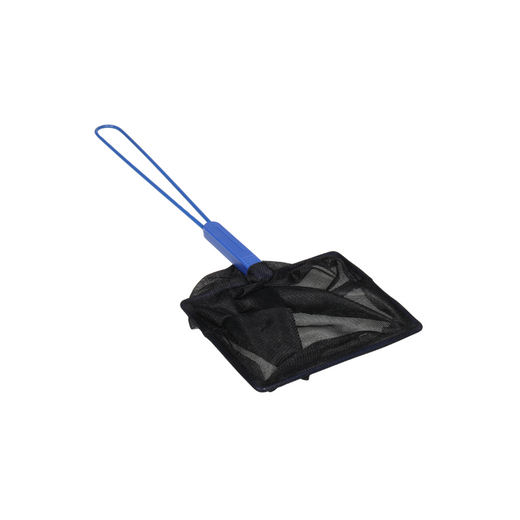
A fine-mesh fish net lets you lift the fish out of the bag without pouring the transport water into your tank. This water has received the waste produced during the journey, and it comes from another system. The essential test pack, for its part, tells you whether the ammonium and nitrite in the receiving tank are staying low, which shows that the water is ready to take in one more inhabitant.
A sachet should never be left in the sun
In the sun, even for a few minutes behind a car window, a bag heats up very quickly, and dissolved oxygen falls as the water warms. Always keep it in a closed container and in the shade.
📦 Getting ready to leave
The day before departure, do not feed the fish: a fast of at least 24 hours empties their digestive tract, so they foul the water in the bag far less, where the ammonia from their waste builds up for lack of a filter. Then fill the bag with water from the original tank, which the fish already knows, and seal it, trapping as much air as possible. For a long journey or a spiny fish, slip the sealed bag inside a second bag, which protects it from puncture. The number of fish to transport should also be decided according to the destination tank: in aquaponics, each fish added immediately increases the amount of ammonia that the filter bacteria must convert, as explained in the article on the nitrogen cycle: so introduce the newcomers in small groups.
Technical specifications
The essentials
- Dimensions
- 20 x 50 cm
- Uses
- Transport and acclimatisationThe sealed bag floats in the inlet tank.
Use
- Filling
- One third water, two thirds airThe oxygen for the journey comes from the air pocket.
- On arrival
- Float it sealed, then mixAbout fifteen minutes before opening.
In the box
- 100 to 500 bags of 20 x 50 cm, depending on the batch chosen
Dimensions recorded on 20/09/2026 from the product in stock. Filling, fasting and acclimatisation: SRAC fact sheet 3903, Shipping Fish in Boxes, consulted on 11/10/2026.
Estimate your
delivery time
Your estimate
Delivery
Estimated time
It covers preparing your order and then the transit time quoted by the carrier, counted in working days.
It is not a guaranteed delivery date: public holidays, peak periods, customs or a carrier delay can extend it. The exact amount, in your currency, is worked out in the cart once your address is entered.
These sachets travel flat and are grouped with the rest of your order. The shipping cost is calculated in the basket, according to the total weight and your destination.
Frequently asked questions
6 questions
6 key questions
You may also like





Related articles

Fish
Which fish to choose for aquaponics?
Introducing a fish into a system that is already running.
Read the article

Bases
The nitrogen cycle in aquaponics
One more occupant means more nitrogen from the very next day.
Read the article

Start-up
Getting started with an aquaponic system
The first few weeks, and the point at which you can finally stock the system.
Read the article

Wellbeing
Is aquaponics suited to animal welfare?
Transport stress, how long it lasts and what it leaves behind.
Read the article

Water
Understanding and clearing cloudy water
Why the water turns cloudy after an introduction.
Read the article
Let us talk about your project
A question about this product or your setup? Our team will answer and advise you.

Interest-free instalment payments
Offered depending on the cart amount, at checkout.

Delivery in 2 to 15 working days
Depending on the products and shipping sites. Estimate by destination in the estimator on this page.

After-sales service 7 days a week by email or chat
Our team answers all your questions.

Shop responsibly
Become part of the change.
