

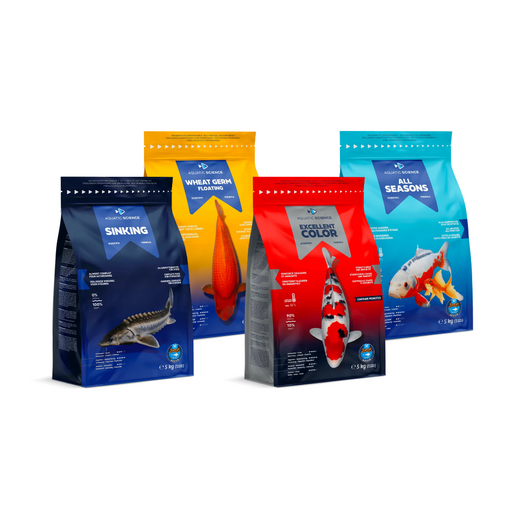
Floating food for koi carp in cool water
Regular price
$67.00
Regular price
Sale price
$67.00
Unit price
/
per
These 100% floating pellets of 4 to 5 mm feed koi carp and goldfish when the water sits between 5 and 15 °C, in spring as it warms and in autumn as it cools.
The formula contains 32% protein, and the resealable bag holds 5 kg.

7/7 customer service by e-mail

Payment in instalments, free of charge
The summary
- What you receive: a resealable 5 kg bag, medium pellets of 4 to 5 mm, 100% floating.
- What the analysis shows: 32% protein, 9% fat, 0.9% total phosphorus.
- Its feeding window: 5 to 15 °C, covering the pond's two shoulder seasons.
- Why floating: you can see who's eating, and remove anything left with a net.
- What else you'll need: a pond thermometer, and a set of scales for the first feed.
- How it arrives: 5 kg parcel, collection point or home delivery.
100% floating pellets of 4 to 5 mm, for water temperatures of 5 to 15 °C
There is a temperature window where a growth food is no longer appropriate but stopping feeding entirely is premature. It opens twice a year: in spring as the water warms and your koi start asking for food again, then in autumn as it cools and they are still feeding. These pellets cover that window, ranging from 5 to 15 °C, in a medium 4–5 mm size and a resealable 5 kg bag.
🍂 Digestion in cool water
Koi are cold-blooded, which means the speed of their digestive tract follows that of the water around them. As the water cools, transit time increases, gastric emptying slows and digestive enzyme activity weakens. In studied fish, transit time is two to four times longer in winter than in summer. A high-energy feed given at this time spends longer in a sluggish digestive tract, and a greater proportion of its content goes unabsorbed. What is not absorbed passes back into your water and adds to the nitrogen load your filtration must then process, as described in our article on the nitrogen cycle. At 32% protein, this pellet places less digestive demand on the fish than the maintenance feed at 33.5% or the colour feed at 39.5%.
In spring
The water temperature rises back above 5 °C. Give a single, very small feed, then carry out a water test before giving a second one.
In autumn
Your koi are still feeding below 15 °C. Aim for one to three feeds per week, removed if still floating after a few minutes.
Below 5 °C
Feeding stops. Your fish live off their reserves until spring temperatures rise again.
🧪 The filter at restart
A biological filter recovers more slowly than your fish's appetite. Coming out of winter, nitrifying bacteria are still sparse, and the load you are feeding shows up in the water several days before it becomes visible on the fish. Two tests settle the question in five minutes: an ammonium test for what your fish are excreting, and a nitrite test for the intermediate stage, which lingers longest in a filter that is getting back up to speed. If either value rises, reduce the feed ration before anything else. A bacterial supplement will speed up this recovery.
Read the water and weigh the first ration
This 5 to 15 °C window refers to water temperature, not air temperature, the difference between the two can be several degrees in spring. Pick up a floating thermometer at the same time as the bag, along with a precision scale or a measuring cup to work out the first reduced ration. Above 15 °C, the pond fish food range takes over.
The pellet that stays on the surface
These pellets float completely, and that gives you direct control over feeding portions: you can see who is eating, who is ignoring the food, and you can net out anything left after five minutes. Never leave uneaten food in the pond in cool water, as it breaks down slowly and burdens a filter that is already running at reduced capacity. And never feed this food to ruminants or any other animal species, as the label states, because it contains fish meal.
🌡️ The two transitions of the year
The two windows call for different approaches, and this is what most printed calendars fail to mention. In autumn, your fish have built up reserves over the summer and the filter is still fully active, so rations can be reduced gradually, without any urgency, and feeding stops naturally on its own. In spring, the situation is reversed: the fish are lean and hungry, yet the filter has not yet recovered. Spring is therefore when mistakes prove costly, and the rule can be summed up in a single sentence, always resume feeding more slowly than your fish are demanding.
📦 The 5 kg bag
Five kilogrammes is a lot for a food distributed one to three times a week, and that is intentional. These pellets are used during two short periods each year, so a single bag generally covers both autumn and the following spring for a medium-sized pond. The bag's resealability therefore matters more here than it does with a summer food: it is worth resealing it carefully, storing it somewhere dry and frost-free, and scooping with a dry measure rather than using your hand. Wheat germ, which gives this formula its name, is valued for its digestibility in cool water, but it does not tolerate moisture once the bag has been opened.
Technical specifications
Guaranteed analysis
- Crude protein
- 32 %Less digestive effort at the time of year when the gut is slowest.
- Crude fat
- 9 %
- Crude fibre
- 4.4%
- Mineral content
- 8.4%Ash: the indigestible mineral fraction of the food.
- Calcium
- 1 %
- Total phosphorus
- 0.9%Compared with 1.3% for the colour feed and 1.6% for the sinking sturgeon feed.
Use and packaging
- Temperature range
- 5 to 15 °CMeasure in the water, in the morning, on several consecutive days.
- Pellet behaviour
- 100% floatingWhatever remains after five minutes should be removed with a net.
- Particle size
- 4 to 5 mm, medium sizeFor specimens of around fifteen centimetres and above.
- Target species
- Koi carp, goldfish
- Pace in cold water
- 1 to 3 feeds per weekBelow 5 °C, deliveries stop until spring.
- Packaging
- Resealable bag of 5 kg
Additives and composition
- Vitamin A (E672)
- min. 8 000 UI per kg
- Vitamine D3 (E671)
- min. 1 400 UI per kg
- Vitamine E (3a700)
- min. 160 mg per kg
- Vitamine C (3a312)
- min. 150 mg per kg
- Declared ingredients
- Cereals, oilseeds, fish, algaeCereal and oilseed by-products, fishmeal, fish oil, algae, minerals.
- Wheat germ
- In cereal by-productsThe regulatory category that covers it without naming it.
To budget for separately
- Pond thermometer
- 1 floating thermometer
- Feeding dose
- 1 set of scales or a measuring jug
12 further specifications are available in the detailed view.
In the box
- 1 resealable bag of 5 kg of medium floating pellets, 4 to 5 mm
- 1 manufacturer label: composition, guaranteed analysis, batch number, and best-before date
Analysis guaranteed, additives, ingredient list, the 5 to 15 °C range, and the 100% floating rate recorded on 5 September 2026 from supplier product sheets. Recommended fish size comes from resellers. Feeding frequencies and nitrogen estimates are reference figures from the shop.
Which food to use when the water is neither warm nor cold
The three floating foods in this range, ranked by the factor that matters most mid-season: water temperature, and what the portion sends back into the filter.
A cool-season feed: is it the right one for you?
This formula is digested when the water is still cold, at a point where other feeds begin to put strain on a sluggish digestive tract.
| Lowest working temperature (°C) | The moment you open the bag | Time of year | Crude protein (%) | Total phosphorus (%) | Ammoniacal nitrogen per 100 g dispensed (g) | Floating portion | Size sold by us | Bag sold by us | |
|---|---|---|---|---|---|---|---|---|---|
| Recommended Fresh water, 5 kgYour choice | 5 °C | From snowmelt, 5 °C | Early spring and late autumn | 32 % | 0.9 % | 3.1 g | 100 % | 4 à 5 mm | 5 kg |
| Pond fish food, floating pelletsYour choice | 10 °C | At resumption, 10 °C | Long growing season | 33.5 % | 0.99 % | 3.2 g | 90 % | 2 to 3 mm or 4 to 5 mm | 2 kg or 5 kg |
| Colour-enhancing food for koi carp, floating pelletsYour choice | 16 °C | At peak warmth, 16 °C | Height of summer | 39.5 % | 1.3 % | 3.8 g | 90 % | 4 à 5 mm | 2 kg |
Fresh water, 5 kgRecommended
Its temperature window
Lowest working temperature (°C)5 °C
The moment you open the bagFrom snowmelt, 5 °C
Time of yearEarly spring and late autumn
What the feed ration returns to the water
Crude protein (%)32 %
Total phosphorus (%)0.9 %
Ammoniacal nitrogen per 100 g dispensed (g)3.1 g
The pellet
Floating portion100 %
Size sold by us4 à 5 mm
Bag sold by us5 kg
Pond fish food, floating pellets
Its temperature window
Lowest working temperature (°C)10 °C
The moment you open the bagAt resumption, 10 °C
Time of yearLong growing season
What the feed ration returns to the water
Crude protein (%)33.5 %
Total phosphorus (%)0.99 %
Ammoniacal nitrogen per 100 g dispensed (g)3.2 g
The pellet
Floating portion90 %
Size sold by us2 to 3 mm or 4 to 5 mm
Bag sold by us2 kg or 5 kg
Colour-enhancing food for koi carp, floating pellets
Its temperature window
Lowest working temperature (°C)16 °C
The moment you open the bagAt peak warmth, 16 °C
Time of yearHeight of summer
What the feed ration returns to the water
Crude protein (%)39.5 %
Total phosphorus (%)1.3 %
Ammoniacal nitrogen per 100 g dispensed (g)3.8 g
The pellet
Floating portion90 %
Size sold by us4 à 5 mm
Bag sold by us2 kg
Figures guaranteed as recorded on 5 September 2026 from supplier product sheets. The range of 5 to 15 °C and the 16 °C threshold are published by the manufacturer; the 10 °C threshold comes from resellers. Ammonia nitrogen values are an upper-bound estimate for 100 g distributed per day.
Help choosing
Is this the right time of year for this food?
Estimate your
delivery time
Your estimate
Delivery
Estimated time
It covers preparing your order and then the transit time quoted by the carrier, counted in working days.
It is not a guaranteed delivery date: public holidays, peak periods, customs or a carrier delay can extend it. The exact amount, in your currency, is worked out in the cart once your address is entered.
5 kg bag, dispatched to a collection point or to your home address, your choice at checkout. The exact amount is calculated at checkout based on the total weight of your order.
Frequently asked questions
8 questions
6 key questions, 8 in the detailed view
How much to feed, and how long does a 5 kg bag last
Enter your fish biomass, that is the sum of their weights. The calculator uses 1% of that biomass per meal, the upper feeding limit commonly published for koi carp in the upper part of the 12 to 15 °C window. The colder the water, the further below this ceiling you should go, and the longer you should space out meals.
kg
1 kg60 kg
0g per meal
One meal's ration, the upper limit set for water at 12 to 15 °C. Only give what disappears in under five minutes.
Monthly consumption at two meals per week
0 g per month
The 1% ceiling comes from figures commonly published for koi carp and stays below the 1.5 to 2% of biomass maximum cited by the FAO for common carp in ponds. The monthly consumption figure assumes two feeds per week, a mid-season rhythm: it has no relevance in summer. The rule that overrides any calculation remains the five-minute rule.
Vous aimerez aussi




Related articles

Guide
Koi carp in aquaponics: the complete guide
Volume, filtration and water parameters: the framework within which a mid-season feed rate is set.
Read the article

Species
Salmoponics, aquaponics in cold water
What cold water does to fish metabolism and how it affects running a system.
Read the article

Understand
The nitrogen cycle in aquaponics
Why the unassimilated portion of a meal is excreted as ammonium and then as nitrites.
Read the article

Avoid
Common mistakes in aquaponics
Overfeeding at the spring restart comes top of the list.
Read the article

Guide
Which fish should you choose for aquaponics?
Koi, goldfish or sturgeon: each feeds at a different level of the pond.
Read the article

Problem
Green pond water: 5 solutions without chemicals
The most visible symptom of too high a ration at the return of warmer weather.
Read the article
Let us talk about your project
Une question sur ce produit ou votre installation ? Notre équipe vous répond et vous conseille.

Paiement plusieurs fois sans frais
Proposé selon le montant du panier, au moment du paiement.

Livraison sous 5 à 15 jours ouvrés
Selon les produits et sites d'expédition. Estimation par destination dans l'estimateur de cette page.

SAV 7/7 par mail ou chat
Notre équipe répond à toutes vos questions.

Faire un achat engagé
Devenez acteurs du changement.
