Aquaponics and Summer Holidays

Written by Joan Canals · May 13, 2026
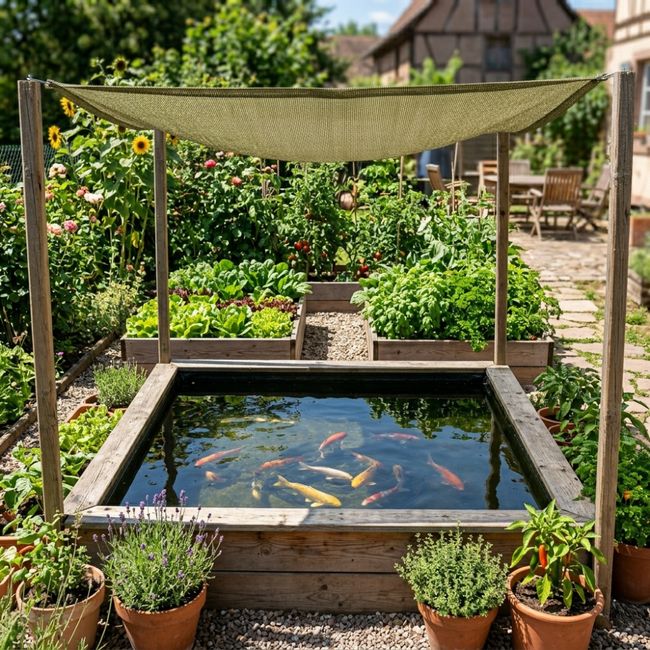
Système aquaponique domestique en été partiellement ombré prêt à fonctionner en autonomie pendant les vacances

You're going away for two weeks in July and your aquaponics system will be running without you : this thought rightly makes you anxious, because heatwaves, evaporation, and fish feeding raise practical questions. Good news, a well-prepared system perfectly tolerates a prolonged absence if you anticipate the right actions.

Why aquaponics tolerates holidays well

Aquaponics relies on a living ecosystem that is largely self-regulating. Filter bacteria continuously convert fish waste into nitrates, plants absorb these nutrients, and the water remains balanced without daily intervention. A mature and stable system can run on its own for two to three weeks, provided that sensitive points have been prepared in advance : feeding, water level, and temperature.

This guide will take you step-by-step, from preparation 15 days beforehand to the return checklist. You will find critical temperature thresholds for fish, the calculation of summer evaporation, the correct setting of an automatic feeder, shading that saves dissolved oxygen, and instructions to leave for your neighbor if you entrust them with a monitoring mission.

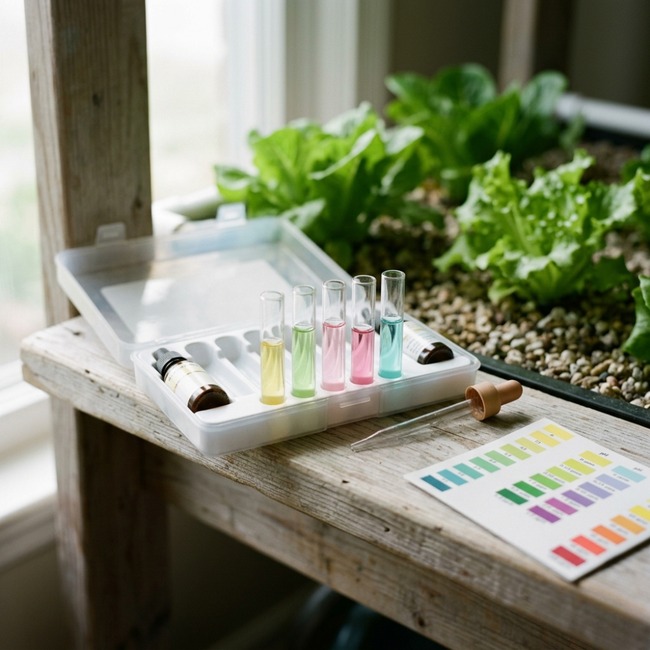
Preparing your system at J-15 Essential Pack : Aquaponics water analysis (NH4, NO2, NO3, pH, KH)

Prepare your system in D-15

Two weeks before departure, conduct a thorough inspection. This window gives you time to fix any issues without rushing. Perform a full battery of water tests to measure pH, ammonia, nitrites, and nitrates : these four parameters tell the essential story.

While you're at it, clean the pre-filters, check the seals, monitor the flow rate of the main pump, and inspect the overflow pipes. A dead leaf stuck in a siphon can cause a tank to overflow in a few hours.

Repair or replace any questionable equipment now, never the day before departure. A system ready 15 days in advance is a system that rests easy.

The nitrogen cycle must be stable

The nitrogen cycle must be stable

Never go on vacation with a system that is cycling. Nitrification, which converts toxic ammonia into nitrates, takes four to eight weeks to establish firmly. During this phase, an invisible spike can kill fish in a single day.

Before you leave, you need to read three clear results : NH4 at 0, NO2 at 0, and measurable NO3. If any of these markers deviate, wait. On a young or recently disturbed system, the safety margin is too narrow to leave with peace of mind.

To fully understand the mechanics of the bacteria involved, read our guide dedicated to the nitrogen cycle. You'll know what to observe to validate a truly mature system.

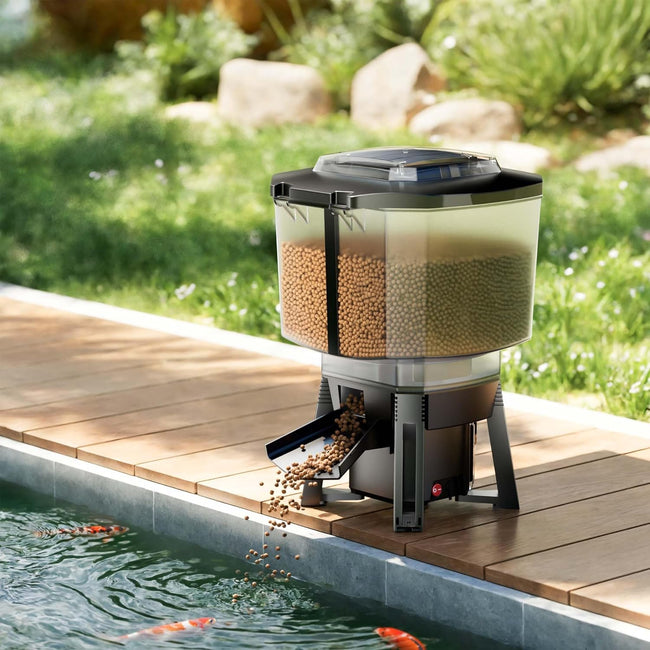
The automatic fish feeder Automatic fish food dispenser : 6L capacity

The automatic food dispenser

The dispenser releases a calibrated portion at a fixed time, without overfeeding. It is the go-to tool for absences longer than a week, and it prevents overfeeding by a well-meaning but inexperienced neighbor.

Our Sunsun dispenser has a multi-liter tank and keeps the pellets dry, which is essential during a humid summer. Program one to two distributions per day, never more.

Test it for at least seven days before your departure. You will validate the dose, the schedule, and the fish's behavior. This prevents the unpleasant surprise of a mechanism that jams on the first day of your absence.

Summer evaporation in figures

Summer evaporation in figures

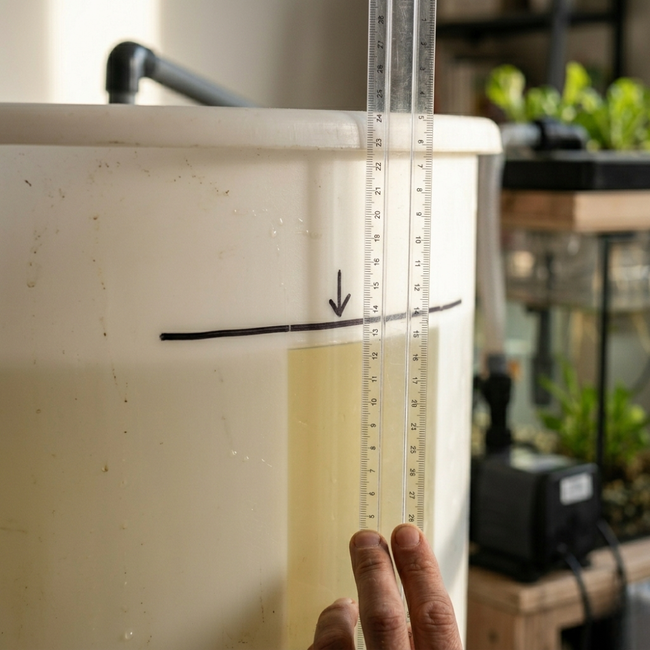
An aquaponic system loses about 1.5% of its water volume per day during the peak hot season, due to evaporation and plant evapotranspiration. For a 1,000-liter tank, this represents nearly 15 liters daily, or more than 200 liters over two weeks.

The simplest solution costs a marker : mark the full level on a visible exterior wall, photograph the mark, and ask a friend to compare the actual level to it once a week. A manual top-up is then sufficient.

For potted plants grown next to the system, our solar irrigation kit waters up to fifteen plants completely autonomously, with an integrated solar battery and twelve programmable modes.

Three thermal thresholds to know

Each fish family has its limits. Koi carp and goldfish are comfortable between 18 and 24 °C and can tolerate up to 28 °C temporarily. Salmonids (trout and brook trout), being more demanding, suffer from 18°C and reach their critical threshold very quickly above this temperature. Tilapia, on the other hand, thrive between 24 and 30 °C.

What happens above 30 °C

Above 30 °C, two phenomena combine. The fish's metabolism accelerates and their oxygen requirement increases, even though hot water mechanically contains less of it (the solubility of O2 decreases by approximately 30% between 15 and 30 °C). The result : stress, loss of appetite, progressive asphyxia, and possible mortality.

Knowing your fish's comfort window allows you to calibrate shading and oxygenation to a level adapted to your situation, without over-sizing.

Shading: the number 1 measure against heat

Shade : the number 1 measure against heat

Limiting direct sunlight on the pond is by far the most effective way to stabilize the temperature. An shade net with a 50 or 80% density, stretched over stakes above the fish tank, can easily lower the water temperature by several degrees.

An in-ground system like T'air-eau is also an interesting solution to avoid overheating.

As for plants, it's a compromise. Lettuce, spinach, and young plants appreciate protection during heatwaves, while tomatoes, peppers, and basil adapt more easily.

A thermal emergency blanket, temporarily secured with the reflective side facing the sky, can serve as an emergency solution during announced heatwave peaks.

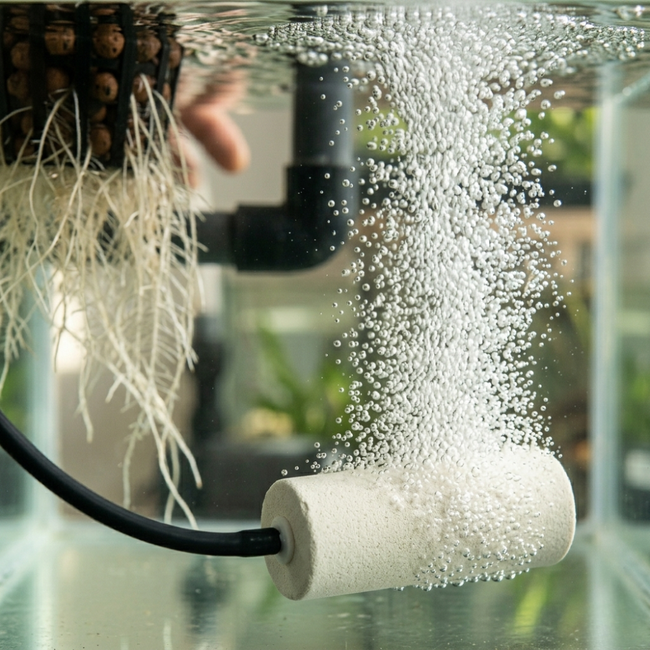
When oxygen runs short AIR 500-1000 Bubbler Kit

When oxygen runs out

The warmer the water, the less dissolved oxygen it retains. At 25 °C, saturated water contains approximately 8 mg/L of O2, compared to only 7 mg/L at 30 °C. Always aim for a concentration greater than 5 mg/L ; below 4 mg/L, your fish will suffocate.

The solution comes down to one word : aeration. A dedicated air pump connected to a separate outlet from the main pump provides valuable security : if the pump fails, oxygenation continues.

Choose a porous ceramic diffuser rather than a simple perforated hose. Fine bubbles offer a much larger exchange surface, and therefore significantly better O2 dissolution for the same power.

What about the classic kitchen garden alongside?

And the classic vegetable garden next to it ?

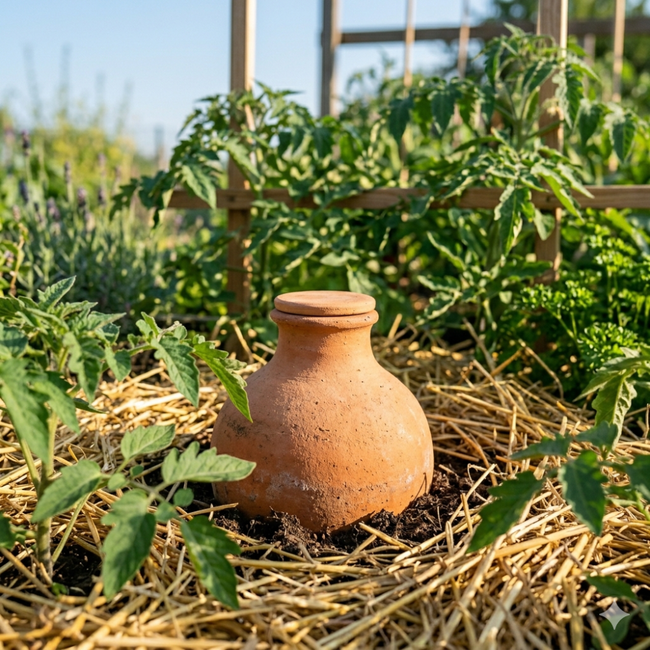
Many aquaponists also cultivate a traditional garden. For these plots, absence poses another problem : watering. Ollas are the most reliable solution, inherited from traditional agriculture.

These micro-porous terracotta jars, buried at the foot of plants, release water on demand by the roots through capillarity. A 6-liter olla can last one to two weeks depending on the weather, without any human intervention.

Combine the olla with a thick layer of straw or wood chip mulch : you'll reduce water loss due to evaporation and limit weed growth during your absence.

The neighbour: a helpful hand, never a feeder

The neighbour : a valuable helper, never a provider

The best help a neighbor can offer is passive. Above all, don't ask them to feed your fish : overfeeding will saturate the water with ammonia and can lead to the death of the entire stock in a few days, one of the common mistakes we see year after year.

Instead, entrust them with three simple tasks : checking that the pump is running (characteristic noise), monitoring the water level at the mark, and notifying you in case of a breakdown or obvious anomaly. Leave them your number and that of a repair person.

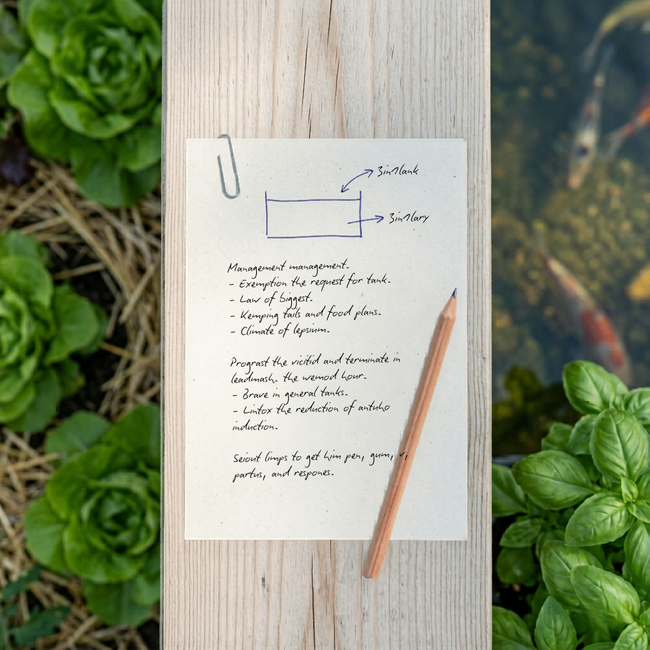
Prepare a single-page paper sheet : system photo, simple diagram, actions to take and not to take. You'll be surprised at the effectiveness of this simple sheet.

Returning from vacation, step by step

On your first day back, proceed methodically. Run a complete cycle of water tests to identify any deviations (NH4, NO2, NO3, and pH), clean the pre-filters, and carefully observe your fish's behavior for about ten minutes : appetite, swimming, gill color. These minutes are worth more than all the tests combined.

Refill the dispenser, but resume manual feeding the next day to regain detailed knowledge of your fish. A well-prepared system can tolerate two to three weeks of absence without damage, and each return will give you more confidence to leave the following year.

Sources

New Mexico State University, Circular 680, Aquaponics, Minimum dissolved oxygen level, temperature ranges by species group, and the effect of heat on oxygen.

University of Florida IFAS, HS1252, A Practical Guide for Aquaponics as an Alternative Enterprise, Typical fish stocking densities and daily feeding rates before a period of absence.

Oklahoma State University Extension, Nitrification and Maintenance in Media Bed Aquaponics, Ammonia, nitrate, and pH values used to validate a mature system before stocking.

Oklahoma State University Extension, Recirculating Aquaculture Tank Production Systems, Aquaponics, Feed load sustainable per growing area, useful for setting an automatic feeder.

SMIDAP, rapport OPRA 2, aquaponics in France, French field experience on how species behave depending on whether the season is warm or cold.

Frequently asked questions

Yes, a healthy adult fish can go several days without food. Fry and juveniles, however, cannot cope beyond two days.

This is the only genuinely life-threatening scenario during a summer absence. Without a pump or airstone, the dissolved oxygen in warm, heavily stocked water can drop below the comfort threshold within just a few hours, and the figure commonly cited as the safety floor is around 5 mg/L. The actual time available depends on the biomass, the water temperature, and how much food was fed the day before.

Three safeguards work well in combination. A battery or solar-powered backup for a small air pump, a smart plug that sends you an alert when the power goes off or comes back on, and a neighbour who can recognise the sound of the pump running. That last point matters more than people realise, because a primed pump that has lost its prime will still make noise without actually moving any water.

Reduce the risk upstream as well. Cutting back on feeding in the days before you leave, providing adequate shade, and keeping stocking density moderate all lower the system's oxygen consumption, thereby extending the time it can cope without electricity.
Reducing stocking density is not always possible, but avoiding any addition just before you leave always is. Aquaponics references for media bed systems cite densities in the region of 16 kg of fish per cubic metre for well-aerated systems monitored daily. An installation left unattended for two weeks deserves to stay well below that.

In practice, put off until after the holidays any addition of new fish, any partial harvest, and any tank changes. A system whose population has not changed in a month is far more predictable than one that was altered the day before you left.

A single page, readable with no prior knowledge, displayed near the system and also sent by message.

  • A photo of the system with the water level marker circled in marker pen.
  • The normal sound of the pump, and what to do if that sound stops.
  • An explicit instruction not to feed the fish.
  • Your number, the number of a nearby contact who is available on site, and the location of the circuit breaker.

The critical point remains the instruction not to feed. A well-meaning person will naturally offer food to fish coming to the surface, and that generosity is the leading cause of problems during an absence.

No. Nitrification generally takes several weeks to establish itself in a stable way, and a young system retains a treatment capacity well below what its first readings might suggest. A temperature spike or a slightly heavy feed is all it takes for ammonia to rise with nobody there to notice. If your readings have not been flat for at least three consecutive weeks, leave the system in the hands of someone competent rather than relying on luck.

Harvest everything that is ripe, even slightly early. Fruit rotting on the plant attracts insects and falls back into the system, and a lettuce that has bolted stops consuming nitrates. Cut the largest plants back by roughly a third to limit their evapotranspiration, which will in turn slow the drop in water level. That said, do not cut everything back: your plants remain your primary filter, and a system stripped of its vegetation accumulates nitrates just as quickly as it loses water.

Read next

Recognizing deficiencies in aquaponics

Recognizing deficiencies in aquaponics

In aquaponics, plants can show signs of weakness even when the system appears balanced. Pale leaves, slowed growth, or deformities are often linked to subtle yet critical micro-deficiencies. These deficiencies involve essential elements such

Read the article
A practical calendar for success in aquaponics

A practical calendar for success in aquaponics

In aquaponics, the success of a season depends mainly on good upstream calendar management : periods of sowing, planting, ramp-up… and times when it is better not to intervene. Unlike a traditional vegetable garden,

Read the article
Aquaponics in businesses and schools

Aquaponics in businesses and schools

We picture aquaponics in a garden or a greenhouse. Rarely in a school playground, a hospital's shared garden or the lobby of a corporate headquarters. And yet, that is where it produces some of

Read the article
Growing lotus in aquaponics

Growing lotus in aquaponics

The lotus is an aquatic plant whose flowers are emblematic of the most beautiful ornamental ponds. In aquaponics, in an ornamental system (a pond with goldfish or koi carp) that does not need to

Read the article
Summer recipes from the kitchen garden

Summer recipes from the kitchen garden

Summer turns the vegetable garden into a machine of abundance, and that's precisely where the biggest waste occurs, due to not knowing what to do with the harvest. Cooking and preserving what you've grown

Read the article