Sold out


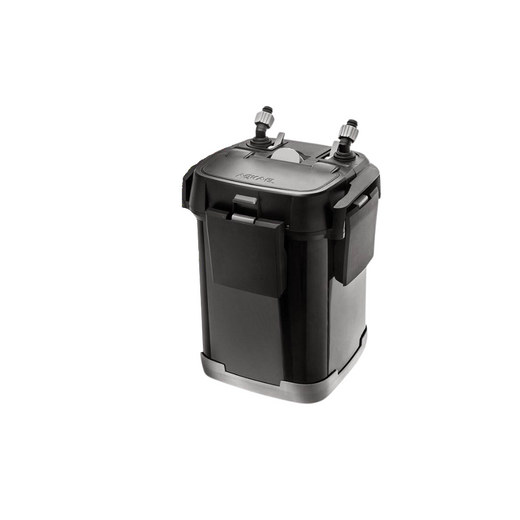
This Aquael Hypermax 4500 BT external filter handles aquariums from 200 to 1,500 L, with an adjustable flow rate of up to 4,500 L/h. It holds 15.9 L of filter media and is controlled via Bluetooth from an app.
 Customer support 7 days a week by email
 Delivery within 2 to 15 business days
This external filter handles aquariums of 200 to 1,500 litres and circulates up to 4,500 litres per hour. Its canister holds 15.9 litres of filter media, including 14.4 litres spread over four baskets and 1.5 litres of pre-filter, and its electronic head can be set from a phone. It is aimed at large volumes, where the filtration has to hold up for several weeks between openings.
Four 3.6-litre baskets stack in the tank, with the 1.5-litre prefilter ahead of them. This prefilter catches waste and plant debris before they reach the baskets, which lets you rinse the dirtiest part without touching the media colonised by bacteria. Three foams are supplied, in 10, 20 and 30 pores per inch, from the coarsest to the finest. The other baskets are filled to suit your use: with biological media when the tank is heavily stocked, or with a finer media when your main aim is crystal-clear water.
Flow rate
It reaches 4,500 litres per hour with no load, and the app lets you reduce it continuously.
Power
It varies from 18 to 36 watts depending on the mode selected, at a voltage of 24 volts.
Height
The pump's flow drops to zero at 2 metres above the surface of the tank.
Fittings
Four 1.5 metre pipes are supplied, with a diameter of 19 by 25 millimetres.
The flow rate of 4,500 litres per hour is that of the pump running with no media. Once the tank is filled with media, it settles at around 2,600 litres per hour, and this is the figure you should use to size the circulation. In an 800-litre tank, the filter, once filled, therefore turns over a little more than 3 times the tank volume every hour. In a 1,500-litre tank, it turns over a little less than 2 times, and you can then supplement the water movement with a circulation pump.
Reducing the flow in a 200 litre tank
The filter's range starts at 200 litres, and at that volume the 2,600 litres per hour of a fully loaded tank amounts to about 13 times the tank volume every hour. Slow swimmers, such as veiltail goldfish, struggle to cope with such a current. Turn the flow down in the app as soon as you start the filter, then increase it gradually while watching how the fish carry themselves.
Fill the empty baskets with biological media
Plan the filter media at the same time as the filter, because a 14.4-litre tank is not filled with a single sachet. The biological filtration beads are sold in packs of up to 5 litres and occupy the central baskets, where they provide the surface on which bacteria settle. Placed beneath the supplied foams, they receive water that has already been cleared of particles and keep their porosity for a long time. On a 1,000-litre tank, this complete filling keeps the water stable between maintenance sessions.
For a fully stocked tank, think in litres rather than in bags. In addition to the three foams supplied, 7.2 litres of media fill the two remaining baskets, that is, one 5-litre pack and one 2-litre pack of biological filtration balls. You can also reserve the lowest basket for ceramic pre-filtration noodles, which trap the remaining particles before the balls and so protect their porosity from clogging.
The filter is controlled via Bluetooth from an app. In it you choose a constant, pulsed or wave flow pattern, and you set up a day and night mode that reduces the current when the lighting goes off. A feeding mode reduces the circulation for the duration of feeding, so that the food does not end up in the pre-filter before it has been eaten. The app also displays operating alerts and a flow graph, adjusts the lighting and the audible signals of the head unit, and a code locks the settings against accidental changes. The filter works without these settings, but on a tank of more than 1,000 litres they let you reduce the current without dismantling an outlet pipe.
For commissioning, rinse the supplied foams and any media you add in clean water, to remove the dust that would cloud the tank water. Once the tank is primed, start at a reduced setting from the app and check every fitting under the cabinet during the first hour, since it is under pressure that a poorly tightened nut starts to drip. Then increase the flow in steps until you reach the desired circulation, watching how the fish behave at each step.
The noise level ranges from 24 to 44 decibels depending on the setting. On the reduced setting, the unit stays unobtrusive in a living space; as the noise level rises with the flow rate, a tank installed in a bedroom is best run on the reduced setting at night, which the night mode does without any intervention. The tank runs on low voltage, 24 volts, and the power supply unit stays outside the cabinet. This unit therefore needs a little more space, mounted high up to stay dry, with a loop of cable below the level of the socket.
With such a volume, the amount of nitrogen produced each day is large, and that is what determines the filling. The bacteria settled in the baskets convert ammonia into nitrite, then nitrite into nitrate. In a tank that is simply planted, this nitrate builds up and is removed by water changes. In a system where crops share the fish's water, it becomes a resource instead, and it is better to keep all the baskets free for biological media rather than sacrifice one to a chemical media. The article on the nitrogen cycle in aquaponics describes these stages and the time they take on a new filter.
The 2 metre head height also allows the pump to feed a grow bed installed above a large aquarium. Placed 50 centimetres above the surface, this bed receives a sufficient share of the flow, and the water returns to the aquarium by gravity after passing through the roots. On 1,000 litres, this setup puts the nitrate produced by the baskets directly to work for your crops; the guide to building your aquaponic system describes its components.
The tank measures 55.5 centimetres high by 36 square, valves included, and it already weighs 15 kilograms empty, considerably more once full. Four castors are built into the base, so you can roll it out of the cabinet instead of lifting it. Priming is done with the piston, in a few strokes, after opening the double ball valves that keep the pipes full while you work. Measure the clearance under your tank before ordering: 56 centimetres is a minimum, and you need room to get your head in above it.
The app's graph flags the drop in flow caused by a clogged pre-filter, and this pre-filter is the part that needs cleaning most often. It comes out on its own, without opening the tank, and is rinsed in a bucket of water taken from the tank, never under the tap, since chlorine kills the bacteria. The baskets are opened only if the flow stays low after this rinse. In that case rinse just one sponge or one basket at a time, so that the media left in place seed the ones you have just cleaned. Biological media are rinsed without scrubbing, and are never replaced.
The essentials
The tank and the media
Footprint and connection
To budget for separately
6 further specifications are available in the detailed view.
In the box
Manufacturer's values, recorded on 11/10/2026; flow rate with the tank filled, weight and package contents recorded on the same date.
One is filled to order and controlled by flow rate, the other arrives filled and ready to run.
| Maximum flow rate (L/h) | Maximum aquarium volume (L) | Volume of filter media (L) | Media supplied | Built-in wheels | Maximum power (W) | Price | |
|---|---|---|---|---|---|---|---|
| Recommended Aquael Hypermax 4500 BT external aquariumYour choice | 4500 L/h | 1500 L | 15.9 L | 3 foams of different densities | Yes | 36 W | $498.66 |
| Sicce Mega Filtra external aquarium filter, up to 950 LYour choice | 2150 L/h | 950 L | 9.5 L | Complete set: foams, carbon, zeolite and ceramics | No | 32 W | $514.67 |
Manufacturers' figures, recorded on 11/10/2026; the Sicce column describes the 950 SDC version.
Help choosing
Which of the two for your tank?
Your estimate
It covers preparing your order and then the transit time quoted by the carrier, counted in working days.
It is not a guaranteed delivery date: public holidays, peak periods, customs or a carrier delay can extend it. The exact amount, in your currency, is worked out in the cart once your address is entered.
The filter is dispatched in its original box, by Colissimo or Chronopost to your home, as you choose at checkout. The exact cost depends on the weight of the parcel, around 16 kg, and is shown in your basket.
12 questions
6 key questions, 12 in the detailed view

The nitrogen cycle, which takes place in the biological media of the tank.

Understanding and correcting cloudy water, before revisiting the filter settings.

Five solutions for green water, to put filtration in context.

Building your system: where the filter pump fits into the circuit.

Getting a system off to a good start, from the moment a new filter is switched on.

Summer maintenance, to be carried out along with rinsing the pre-filter.
A question about this product or your setup? Our team will answer and advise you.

Interest-free instalment payments
Offered depending on the cart amount, at checkout.

Delivery in 2 to 15 working days
Depending on the products and shipping sites. Estimate by destination in the estimator on this page.

After-sales service 7 days a week by email or chat
Our team answers all your questions.

Shop responsibly
Become part of the change.