Sold out


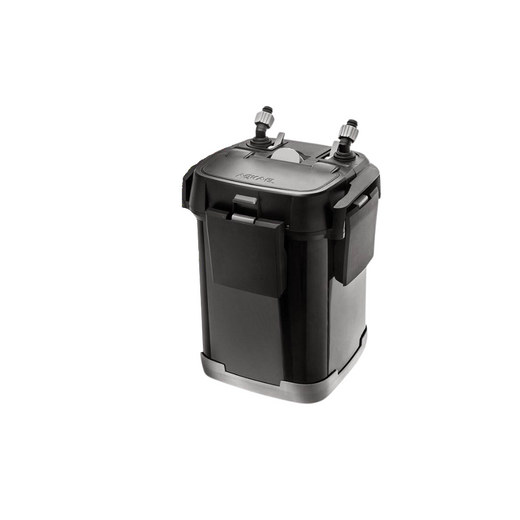
This external filter sits under the tank, draws in the water, passes it through its filter media and returns it via a spray bar. Four sizes cover aquariums and small aquaponic systems from 50 to 600 litres, in a standard version or with two double taps so that it can be disconnected without draining the pipes.
 Customer support 7 days a week by email
 Delivery within 2 to 15 business days
An aquaponics aquarium, like any fish tank, needs water that circulates and passes through a filter medium colonised by bacteria. This external filter is installed under the cabinet or beside the tank, draws water in through a tube dipping into the aquarium, passes it through its foams and pads, then returns it through a perforated spray bar. Its green tank and pump head form a single unit, quiet and economical, which runs continuously and asks only for a regular rinse of its foams.
The water first enters through the strainer on the intake tube, which stops leaves and large debris before they reach the pipe. It then flows down by gravity to the bottom of the tank, rises through the filter layers placed between two grids, and then reaches the pump head, which sends it back to the aquarium. Because the intake and return form a closed circuit full of water, the pump does not have to lift the water up to the aquarium: it mainly overcomes the resistance of the pipes and the filter media, which explains a power of 5 to 20 W depending on the model. A sealing ring, housed in the head, is removed and refitted at each clean.
Strainer
It holds back debris and protects small fish from being sucked in, at the end of the tube dipped into the tank.
Foams and mats
The blue foams trap particles, the white wadding refines the filtration, and the carbon wadding clarifies fresh water.
Pump head
It closes the tank with clips, carries the motor and sends the filtered water back to the tank.
Discharge manifold
Its perforations spread the return flow just beneath the surface and stir the water without creating a violent current.
The initial filter media set is enough to get the filter running, and you can then adapt it to how you use it. The carbon fleece is used for the first 2 to 4 weeks, long enough to adsorb the dissolved substances in fresh water, and is then removed. You can then replace some of the sponges with loose media, ceramic noodles at the bottom and porous beads above, which offer far more surface area to the bacteria. The usable volume of filter media ranges from 1 litre on the classic 150 to 6 litres on the classic 600.
Fill the tank before plugging in the pump
The pump must never run dry: it is cooled and lubricated by the water passing through it. Once the pipes are fitted, detach the discharge pipe at the elbow spout, suck briefly on its end until the water flows and fills the tank, then reconnect it. Only switch the filter on at that point, once no more bubbles come out of the head.
Fill the tank with sintered beads for the bacteria
In aquaponics, it is the surface colonised by bacteria that determines how many fish you can feed. Sintered glass biological filtration beads offer an internal surface far greater than that of a foam of the same volume. Place them above a layer of ceramic noodles, under the white filter floss: nitrification starts faster and copes better with generous feeding.
The four models share the same construction and differ in size. The classic 150, the most compact, delivers 300 L/h for a tank of 50 to 150 litres; it draws in through a 12/16 mm pipe, discharges through a 9/12 mm one, and its tank stands upright on a foot that steadies it. The 250 model delivers 440 L/h and suits tanks of 80 to 250 litres, with 12/16 mm pipes on both sides. The 350 model delivers 620 L/h for 120 to 350 litres, again with 12/16 mm. The 600 model delivers 1,000 L/h for 180 to 600 litres; it draws in through a 16/22 mm pipe and discharges through a 12/16 mm one. If you are torn between two sizes, choose the larger one when the tank is heavily stocked or when the water has to rise to a grow bed.
The 250, 350 and 600 models come in two configurations. The with taps version adds two double taps that isolate the filter from its pipes during cleaning. The version without taps costs less and suits a tank that you maintain by hand, close to a sink. Finally, the 250 model is also available with taps and loose filter media, so you can start biological filtration straight away.
In an indoor aquaponic system, for example an aquarium topped with a grow bed, the tank of this filter becomes the main support for nitrification. The bacteria attached to its media convert the ammonia excreted by the fish into nitrite, then into nitrate, the form of nitrogen that your lettuces and herbs absorb. The filter also retains solid waste, which breaks down in the tank instead of clogging the roots. Finally, you can direct its outlet pipe towards the grow bed rather than the spray bar: the filtered water rises into it, passes through the roots and flows back down into the aquarium by gravity.
On a 200-litre aquarium topped with a grow bed, the 250 model passes roughly 2 times the volume of the bed per hour at nominal flow, which is fine as long as the water returns directly to the aquarium. If you send the outflow to a grow bed positioned 60 cm higher, the flow decreases with height, since the pump tops out at 1.5 m of head: the 350 model, whose maximum head reaches 1.8 m, then keeps a more comfortable circulation. The guide to building your own aquaponic system explains this circuit between the tank and the crops.
The filter is placed lower than the aquarium, so that its pump head sits at least 10 cm below the water level. It always works upright, and the difference between the aquarium surface and the bottom of the canister must not exceed 180 cm. Fix the intake tube in a rear corner with its suction cups, and the outlet spray bar on the same pane, about 1 cm below the surface. Then cut the pipes as short as possible, with no loops or tight bends, and tighten each fitting with its nut. On versions so equipped, the two double taps are fitted on the pipes, close to the canister.
When the flow from the spray bar drops noticeably, it is time to rinse the sponges. With the double taps, you close them, unplug the unit, then separate the quick-release fittings: the pipes stay full of water and the circuit does not need to be re-primed. Without taps, you drain the pipes and re-prime the filter when reassembling, as for the first start-up. Open the clips, take out the sponges and rinse them lightly, preferably in a bucket of aquarium water to protect the established bacteria. Once or twice a year, also remove the pump impeller and brush its chamber; its shaft is ceramic, so handle it without forcing.
You receive the assembled filter, its tank, its pump head and the grilles that hold the media in place. The box also contains the intake pipe and its strainer, the angled spout, the outlet bar, the suction cups and the hose. The versions with taps and the classic 250 without taps come with a starter set of foams and pads; the versions with taps add two double taps, and the version with filter media adds loose media. The filter is designed for indoor use, in water that does not exceed 35 °C, and it comes with a 2-year guarantee. To connect it to another device or extend a run, the grey flexible pipe for filter and pump is available in 12/16 mm, the diameter of the 250 and 350 models. If your system is only just starting up, the NO2 nitrite drop water test will tell you when biological filtration has taken over.
The four models
Installation
Warranty and origin
To budget for separately
6 further specifications are available in the detailed view.
In the box
Flow rates, heads, power ratings, tank and aquarium volumes, dimensions, pipe diameters and warranty taken on 08/10/2026 and 11/10/2026 from the manufacturer's data sheets. Installation, priming and maintenance instructions: manuals for types 2213, 2215 and 2217.
The same external filter in four sizes. Flow rate, delivery head and filter media volume increase together.
| EHEIM classic 150 to 600 externalYour choice | Recommended classic 250Your choice | classic 350Your choice | EHEIM classic 150 to 600 externalYour choice | |
|---|---|---|---|---|
| The tank | ||||
| Recommended tank, up to (L) | 150 L | 250 L | 350 L | 600 L |
| Recommended tank, from (L) | 50 L | 80 L | 120 L | 180 L |
| The pump | ||||
| Flow rate (L/h) | 300 L/h | 440 L/h | 620 L/h | 1000 L/h |
| Maximum delivery head (m) | 1,2 m | 1,5 m | 1,8 m | 2,3 m |
| Power consumption (W) | 5 W | 8 W | 15 W | 20 W |
| Filtration | ||||
| Volume of filter media (L) | 1 L | 3 L | 4 L | 6 L |
| Hoses, intake and discharge | 12/16 and 9/12 mm | 12/16 mm | 12/16 mm | 16/22 and 12/16 mm |
| Version with taps available | No | Yes | Yes | Yes |
| Price | $74.24 | $85.68 | $137.16 | $182.92 |
Flow rates, heights, power ratings, volumes and diameters recorded on 08/10/2026 and 11/10/2026 from the manufacturer's data sheets.
Help choosing
Two questions about your tank
Instructions for the classic 150
Official EHEIM manual in several languages, including French: installation, priming, maintenance and safety.
Instructions for the classic 250
Official EHEIM manual in several languages, including French: contents, installation, priming and maintenance.
Instructions for the classic 350 and 600
Official EHEIM manual covering both large models, in several languages including French.
Document not showing? Some publishers block display inside a frame, so open it in a tab.
Your estimate
It covers preparing your order and then the transit time quoted by the carrier, counted in working days.
It is not a guaranteed delivery date: public holidays, peak periods, customs or a carrier delay can extend it. The exact amount, in your currency, is worked out in the cart once your address is entered.
The filter is dispatched within 48 hours in its original box, by Colissimo or Chronopost to your home, as you choose at checkout. The exact cost depends on the model and is shown in your basket.
10 questions
6 key questions, 10 in the detailed view

This guide describes the circuit between the fish tank, the filter and the crops.

This article explains the work of the bacteria that colonise the filter tank.

This item supports the first few weeks, while the biological filtration is establishing itself.

This article helps you understand cloudy water and what filtration changes.


This article reviews the mistakes made at start-up, including filtration that is too weak.
A question about this product or your setup? Our team will answer and advise you.

Interest-free instalment payments
Offered depending on the cart amount, at checkout.

Delivery in 2 to 15 working days
Depending on the products and shipping sites. Estimate by destination in the estimator on this page.

After-sales service 7 days a week by email or chat
Our team answers all your questions.

Shop responsibly
Become part of the change.