





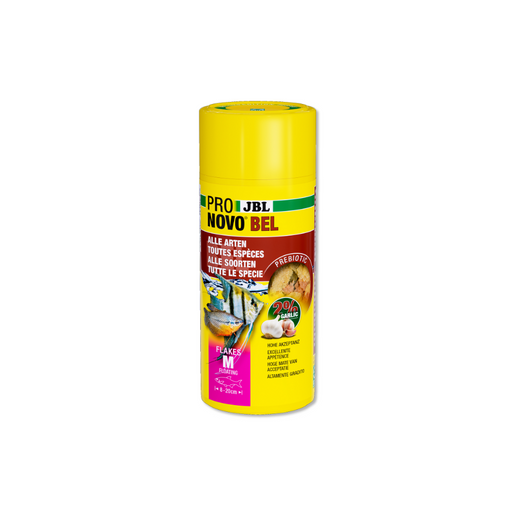
JBL ProNovo Pleco Wafer food for bottom-feeding fish
Regular price
$10.83
Regular price
Sale price
$10.83
Unit price
/
per
These sinking wafers feed herbivorous catfish that graze on tank décor, and their ingredient list includes wood fibre.
They contain 11% crude fibre against 29% protein, and should be offered after the lights go out.
 Customer support 7 days a week by email
 Delivery within 2 to 15 business days
100 % secure payment
The summary
- What you receive: a 250 ml tub of slow-sinking pellets, with an airtight seal.
- Which fish it suits: herbivorous catfish that graze on the décor.
- What sets it apart: declared wood fibre, and 11% cellulose.
- When to feed it: after the lights go out, once or twice a day.
- How to choose: two questions about your tank point you to one of the four tubs.
- How it arrives: a light parcel, sent by Colissimo or Chronopost to your door.
Sinking wood-fibre wafers for herbivorous bottom-dwelling catfish
JBL ProNovo Pleco Wafer feeds herbivorous catfish of 1 to 20 cm that graze on the decor, plecos and ancistrus above all. Its sinking wafers contain wood fibre, which accounts for 11% cellulose alongside 29% protein. They are given after the lights go out, once or twice a day.
These tablets feed herbivorous catfish of 1 to 20 cm that spend their time stuck to the decor, plecos and ancistrus above all. They reach the bottom quickly and keep their shape there for several minutes, instead of breaking up as they fall. The ingredients list opens with wheat germ and spinach, and it includes a raw material that no other food on the shelf declares, namely wood fibre.
🪵 11% cellulose
The cellulose content here reaches 11%, against 2 to 4% in the other aquarium foods on the shelf. It comes from wood fibre, which makes up 10% of the recipe, and from the plant ingredients that top the list: spinach, spirulina, green meal and beet pulp. Protein stays low at 29%, and fat at 7%. One consequence is worth remembering for your water: at an equal ration, a 29% formula releases less nitrogen than a 42% one, so your filter has less ammonium to convert and your plants receive less nitrate, as explained in the article on the nitrogen cycle.
🌙 The meal after lights out
The rhythm of these fish differs from that of the rest of the tank. Midwater fish feed in the light, at the surface or mid-water, whereas nocturnal loricariids feed in the evening, on the bottom, in the dark. So you give two separate feeds, and the ration for each is calculated separately: if you add the evening tablet without revisiting the morning quantity, the total input rises and your water becomes overloaded. Observe for a week what is left on the bottom in the morning, then adjust the number of tablets with the help of an ammonium test.
The timing
Species that are active at dusk and at night look for food once the light is off. So feed after the light unit has gone out.
The quantity
Give what is eaten within a few minutes, once or twice a day. Remove the rest in the morning.
The opened box
Allow 4 months at most to use it up, kept closed between uses, in a dry place away from light.
A root to grate between meals
An aquarium root gives these fish a surface to rasp at constantly, between feeds. Get one if your tank does not have one yet, because the pellet covers the meal and not the occupation of the day. And keep an ammonium test to hand, since a pellet forgotten at the bottom raises the ammonium level before you spot it.
The tablet left over in the morning
A pellet that is not eaten softens on the bottom without disappearing, and it releases organic matter into the water for as long as it stays there, even when it still looks intact. Siphon it out the very next morning rather than leaving it another day, especially as it often ends up wedged under a decoration where you can no longer see it. If the ammonium level rises for no apparent reason, look first for a pellet left under a stone or a root.
🐟 Which fish it suits
The primary target is the ancistrus, plecos and other grazing loricariids, whose digestive tract is built for a fibrous plant-based diet. These fish rasp continuously at wood and biofilm, and a diet too rich in protein does not suit them well in the long run. Corydoras and loaches, which sift the substrate without rasping wood, benefit less from cellulose at 11% and need a mainly meat-based pellet instead. So check which family your bottom-dwelling fish belong to before ordering, as these two groups live in the same part of the tank without having the same diet.
Technical specifications
The pellet and its analysis
- Target fish
- Herbivorous loricariids from 1 to 20 cm
- Shape
- Fast-sinking pelletIt holds its shape on the bottom for several minutes
- Crude protein
- 29%
- Crude fat
- 7%
- Crude fibre
- 11%Wood fibre makes up 10% of the recipe
- Crude ash
- 8%
To budget for separately
- A surface to rasp
- An aquarium root
- Nitrogen monitoring
- An ammonium drop test
In the box
- 1 box of 250 ml of tablets
- 1 built-in dosing cap
Nutritional analysis and composition as declared by JBL, recorded on 19/09/2026 and checked on 08/10/2026.
Manufacturer and product safety
- Manufacturer
- JBL GmbH & Co. KG
- Postal address
- Dieselstraße 3, 67141 Neuhofen, Allemagne
- Contact
- info@jbl.de
- Website
- www.jbl.de
Information provided under Regulation (EU) 2023/988 on general product safety.
Four aquarium foods from the shelf, head to head
What sets them apart is the target species, the shape and the protein content.
Is this bottom tablet the one you need?
The fish that concerns you and the place where the food should stay are enough to point to one of the four tubs.
| JBL ProNovo Guppy Grano S food for guppiesYour choice | JBL ProNovo Insect Stick S insect-basedYour choice | JBL ProNovo Cichlid Grano M food forYour choice | Recommended JBL ProNovo Pleco Wafer food forYour choice | |
|---|---|---|---|---|
| Who it's for | ||||
| Target species | Guppies and other livebearers | Ornamental fish from 3 to 10 cm | Omnivorous and carnivorous cichlids | Herbivorous bottom-dwelling loricariids |
| First raw material | Spirulina 18 % | Insect protein | Salmon meal | Wheatgerm |
| What the label states | ||||
| Crude protein (%) | 36 % | 42 % | 42 % | 29 % |
| Crude fat (%) | 5 % | 6 % | 8 % | 7 % |
| Crude fibre (%) | 2 % | 3 % | 4 % | 11 % |
| Shape | Fine granule | Stick | Granule | Tablet |
| The price | ||||
| Price | $12.43 | $9.01 | $12.43 | $10.83 |
JBL ProNovo Guppy Grano S food for guppies
Who it's for
Target speciesGuppies and other livebearers
First raw materialSpirulina 18 %
What the label states
Crude protein (%)36 %
Crude fat (%)5 %
Crude fibre (%)2 %
ShapeFine granule
The price
JBL ProNovo Insect Stick S insect-based
Who it's for
Target speciesOrnamental fish from 3 to 10 cm
First raw materialInsect protein
What the label states
Crude protein (%)42 %
Crude fat (%)6 %
Crude fibre (%)3 %
ShapeStick
The price
JBL ProNovo Cichlid Grano M food for
Who it's for
Target speciesOmnivorous and carnivorous cichlids
First raw materialSalmon meal
What the label states
Crude protein (%)42 %
Crude fat (%)8 %
Crude fibre (%)4 %
ShapeGranule
The price
JBL ProNovo Pleco Wafer food forRecommended
Who it's for
Target speciesHerbivorous bottom-dwelling loricariids
First raw materialWheatgerm
What the label states
Crude protein (%)29 %
Crude fat (%)7 %
Crude fibre (%)11 %
ShapeTablet
The price
Nutritional analyses and compositions as declared by JBL, recorded on 19/09/2026 and checked on 08/10/2026.
Help choosing
Two questions about who eats what at your place
Estimate your
delivery time
Your estimate
Delivery
Estimated time
It covers preparing your order and then the transit time quoted by the carrier, counted in working days.
It is not a guaranteed delivery date: public holidays, peak periods, customs or a carrier delay can extend it. The exact amount, in your currency, is worked out in the cart once your address is entered.
The lightweight box is dispatched within 48 hours by Colissimo or Chronopost home delivery, to be chosen at checkout. The exact cost is calculated in the basket according to the total weight of your order.
Frequently asked questions
6 questions
6 key questions
You may also like



Related articles

Understand
The nitrogen cycle in aquaponics
What happens to a tablet left forgotten at the bottom, and where to measure it.
Read the article

Problem
Understanding and correcting cloudy water in aquaponics
The first sign that bottom-feeding rations are not being consumed.
Read the article

Getting started
Common mistakes in aquaponics
Feeding fish you cannot see eating, and doubling the dose out of uncertainty.
Read the article

Considerations
Is aquaponics suited to animal welfare?
A nocturnal fish in a lit tank, and what that means for it.
Read the article

Getting started
Getting started with an aquaponic system
When the first feed is given, and at what rate to increase it afterwards.
Read the article

Maintenance
Keeping pests under control in aquaponics
What clears up the leftovers when feeding takes place at night.
Read the article
Let us talk about your project
A question about this product or your setup? Our team will answer and advise you.

Interest-free instalment payments
Offered depending on the cart amount, at checkout.

Delivery in 2 to 15 working days
Depending on the products and shipping sites. Estimate by destination in the estimator on this page.

After-sales service 7 days a week by email or chat
Our team answers all your questions.

Shop responsibly
Become part of the change.
