




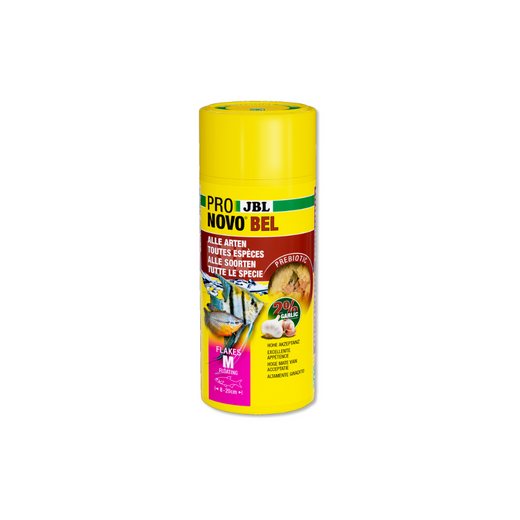


Tropical Cichlid Gran granules for cichlids, 250 ml to 10 L
Regular price
$9.61
Regular price
Sale price
$9.61
Unit price
/
per
| Contenance | Price | Price per L | vs 250 ml |
|---|---|---|---|
| 250 ml | $9.61 | $38.44 | — |
| 1 L | $21.62 | $21.62 | −44 % |
$3.20 × 3 with no fees
Klarna.
Tropical's Cichlid Gran granules are a staple food for omnivorous and carnivorous cichlids, including those from Lake Malawi, and for tilapia. They sink and bring out the colours thanks to their carotenoids, and they are sold in 250 ml or 1 L tubs, or in a 10 L bucket for large tanks.
 Customer support 7 days a week by email
 Delivery within 2 to 15 business days
100 % secure payment
The summary
- Which size: 250 ml, 1 L or a 10 L bucket, about 5.5 kg.
- Its composition: 48% protein, beta-glucan and astaxanthin.
- For which fish: omnivorous and carnivorous cichlids, and tilapia.
- How it behaves: it sinks and can be caught at mid-depth.
A rich base for cichlids, from the ornamental tank to the tilapia tank
Tropical Cichlid Gran granules are a complete staple diet for omnivorous and carnivorous cichlids, including many Lake Malawi cichlids. This large family ranges from dwarf cichlids to African cichlids, taking in tilapia, and their needs are similar: plenty of protein for growth, pigments to keep colours vivid, and a food that does not break down as soon as it touches the water. The granules sink, which lets your fish catch them mid-water before they reach the bottom.
The analysis shows 48% protein, 7% fat, 3% fibre and 10% moisture. The recipe provides beta-glucan, a yeast compound that supports natural defences, stabilised vitamin C and zeolite, a mineral that aids digestion. Its carotenoids come from krill and spirulina, topped up with 80 mg of astaxanthin per kilo, the pigment that intensifies the reds and oranges of your cichlids.
🪨 Mbunas and carnivorous cichlids
The Lake Malawi cichlids known as mbunas graze mostly on the algae covering the rocks, whereas the more carnivorous species hunt small prey. For mbunas, Cichlid Gran should therefore be used alternately with a food rich in plant matter, spirulina-based for example, which is kinder to their digestion. If you keep carnivorous cichlids, they will on the contrary make full use of its protein content. In a tank where the dominant fish hog the food, spread the ration over 2 or 3 spots so that every fish gets to eat, and watch for any that hang back.
An ammonia test for heavily stocked cichlid tanks
A cichlid tank often holds a lot of fish and a protein-rich food, two conditions that put a load on the filtration. The NH4 ammonium drop test measures ammoniacal nitrogen from 0.05 to 5 mg/L, and it is read together with your pH to work out the share that is actually toxic. This way you know, before any sign appears on the fish, whether the ration exceeds what your filter can process.
🍽️ The ration and the size
Give small portions several times a day, generally 2 to 3 meals, each one the amount your cichlids finish in 3 minutes. Uneaten food breaks down and releases ammonium, then nitrates. Choose the size according to consumption: the 250 ml tub suits a cichlid tank of ordinary size, the 1 L tub, which holds about 550 g, suits tanks of 200 litres and more, and the 10 L bucket, about 5.5 kg, suits large setups and breeding operations.
A swollen belly calls for a reduced ration
A swollen belly or white, stringy droppings point to a diet that is too rich or too abundant, particularly in mbunas. In that case, cut the ration, add one fasting day a week and increase the proportion of plant matter in the diet.
🌱 In aquaponics
Tilapia, one of the most widely farmed fish in aquaponics, is an omnivorous cichlid that readily accepts these pellets, particularly during the grow-out phase, when it puts on most of its weight. For 20 tilapia of 200 g, i.e. 4 kg of live weight, a ration of 1.5% of live weight comes to 60 g per day, and the 10 L bucket then lasts about 3 months. A feed with 48% protein produces more ammonium, which bacteria convert into nitrate for the plants, provided your biological filter is sized to handle it. The guide to raising tilapia in aquaponics details their temperature and stocking density, and the article on the nitrogen cycle explains this conversion.
Technical specifications
Analysis
- Proteins
- 48%
- Fat content
- 7 %
- Cellulose
- 3 %
- Humidity
- 10%
Use
- Shape
- Slow-sinking pellets
- Additives
- Beta-glucan, zeolite, astaxanthin
- Fish
- Omnivorous and carnivorous cichlids
- Weight
- Approximately 550 g per litre
In the box
- 1 tub or 1 bucket of Tropical Cichlid Gran granules, in the size chosen
Analysis, composition, additives and weight from the manufacturer Tropical, recorded on 12/10/2026.
What capacity for your cichlids?
The same pellet in three sizes. The number of fish decides.
Which size?
Give one answer, and the table highlights the model that suits you.
| For | Weight (g) | Price | |
|---|---|---|---|
| 250 mlYour choice | A cichlid tank | 138 g | $9.61 |
| Recommended 1 LYour choice | A large tank | 550 g | $21.62 |
| 10 L bucketYour choice | A breeding set-up or a system | 5500 g | $137.16 |
250 ml
Use
ForA cichlid tank
Weight (g)138 g
1 LRecommended
Use
ForA large tank
Weight (g)550 g
10 L bucket
Use
ForA breeding set-up or a system
Weight (g)5500 g
Manufacturer's approximate weights for each capacity.
Help choosing
A question about your set-up
Estimate your
delivery time
Your estimate
Delivery
Estimated time
It covers preparing your order and then the transit time quoted by the carrier, counted in working days.
It is not a guaranteed delivery date: public holidays, peak periods, customs or a carrier delay can extend it. The exact amount, in your currency, is worked out in the cart once your address is entered.
Delivered to your home by Colissimo or Chronopost, as you prefer at checkout. The exact cost is shown in the basket, according to the total weight of your order.
Frequently asked questions
6 questions
6 key questions
You may also like


Related articles

Species
Raising tilapia in aquaponics
The cichlid most widely raised in aquaponics, and its ration during grow-out.
Read the article

Understanding

Guide
Which fish to choose for aquaponics?
The species that tolerate warm water and a rich diet.
Read the article

Understanding
Common mistakes in aquaponics
Overfeeding, the main cause of water quality declining.
Read the article

Start-up
Getting started with an aquaponic system
Introduce the fish and increase the ration at the pace of the filter.
Read the article
Let us talk about your project
A question about this product or your setup? Our team will answer and advise you.

Interest-free instalment payments
Offered depending on the cart amount, at checkout.

Delivery in 2 to 15 working days
Depending on the products and shipping sites. Estimate by destination in the estimator on this page.

After-sales service 7 days a week by email or chat
Our team answers all your questions.

Shop responsibly
Become part of the change.
