Growing lotus in aquaponics

Written by Tristan Ulrich · June 3, 2026
Lotus cultivé à la surface d'un bassin aquaponique

The lotus is an aquatic plant whose flowers are emblematic of the most beautiful ornamental ponds. In aquaponics, in an ornamental system (a pond with goldfish or koi carp) that does not need to be optimised for food production and where aesthetics matter, the lotus is also a valuable ally.

Beyond its beauty, when well chosen and well installed it filters and oxygenates the water, all while telling a story several millennia old.

A royal plant in service of your system

Grown since ancient Egypt and omnipresent in Asian culture, the lotus is far from being a mere decorative ornament. Its impressive root biomass and its ability to absorb large quantities of nutrients make it a particularly interesting plant for aquaponic ponds that seek to combine beauty, filtration and strong symbolism.

This complete guide covers the distinction from the water lily, the lotus's purifying role, optimal growing conditions, cohabitation with fish, technical integration into a circuit, the complex relationship with the nitrogen cycle, overwintering the rhizome, the varieties to favour, classic mistakes, starting from seed and the aesthetic dimension of a successful installation.

Lotus or water lily?

Lotus or water lily?

The most common mistake among beginners is confusing lotus and water lily. Both plants are aquatic and ornamental, but they belong to distinct botanical families with opposite behaviours.

The lotus, of the genus Nelumbo, raises its leaves and flowers well above the water on rigid stems that can reach 1.50 metres. The water lily, of the genus Nymphaea, floats on the surface, its leaves and flowers level with the water.

The lotus is a perennial rhizome plant that overwinters at the bottom of the water, sheltered from frost. Its growth is vigorous in summer and completely dormant in winter. The water lily follows a similar cycle but always remains at the surface.

Choosing a lotus when buying therefore means checking the genus name. Nelumbo nucifera is the sacred Asian species, Nelumbo lutea the North American species with yellow flowers. Any other name most often refers to a water lily.

A remarkably effective living filter

A formidable living filter

The lotus's strength lies in its extraordinary root system. The rhizome and its network of rootlets colonise the entire substrate and water column, creating a vast exchange surface with the aquatic environment.

This root density massively absorbs the nitrates and phosphates produced by fish waste and the breakdown of food, two unavoidable stages of the nitrogen cycle in aquaponics. The lotus also captures certain heavy metals documented by phytoremediation studies.

Compared with lettuce or basil, the lotus offers ten to twenty times more root biomass, which translates into a much stronger purification capacity per plant. A valuable asset in heavily stocked ponds.

Be careful, however: this absorption power is concentrated almost exclusively during the active growth period, from April to August. For the rest of the year, its filtering role decreases sharply.

Moreover, in an aquaponic system, too high a density of aquatic plants can create competition for your fruit and vegetables. It is therefore essential to find the right balance between ornamental and edible.
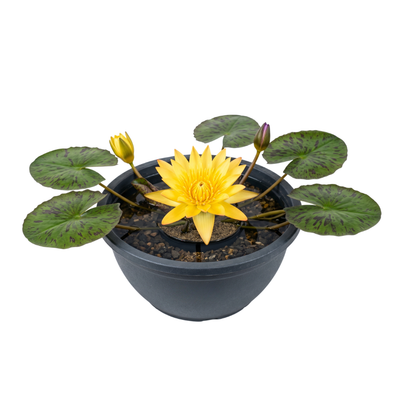
The right environment Hydrogen Potential Test

The right environment

The lotus requires precise conditions to express its potential in aquaponics. Three parameters dominate: temperature, pH and light. None of them is negotiable.

In terms of temperature, the plant starts its growth above 20 °C during the day and flowers around 25 °C. The ideal range is between 18 and 30 °C in season. Below 15 °C, the lotus stagnates. Beyond a prolonged 32 °C, it suffers.

The ideal pH is between 6.5 and 7.5, which matches the usual preferences of most aquaponic fish. The water depth above the rhizome ranges from 15 to 60 cm for dwarf varieties, up to 1 metre for the giants.

Light exposure is the most frequently underestimated factor. The lotus requires at least 6 hours of direct sunlight per day to flower. In the shade, it develops leaves but produces no blooms.

Which fish can live alongside a lotus?

Cohabitation between lotus and fish depends as much on the water parameters as on the behaviour of the chosen species. Not all fish are equal when faced with a buried rhizome and tender young shoots.

Compatible species are those that share the plant's thermal requirements and do not dig aggressively into the substrate. Koi carp remain the great classic of lotus ponds, provided the rhizomes are protected in mesh planting baskets. Tilapia, when the climate or a heater allows, shares the lotus's ideal temperatures and provides a protein yield.

Goldfish and their varieties are well suited to small ornamental ponds, with no risk to properly protected rhizomes. Sturgeon or very large carp, on the other hand, systematically turn over the substrate and damage young shoots. Better to avoid them.

The trick that changes everything is to physically separate the fish's living area from the lotus planting area, using a mesh bottom, a suspended basket or a separate growing tank connected to the circuit. This precaution protects the plant while keeping the filtering benefit.

Technical integration into the circuit

Technical integration into the circuit

Integrating a lotus into an aquaponic system requires a few technical choices. Three approaches dominate, depending on the size of the installation and the goal sought.

The first solution is the aquatic planting basket, placed at the bottom of the main pond. The rhizome is protected by a heavy substrate, clay soil mixed with pozzolana, covered with a layer of gravel. A method suited to small and medium ponds.

The second solution integrates the lotus into a dedicated settling pond, upstream of the return to the main pond. The plant then treats the most heavily loaded water, which maximises its filtering role while protecting it from fish.

Whatever solution is chosen, selecting a suitable substrate is central. An adult plant can cover up to 1 m² of water surface, which means space must be planned from the design stage.

Lotus and the nitrogen cycle Fertilizer for aquatic plants

Lotus and the nitrogen cycle

The lotus has a more complex relationship with the nitrogen cycle than it appears. Its nutrient consumption follows a marked seasonality that absolutely must be anticipated.

From April to August, in full vegetative and floral growth, the plant massively absorbs nitrates and phosphates. This is the period when its filtering role reaches its maximum, relieving the system and stabilising water quality.

From September, the metabolism slows down. The leaves yellow and then die, the plant stores its reserves in the rhizome and its absorption drops sharply. A system that relied heavily on this living filter may see its nitrates rise again quickly.

The right reflex is to anticipate this seasonal imbalance by slightly reducing the fish's feeding in early autumn, increasing monitoring and providing a filtering backup to get through the winter without accumulation.

Overwintering the rhizome

Overwintering the rhizome

Overwintering the lotus is the step that separates lasting ponds from installations that must be redone every spring. The rhizome cannot tolerate frost, and its winter survival determines the entire spring restart.

Two strategies exist. The first is to leave the rhizome in place in the pond, provided there is a minimum depth of 60 cm above the rhizome. At this depth, the water does not freeze in mainland France, even during prolonged spells.

The second takes the rhizome out of the pond before the first frosts, cleans it carefully and stores it submerged in a bucket of fresh water in a frost-free cellar, between 4 and 10 °C. The safest method for shallow ponds, balconies or terraces.

During dormancy, plant filtration stops. Adjust the fish's feeding to the drop in temperature, monitor the parameters twice a month and gradually resume from mid-March when the water exceeds 12 °C at night.

Varieties to favour Lotus Xiao Gongzhu

Varieties to favour

The choice of variety determines the success of the installation. Lotuses fall into three main categories according to their adult size, and each suits a different type of pond.

Dwarf varieties such as the Yu Tang Jin Ma lotus, the Xiao Gongzhu or the famous Momo Botan are grown in 30 to 60 litres of water, perfect for balconies and small ponds. Height 40 to 60 cm.

Standard varieties such as Alba Striata, Flavescens or Ying Ying reach 80–120 cm, flower generously and suit medium ponds of 200 to 500 litres. Ideal depth 30 to 60 cm.

Giant varieties such as the High Cotton produce spectacular flowers on stems of 1.50 metres and beyond. Reserved for large landscaped ponds or professional installations.

Classic mistakes to avoid

A few recurring pitfalls turn a promising installation into a disappointment. Identifying them in advance avoids ruining the first season.

The first mistake is planting too early, before the pond water has reached a stable 18 to 20 °C. The rhizome stagnates, does not root properly and gets off to a worse start than if it had waited until mid-May in the south, early June in the north. A deliberate delay is better than a forced start.

The second is confusing lotus and water lily when buying. Specialist nurseries clearly state the genus Nelumbo. Generalist shops sometimes mix the two families, creating frustration and confusion in the first season.

The third concerns the coverage rate. A lotus that covers more than 30 % of the surface of the pond dangerously reduces night-time oxygenation, especially on hot summer nights. Trimming excess leaves is part of normal summer maintenance.

The fourth concerns dead leaves left to decompose in the water at the end of the season. They acidify the environment, release a high organic load and can lastingly disturb the system's balance. Systematically removing yellowing leaves with a net before they fall remains the best prevention.

Starting from seed Pink Nelumbo Nucifera Lotus Seeds for Planting

Starting from seed

Beyond ready-to-plant rhizomes, the lotus starts very well from Nelumbo nucifera lotus seeds. A fascinating method that lets you discover the plant's complete cycle.

The lotus seed has an extremely hard shell that keeps it viable for a long time, sometimes more than a thousand years according to archaeological studies. To germinate, it needs to be scarified. You gently file the shell on the side opposite the attachment point until you see the white kernel.

Then soaked in lukewarm water at 25 °C with daily water changes, the seed germinates in three to ten days. The first floating leaves appear in two to three weeks, then the first aerial leaves in five to six weeks.

In the first year, the young plant does not reach flowering. Patience, then: the second year rewards you with its first flowers and the start of a fully productive cycle.

The lotus, king of the pond

The lotus, king of the pond

Beyond its filtering function, the lotus brings the pond a visual and symbolic dimension that is hard to match. Flowering occurs in July–August, lasts several weeks and marks the peak of the water garden.

Each flower lasts three to four days, opening in the morning and closing in the evening. A mature plant can produce a dozen flowers per season, each measuring 20 to 30 cm in diameter depending on the variety. The display attracts pollinators and admiring eyes alike.

Beyond pure beauty, the lotus carries a rich cultural dimension. A symbol of purity and rebirth in Asian traditions, a sacred plant of ancient Egypt, it speaks to the imagination of anyone who lingers to contemplate it.

In an aquaponic approach that seeks to combine production, ecological balance and aesthetic pleasure, the lotus ticks all three boxes at once. Few other aquatic plants reach this level of versatility.

A plant rooted in a more living system

Integrating a lotus into your aquaponic system means bringing into daily life a plant that goes beyond the mere status of ornament. A powerful filter in summer, a visual sentinel of the pond's health, a seasonal witness to nature's cycles, the lotus turns the installation into a complete living organism.

Well chosen according to volume, properly protected from digging fish, monitored throughout its growth and dormancy cycle, it rewards the patience of the first winter with a summer explosion of leaves and flowers. It is a companion both demanding and generous, to be integrated into any pond that wants to combine ecology, aesthetics and biological coherence.

Sources

NC State Extension Gardener Plant Toolbox, Nelumbo nucifera, Requirement for six hours of direct sunlight, mature dimensions, flowering period, and spreading habit.

International Waterlily and Water Gardening Society, Lotus Care Sheet, Container size, grow medium type, heat required in summer, fertilisation, and rhizome overwintering.

Zhao et al. 2022, Int. J. Environ. Res. Public Health, grow media and plants for water purification, The respective roles of the grow medium and the plant in nitrogen removal.

Goddek et al. 2015, Sustainability, Challenges of Sustainable and Commercial Aquaponics, Balance between fish load and the plants' uptake capacity.

Oklahoma State University Extension, Nitrification and Maintenance in Media Bed Aquaponics, Working pH range and nutrient availability for plants.

Frequently asked questions

Three causes account for the vast majority of cases, and none of them can be corrected mid-season. The first is light. Lotus requires a minimum of six hours of direct sunlight per day, and partial exposure produces exactly what you describe: vigorous foliage and not a single flower.

The second is accumulated heat. Specialist water garden suppliers consider that at least three summer months averaging around twenty-four degrees are needed for reliable flowering. In a cool climate, or in a pond that is shaded during the warmest part of the day, that thermal total is never reached, even if the plant itself looks perfectly healthy.

The third is the container. A rhizome that is cramped will spend the entire season seeking space rather than flowering, and a pot shared with another aquatic plant produces the same result. Add to this, in aquaponics, nitrogen-rich water that promotes foliage growth over bud formation, and you end up with a magnificent but sterile plant.

Lotus is planted in a wide rather than deep container, as its rhizome runs horizontally. Water garden references recommend a container of at least sixty centimetres in diameter for a standard variety.

  • A heavy garden soil, sandy or clay-based, low in organic matter.
  • Around ten centimetres of grow medium is sufficient — there is no need to fill the container.
  • A layer of gravel on the surface to stop fish from digging.
  • Five to ten centimetres of water above the grow medium at the start.

Avoid commercial composts and peat-based mixes, whose components float and cloud the pond for weeks.

Yes. In a shallow pond with an earthen base, it will readily colonise the entire surface. Grown in a closed basket placed on the bottom, the risk becomes negligible.

Almost never in the same way as in an ornamental pond. Horticultural guides recommend a noticeably more generous fertiliser regime for lotus than for a water lily, but those doses assume nutrient-poor, fish-free water. In aquaponics, the water already supplies nitrogen, and slow-release fertiliser tablets are more likely to upset the system's balance than to help.

If your plant shows pale foliage despite a well-loaded water column, look first at iron levels and pH — which governs nutrient availability — before adding anything. A tablet pushed deep into the grow medium remains a last resort, and should be trialled in a single basket first.

It assists it; it doesn't replace it. Research on planted beds shows that filtration performance depends as much on the grow medium colonised by bacteria as on the plant itself, and the lotus is no exception to this rule.

There is also a seasonal constraint to consider. Its absorption capacity drops sharply in autumn, when the plant draws its reserves back into the rhizome, while the fish continue to produce. Always size your mechanical filtration for the low season, and treat the lotus as summer backup.

Remove the basket and inspect the rhizome. A healthy one remains firm and pale, with intact growing tips. A dead one turns soft, brownish, and crumbles between your fingers — most often after a frost or an excessively dry winter storage.

Do not draw conclusions too quickly. Lotus starts late, often several weeks after water lilies, and water that has not yet consistently reached fifteen degrees is enough to explain a pond that looks empty in mid-May.

Read next

Aquaponics and Summer Holidays

Aquaponics and Summer Holidays

You're going away for two weeks in July and your aquaponics system will be running without you : this thought rightly makes you anxious, because heatwaves, evaporation, and fish feeding raise practical questions. Good

Read the article
Recognizing deficiencies in aquaponics

Recognizing deficiencies in aquaponics

In aquaponics, plants can show signs of weakness even when the system appears balanced. Pale leaves, slowed growth, or deformities are often linked to subtle yet critical micro-deficiencies. These deficiencies involve essential elements such

Read the article
A practical calendar for success in aquaponics

A practical calendar for success in aquaponics

In aquaponics, the success of a season depends mainly on good upstream calendar management : periods of sowing, planting, ramp-up… and times when it is better not to intervene. Unlike a traditional vegetable garden,

Read the article
Controlling pests in aquaponics

Controlling pests in aquaponics

Aquaponics has a reputation for being a clean, ecological, and naturally protective method of cultivation. However, like any living system, it can be affected by pests : aphids, gnats, mites, invasive algae, or unwanted

Read the article
Plant deficiencies in aquaponics

Plant deficiencies in aquaponics

Aquaponics relies on a precise balance between fish, plants and bacteria. When that balance is disrupted, plants can quickly show signs of nutritional deficiencies, even in a system that appears stable. Understanding the cause

Read the article