Growing strawberries in aquaponics: the complete guide

Written by Tristan Ulrich · July 4, 2026
Fraises mûres récoltées en aquaponie

Soil-free and fed by fish water, strawberries grow clean, fragrant and within easy reach. With the right varieties and a few key conditions, it's one of the most rewarding crops you can grow in aquaponics.

Sweet strawberries, soilless and pesticide-free

Few crops bring as much pleasure as strawberries in aquaponics. Nourished by fish water and grown at hand height, they grow clean, protected from slugs and soil that dirties the fruit, and develop a flavour that supermarket strawberries forgot long ago.

That said, you do need to follow a few rules, because strawberries are more demanding than lettuce: they need light, careful nutrition and, indoors, a helping hand with pollination. Varieties, light, temperature, pH, iron, planting, propagation, disease and harvest – this guide covers everything so your strawberry plants produce from the first season, and for years to come.

Why strawberries thrive in aquaponics Clay pebbles 10L Plagron

Why strawberries thrive in aquaponics

The strawberry is a shallow-rooted plant: it only explores the first 15 to 20 centimetres of the grow medium. That works perfectly, because that's exactly the zone that an irrigated media bed keeps cool, well-aerated and constantly supplied with nutrient solution. Where it would suffer in heavy soil, it thrives in a free-draining media.

Grown without soil, it escapes most soil-borne diseases and stays pristine, away from mud and crawling pests. Harvesting at table height turns picking into pleasure rather than a back-breaking chore, and the fruit, never touching the earth, doesn't rot from underneath.

Set up on an established system rich in nitrates, it produces steady fruit over many weeks with minimal upkeep. It's one of the most rewarding crops to grow alongside other easy plants.

Fruiting once or repeatedly: the choice that shapes your entire season

Your first decision determines the timing of your whole growing cycle. Non-remontant varieties (or spring-fruiting) produce a single, abundant harvest concentrated over two to three weeks in May-June; they're perfect if you're aiming for a large one-off yield, for jam-making for instance.

Remontant varieties produce in successive waves from June until the first frosts, with a total yield that's often higher but spread over time. For a system you want to enjoy continuously, these are the ones to choose.

A few reliable varieties: Mara des Bois, a remontant with wild strawberry perfume, Charlotte, productive and sweet, and Gariguette, early and refined but non-remontant. Choose certified healthy plants and, ideally, bare-root ones thoroughly rinsed before introducing them, so you never introduce pests or soil particles into your water.
Light and temperature, the two drivers 42W 95CM LED Grow Light Bar

Light and temperature, the two drivers

Strawberries are light-hungry. Aim for at least six hours of direct sunlight daily, or 200 to 300 µmol horticultural lighting indoors: below that, fruit stays rare, small and acidic, because light is what makes the sugars.

Temperature-wise, they perform best between 15 and 25°C. Above 30°C, fruit set stops and fruit softens; below 10°C, the plant goes dormant. This window explains why spring and autumn are their best seasons in our climate.

One often-overlooked point: strawberries hate having their roots waterlogged permanently. A media bed in flood and drain cycle, which alternates flooding and draining, suits them perfectly and oxygenates the roots with each cycle.

Pollination, the step often overlooked indoors

Pollination, the step often overlooked indoors

Outdoors, bees and wind do the work without you thinking about it. Indoors or in a closed greenhouse, it's a different story: without pollinators, flowers produce nothing, or yield deformed, bumpy strawberries – the clearest sign of incomplete pollination.

The answer is simple and free. Gently brush a small paintbrush or cotton bud from flower to flower every other day during flowering, to transfer pollen. A fan set to low speed also works brilliantly by circulating air around the plants.

Each flower stays fertile for just a few days, so be consistent throughout the flowering period. Five minutes a day is what determines the quantity and shape of your fruit.

Planting your strawberry plants: the technique that makes all the difference

Space each strawberry plant approximately 20 to 25 centimetres apart to allow air and light to circulate between them. Planting too densely traps moisture on the foliage and opens the door wide to grey mould, strawberry number one disease.

The decisive move, the one almost all beginners get wrong: never bury the crown, that swollen heart from which the leaves emerge. Buried, it rots within days; planted too high, the root ball dries out and establishment fails. It should sit exactly at the surface of the grow medium, neither above nor below.

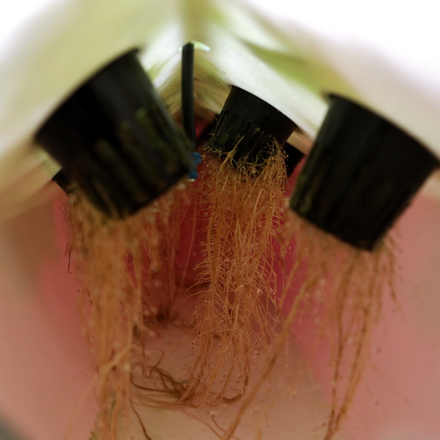
Rinse the roots thoroughly in clean water before introduction, spread them out in a fan shape within the media, then let the system do the rest. In the first few weeks, monitor establishment more closely than growth: once the crown is well anchored, everything accelerates.

pH, iron and nutrition Chelated iron (iron chelate) EDDHA 6%

pH, iron and nutrition

The strawberry is more demanding than lettuce when it comes to nutrition, and pH is its most sensitive variable. It prefers a slightly acid environment; the aquaponic compromise around 6.5 suits it perfectly and keeps iron available.

Watch it carefully, because above 7.0 iron becomes chemically locked up. Leaves that turn yellow between green veins then signal an iron deficiency, very common in strawberries; knowing how to manage pH sorts out most growth problems.

The rest comes from the system itself: a mature, well-stocked tank provides nitrate, potassium and trace elements in abundance. On a young system, be patient and don't expect high yields before the biofilter has matured over a few months.

Which grow medium and support to choose

Three setups dominate for strawberry growing. The media bed with clay pebbles (media bed system) is the most versatile: it drains well, retains just the right amount of moisture and handles the flood and drain cycle perfectly. This is the recommended choice for beginners.

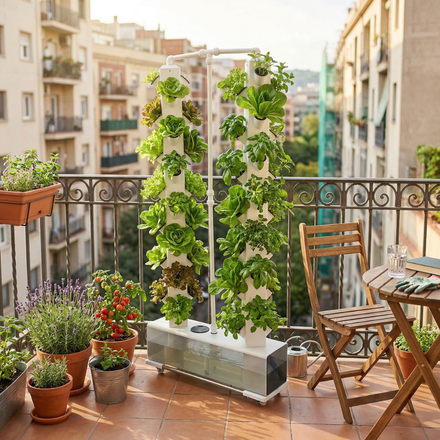
Vertical towers and suspended gutters make use of height and deliver a spectacular result for minimal floor space, ideal in a greenhouse or on a sunny wall. Just ensure each level receives enough light and water.

The NFT technique, a thin film of nutrient solution flowing through tubes, works too but is less forgiving of pump failures, as the shallow roots dry out quickly. Whatever the setup, the goal remains the same: roots that stay moist but never waterlogged, and an inert grow medium that won't push pH up.

Seasonality and yield

Seasonality and yield

Outdoors, strawberries follow the seasons: a peak in spring, then for remontant varieties waves that stretch through to the first frosts. Indoors under controlled lighting, you can extend production for much of the year and even out harvests.

Yield depends on the variety and system maturity, but a well-managed plant easily gives several hundred grams of fruit over a season. Consistency beats quantity: a few strawberry plants in top condition will outperform many cramped, stunted plants competing with each other.

Pick fruit when completely red, preferably in the morning when they're most fragrant and firm. Picked too early, they won't ripen once detached – unlike tomatoes.

Diseases, pests and mistakes to avoid

Diseases, pests and mistakes to avoid

Three mistakes keep recurring, and all are avoidable: burying the crown, which kills the plant; insufficient light, which gives pale, bland fruit; neglecting indoor pollination, which results in flowers that don't set fruit.

For disease, grey mould (botrytis) lurks whenever air is stagnant and humid: ventilate, space them out, remove damaged fruit promptly. Powdery mildew, that white felt on leaves, is prevented by good air circulation rather than treatments.

Finally, never introduce a plant in a peat pot straight into the system: you'd be importing pests and fine particles that cloud the water and clog the filter. Rinsing the roots in clean water is a non-negotiable step.

Multiplying your strawberry plants for free, using runners

This is one of the great pleasures of growing strawberries: they multiply themselves. After fruiting, each plant sends out long horizontal stems, the runners, at the ends of which young plantlets form, complete with their own roots.

To get free plants, let the runner take root in a small pot of inert grow medium placed beside the mother plant, then sever the connection once the plantlet is self-sufficient. You'll renew your strawberry patch each year without spending a penny.

There's a catch, though: a plant that puts all its energy into runners produces fewer fruits. If you're after a harvest, pinch off the runners as they appear; if you're after multiplication, let a few run. It's your choice, season by season.

Conclusion: home-grown strawberries, season after season

The strawberry brings together everything we love about aquaponics: clean, flavourful cultivation that's spectacular to watch ripen, making wonderful use of the nitrate-rich water from your fish. With good remontant varieties, sufficient light, a pH maintained around 6.5, an eye on iron levels and a bit of hand pollination indoors, success is virtually guaranteed.

Start with a few plants, take care with planting the crown, observe the establishment and then multiply them by runners: you'll quickly have a generous and sustainable patch of strawberry plants at the heart of your system. A crop that rewards patience better than almost any other, and one that transforms your fish water into fruit you can pick with your fingertips, for the delight of young and old alike.

Sources

University of Arizona, Hydroponic Strawberry Irrigation, recommended pH range and iron deficiency appearing above 7

University of Arizona, Hydroponic Strawberry Pollination, Pollination under cover and the origin of misshapen fruit

Illinois Extension, Hydroponic day-neutral strawberry production observations, yields measured by day-neutral variety, EC and pH of the solution

Purdue University Extension, HO-238-W Measuring Daily Light Integral in a Greenhouse, Expected daily light integral under greenhouse conditions

Frequently asked questions

Outdoors, no. Even a day-neutral variety stops producing when light drops and water falls below 10 °C, and that pause is actually useful – it lets the plant rebuild its reserves.

Indoors with controlled lighting, you can get close. You'll need to maintain sufficient light throughout the year and accept harvests spread out rather than spectacular. Factor in the electricity cost too, which often exceeds the value of fruit produced in the depths of winter.

Day-neutral varieties, without hesitation. They produce in waves from April until the first frost, giving you time to correct a growing error without losing the whole season. A June-bearing variety concentrates all its harvest over two to three weeks, and any mishap during that window costs you the year.

Three causes keep cropping up, and they're easy to tell apart.

  • Bumpy or accordion-shaped fruit: incomplete pollination. Each unfertilised achene leaves a zone that won't develop. This is the most common cause indoors.
  • Small but regular fruit, pale and acidic: insufficient light. Sugar is made by light, not in the nutrient solution.
  • Fruit that softens before turning red: too much heat. Above 30°C, fruit set stops and already-formed fruit deteriorates.

Think in terms of light received over the day, not watts. The horticultural reference for strawberries is around 17 mol per square metre per day minimum, with 20 considered optimal. Over a 14-hour lighting period, this equates to roughly 300 µmol at leaf level.

In practice, a horticultural bar placed 30 or 40 cm above the plants and lit for 12 to 14 hours will meet the requirement. Dropping to 8 hours of lighting gives you green, healthy-looking plants that won't fruit – it's the most common mistake.

No, never. The collar should be level with the grow medium surface. If buried, it will rot within a few weeks and the plant won't recover.

Six to ten plants, no more. The calculation isn't based on available space but on what the system can feed. A 300-litre tank with a reasonable fish load can nourish a modest growing area, and strawberries demand more trace elements than lettuce.

A useful approach is to keep a base of leafy vegetables alongside your strawberry plants. They absorb nitrate fluctuations, grow quickly and can be harvested continuously, which stabilises the whole system whilst the strawberries establish themselves.

Ten well-fed plants will yield significantly more than twenty competing plants, and they'll get far fewer diseases.

Read next

Growing lotus in aquaponics

Growing lotus in aquaponics

The lotus is an aquatic plant whose flowers are emblematic of the most beautiful ornamental ponds. In aquaponics, in an ornamental system (a pond with goldfish or koi carp) that does not need to

Read the article
Aquaponics and Summer Holidays

Aquaponics and Summer Holidays

You're going away for two weeks in July and your aquaponics system will be running without you : this thought rightly makes you anxious, because heatwaves, evaporation, and fish feeding raise practical questions. Good

Read the article
Growing without soil in hydroponics

Growing without soil in hydroponics

Hydroponics is not a trend but an agronomic revolution thousands of years old, using up to 90% less water and supporting faster plant growth. Understanding its principles, methods and limitations is becoming essential for

Read the article
Salmonponics: aquaponics in cold water

Salmonponics: aquaponics in cold water

Aquaponics is often associated with pond fish like goldfish and koi. However, there is a variant perfectly suited for our temperate regions, cool climates, and winters : salmoponics. Trout, char, brook trout, these iconic

Read the article
Is aquaponics suitable for animal welfare ?

Is aquaponics suitable for animal welfare ?

We often talk about what aquaponics produces. But rarely about what the fish that make it work experience. Are they simply tolerated in a system designed for production, or can aquaponics truly respect their

Read the article
15 plants to grow in aquaponics

15 plants to grow in aquaponics

Aquaponics is ideal for growing a wide variety of plants, both indoors and outdoors. Some varieties adapt particularly well to this soilless growing method, with a constant supply of nutrient-rich water.

Read the article