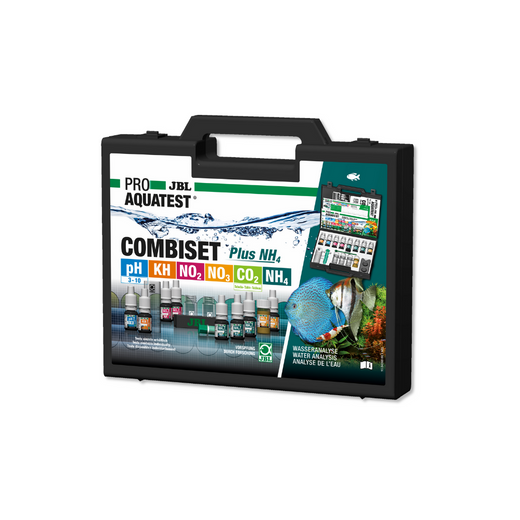


pH drop test kit
Regular price
¥1,800
Regular price
Sale price
¥1,800
Unit price
/
per
¥600 × 3 with no fees
Klarna.
This test gives the pH from 3.0 to 10.0 by colour reading, in fresh water, in ponds and in aquaponics.
The reading should be taken alongside the carbonate hardness, or KH, which stabilises the pH, and with the time of measurement in mind, since the pH of a planted tank varies throughout the day.
 Customer support 7 days a week by email
 Delivery within 2 to 15 business days
100 % secure payment
The summary
- What you receive: one reagent bottle, a graduated plastic test tube and a 14-colour chart, for approximately 50 tests.
- What you measure: pH from 3.0 to 10.0 across 14 colour fields, in freshwater, saltwater and garden pond water.
- What the figure means: the scale is logarithmic. Between pH 7.5 and pH 8.5, your water becomes ten times more alkaline.
- When to test: always at the same time of day, and make a note of it. In a planted tank, pH can shift by several tenths between morning and evening.
- How to choose: this is the wide-range version, designed for screening rather than fine adjustment.
- What we send you: a parcel weighing 0.12 kg, reagent in its original packaging.
Wide-range drop test, from 3.0 to 10.0, for aquarium, pond and aquaponics
pH is the parameter you will measure most frequently, and its value should always be interpreted alongside other readings. This test gives a figure between 3.0 and 10.0, which on its own says nothing about whether your water is stable or will remain so, since that stability depends on carbonate hardness. A correction made on the basis of pH alone can therefore cause a sharper swing than the imbalance it was intended to address.
📉 A logarithmic scale
pH is a logarithmic scale: each unit represents a factor of 10. Water at pH 7.5 is 10 times less alkaline than water at pH 8.5, and a difference of 0.5 already represents a ratio of 3. This is why a pH that shifts by one unit in a single evening puts your fish under serious stress, whereas the same change spread over 3 weeks is far better tolerated: it is sudden swings that must be avoided above all else. The article on pH regulation explains the procedure in detail.
In aquaponics, a trade-off
Nitrification is most efficient between 7 and 8, whilst roots absorb iron and phosphorus more readily below 7, so the usual compromise sits around 6.8.
In a garden pond
The favourable range is between pH 7.5 and 8.5. A step of 0.5 is enough to push the value outside this range.
In very soft water
Without a buffer, pH drops on its own, sometimes below 6, where narrow colour charts run out.
After adding
pH corrector, fresh grow medium, limestone, peat: each one changes the value, not always in the expected direction.
Measure KH before correcting pH
What stabilises pH is carbonate hardness, which absorbs the acids produced by nitrification. Take the carbonate hardness test alongside this one: if KH is high, a pH corrected with an adjuster will return to its equilibrium value within a few days; if it's low, there's no buffering capacity left and pH can crash suddenly. With both figures to hand, you'll know which one to correct and in what order.
🕑 The time of the reading
In a planted volume, dissolved carbon dioxide causes the pH to vary from hour to hour: during the day photosynthesis consumes it and pH rises, while at night plants and bacteria release it and pH falls. The swing commonly reaches several tenths of a unit between early morning and the end of the day. Always measure at the same time of day and make a note of it; to establish the true range of your system, take two readings on the same day rather than two readings a week apart.
Three mistakes that skew pH readings
Read the result in daylight, with the test tube resting on a white background, as aquarium lighting distorts the perception of yellows and greens. Use exactly 5 ml and 5 drops, the number of drops is calibrated for that volume alone, and wait the full 5 minutes before comparing. Always take your sample from the middle of the water column, never directly beneath the surface film.
🐠 pH and ammonium toxicity
pH also determines the toxicity of ammonium. Dissolved ammoniacal nitrogen is divided between the ammonium ion, which is relatively harmless, and ammonia, which crosses the gill membranes; the proportion of ammonia increases with pH. At 25 °C, it accounts for around 0.6% of ammoniacal nitrogen at pH 7, compared with 5.4% at pH 8: the same ammonium level is therefore nearly 10 times more dangerous in a pond at pH 8 than in a tank at pH 7. Always read your ammonium test alongside the pH recorded on the same day, especially in summer, when temperature compounds the effect of pH.
Technical specifications
The essentials
- Parameter measured
- pH, acidity or alkalinity of the waterLogarithmic scale: a difference of one unit equals a factor of ten in actual acidity
- Measurement range
- 3.0 to 10.0This is the wide-range version in the range. Two finer versions cover 6.0 to 7.6 and 7.4 to 9.0.
- The colour chart fields
- 14 colours, from 3.0 to 10.0One field at 3.0, then steps of 0.5 from 4.0 to 10.0. Match between two adjacent fields. A difference of 0.2 units cannot be read here
- Tests per kit
- Approximately 50
- Method
- Liquid reagent, colorimetric readingA single sample, with no reference: this test does not use a comparator block
- Manufacturer's reference
- JBL 2410100, PROAQUATEST rangeCode EAN 4014162241016
The procedure
- Water volume
- 5 mlSamples taken from mid-column, never just below the surface
- The steps
- Rinse, fill, dose, shake, wait, readThe number of drops is calibrated for this volume and no other
- Waiting time
- 5 minutesStabilisation time. An immediate reading gives a shade that is still changing.
- Total duration
- Approximately 6 minutesHandling included
- Reading
- Colour chart, in daylightAquarium lighting skews the perception of yellows and greens, and therefore the reading obtained
- Environments covered
- Freshwater, saltwater, pondThe wide range is suited to screening rather than fine-tuning a reef tank
Security and parcels
- Ranking
- WarningThe lower of the two threshold levels under CLP regulations
- Main risks
- Flammable, causes serious eye irritationH226 and H319 statements
- Precautions
- Rinse the eye with water, keep out of reachAdvice P101, P102, P305 with P351 and P338. Keep away from all sources of ignition.
- Parcel weight
- 0.12 kgPackaging included
To budget for separately
- The matching test
- A carbonate hardness testIt shows whether your pH will remain stable, and it is the first thing to correct
- Reagent refill
- Reagent only, ref. 2410200The test tube and colour chart keep well
10 further specifications are available in the detailed view.
In the box
- 1 bottle of pH reagent with child-safety cap
- 1 graduated plastic test tube
- 1 14-field colour chart, from 3.0 to 10.0
- 1 multilingual instruction leaflet, French included
Reference, EAN code, kit contents, range, reading increment, protocol, and hazard information taken from the manufacturer's data sheet and instructions on 05/09/2026. The number of tests is that printed on the packaging. The daily pH swing in a planted tank is an approximate figure; it depends on the plant mass and the lighting.
pH alone, or all the water chemistry?
pH should never be interpreted without carbonate hardness. First check whether the column gives you both values, then what it covers around them.
A fluctuating pH should be interpreted alongside KH
pH is a result: it drops when KH is exhausted, and rises when plants consume CO2. Depending on the age of your tank, you may need the figure alone or also the values it depends on.
| Parameters covered (parameters) | Drop tests included (tests) | pH | KH, the carbonate hardness that stabilises pH | Ammonium, nitrites and nitrates | GH, iron, phosphates, copper, silicates, oxygen | Reagent bottles (bottles) | Glass test tubes | Laboratory comparator block | Thermometer | Reagent refill sold separately | Price | |
|---|---|---|---|---|---|---|---|---|---|---|---|---|
| Recommended pH test only, wide rangeYour choice | 1 parameters | 1 tests | Yes | No | No | No | 1 bottles | 0 | No | No | Yes | ¥1,800 |
| 6-in-1 Aquarium Water Testing KitYour choice | 6 parameters | 5 tests | Yes | Yes | Yes | No | 9 bottles | 3 | Yes | No | Yes | ¥9,300 |
| 14-in-1 water analysis kit for aquariumYour choice | 14 parameters | 13 tests | Yes | Yes | Yes | Yes | 23 bottles | 12 | Yes | Yes | Yes | ¥21,700 |
pH test only, wide rangeRecommended
What you're measuring
Parameters covered (parameters)1 parameters
Drop tests included (tests)1 tests
pHYes
KH, the carbonate hardness that stabilises pHNo
Ammonium, nitrites and nitratesNo
GH, iron, phosphates, copper, silicates, oxygenNo
Equipment supplied
Reagent bottles (bottles)1 bottles
Glass test tubes0
Laboratory comparator blockNo
ThermometerNo
Budget
Reagent refill sold separatelyYes
6-in-1 Aquarium Water Testing Kit
What you're measuring
Parameters covered (parameters)6 parameters
Drop tests included (tests)5 tests
pHYes
KH, the carbonate hardness that stabilises pHYes
Ammonium, nitrites and nitratesYes
GH, iron, phosphates, copper, silicates, oxygenNo
Equipment supplied
Reagent bottles (bottles)9 bottles
Glass test tubes3
Laboratory comparator blockYes
ThermometerNo
Budget
Reagent refill sold separatelyYes
14-in-1 water analysis kit for aquarium
What you're measuring
Parameters covered (parameters)14 parameters
Drop tests included (tests)13 tests
pHYes
KH, the carbonate hardness that stabilises pHYes
Ammonium, nitrites and nitratesYes
GH, iron, phosphates, copper, silicates, oxygenYes
Equipment supplied
Reagent bottles (bottles)23 bottles
Glass test tubes12
Laboratory comparator blockYes
ThermometerYes
Budget
Reagent refill sold separatelyYes
Parameters covered, equipment supplied and kit contents noted from the three product pages on 05/09/2026.
Help choosing
pH alone, or pH with what stabilises it
Documents & manuals
Official manufacturer's instructions
Full broad-range pH test protocol, volumes and number of drops, hazard statements and precautionary advice. Document published by the manufacturer, multilingual, French included.
Document not showing? Some publishers block display inside a frame, so open it in a tab.
Estimate your
delivery time
Your estimate
Delivery
Estimated time
It covers preparing your order and then the transit time quoted by the carrier, counted in working days.
It is not a guaranteed delivery date: public holidays, peak periods, customs or a carrier delay can extend it. The exact amount, in your currency, is worked out in the cart once your address is entered.
Package weight 0.12 kg, dispatched to a collection point or by Colissimo home delivery, your choice at checkout. The reagent is sent in its original box with a child-resistant cap. The exact amount is shown in the basket.
Frequently asked questions
6 questions
6 key questions
You may also like


Related articles

Parameters
Regulating pH in an aquaponics system
How to shift a pH without forcing it, and why KH determines what the correction will achieve.
Read the article

Crops
Iron deficiency in aquaponics
Above pH 7, iron becomes increasingly unavailable to roots. Leaves yellow even though nothing appears to be missing from the water.
Read the article

Guide
The nitrogen cycle in aquaponics
Nitrification continuously produces acid: it is what gradually pulls the pH down week after week.
Read the article

Guide
Common mistakes in aquaponics
Adjusting pH without checking the KH features prominently on the list of actions that backfire on a system.
Read the article

Pond
Koi carp in aquaponics
A koi pond often runs above pH 8, in the upper range that this test's wide scale covers with ease.
Read the article

Pond
Green pond water: 5 solutions
Water with a high phytoplankton load causes the pH to rise during the day: a late-afternoon reading then gives a misleading picture of the pond's actual condition.
Read the article
Let us talk about your project
A question about this product or your setup? Our team will answer and advise you.

Interest-free instalment payments
Offered depending on the cart amount, at checkout.

Delivery in 2 to 15 working days
Depending on the products and shipping sites. Estimate by destination in the estimator on this page.

After-sales service 7 days a week by email or chat
Our team answers all your questions.

Shop responsibly
Become part of the change.
